

Children’s Long-Term Inpatient Program (CLIP) Provides Residential Psychiatric Treatment

A Brief Overview

  • CLIP serves children ages 5-17 by providing mental-health treatment and school in a secure, residential facility. Read on for more information about CLIP eligibility and how to initiate a referral.
  • Young people placed in CLIP could not recover adequately with the most intensive outpatient services available, which in Washington are provided through Wraparound with Intensive Services (WISe).
  • Family caregivers of young people with intensive behavioral health needs can request support from A Common Voice, staffed by lead parent support specialists. Find their contact information on the Center of Parent Excellence (COPE) page of the Health Care Authority’s website.

Full Article

Families have few options to help a child with a psychiatric illness that makes in-home, community-based care unworkable. Local hospitals are designed to provide crisis care and generally do not keep a patient for mental health treatment and recovery beyond a few days or weeks. Sometimes those short hospitalizations are not long enough for lasting stability.

One choice for children 5-17 is the Children’s Long-Term Inpatient Program (CLIP), which provides intensive mental health services and school in a secure residential setting. A CLIP stay is usually about 6 months long. Eligibility for CLIP ends on the child’s 18th birthday.

Most CLIP referrals are for children with Medicaid—public health insurance, which is called Apple Health in Washington State. Families with private health insurance have access to CLIP but may be referred first to private facilities for long-term, inpatient care. Medicaid is the payer of last resort.

Who is Eligible for CLIP?

  • Youth ages 5 to 18
  • Legal residents of Washington State
  • Youth diagnosed with a severe psychiatric disorder
  • Youth at risk to themselves or others or gravely disabled due to a psychiatric condition
  • Youth who are not successfully treated through community-based mental health resources

Families are involved and children get school at CLIP

Parents/legal guardians engage with the treatment team while a child is at CLIP. The goal is to help the child stabilize and provide the family with skills and tools for a successful return to the home, school and community.

Children attend school while at CLIP. Teachers at the residential facility manage the student’s Individualized Education Program (IEP), or Section 504 plan, and help with transitions from and back into the student’s local school.

CLIP referrals may be voluntary or involuntary

Parents and legal guardians can refer children to CLIP. The first step is to know whether the referral is voluntary or involuntary. Parents can volunteer their children younger than 13 for residential treatment. Youth 13 and older must voluntarily go to CLIP unless they meet criteria for involuntary commitment.

The Revised Code of Washington (RCW 71.34.010) establishes that an adolescent 13-18 may be committed for up to 180 days of involuntary inpatient psychiatric treatment if commitment criteria are met. Residential placement at CLIP is one way to carry out a commitment order, which may be based on a standard of imminent threat (to self or others) or grave disability/severe psychiatric deterioration. Seattle Children’s Hospital provides a Guide to the Involuntary Treatment Act (ITA).

To refer a child or youth to CLIP for voluntary admission, the parent, legal guardian, or youth may get help by following a CLIP administration menu that starts with the name of the child’s heath plan. A child’s mental health provider or social worker also can support a CLIP application.

The family can request a hearing with a regional committee, which may then refer the case to the CLIP Administration for final approval. Sometimes a child is put on a waiting list for an available bed.

CLIP is a step up from WISe

Young people placed in CLIP have a record of being unable to access an appropriate level of care within their community. That usually means failure to recover with services from our state’s most intensive outpatient option for children and youth, which is Wraparound with Intensive Services (WISe).

The WISe program was begun as part of the settlement of a class-action lawsuit, TR v Dreyfus, in which a federal court found that Washington wasn’t providing adequate mental-health services to youth. WISe teams provide a wide range of therapies and supports with a goal to keep the young person out of the hospital.

Families engaged in WISe and/or CLIP services are encouraged to participate in their regional Family, Youth, and System Partner Roundtable (FYSPRT), which provides a place to share resources, solidarity, and feedback about the behavioral health system. See PAVE’s article: Families and Youth Have a Voice on Mental Health Matters Through FYSPRT.

Organize and prepare for a CLIP application process

Families need an organized set of medical and school paperwork to complete CLIP applications. Refer to PAVE’s article about document management for guidance about how to create a care notebook or other filing system for this and other purposes.

The regional CLIP committee includes care providers from managed care organizations and other agencies that may provide additional support and resources to the family, regardless of whether a CLIP referral is recommended. Generally, the committee determines that all community-care options have been exhausted before recommending a more restrictive placement through CLIP. The team will also make a recommendation based on whether the child is likely to benefit from the therapeutic program, which is mental health based and may not be a good fit for an individual with a severe form of developmental or intellectual disability.

Where is CLIP located?

The largest CLIP facility is the Child Study and Treatment Center (CSTC) in Lakewood, adjacent to Western State Hospital. CSTC provides about 60 beds in cottages that house children in groups by age and other factors. Additional options with fewer beds include:

  • Tacoma, The Pearl Street Center
  • Spokane, the Tamarack Center
  • Yakima, Two Rivers Landing

Further Resources

Washington’s Health Care Authority (HCA) has additional information about WISe, CLIP, early signs of psychosis, and Family Initiated Treatment (FIT).  If a person 15-40 is newly experiencing psychosis, Washington offers a wraparound-style program called New Journeys (website link includes access to a referral form).

Help for Understanding Health Insurance

Healthcare insurance includes words and abbreviations that can be confusing and hard to remember. This article describes a few key terms to demystify the health insurance world for Washington State families. Washington Healthplanfinder.org is a place to research insurance options statewide, with English and Spanish options.

Managed Care Organization (MCO)

A Managed Care Organization (MCO) is an agency that coordinates medical services and reimburses providers.

State medical insurance in Washington is called Apple Health. Apple Health pays a monthly premium to an MCO that an individual or family chooses to manage preventive, primary, specialty, and other health services. Apple Health also pays for some services directly, through Fee for Service (FFS).

The term “provider” describes any health care professional or facility that provides treatment. Doctors, nurses, mental health professionals, physician assistants, dentists, therapists, behavior specialists, and many other professionals are considered providers.

Clients enrolled in managed care must seek providers who are part of their plan’s network unless there is an emergency or prior authorization is arranged. Prior authorization means the insurance company agrees to pay for a service, treatment, prescription drug, medical equipment, or something else because it is determined to be medically necessary.

The Apple Health system includes five MCOs. Not all plans are available in all areas of Washington State. ​

  • Amerigroup (AMG)
  • Community Health Plan of Washington (CHPW)
  • Coordinated Care of Washington (CCW)
  • Molina Healthcare of Washington, Inc (MHW)
  • United Healthcare Community Plan (UHC)

For complicated circumstances, an MCO may recommend a case manager be assigned to support an individual’s care. Families also have the option to request case management, especially if locating providers is difficult to meet unique or substantial needs.

Health Maintenance Organization (HMO)

A Health Maintenance Organization (HMO) is a type of MCO.  An HMO is an independent system that requires enrollees to seek care within a specific network of hospitals and providers. An HMO plan is based on a network of providers who agree to coordinate care in return for a certain payment rate for their services. 

Preferred Provider Organization (PPO)

A Preferred Provider Organization (PPO) is another type of MCO. A PPO generally will allow individuals to choose their providers and does not limit reimbursement to providers in a specific network. Because of that, a PPO tends to be more expensive than an HMO.

What is the difference between Medicaid and Medicare?

Medicaid is income dependent, and Medicare is not. Both provide government-funded healthcare.

Medicaid is state-managed to provide free or low-cost medical coverage for individuals or families who qualify based on income. Washington’s Medicaid program is Apple Health.

Medicare is a federal health insurance program for individuals age 65 and older and for those with qualifying disabilities. Medicare is not dependent on income.

Copayments, Premiums, and Deductibles

When healthcare is not free, the cost to the family adds up through the copayments, premiums, and deductibles. Here’s what that means:

  • Copayment: a specific fee for a visit or procedure.
  • Premium: payment for the insurance. An individual might have premiums withheld from a paycheck, or an employer might agree to pay all or part of the premium.
  • Deductible: the amount of money an individual must pay each year before insurance payments “kick in.” After a deductible is met, the patient may still make copayments or pay a percentage of the cost, depending on the plan. Supplemental insurance through Medicare is sometimes an option to cover deductible expenses.

What is a Medicaid Waiver?

A Medicaid waiver allows the federal government to waive rules that usually apply to the Medicaid program. The intention is to reimburse for services that would not otherwise be covered by Medicaid. Waivers generally provide local, non-institutional solutions for individuals with disabilities. For example, in-home care paid for through a waiver might support someone to live in the community.

Medicaid.gov provides a Washington Waiver Fact Sheet that outlines waiver programs available in Washington State.
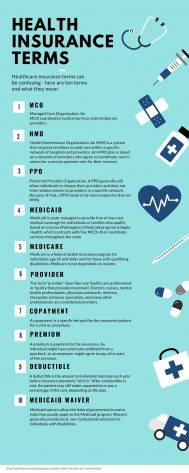
An Illustration of the insurance terms described in this document

Download the illustration as a PDF – Health Illustrative