

Evaluations Part 1: Where to Start When a Student Needs Special Help at School

When a student is struggling in school and may have a disability, families can request a formal evaluation to explore eligibility for special education services. The process includes submitting a written referral, participating in a team-based assessment, and using the results to guide individualized supports. Even if a student doesn’t qualify for an IEP, other protections and accommodations may still be available. 

A Brief Overview 

  • Special Education is provided through the Individualized Education Program (IEP) for students with qualifying disabilities. 
  • Anyone with knowledge of a student’s needs can make a referral for evaluation. 
  • If a student is struggling and has a known or suspected disability, the school must evaluate to determine eligibility for special education. 
  • Referrals must be made in writing, and schools must support families in removing barriers to this process, including providing translation and interpretation. 
  • To qualify for an IEP, a student must meet three criteria: have a disability, experience adverse educational impact, and need Specially Designed Instruction (SDI). 
  • Families are active participants in the evaluation and IEP development process and may request revisions to evaluation summaries and IEP statements. 
  • Eligibility is determined based on how a disability affects learning, not solely on a medical diagnosis, and must fit one of 14 federally recognized categories. 
  • Schools follow specific timelines for responding to referrals, completing evaluations, and developing IEPs.  
  • PAVE provides Sample Letters to Support Families in Their Advocacy, including a Sample Letter to Request an Evaluation

Introduction

When a student is struggling in school and may have a disability, families have the right to ask for an evaluation to better understand their child’s needs. This process helps identify learning challenges and guides decisions about supports that can make school more accessible. Starting with a referral for evaluation, families and schools can work together to identify what a student needs to thrive with individually tailored school-based supports. 

Anyone with knowledge of a student’s learning or developmental needs can make a referral for special education evaluation. This includes parents, guardians, family members, teachers, school staff, counselors, early learning providers, and even community members. Referrals can be made for students ages 3–22 who are suspected of having a disability and may need special education services.

School districts are required to actively seek out and evaluate students who may need support. This responsibility is called Child Find, and it is part of the federal Individuals with Disabilities Education Act (IDEA).

Removing the Barriers to Evaluation

Schools must support individuals who are unable to write by helping them complete the referral in another format. This includes offering assistance in drafting the referral or providing alternative methods such as verbal requests or translated forms. The goal is to remove barriers that might prevent a family from initiating the evaluation process.

Schools are legally required to provide evaluation materials and meeting support in the family’s native language or preferred mode of communication. This includes oral translation, sign language interpretation, Braille, or other formats when written language is not used. During the evaluation process, districts must ensure that parents understand all documents and decisions, and must document that translation or interpretation was provided. For example, prior written notice must be translated orally or by other means, and the district must keep written evidence that the parent understood the content. These protections are outlined in the statewide Procedural Safeguards developed by the Office of Superintendent of Public Instruction (OSPI).

Appropriate Evaluation

The IDEA requires schools to use “technically sound” instruments in evaluation. Generally, that means the tests are evidence-based as valid and reliable, and the school recruits qualified personnel to administer the tests. A single assessment tool, such as an Intelligence Quotient (IQ) test, is not enough to determine eligibility for special education services. Instead, schools must conduct a comprehensive, unbiased evaluation using multiple methods to understand a student’s unique educational needs. This process involves a team approach and includes parents or guardians as active participants. The results help guide decisions about how best to support the student’s learning.

Not every student who has a disability and receives an evaluation will qualify for an IEP. The school district’s evaluation asks 3 primary questions in each area of learning that is evaluated:

  1. Does the student have a disability?
  2. Does the disability adversely impact education?
  3. Does the student need Specially Designed Instruction (SDI)?

If the answer to all three questions is Yes, the student qualifies for an IEP.

Keep in mind that a student does not need to meet all three criteria to be evaluated. Under the Child Find Mandate of IDEA, the school district must evaluate a child if there is a known or suspected disability that may have significant impact on learning. 

From Evaluation Results to IEP

Information, or data, collected during the evaluation is essential for developing the IEP. One of the most important outcomes of the evaluation is determining whether the student needs Specially Designed Instruction (SDI), which is the “special” in special education. The evaluation determines whether SDI is needed to help a student overcome barriers and access learning in ways that work best for them.

SDI is tailored instruction that helps a student overcome barriers caused by a disability and access learning in ways that work best for them. This may include changes in content, teaching strategies, or learning environments. For example, SDI might involve breaking tasks into smaller steps, using visual supports, or providing extra time for assignments. These supports are designed to help the student make meaningful progress in school.

Understanding how SDI works can help families participate more fully in IEP development. Asking questions about SDI can lead to more effective planning and collaboration. For example:

  • What specific instruction will be provided?
  • Who will deliver it?
  • How will progress be measured?

These questions can guide meaningful conversations during IEP meetings and ensure that the IEP reflects the student’s strengths, challenges, and learning needs.

To learn more, watch PAVE’s three-part video series: Student Rights, IEP, Section 504, and More.

In What Areas Can a Student Be Evaluated?

When a parent signs consent for an evaluation, looking through the list of areas the school intends to evaluate is important to ensure that all concerning areas are included. Families can request additional areas to include in the evaluation, including a Functional Behavioral Assessment, for example.

Keep in mind that strengths are measured alongside challenges and can provide important details. An IEP should always include statements about what the student does well, and the IEP team uses this information to reinforce and build on strengths throughout the program.

Below is an infographic showing skill areas that are commonly evaluated:
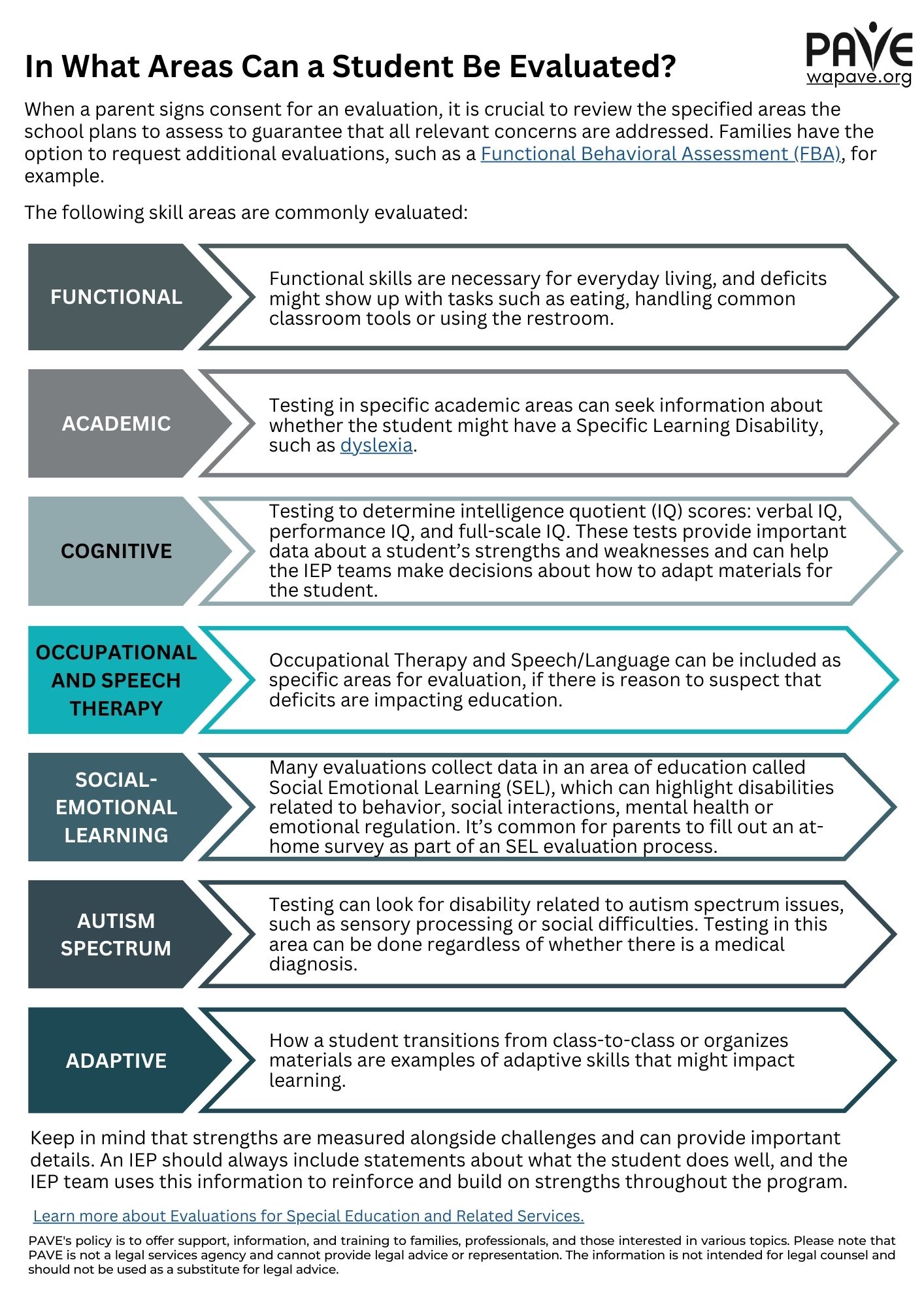
Areas of evaluation

Download In What Areas Can a Student Be Evaluated?:
English | Chinese (Simplified) 中文 (Zhōngwén) | Korean 한국어 (Hangugeo) | Russian Русский (Russkiy) | Somali Soomaali | Spanish Español | Tagalog | Ukrainian українська | Vietnamese Tiếng Việt

Eligibility Categories for Special Education

Once a student’s evaluation confirms a disability that impacts learning, the next step is to determine whether the disability fits one of 14 federally recognized categories. These categories are outlined in Washington’s Administrative Code (WAC 392-172A-01035):

  • Autism
  • Emotional Disturbance
  • Multiple Disabilities
  • Specific Learning Disability
  • Visual Impairment / Blindness
  • Deaf-Blindness
  • Hearing Impairment
  • Orthopedic Impairment
  • Speech/Language Impairment
  • Developmental Delay (ages 0-8)
  • Deafness
  • Intellectual Disability
  • Other Health Impairment
  • Traumatic Brain Injury

These categories are intentionally broad to reflect the diverse ways disabilities can affect learning. The IEP team may discuss which category best fits the student’s unique situation. While a medical diagnosis can help inform the process, eligibility is determined by how the disability impacts the student’s education. This impact can be assessed with or without a formal diagnosis.

There is no such thing as a “behavior IEP” or an “academic IEP.” Once a student qualifies, the school is responsible for addressing all identified areas of need. The IEP is personalized to include programming, services, and placement designed to support the whole child.

In Washington State, children through age 9 may be eligible for services under the category of Developmental Delay. Full definitions for each category are available in WAC 392-172A-01035 and are also reproduced in this PAVE article: Washington Special Education Categories.

Timeline of Evaluation and Development of an IEP

The school follows set timelines for the evaluation process:

  • The school has 25 school days to respond to a written referral.
  • If they agree to evaluate the student, they have 35 school days from the date the family signs consent to complete the evaluation and provide results to the family.
  • After that, the district must wait at least 5 school days, but no more than 40 school days from consent, to hold the eligibility determination meeting.
  • If the student is found eligible, an IEP must be developed within 30 calendar days of that eligibility determination meeting.

Track your student’s progress from the point of referral for evaluation to the development of the IEP with the infographic below.
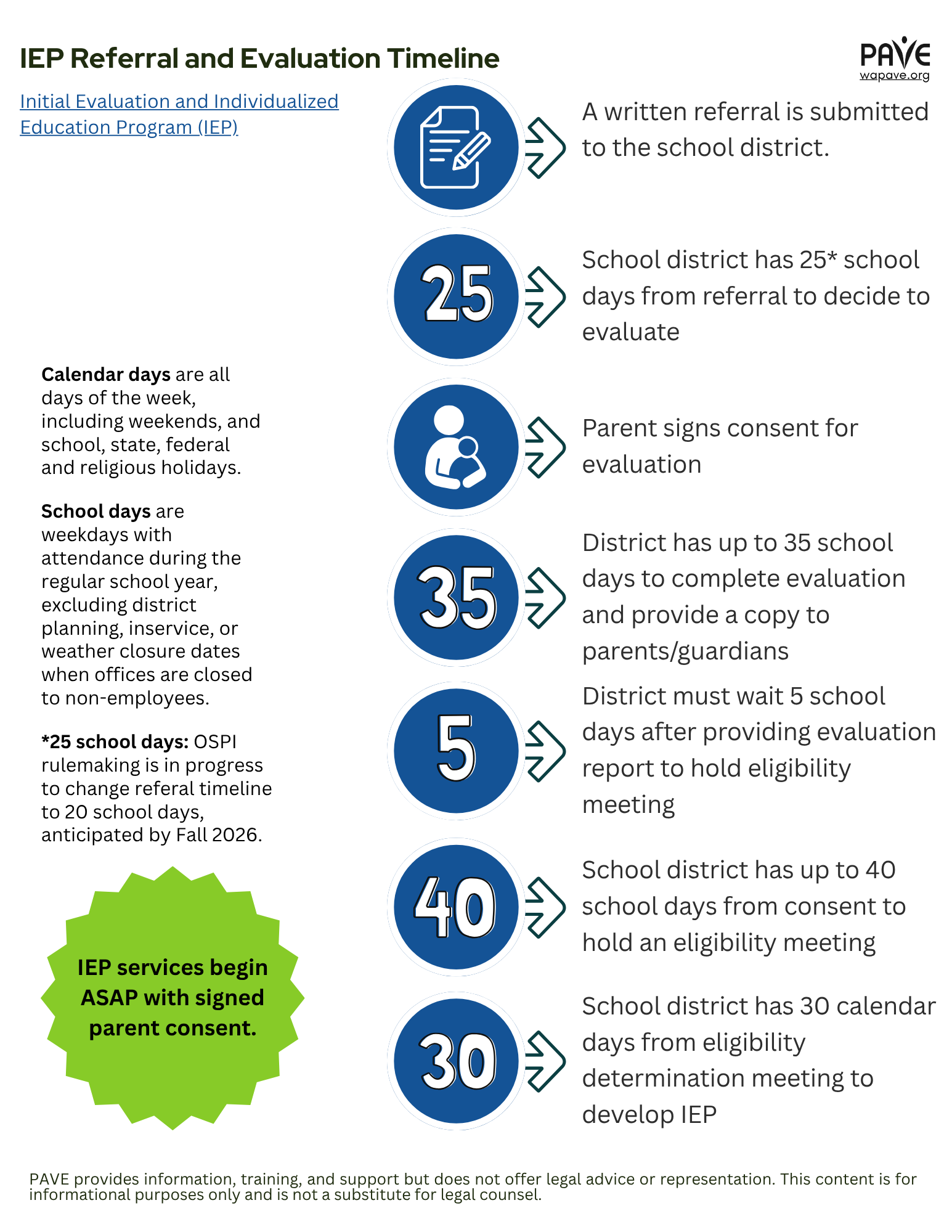
Timeline of Evaluation and development of an individualized education program (IEP)

Download the IEP Referral and Evaluation Timeline:
English

Sample Letter to Request an Evaluation

Washington law requires that referrals for special education evaluation be made in writing. If a verbal request was previously denied, start again with a formal written letter sent by email, certified mail, or delivered in person.

OSPI provides a downloadable referral form on its Making a Referral for Special Education page. The person making the referral can use this form or any other written format that clearly communicates the request to evaluate.

Address the referral to the district special education director or program coordinator, and include an administrator at the student’s school. Be sure to include the student’s full name and birthdate, a clear statement requesting evaluation in all areas of suspected disability, and specific concerns. Supporting documents or letters from doctors, therapists or other providers may be attached. Include complete contact information and a statement that the parent or guardian is prepared to sign consent for the evaluation to begin.

Download the Sample Letter to Request an Evaluation:
English | Chinese (Simplified) 中文 (Zhōngwén) | Korean 한국어 (Hangugeo) | Russian Русский (Russkiy) | Somali Soomaali | Spanish Español | Tagalog | Ukrainian українська | Vietnamese Tiếng Việt

Options When Families and Schools Disagree

Families can ask school staff to explain their decisions in writing. If a parent or guardian disagrees with something the school decides, they have rights to informal and formal dispute resolution options that are protected by the IDEA. Schools must provide a document called procedural safeguards, which outlines these options and explains the rights of both students and families. PAVE continues this topic in an article: Evaluations Part 2: Next Steps if the School Says ‘No.’

Section 504 Protections

Section 504 of the Rehabilitation Act of 1973 is a federal civil rights law that helps protect students with disabilities from discrimination in schools that receive federal funding. It applies to individuals whose disabilities significantly affect major life activities—such as learning, breathing, walking, or concentrating. Because the law is broadly written, it can apply to a wide range of conditions and circumstances.

Students who receive services through an IEP also benefit from protections under Section 504, which are built into the IEP process. In some cases, students who don’t qualify for an IEP may still be eligible for support through a Section 504 Plan.

Protections against bullying and discriminatory discipline are aspects of Section 504. PAVE provides articles about Bullying at School: Resources and the Rights of Students with Special needs and What Parents Need to Know when Disability Impacts Behavior and Discipline at School.

Learn More

PAVE provides downloadable toolkits ready for you, including Where to Begin When a Student Needs Help. For the full list of toolkits, type “toolkit” in the search bar at the top of this page.

Click on Get Support at the top of this page to submit a Support Request and receive individually tailored support, training, information, and resources.

PAVE Provides Sample Letters to Support Families in their Advocacy

PAVE offers a collection of downloadable sample letters, available in multiple languages, to help families advocate for their children’s educational needs. These letters support clear and effective communication between families and schools, making it easier to request evaluations, meetings, or behavioral support. Whether you’re just getting started or need help with a specific concern, these tools can guide your next steps.

What is an Advocate?

An advocate is someone who works toward a cause or goal. While professional advocates may be trained to support others, family caregivers often become advocates themselves when they speak up for a child’s needs. Sometimes the hardest part of advocacy is figuring out what to do next. When a child has unmet needs at school, students and family advocates can request evaluations, meetings, or behavioral assessments to help improve services. Putting these requests in writing helps formalize the process and ensures that everyone involved is accountable.

PAVE helps families get started with a collection of sample letters, available for download in multiple languages. We’ve bundled links to those letter templates here for easy reference. Each link takes you to a short article with key information to help you understand the process of special education and how your customized letter can move you forward in that process.

Always Keep Your “Why” in Mind

Why are you taking action? Because you want something to improve for your child! PAVE’s short video, Quick Start Your Advocacy in Two Steps, might help you get ready to craft a letter. The video helps you ask two key questions:

  • What do you want?
  • Who has the power to work with you and make that happen?

As you write your letter, keep those questions and your “why” top of mind.

Request an Evaluation

Sample Letter to Request Evaluation: Schools are required to evaluate students to determine eligibility for a Section 504 Plan or an Individualized Education Plan (IEP). A referral can come from anyone with knowledge of the student and must be in writing. This article provides a sample letter and a link to an alternative form provided by the Office of Superintendent of Public Instruction (OSPI).

Download the Sample Letter to Request an Evaluation in:
English | Chinese (Simplified) 中文 (Zhōngwén) | Korean 한국어 (Hangugeo) | Russian Русский (Russkiy) | Somali Soomaali | Spanish Español | Tagalog | Ukrainian українська | Vietnamese Tiếng Việt

Request an IEP Meeting

Sample Letter to Request an IEP Meeting: Family members can request an IEP team meeting anytime there are concerns about how the IEP is being implemented and whether a student may have unmet needs. This article includes information about who is required to attend an IEP meeting and the rights of parents to participate in educational decision making.

Download the Sample Letter to Request an IEP Meeting in:
English | Chinese (Simplified) 中文 (Zhōngwén) | Korean 한국어 (Hangugeo) | Russian Русский (Russkiy) | Somali Soomaali | Spanish Español | Tagalog | Vietnamese Tiếng Việt

Request a Functional Behavioral Assessment

Sample Letter to Request a Functional Behavioral Assessment: If a child’s behavior is getting in the way of their education, the school is responsible to assess the problematic behaviors and develop a support plan to teach the student what to do instead. In addition to a sample letter, this article provides a link to a video to help families and schools work together through this process.

Download the Sample Letter to Request a Functional Behavioral Evaluation in:
English | Chinese (Simplified) 中文 (Zhōngwén) | Korean 한국어 (Hangugeo) | Russian Русский (Russkiy) | Somali Soomaali | Spanish Español | Tagalog | Ukrainian українська | Vietnamese Tiếng Việt

Request an Independent Educational Evaluation (IEE)

Evaluations Part 2: Next Steps if the School Says ‘No’: If the school evaluates a student and says they aren’t eligible for an IEP or a specific area of service, parents have steps they can take if they disagree. One option is to request an Independent Educational Evaluation (IEE) from an outside provider. This article provides a sample letter for requesting an IEE at school district expense. If the family requests an IEE because they disagree with the school’s evaluation or its conclusions, then the district must pay for the IEE or deny the request through Due Process: IEE denials are evaluated by an Administrative Law Judge.

Download the Sample Letter to Request an Independent Educational Evaluation (IEE) in:
English | Chinese (Simplified) 中文 (Zhōngwén) | Korean 한국어 (Hangugeo) | Russian Русский (Russkiy) | Somali Soomaali | Spanish Español | Tagalog | Ukrainian українська | Vietnamese Tiếng Việt

Final Thoughts

Families who want individualized assistance can reach out to PAVE by completing the Get Support  form. Check out the PAVE Calendar for upcoming trainings and events.

Sample Letter to Request Evaluation

Anyone with knowledge of a student may request a special education evaluation, and Washington State law requires that referrals be made in writing. Schools must respond within specific timelines and provide language access and support throughout the process. Families have the right to participate in all decisions and may dispute outcomes if they disagree. Special education is a service designed to meet individual needs, not a predetermined placement.

A Brief Overview

  • Washington State requires special education referrals to be in writing (WAC 392-172A-03005). Schools must assist individuals who cannot write.
  • Anyone with knowledge of a student can write a referral.
  • The state provides a Referral for Special Education Evaluation form for making a special education referral, available for download in multiple languages from the Office of Superintendent of Public Instruction (OSPI) website. The form is not required—any written request is valid.
  • Another option is to write a referral using the sample letter at the end of this article.
  • Schools are responsible to provide families with a referral form in their native language and to provide qualified interpreters so families can participate in all meetings to discuss their student’s special education eligibility and services.
  • Schools must respond to a referral within 25 school days and provide a Prior Written Notice (PWN) explaining their decision.
  • If the school agrees to evaluate, parent consent is required before the process begins. The evaluation must be completed within 35 school days, and an IEP developed within 30 calendar days if the student qualifies.
  • If a student is found ineligible for an IEP or the school refuses to evaluate, families may dispute the decision using procedural safeguards, request an Independent Educational Evaluation (IEE), or pursue evaluation for a Section 504 Plan.

Introduction

When a student is struggling in school and there is reason to suspect the challenges are disability related, anyone can refer the student for an educational evaluation. If the evaluation shows that the student is eligible, services are provided through an Individualized Education Program (IEP). Washington State requires special education referrals to be in writing, as specified in Washington Administrative Code (WAC 392-172A-03005).

What Schools Must Do After a Referral

If someone who knows the student asks for an evaluation, the school is responsible for:

  • Documenting the request
  • Recording the date the referral was made
  • Providing a referral form in the person’s native language
  • Responding to the request within 25 school days

If the person asking for the evaluation cannot write, the school is responsible for supporting them to complete the referral.

The school must provide a referral form in the native language of the person making the request. Schools are required to provide qualified interpreters to support parent participation in the referral process and for all meetings where a student’s eligibility and/or educational services are discussed. The Office of Superintendent of Public Instruction (OSPI) provides Parent Rights Information Sheets, downloadable in many languages on the Interpretation and Translation Services webpage.

Evaluation Process and Timelines

When a student is referred for a special education evaluation, the school has 25 school days to decide if they will do the evaluation. These are days when students are actually in school. The school must tell the family their decision in writing. This letter is called a Prior Written Notice (PWN), and it follows rules from WAC 392-172A-05010.

Usually, the school and family meet to talk about the referral and how the student is doing. If everyone agrees to move forward, the parents or caregivers sign a form giving permission for the evaluation to begin. Families can ask questions about what the evaluation will include. The school will look at all areas where the student might need help. This helps them understand the student’s strengths and challenges. If the student qualifies for special education, the results will help create a plan called an Individualized Education Program (IEP).

If the school decides not to evaluate and the family disagrees, the family has the right to take steps to solve the disagreement. These steps are explained in the procedural safeguards.

When the school agrees to evaluate the student, staff must promptly seek parent consent to begin the evaluation process (WAC 392-172A-03005).

Generally, parents sign a form that lists what the school will include in its evaluation. Parents can ask for additional areas to be evaluated to make sure the school gets data for all areas of concern. Families can ask for more information about what the evaluation will look like, where it will take place, how long it will take, and who will participate. The school and family can creatively plan the evaluation process if accommodations are needed. For example, if a student isn’t able to attend in-person school, the evaluation can be done in alternative locations.

After a parent signs consent, the school has 35 school days to finish the evaluation and meet with the family to talk about the results. The deadline may be extended if the family agrees, particularly to accommodate needs of the family or student.

The 35-day deadline does not apply if the student is unavailable for the evaluation or enrolls in another school district before the evaluation is finished (WAC 392-172A-03005).

For students found eligible for services, the school develops an IEP within 30 calendar days and requests parent consent for services to begin. The school and family meet to review a DRAFT version of the IEP and write a final version together before consent is signed. School staff provide a Prior Written Notice (PWN) with a summary of the meeting, agreements, and timelines before services start. PWN requirements are described in WAC 392-172A-05010.

How to Refer a Student for Evaluation for Special Education

The Office of Superintendent of Public Instruction (OSPI) is the guidance agency for Washington State. OSPI provides a Referral for Special Education Evaluation form, downloadable in multiple languages from a website page titled, Model Forms for Services to Students in Special Education. Families may use OSPI’s form, a form provided by their school, or their own choice of format to write their request for a student to be evaluated.

Further explanation of the referral and evaluation process is provided on the OSPI website page, Making a Referral for Special Education.

A non-discriminatory evaluation is part of the protections for a student with a known or suspected disability that may significantly impact their access to education (Child Find Mandate). Child Find protections are part of the federal Individuals with Disabilities Education Act (IDEA). Child Find applies whether there are academic and/or non-academic school impacts.

PAVE provides more detail about IEP eligibility and evaluation process: Evaluations Part 1: Where to Start When a Student Needs Special Help at School.

Sample Letter to Request an Evaluation

Below is a sample letter to write a request for a special education evaluation. You can copy and paste the text of this sample letter into your word processor to build your own letter.

Download the Sample Letter to Request an Evaluation in:
English | Chinese (Simplified) 中文 (Zhōngwén) | Korean 한국어 (Hangugeo) | Russian Русский (Russkiy) | Somali Soomaali | Spanish Español | Tagalog | Ukrainian українська | Vietnamese Tiếng Việt

The state provides an alternative form, downloadable from OSPI’s website page titled, Making a Referral for Special Education. Your school district is responsible to provide a form, in your language, for you to submit your written request. These formats are your choice—any written request is valid. If you cannot write, you can ask for an evaluation by telling the school and they can write the request with you.

Submit your written request through email, by mail, or by hand delivery, to the special education/special services manager at your school’s district office. You may submit additional copies to school administrators and/or a school psychologist—the person who manages evaluations for your school. Be sure to keep copies of all of your communications with the school in an organized, safe place.

Special Education is a Service, Not a Location

A request for a special education evaluation is NOT a recommendation to remove a student from the regular classroom and move them into an exclusive learning environment. Federal and state laws require that students receive education and services in the Least Restrictive Environment (LRE) to the maximum extent possible to meet their needs. Special Education is a service, while LRE refers to placement. You can read more about this in the PAVE article, Special Education is a Service, Not a Place. Decisions about placement are made by the IEP team, which includes the family. The IEP team is responsible to consider the child’s circumstances and capacities as its top priority—not pre-built programs or district resources. The PAVE article, Parent Participation in Special Education Process is a Priority Under Federal Law, provides detail about parent participation in special education process.

Parents Can Appeal Decisions and/or Seek a 504 Plan

If a student is evaluated and found not eligible for an IEP (or if the school refuses to do an evaluation), the family has the right to dispute the decision using Procedural Safeguards.

If they disagree with the district’s evaluation or its findings, the family may seek an Independent Educational Evaluation (IEE), which is done by an agency outside of the school district. The district must pay for an IEE or deny the request using Due Process. See PAVE’s article: Evaluations Part 2: Next Steps if the School Says ‘No’ to Your RequestThe article includes a sample letter to request an IEE.

Another option if a student doesn’t get an IEP is to develop a Section 504 Plan, which accommodates a person with a disability that impacts a major life activity (learning, walking, speaking, writing, socializing…). Section 504 is part of the Rehabilitation Act of 1973, which protects the civil rights of individuals with disabilities against discrimination throughout their lives. See PAVE’s article about Section 504 rights, which also protect students who qualify for an IEP: Section 504: A Plan for Equity, Access and Accommodations.

Final Thoughts

Requesting a special education evaluation is a straightforward process that begins with a written referral. By following the required steps and understanding your rights, you can help ensure your student receives the support they need. Whether you use a formal form or write your own letter, the request must be clear and submitted in writing. This step initiates the evaluation process and ensures the school is legally obligated to respond.

Learn More