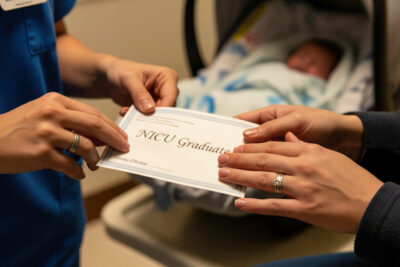
Coming home from the hospital with your baby can be both a joyous and potentially uncertain event, especially for families whose child is graduating from the Neonatal Intensive Care Unit or NICU. As parents, you have had a much different journey home than is typical for most families. Often, a baby is in the NICU because they are born early and need support with getting their bodies up and running because they “joined the world” a little or a lot early. Sometimes a baby is in the NICU because they were born needing medical support before they can go home. It can be because of genetic conditions, trauma during birth, other conditions needing medical support, interventions, and time in the hospital. This article will discuss “graduation” to home, how to shift expectations for caring for your baby, and where to go when it’s overwhelming.
Highlights:
- Building a transition plan before you leave that includes what’s next at home
- Talking with your transition team on building a Medical Home for your baby
- How do I get feeding support if I need it?
- Where do I go if I just need someone to talk to?
- What is Birth to Three and is it helpful?
Heading Home
Before your baby leaves the NICU, the doctors and nurses will teach you how to take care of your baby at home. You’ll learn about feeding, sleeping, using medical equipment, and what is expected and when you should bring your baby in to be seen. There is a lot happening while your baby is in the NICU, but if you can get connected with a Developmental Pediatrician or a Pediatrician’s clinic before you leave, you have already set you and your baby up for support outside of the hospital when you have questions. That Pediatrician and their team can also be a hub for connecting you and your baby to the specialists that are needed outside of the hospital. In the transition meetings before your baby comes home, the first appointments for specialists and follow-ups will be set up by the transition team but the Pediatrician can help keep it going if you pull them into the conversation right away. Ask the transition team to help set up an appointment with the Pediatrician when you and baby get home to help get it started.
Specialists and Therapies
Depending on the health impacts that your child has been diagnosed with, you may be juggling several different kinds of appointments for the first year after bringing your child home from NICU. Some of the specialists could be Pulmonology for breathing, because many premature babies need extra time for their lungs to catch up, Cardiology for any heart issues, and a Neurologist for any developmental delays, and to help families keep track of where their child is if there is no diagnosis of a developmental disability or a genetic disorder.
Often, there are feeding challenges, and a baby may need a feeding tube. There are specialists who can help with tracking everything that needs to happen for the care of feeding tubes, and with where and how to get formulas. The UW/Seattle Children’s Feeding Program has nutritionists to support families and resources that families and pediatricians can access.
Occupational and Physical Therapists also support a child’s developmental needs and can be part of the team that adds components to strengthen mind and body development over the year post-NICU. Depending on where you live and what NICU your baby was in, those pediatric specialists could be at Mary Bridge, Seattle Children’s, Children’s Village in Yakima, Sacred Heart in Spokane, or Madigan if you are a Military family. If your baby has a rare condition or disorder, you may need to travel to Seattle Children’s or Mary Bridge, no matter where you live in the state, because of the limited availability of specialists for some diagnoses. Establishing a Medical Home by setting up connections for your baby with a Pediatric clinic can help with referrals, keeping track of who the specialists are, and having someone to call if you have a question, rather than going to the emergency room for every medical concern.
Another help for families that can also lessen the volume of therapy appointments that may come with NICU graduation is having your baby in the Birth to Three services. Some NICUs can and do enroll a family before they leave as part of transition supports, but not all families are ready, and just getting home is the priority. If you get home and decide you are ready to enroll your baby, you can get started by visiting Early Support for Infants and Toddlers (ESIT) online or by calling 360-725-3500. Your baby, having been in the NICU, meets the qualifications for early intervention services. Many of the Occupational, physical, and feeding/nutrition therapies you would need to coordinate on your own are part of the ESIT program, and they come to your door. For many families, this takes a huge burden of some of the care coordination off their plates and gives them some respite. Parents also get skill-building to increase their confidence and knowledge in caring for their child’s unique needs from experts who take more than 15 minutes during a doctor’s visit.
Community Supports
Juggling all of this can be very overwhelming, even if this isn’t your first baby. This is all new, the expectations are different, it’s more complicated and time-consuming. There are some peer supports to call, text, or email if you need someone to help with navigating this new parent landscape. Two Statewide supports you can connect with, no matter where you live, are PAVE and a Family-to-Family support navigator. They are the parents of a child with special healthcare needs who have experience with navigating complex needs. They have supported many families in learning and understanding the next steps. Another is the Statewide Parent to Parent program. There is a Parent-to-Parent program in almost every county in our state, specializing in supporting families new to a diagnosis. While their main focus is developmental disability, Parent to Parent coordinators can and do connect families to resources, regardless of the need. If your child has impacted hearing, a family support organization in Washington State is Hands and Voices. They provide peer support, training, and a family toolkit for families once they receive a diagnosis. They also work with ESIT and later with the schools if a family requests.
Keeping Records
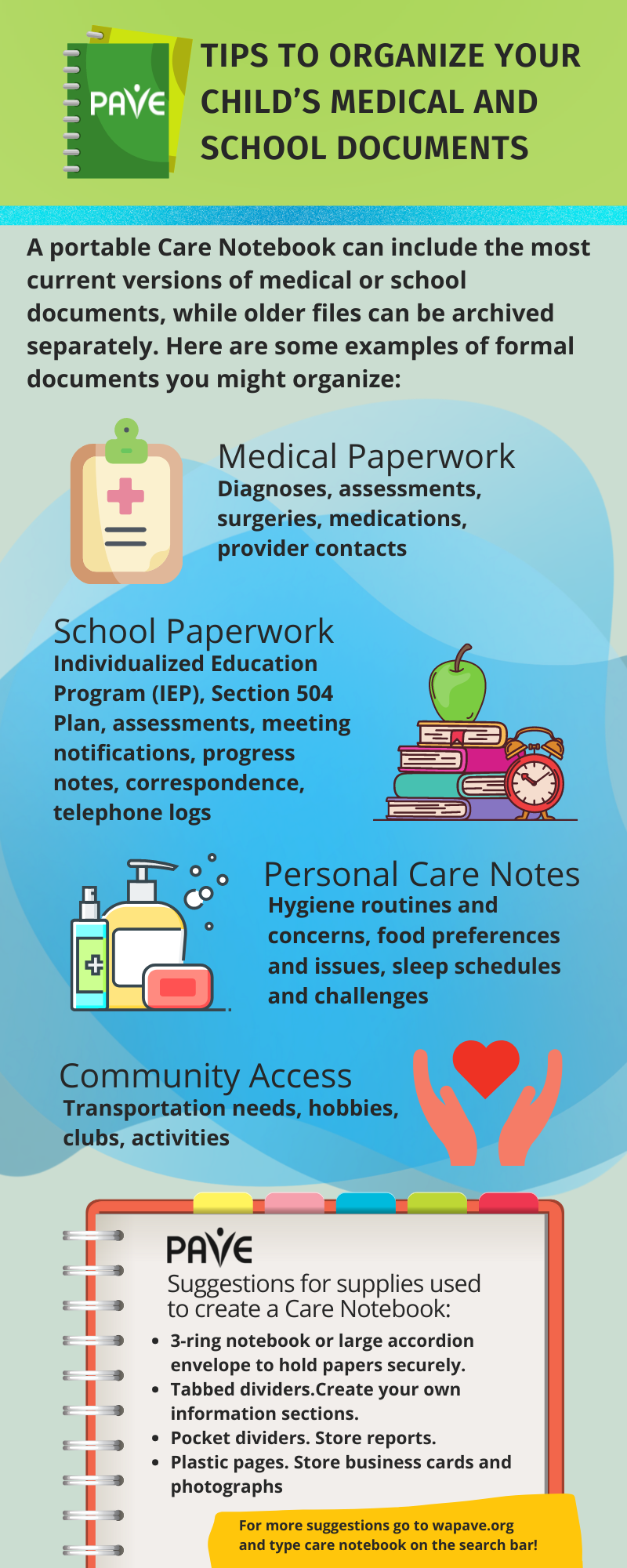
One final difference that becomes an enormous help down the line is starting a Care or Medical Notebook. It is like a traditional baby book in some ways, but it pulls together all the important medical and care documents and instructions related to your baby’s care. There are several templates available, including some online. If you go to a clinic that shares the same electronic chart system as the hospital and specialist that your baby sees, it is easy for them to access notes, medication recommendations, and surgery charts. If they are in different systems, then the burden of bridging that information goes to you. Even though a release of information is signed, it doesn’t necessarily mean that notes or information are faxed or emailed. It helps to request the notes from a visit and put them in your baby’s care notebook, so you have accurate information to share if things get delayed or lost in the system. There will be a couple of templates shared in the helpful resources below, as well as a couple of NICU information packets that have good general information. A simple information-sharing “roadmap” will be attached to the article and can also be taken to each Doctor so that information can be shared and you can stay on track. Here are a couple of Care Notebook articles to give you some ideas: