Graduating from NICU: The Joy and Anxiety Finding Your Way to Baby’s Norm

Coming home from the hospital with your baby can be both a joyous and potentially uncertain event, especially for families whose child is graduating from the Neonatal Intensive Care Unit or NICU. As parents, you have had a much different journey home than is typical for most families. Often, a baby is in the NICU because they are born early and need support with getting their bodies up and running because they “joined the world” a little or a lot early. Sometimes a baby is in the NICU because they were born needing medical support before they can go home. It can be because of genetic conditions, trauma during birth, other conditions needing medical support, interventions, and time in the hospital. This article will discuss “graduation” to home, how to shift expectations for caring for your baby, and where to go when it’s overwhelming.

Highlights:

  • Building a transition plan before you leave that includes what’s next at home
  • Talking with your transition team on building a Medical Home for your baby
  • How do I get feeding support if I need it?
  • Where do I go if I just need someone to talk to?
  • What is Birth to Three and is it helpful?

Heading Home

Before your baby leaves the NICU, the doctors and nurses will teach you how to take care of your baby at home. You’ll learn about feeding, sleeping, using medical equipment, and what is expected and when you should bring your baby in to be seen. There is a lot happening while your baby is in the NICU, but if you can get connected with a Developmental Pediatrician or a Pediatrician’s clinic before you leave, you have already set you and your baby up for support outside of the hospital when you have questions. That Pediatrician and their team can also be a hub for connecting you and your baby to the specialists that are needed outside of the hospital.  In the transition meetings before your baby comes home, the first appointments for specialists and follow-ups will be set up by the transition team but the Pediatrician can help keep it going if you pull them into the conversation right away. Ask the transition team to help set up an appointment with the Pediatrician when you and baby get home to help get it started.

Specialists and Therapies

Depending on the health impacts that your child has been diagnosed with, you may be juggling several different kinds of appointments for the first year after bringing your child home from NICU. Some of the specialists could be Pulmonology for breathing, because many premature babies need extra time for their lungs to catch up, Cardiology for any heart issues, and a Neurologist for any developmental delays, and to help families keep track of where their child is if there is no diagnosis of a developmental disability or a genetic disorder.

Often, there are feeding challenges, and a baby may need a feeding tube. There are specialists who can help with tracking everything that needs to happen for the care of feeding tubes, and with where and how to get formulas. The UW/Seattle Children’s Feeding Program has nutritionists to support families and resources that families and pediatricians can access.

Occupational and Physical Therapists also support a child’s developmental needs and can be part of the team that adds components to strengthen mind and body development over the year post-NICU. Depending on where you live and what NICU your baby was in, those pediatric specialists could be at Mary Bridge, Seattle Children’s, Children’s Village in Yakima, Sacred Heart in Spokane, or Madigan if you are a Military family. If your baby has a rare condition or disorder, you may need to travel to Seattle Children’s or Mary Bridge, no matter where you live in the state, because of the limited availability of specialists for some diagnoses. Establishing a Medical Home by setting up connections for your baby with a Pediatric clinic can help with referrals, keeping track of who the specialists are, and having someone to call if you have a question, rather than going to the emergency room for every medical concern.

Another help for families that can also lessen the volume of therapy appointments that may come with NICU graduation is having your baby in the Birth to Three services. Some NICUs can and do enroll a family before they leave as part of transition supports, but not all families are ready, and just getting home is the priority. If you get home and decide you are ready to enroll your baby, you can get started by visiting Early Support for Infants and Toddlers (ESIT) online or by calling 360-725-3500. Your baby, having been in the NICU, meets the qualifications for early intervention services. Many of the Occupational, physical, and feeding/nutrition therapies you would need to coordinate on your own are part of the ESIT program, and they come to your door. For many families, this takes a huge burden of some of the care coordination off their plates and gives them some respite. Parents also get skill-building to increase their confidence and knowledge in caring for their child’s unique needs from experts who take more than 15 minutes during a doctor’s visit.

Community Supports

Juggling all of this can be very overwhelming, even if this isn’t your first baby. This is all new, the expectations are different, it’s more complicated and time-consuming. There are some peer supports to call, text, or email if you need someone to help with navigating this new parent landscape. Two Statewide supports you can connect with, no matter where you live, are PAVE and a Family-to-Family support navigator. They are the parents of a child with special healthcare needs who have experience with navigating complex needs. They have supported many families in learning and understanding the next steps. Another is the Statewide Parent to Parent program. There is a Parent-to-Parent program in almost every county in our state, specializing in supporting families new to a diagnosis. While their main focus is developmental disability, Parent to Parent coordinators can and do connect families to resources, regardless of the need. If your child has impacted hearing, a family support organization in Washington State is Hands and Voices. They provide peer support, training, and a family toolkit for families once they receive a diagnosis. They also work with ESIT and later with the schools if a family requests.

Keeping Records

One final difference that becomes an enormous help down the line is starting a Care or Medical Notebook. It is like a traditional baby book in some ways, but it pulls together all the important medical and care documents and instructions related to your baby’s care. There are several templates available, including some online. If you go to a clinic that shares the same electronic chart system as the hospital and specialist that your baby sees, it is easy for them to access notes, medication recommendations, and surgery charts. If they are in different systems, then the burden of bridging that information goes to you. Even though a release of information is signed, it doesn’t necessarily mean that notes or information are faxed or emailed. It helps to request the notes from a visit and put them in your baby’s care notebook, so you have accurate information to share if things get delayed or lost in the system. There will be a couple of templates shared in the helpful resources below, as well as a couple of NICU information packets that have good general information. A simple information-sharing “roadmap” will be attached to the article and can also be taken to each Doctor so that information can be shared and you can stay on track. Here are a couple of Care Notebook articles to give you some ideas:
IDEA: The Foundation of Special Education

The Individuals with Disabilities Education Act (IDEA) is a federal law that was passed in 1990 and has been amended. The IDEA provides children with qualifying disabilities, from birth to age 21, with the right to services designed to meet their unique, individual needs.

A Brief Overview

  • The Individuals with Disabilities Education Act (IDEA) is a federal law that entitles children to special education services if disability significantly impacts access to education and a specially designed program is needed.
  • IDEA has been federal law since 1990, and key concepts are from the Education for All Handicapped Children Act, passed in 1975. PAVE provides an article and infographic about disability rights history.
  • A primary principle of the IDEA is the right to FAPE (Free Appropriate Public Education) for students eligible for special education services. FAPE rights are also protected by civil rights laws, including Section 504 of the Rehabilitation Act of 1973.
  • IDEA consists of four parts that ensure that individuals with disabilities receive support and education throughout their lives, from early childhood through adulthood.
  • To qualify for an IEP, a student meets criteria in one of the 14 eligibility categories (WAC 392-172A-01035), the disability must have a negative impact on their learning, and the student must require specially designed instruction (SDI) to benefit from the general education curriculum.

Introduction

Eligible children ages 3-21 who receive services at school have a right to FAPE: Free Appropriate Public Education. In accordance with the IDEA, FAPE is provided when individualized services enable a student with a disability to make progress that is appropriate, in light of their circumstances.

Services are delivered through an Individualized Education Program (IEP). A non-discriminatory evaluation and family participation on an IEP team are aspects of FAPE. Families have dispute resolution options that are described in the Procedural Safeguards.

IDEA requires FAPE to be provided in the Least Restrictive Environment to the maximum extent possible, which creates a responsibility for schools to serve students in the general education environment, with appropriately inclusive access to grade-level learning, whenever possible. Access to general education might be provided through an adapted curriculum, additional adult support, assistive technology, or something else. PAVE provides more information about Washington State’s work to improve inclusive practices.

Many of these concepts were part of IDEA’s predecessor law, the Education for All Handicapped Children Act, passed in 1975. That was the first United States law that required schools to provide special education services to all children with eligible disabilities. PAVE provides an article and infographic about disability rights history. The IDEA’s primary features are further detailed later in this article.

The IDEA drives how states design their own special education policies and procedures. Title 34, Part 104 is the non-discrimination federal statute under the Office for Civil Rights Department of Education. In Washington State, rules for the provision of special education are in Chapter 392-172A of the Washington Administrative Code (WAC).

FAPE is an important acronym to learn!

Families often ask: What does the school have to provide? The answer to that question is FAPE. The school district is responsible to make sure a student with an eligible disability condition is receiving FAPE.

As part of their right to FAPE, a student eligible for an IEP has the right to an individualized services program that ensures their education is appropriate, equitable, and accessible. All of those terms are part of FAPE. Figuring out how to provide FAPE is the work of an IEP team, and part of FAPE is ensuring that family is part of the decision-making team.

FAPE must ensure that the student finds meaningful success, in light of their circumstances. Trivial progress on IEP goals or the same goals year after year does not meet the federal standard for FAPE. A lawsuit referred to as Endrew F was settled by the 2017 U.S. Supreme Court and included specific requirements for meaningful progress and parent participation.

If a neighborhood school cannot provide the services and programming to guarantee FAPE within the general education classroom, then the school district is responsible to work through the IEP process to design an individualized program and placement that does meet the student’s needs. Keep in mind that Special Education is a Service, Not a Place: see PAVE’s article with that statement as its title.

IDEA considers the whole life of a person with a disability

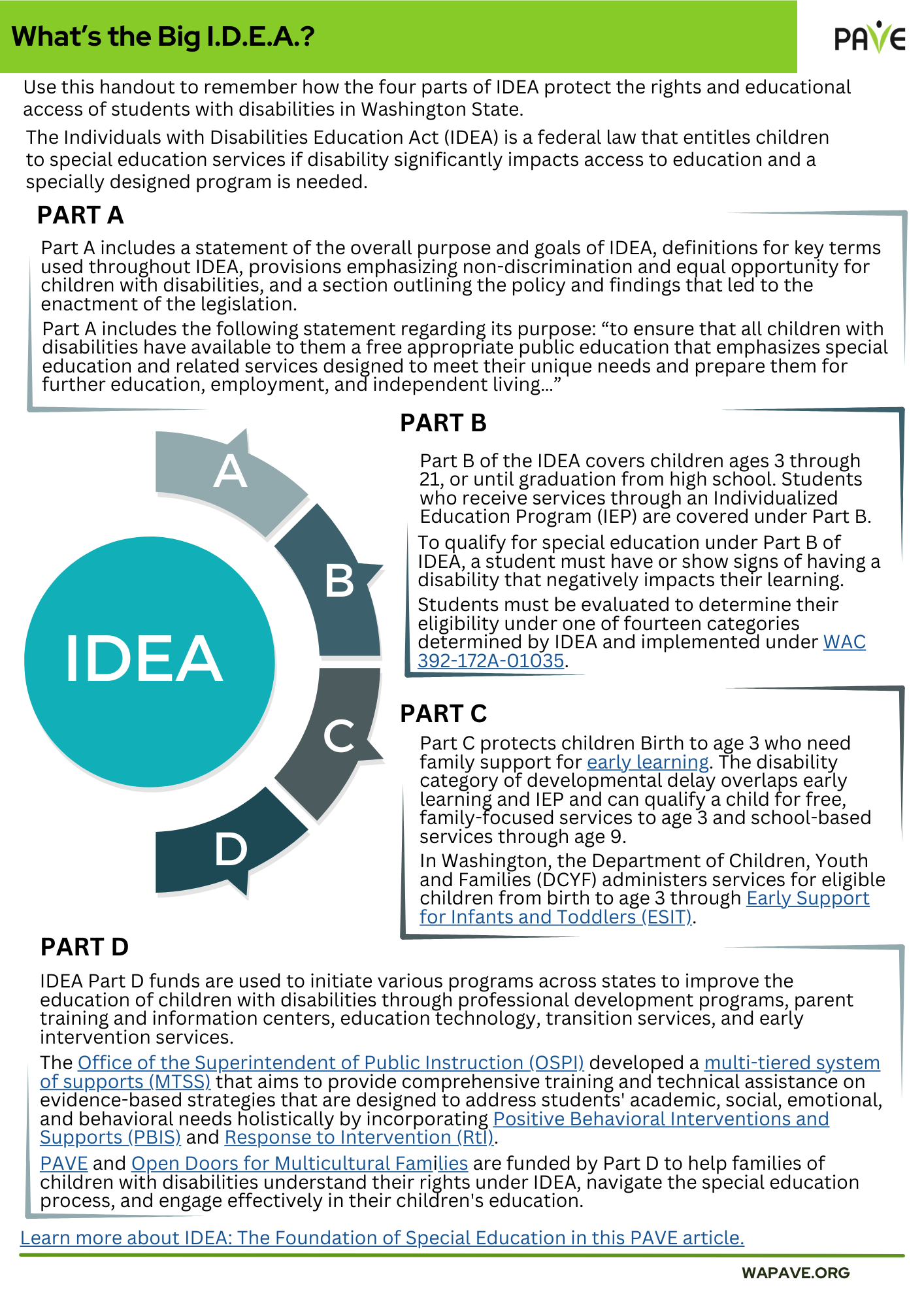
IDEA includes Parts A, B and C. The right of a child with disabilities to receive an education that prepares that child for adult life is stated in Part A: ​

“Disability is a natural part of the human experience and in no way diminishes the right of individuals to participate in or contribute to society…

“Improving educational results for children with disabilities is an essential element of our national policy of ensuring equality of opportunity, full participation, independent living, and economic self-sufficiency for individuals with disabilities.”

Part B of the IDEA covers children ages 3 through 21—or until graduation from high school. Students who receive services through an Individualized Education Program (IEP) are covered under Part B.

Part C protects infants and toddlers, aged 0 (birth) to 3 years old, who need family support for early learning. ​The disability category of developmental delay overlaps early learning and IEP and can qualify a child for free, family-focused services to age 3 and school-based services through age 9. PAVE provides downloadable toolkits specifically designed for parents and families of young children:

  • From Birth to Three Toolkit: This toolkit provides places to begin if caregivers suspect that a baby or young child may need services due to a developmental delay or disability.
  • Transition Toolkit for Ages 3-5: This toolkit encompasses a collection of our informative articles, complemented by sample letters to provide you with a solid foundation as you navigate through this crucial transition period.

Part D outlines grants and funding for programs that help students with disabilities get a better education, including:

  • Teacher training programs to train teachers and school staff in Washington State on the best ways to teach students with disabilities.
  • Office of the Superintendent of Public Instruction (OSPI)’s Multi-Tiered System of Supports (MTSS) – a system that helps train school staff on how to support students’ academic, social, emotional, and behavioral needs.
  • Parent Training and Information Centers help students with disabilities and their families understand their rights, navigate the special education process, and get involved in their children’s education. PAVE provides Parent Training and Information (PTI) to family caregivers, youth, and professionals in Washington state with questions about services for children and young people with disabilities, aged 0-26. In addition, Community Parent Resource Centers (CPRCs) serve the same function as PTIs but are typically smaller and located in underserved communities, often addressing the needs of families from culturally or linguistically diverse backgrounds. CPRC, Open Doors for Multicultural Families serves multicultural families in South King County.
  • Educational technology funds can be used to buy or create technology that helps children with disabilities learn, so they have the same opportunities as other students.
  • Transition services help students with disabilities move from high school to adult life, like getting a job, going to college, or living independently.
  • Washington’s Early Support for Infants and Toddlers (ESIT), can use Part D funds to help research and expand services for young children with disabilities to get them ready for school.
Explanation of what IDEA stands for.

Click to print the explanation of IDEA

Eligibility for school-based services

To qualify for an IEP, a student meets criteria in one of the 14 eligibility categories defined in WAC 392-172A-01035. The disability must have a negative impact on learning. Not every student who has a disability and receives an evaluation will qualify for an IEP. Following procedures described by the IDEA, school districts evaluate students to consider 3 key questions:

  1. Does the student have a disability?
  2. Does the disability adversely impact education?
  3. Does the student need Specially Designed Instruction (SDI)?

When each answer is yes, a student qualifies for services. In each area of identified need, Specially Designed Instruction (SDI) is recommended to help the student overcome the impact of the disability to access FAPE. Progress in that area of learning is tracked through goal-setting and progress monitoring.

What Happens During an Early Intervention Evaluation?

Early Intervention is intended for infants and toddlers who have a developmental delay or disability.

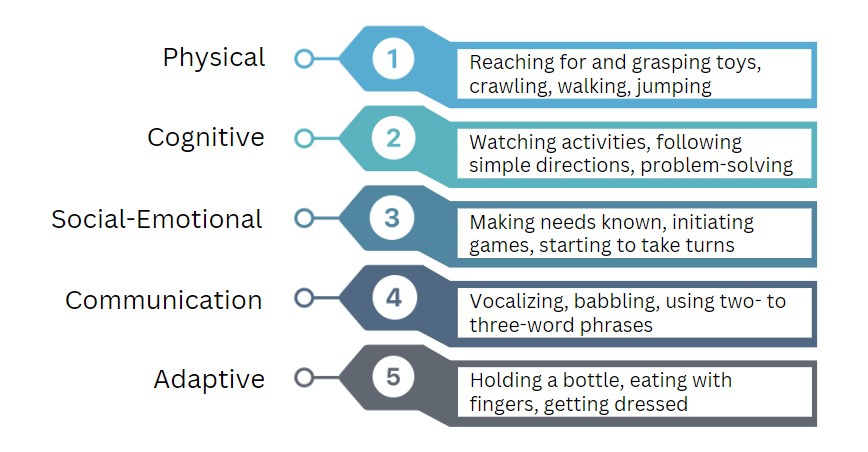
Eligibility is determined by evaluating the child (with parental consent) to see if the child does, in fact, have a delay in development or a disability. Eligible children can receive early intervention services from birth to the third birthday. After a referral is accepted, a team of professionals uses standardized tools and observations to evaluate a child’s development in five areas:

  1. Physical – Reaching for and grasping toys, crawling, walking and jumping
  2. Cognitive – Watching activities, following simple directions, problem – solving
  3. Social Emotional – Making needs known, initiating games, starting to take turns
  4. Communication – Vocalizing, babbling, using two -to-three word phrases
  5. Adaptive – Holding a bottle, eating with fingers, getting dressed
Five areas of a child's development: Physical, Cognitive, Social - Emotional, Communication and Adaptive
Five Areas of a Child’s Development

After a child is evaluated, data are compared against typically developing children of the same age. If scores show a 25 percent delay overall or if the score in one developmental area is statistically 1.5 standard deviations below typical peers, then the child is eligible for an IFSP.

Some medical and developmental conditions are more likely to cause developmental delays. ESIT has a Qualifying Diagnoses List of these conditions that allows for automatic eligibility determinations. If an infant or toddler has a qualifying diagnosis, they will be enrolled in early intervention services without completing the initial eligibility evaluations.

ESIT’s A Family’s Guide to Early Intervention Services in Washington State contains more details about the evaluation process.

Next Steps When Your Child is Found Eligible for Early Intervention Services (EIS)

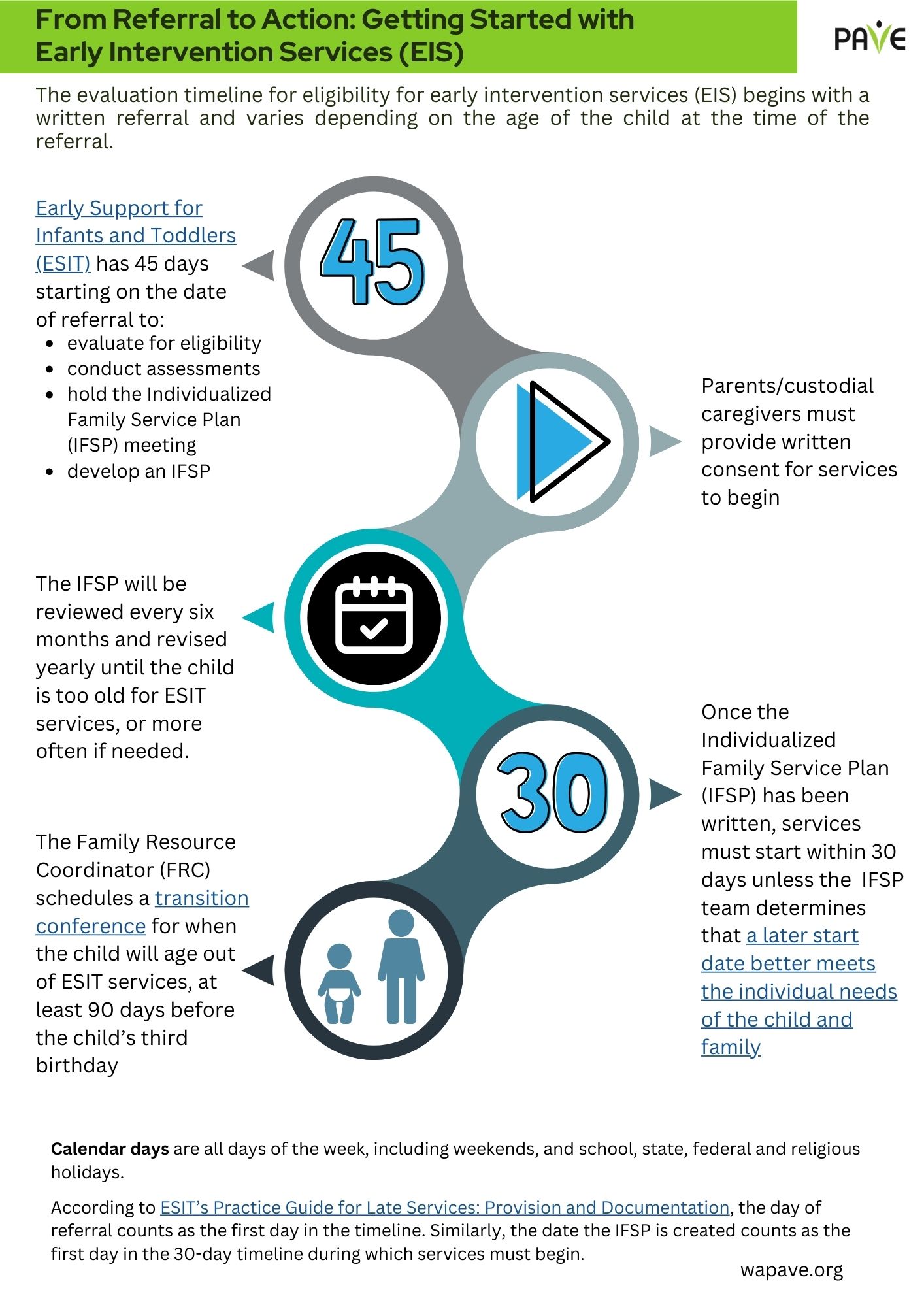
The evaluation timeline for eligibility for early intervention services (EIS) begins with a written referral and varies depending on the age of the child at the time of the referral.

Early Support for Infants and Toddlers (ESIT) has 45 days starting on the date of referral to:

  • evaluate for eligibility
  • conduct assessments
  • hold the Individualized Family Service Plan (IFSP) meeting
  • develop an IFSP

Parents/custodial caregivers must provide written consent for services to begin

The IFSP will be reviewed every six months and revised yearly until the child is too old for ESIT services, or more often if needed.

Once the Individualized Family Service Plan (IFSP) has been written, services must start within 30 days unless the IFSP team determines that a later start date better meets the individual needs of the child and family

The Family Resource Coordinator (FRC) schedules a transition conference for when the child will age out of ESIT services, at least 90 days before the child’s third birthday

Calendar days are all days of the week, including weekends, and school, state, federal and religious holidays.

According to ESIT’s Practice Guide for Late Services: Provision and Documentation, the day of referral counts as the first day in the timeline. Similarly, the date the IFSP is created counts as the first day in the 30-day timeline during which services must begin.

Graphic explaining the process from Referral to Action Getting Started with Early Intervention Services (EIS)