Medicaid or Medicare-Which Covers Long-Term Care?

Courtesy of Pierce County Washington’s Aging and Disability Resource Center (ADRC), part of the Aging and Disability Resource Centers network across WA State. Find your area’s ADRC at Community Living Connections.

Medicare:  No long-term care coverage in the home or in a care facility

  • The Medicare Part A benefit for medically necessary skilled nursing facility care becomes active after hospital treatment for an illness or injury.  The “three overnight admission rule” has been waived due to COVID-19. 
  • Medicare Part A pays for medically necessary skilled nursing facility care, up to 100 days, if the patient is actively participating in rehabilitation services and showing improvement within their plan of care.
  • Medicare Part A does not pay for ongoing long-term (custodial) care in a skilled nursing facility once rehabilitation is complete, nor does Part A pay for ongoing long-term (custodial) care in assisted living, memory care, or adult family homes. 
  • Medicare Part B pays for medically necessary home health care, if the patient is homebound, actively participating in rehabilitation services (physical therapy, occupational therapy, respiratory therapy) and showing improvement within their plan of care.

Medicaid:  Long-term care coverage is available in the home and in certain care facilities.

  • Eligibility is based upon the income, resources, and functional need of the applicant.
  • There are special allowances for income, resources, and housing costs of married couples.
  • Medicaid can pay for in-home care or residential care in certain facilities that accept Medicaid funding to pay for the long-term (custodial care) of their residents.
  • Recipients may be required to pay “financial participation” to their care provider, to qualify for and to maintain their Medicaid eligibility, depending upon their income level. 
  • Estate recovery is required to return Medicaid funds to the state once a Medicaid recipient or the surviving spouse of a Medicaid recipient dies.
  • There is a five-year “lookback period” to determine whether an applicant had been “gifting away” resources to qualify for Medicaid. 
  • Eligibility for a recipient receiving Medicaid is reviewed every twelve months. 

How to Afford Family Caregiving, Part 4: How Can I Afford Long-Term Care?

What happens if you, or a loved one, cannot do things that keep you healthy, active and safe? Becoming disabled or having less ability to do certain things can happen to anyone at any age. Accidents or a chronic illness may result in a situation where you may have difficulty with “activities of daily living”. Preparing meals, dressing, showering or taking a bath, going to the toilet and cleaning yourself after, walking easily, being able to clean your house or apartment, taking your dog out for walks, driving, shopping for food –it’s a long list! We may take our abilities for granted until we can’t do them anymore. 

Video transcript in English

When activities of daily living become difficult, many people find others who step in to help: spouses, siblings, adult children, other family members, even friends and neighbors. These are “family caregivers”, and their support allows people to continue to live in their own homes and avoid the high costs of professional caregivers or having to move to a residential facility like a memory-care unit or a nursing home.

Just how important are these free services offered by family members, friends, neighbors and others? 

Services like these, whether given by family members or professionals, at home or in a facility, are called “Long-Term Services and Supports (LTSS)”. According to a 2022 Health and Human Services report, over half of Americans turning 65 today will require LTSS.

The cost of care for LTSS given by professionals, or in a facility:

The average American turning 65 today will incur over $120,000 in future LTSS costs and may have to pay much of that out-of-pocket. A 2023 KFF report stated “the overwhelming majority of adults say that it would be impossible or very difficult to pay the estimated $100,000 needed for one year at a nursing home (90%) or the estimated $60,000 for one year of assistance from a paid nurse or aide (83%).” Traditional Medicare doesn’t cover long-term care, while some Medicare Advantage plans offer only limited  coverage for services like meal delivery.

Medicare does NOT cover LTSS. It’s important to know that Medicare health insurance, which many individuals rely on for health care after age 65, does not cover or contribute to the costs of in-home help for activities of daily living or care in a facility such as a nursing home or memory-care residence.

Medicare does cover temporary care in a rehabilitation facility when your physician orders it for recovery from accidents, surgery, stroke and heart attack, and similar medical reasons. It may also cover short term rehabilitation care in your home after you are released from a hospital or rehabilitation facility. All services are based on medical need and are time limited.

Medicaid or Medicare, Which Covers Long-Term Care? compares which program covers which services and under what circumstances.

In Washington State we have an agency focused on LTSS, the Aging and Long-Term Support Administration (ALTSA). Washington State has several programs that may help families reduce the costs of long-term care.
To find which of the programs and services below you are eligible for, contact Community Living Connections by phone toll-free, 1-855-567-0252, or on their website.

ALTSA has a website page listing the types of services that support people to stay in their own home (these are often called Home and Community-Based Services).When it’s not possible or desirable for you to stay in your own home many people use residential care. Some types of residential care are paid for by Medicaid, if you are eligible. Information about types of residential settings, state supervision of residential facilities, and tools to search for and compare residential options are listed on ALTSA’s page about Long Term Care Residential Options.

Ways to reduce the cost of long-term care:

Washington State Medicaid (Apple Health) 

Long-Term Services and Supports are available for some individuals under Washington Medicaid/Apple Health. There are financial criteria to qualify, including looking at income and assets. In many cases, those who own their own home and are without significant debt are deemed ineligible. To check the eligibility requirements see the Washington State Medicaid Long-Term Services and Supports for Adults booklet

Note: WA State offers the Specialized Dementia Care program at some assisted living facilities for people who qualify for long-term care under Medicaid.

The package of specialized dementia care services includes (in part):

  • Care, supervision, and activities tailored to the specific needs, interests, abilities, and preferences of the person. 
  • Coordination with the person’s family to ensure the person’s routines and preferences are honored.
  • Dementia-specific training for staff. 
  • Awake staff twenty-four hours a day.
  • A safe outdoor environment with walking paths and access to a secure outdoor area.
  • Intermittent nursing services, help with medications, personal care, and other support services.

LTSS for Military-connected Individuals:

Veterans can access long-term care through the U.S. Department of Veterans Affairs. 

TRICARE, health insurance for military members and their families, does not cover long-term care but can provide some services and supports, similar to those Medicare does cover. Some military members may be eligible for the Federal Long Term Care Insurance Program.

Private Long-Term Care Insurance:

These insurance policies can be purchased at any time and are meant to last for a lifetime. The cost of these policies is determined by a recipient’s age, health, and location, and rates go up over time. These can be expensive and difficult to find but may be worth looking into.

Not all Long-Term Care Insurance companies operate in the state of Washington – to see a list of all approved agencies, view them at the Office of the Insurance Commissioner.  The Office of the Insurance Commissioner has an online booklet called A Consumer’s Guide to: Buying Long-Term Care Insurance and Other Ways to Pay for Long-Term Care that can answer questions and explain the process for signing up for insurance. 

Washington State Long-Term Care Partnership Program 

Many families liquidate (get rid of, or use up) assets in order to be eligible for Medicaid LTSS services, and to address the issue, the state created the Long-Term Care Partnership Program.  The program is a partnership between long-term care insurance companies and the state of Washington Medicaid program, so that families can keep many of their assets, yet receive Medicaid Services for LTSS.  Under these policies, assets are protected up to the amount of benefits paid under the policy. For example, if the Partnership Policy paid $100,000, then Medicaid would allow you to keep $100,000 in assets, yet you’d still qualify for government LTSS as long as you meet all other qualifications. This is a movable policy, as Washington participates in a “reciprocity” agreement with several other states. See the list of long-term care insurance companies approved to sell Partnership policies in Washington state. 

WA Cares Fund:

A newer option that helps with the expenses of long-term services and supports is the WA Cares Fund, a public, long-term care insurance program.  All Washingtonians who get a paycheck have a small percentage of their earnings go to this fund automatically, just like Social Security and Medicare tax is withheld from a paycheck. The program went into effect in July of 2023.

  • Most Washington employees will have .058 % of their paycheck placed in the WA Cares Fund. WA Cares website has an online calculator so you can check out the actual dollar amount. Everyone contributes at this same low rate, regardless of income.
  • Exceptions: Federal employees do not contribute. Employees of tribal entities only contribute if the tribe decides to have their employees contribute.
  • If you are self-employed you can choose to contribute to the fund.
  • After paying into the system for 10 years you can withdraw from the fund. There are exceptions to the 10 year rule if you are retiring soon or have an emergency need for LTSS. 
  • Funds can be withdrawn beginning in July of 2026.
  • WA Cares funds can be used if you live in another state.
  • Funds can be used to pay for many services and supplies: paying a relative to care for you, making your home safe and accessible, transportation, food delivery, durable medical equipment to help you stay safely in your home, and more. Funds can also be applied to the cost of residential (facility) care.
    You will have to create an online WA Cares account and submit an application
  • If you have contributed to the fund for 10 or more years, you will receive up to $36,500 (adjusted for inflation) to pay for your long-term care.
  • If you need to access WA Cares funds earlier, because of retirement or emergency need, you will get less.

Help for your family caregivers

If you plan to get in-home supports from family members or others, using your benefit from the WA Cares Fund can take some tasks off their list, or pay them for their time. That’s a big help because even though family caregivers help out of love, the time and out-of-pocket costs of caring for you can have an impact on their financial situation.


 Open Enrollment for Medicaid and Medicare Dual Eligibility 

Brief Overview  

  • Open enrollment ends January 15th, 2025.  
  • Go to healthcare.gov to get assistance if during the Covid Medicaid unwinding your coverage was dropped.  
  • If you are an immigrant or a part of the DACA program, a portal is now  available at Washington HealthPlan Finder to help with connecting you to coverage through a dedicated line in the Washington Health Plan Finder Immigrant Portal

Full Article  

Open enrollment for Medicaid and Medicare starts on November 1st, 2024 and ends on January 15th, 2025. The annual opportunity to sign up, renew, or change coverage to best suit your family’s situation. Washington Health Plan Finder has step-by-step instructions for applying and navigators to help with the application process. Help is available for those who are having trouble navigating the health insurance landscape. 

Medicaid, also known as Apple Health, is run by the state and can be accessed through the Washington Health Plan Finder.  Open Enrollment is the time for those enrolled in Medicaid to review your eligibility and renew your plan. To find out if you or a family member is eligible for Medicaid primarily based on income and age, visit the Apple Health Eligibility page.  For those enrolled in Medicaid Classic, go to Washington Health Plan Finder to renew coverage. Go to healthcare.gov to get assistance if your enrollment coverage was dropped during the unwinding from Covid. Many experienced challenges during this shift period, and healthcare.gov can support fixing any issues that may have occurred. 

If you are an immigrant or a part of the DACA program, using a dedicated  Immigrant portal in the Washington Health Plan Finder will connect you to coverage.  

 ¡Seguro médico para todos! 

Todos los habitantes del estado de Washington pueden contratar seguros médicos y dentales por medio de Washington Healthplanfinder™, sin importar su situación migratoria. 

If you have questions about the new ruling for those in DACA please download the PDF healthcare.gov  with this article that gives the full information available about the new ruling concerning DACA coverage. 

For individuals under 65 with disabilities, eligibility for Medicare A and B is completed automatically, and they will be enrolled after two years on SSI disability. However, the Open Enrollment period can be used to change coverage. Special circumstances will allow individuals to sign up for Medicaid or Medicare at other times of the year, but it is safest to do it now before the end of open enrollment. If you are an individual on SSI with Classic Medicaid and a Parent or guardian passes away you can become eligible for Dual Enrollment or DAC in Medicare A and B as well. 

Coverage options have grown in the marketplace over the last few years, especially for those who are just over the cap for Medicaid coverage. With options like the Cascade Care Savings Plan tool, finding options to fit budgets and healthcare needs is a little easier. ParentHelp123/HelpMeGrow Washington also has navigator support for finding coverage and other supports to help your family. Although choosing a plan can be daunting, the new tools and navigators have come a long way in helping choose new or updating an existing plan. 

Resources 

Washington State Health Care Authority 

626 8th Ave.  SE 

Olympia, WA 98501 

(844) 461- 4436 

www.hca.wa.gov 

Washington Health Plan Finder 

www.wahealthplanfinder.org 

Key search words: apple health, Medicaid renewal, Medicaid, renew coverage, immigrant, open enrollment 

Medicare 

www.medicare.gov 

Help Me Grow Washington 

www.resources.helpmegrowwa.org 

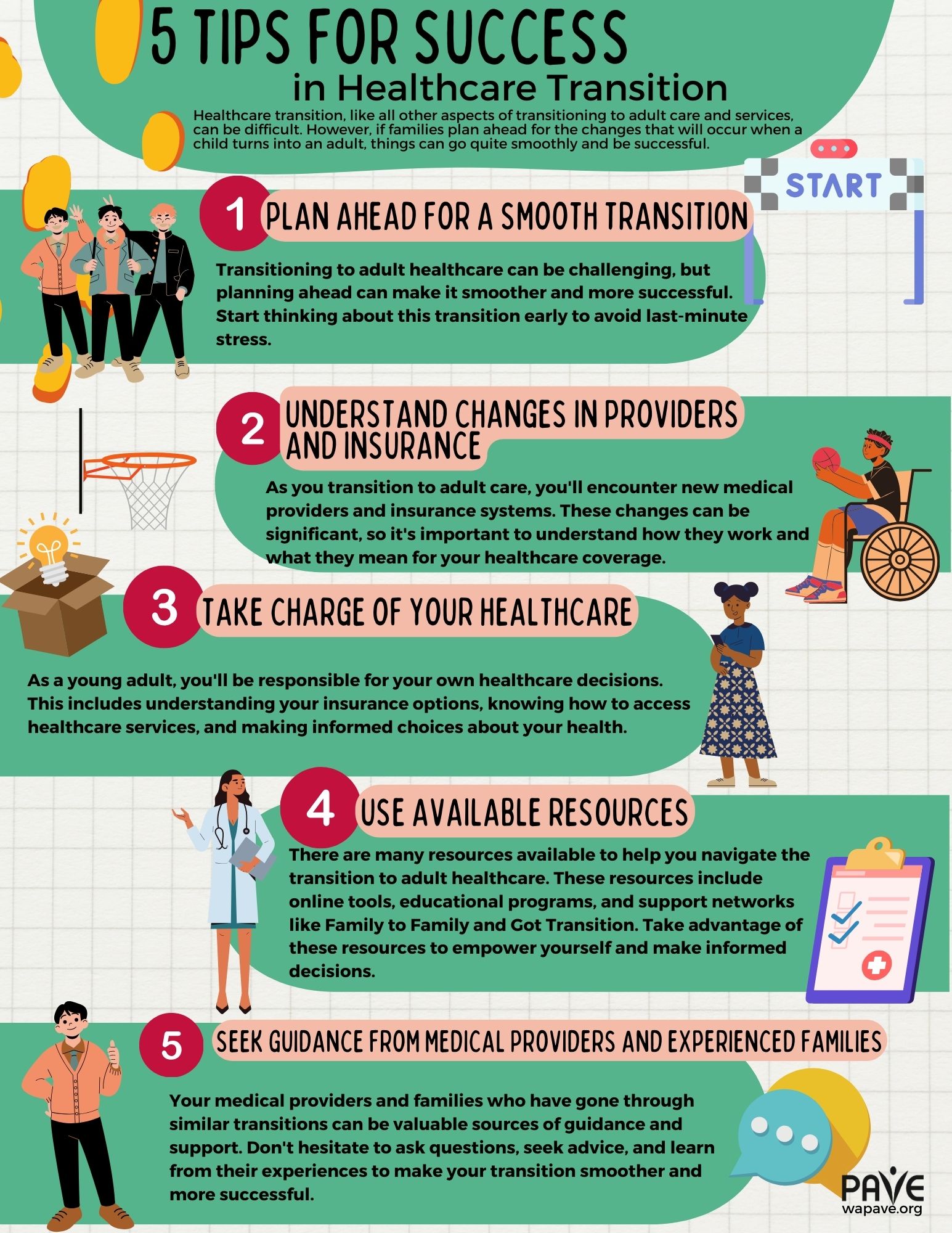
Healthcare in Transition

Healthcare transition, like all other aspects of transitioning to adult care and services, can be difficult. However, if teenagers and families plan ahead for healthcare changes that occur when a child becomes an adult, things can go smoothly and be successful. Here are some resources and information for making the health care transition to adult care successful and seamless.

There are two main components for individuals transitioning from pediatric (children’s) to adult health care.

  • New medical providers and systems, including changes in insurance.
  • The young adult’s new responsibility to be in charge of their own health care.

Health Insurance and Providers

For individuals on Medicaid, Medicare, or private health insurance, eligibility, cost, and what services are covered may change.

Washington’s Medicaid option, Apple Health, has different financial requirements for adults than they do for minors. See the chart below for current income requirements for Apple health.

ProgramSingle person2-person house-hold3-person household4-person household5-person household6-person household7-person household
Apple Health for Adults, age 19 through 64 years of age$1,677 monthly$2,268 monthly$2,859
monthly
$3,450
monthly
$4,042
monthly
$4,633
monthly
$5,224
monthly
Current income requirements for Apple Heath
  • To apply or renew for Apple Health, go to the Health Plan Finder website.  Even if an individual is not eligible for fully subsidized healthcare, the Health Plan Finder can reveal some low-priced options. 
  • For young adults on their parents’ private insurance, they will have coverage under their parent’s plan until they are 26, at which time they will need to apply for their own health insurance.  The Health Plan Finder can help you find affordable options, including Apple Health.
  • For individuals under 65 who are receiving Medicare due to a disability, insurance should not change due to the transition to adulthood.

A person’s health insurance may limit the health care providers available. Once you and your family know what type of health insurance you will have, you can select from physicians and other health professionals who accept that insurance. Most medical practices either list what insurances they accept, or you can call the office and ask. Health care insurance plans may also send information on where to find a provider, or you may find it on their website.

Taking on Responsibility for Health Care and Decisions

Healthcare is just one of many new responsibilities that young people take on as they become adults.  Parents can avoid overwhelming a teen with new obligations, beginning with giving younger teens options and increasing tasks to help them adapt to this change.  There are several resources for families and youth to use in this transition:

  • Family to Family has a youth-written curriculum about Transitioning to Adult Doctors for individuals with disabilities that can help teens start their medical transition journeys.
  • Charting the LifeCourse™ was created by families to help individuals and families of all abilities and all ages develop a vision for a good life, including their health care.
  • Got Transition is a comprehensive website about the transition to adult health care, with quizzes, FAQs, and timelines to make it easier to understand.
  • The Center for Transition to Adult Health Care for Youth with Disabilities is a national health care transition resource center. The goal of the center is to empower youth and young adults with intellectual and developmental disabilities (ID/DD) ages 12-26 to direct their own transition from pediatric to adult care with no reduction in quality of care and no gaps in service.

Beyond these resources, the most useful are young adults, whether you are the parent/caregiver or a transitioning individual. It’s important to recognize that lived experience gives knowledge even in a new situation. Parents/caregivers and young adults have knowledge of medical need that may not be in a chart, emotional or behavioral challenges, developing self-determination that supports transition, and other important things only you know. Next in line are the current medical providers and specialists. They have helped numerous other teens transition to adult healthcare, and they are a part of developing the care plan, a critical resource for transitioning to an unfamiliar doctor or clinic when a young adult may have complex care needs. Doctors’ office staff are also used to dealing with these issues and may have some good planning advice for families. Lastly, advice from families who have already helped a child transition to adult care can know what to do—and what not to do!  Parent-to-Parent can match parents up with families who have already gone through such transitions with those who seek their knowledge and experience.

5 Tips for Success in Healthcare Transition


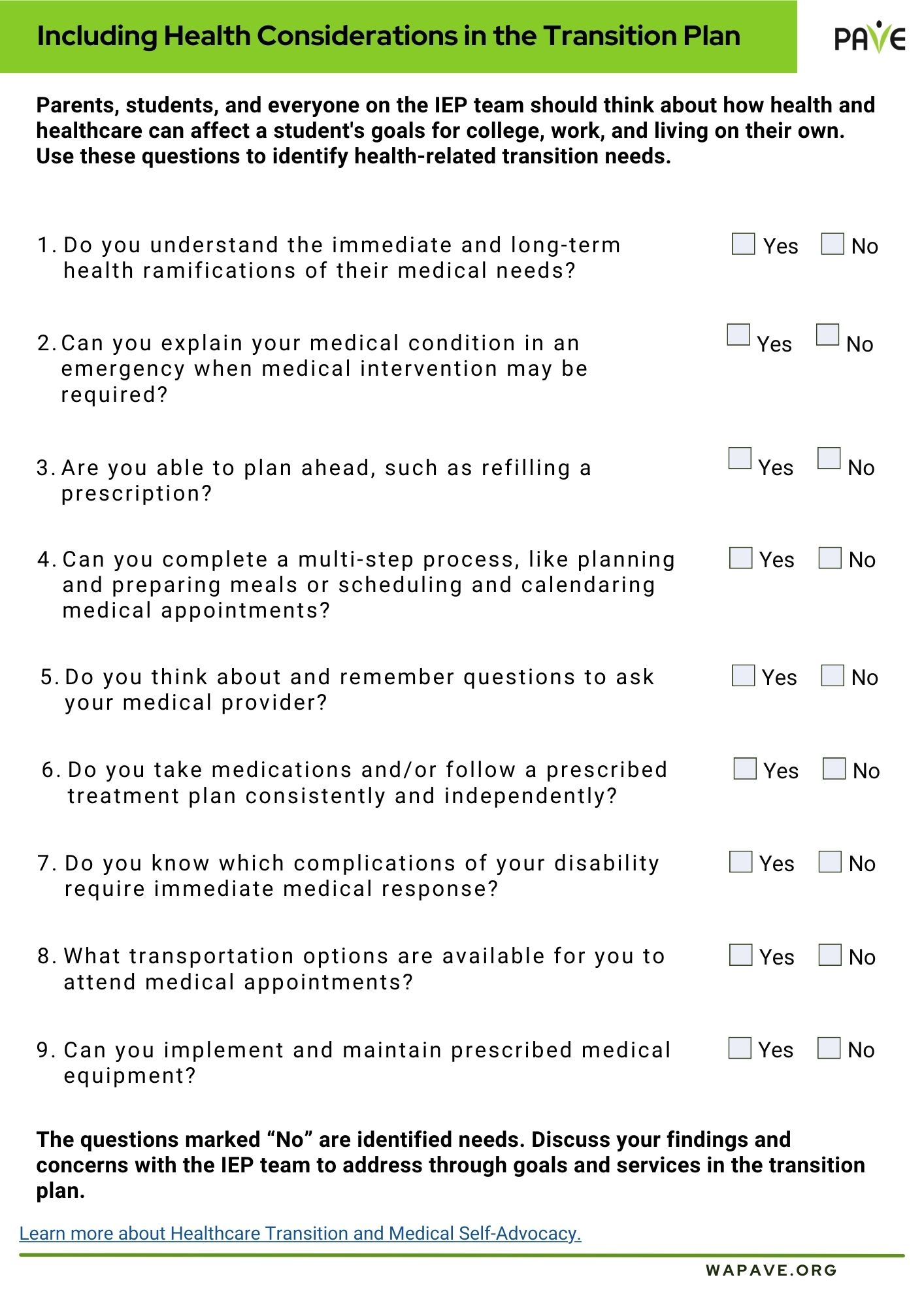
Including Health Considerations in the Transition Plan

Parents, Students, and everyone on the IEP team should think about how health and healthcare can affect a student’s goals for college, work and living on their own. PAVE has made a fillable form that you can download when starting to think about this area in transition.

Including Health Considerations in the Transition Plan

Medicaid Basics

A Brief Overview 

  • Medicaid is state-run health care for those with limited income or individuals with chronic or complex health care needs with special circumstances. 
  • Medicaid is available to many families In Washington state who are not eligible for Medicare and are below certain income levels. 
  • Apple Health for children has broader eligibility requirements, meaning that more children in Washington state can be covered for low or no cost. 
  • You can apply for Medicaid through the Washington Health Plan Finder
     

Full Article 

Medicaid is a federal health care program that each state manages based on their own states legislative system. It is set up for individuals and families with limited income or special circumstances such as a genetic, medical, or job or accident-related disability. This health care covers physical and mental health and can be low to no-cost. To be eligible for fully subsidized (free) Medicaid you must meet the household income eligibility and not be eligible for Medicare. However, Medicaid for those with Medicare can help with some expenses not covered by Medicare for those with low income. It is available for an individual on classic Medicaid whose parent or guardian has died and whose benefits pass to their child. In the state of Washington, Medicaid is generally known as Apple Health and is administered by the Health Care Authority

There are two main types of Medicaid available in the state of Washington: Apple Health (income based), and Classic Medicaid. The day-to-day administration of Apple Health and Classic Medicaid is run by one of five Managed Care Organizations, or MCOs. Apple Health covers individuals up to the age of 6 and eligibility is based on household income. Apple Health has higher income limits for children than adults, meaning that many children in Washington State are eligible for free Apple Health, even when their parents or guardians are not..  If you have Apple Health, you will get healthcare from the providers at one of those MCOs. If you are found (determined) to have a disability or a disabling medical condition and are under the age of 65, you are eligible for Classic Medicaid if you are on Social Security Income or Supplemental Security Income (SSI). This is also considered Apple Health and under one of the 5 MCOs. If an infant, child, or youth through age 21 is in the foster care system they will be covered by Apple Health and will get their healthcare from one specific MCO no matter where they live in the state. 

Determining Eligibility for Apple Health 

Apple Health has different eligibility requirements for children and adults. These differences are listed below, including the maximum monthly household income requirements that families may have to obtain coverage. 

Eligibility for Apple Health for Children: 

  • Children of public employees with access to health insurance coverage under the PEBB or SEBB programs are not eligible for Apple Health for Kids with premiums. 
  • Low-cost coverage (Apple Health with premiums) is only available to children who are uninsured when household income is too high to qualify for free Apple Health (no premiums) 
  • Income requirements for free coverage: (2024) 
 Single Person 2-Person Household 3-Person Household 4-Person Household 5-Person Household 6-Person Household 7-Person Household 
Apple Health for Kids $2613 monthly $3534 monthly $4455 monthly $5375 monthly $6296 monthly $7217 monthly $8138 monthly 
  • Income requirements for Tier I subsidized coverage ($20 monthly per child; $40 family maximum): 
 Single Person 2-Person Household 3-Person Household 4-Person Household 5-Person Household 6-Person Household 7-Person Household 
Apple Health for Kids Tier I $3220 monthly $4355 monthly $5490 monthly $6625 monthly $7761 monthly $8896 monthly $10031 monthly 
  • Income requirements for Tier II subsidized coverage ($30 monthly per child; $60 family maximum): 
 Single Person 2-Person Household 3-Person Household 4-Person Household 5-Person Household 6-Person Household 7-Person Household 
Apple Health for Kids Tier II $3852 monthly $5210 monthly $6568 monthly $7925 monthly $9283 monthly $10641 monthly $11999 monthly 

Eligibility for Apple Health for Adults: 

  • For those aged 19 through 64. 
  • For U.S. citizens or those who meet Medicaid immigration requirements. (Including Washington residents from the Republic of Palau, the Republic of the Marshall Islands, and the Federated States of Micronesia) 
  • For those who are not entitled to Medicare.  
  • Have annual household income at or below the Medicaid standard: 
 Single Person 2-Person Household 3-Person Household 4-Person Household 5-Person Household 6-Person Household 7-Person Household 
Apple Health for Adults $1677 monthly $2268 monthly $2868 monthly $3450 monthly $4042 monthly $4633 monthly $5224 monthly 

How to Apply 

There are a couple of ways to start the process of getting Medicaid or other subsidized health care plans. The Health Insurance Marketplace Calculator provides estimates of health insurance premiums and subsidies for people purchasing insurance on their own in health insurance exchanges or “Marketplaces.” The Washington Health Benefit Exchange can help families and individuals find subsidized health care in their area.  

When ready to apply for coverage from Apple Health: 

  1. Review adult and/or child income eligibility requirements. 
  1. Read the Eligibility Overview to determine if Apple Health is the best fit for you and your family. 
  1. Create an account on Washington Health Plan Finder
  1. Collect and enter information into the Washington Health Plan Finder application, WAPlanfinder Mobile App, downloadable paper form, or call the Washington Healthplanfinder Customer Support Center at 1-855-923-4633. 
  1. Review the five Integrated Health Care Plans responsible for Medicaid in Washington, not all of which may be available in your location. 
  1. If you need further help, contact a free Health Plan Navigator

To get signed up with Medicaid Classic, go online to Washington Connection and select “Apply Now,” or call 1-877-501-2233. For additional help signing up for Medicaid in Washington, help is available from Parent help 123, which can be contacted at 1-800-322-2588, or PAVE. If, in looking at the information above, you feel that you or the person you care for has lost Medicaid through a mistake or a problem with the system and going through the Washington Connection is not resolving the issue, the Federal Government is asking that you go through Healthcare.gov to get help with re-enrollment.