

For families supporting a young person with a disability, it’s never too soon to begin planning for the years after high school. Post-secondary transition planning is the process of getting ready for life after graduation.
A Brief Overview
- Transition planning helps students with disabilities prepare for life after high school by exploring goals, building skills, and learning about education, employment, and community options.
- In Washington State, all students are required to complete a High School and Beyond Plan (HSBP), usually beginning in middle school, as part of graduation requirements and transition planning.
- Students with an Individualized Education Program (IEP) must have a transition plan with individualized Transition Services by the school year in which a student turns 16.
- Students remain eligible for special education until they earn a diploma or reach age 22 and may participate in graduation ceremonies at the end of their senior year, regardless of when they will earn a diploma, under Kevin’s Law.
- At age 18, legal responsibility for education transfers to the student, and schools must explain these rights ahead of time. For students who need help making or understanding decisions, families can continue to support them through options such as being invited to the IEP team, Supported Decision Making (SDM), or, when needed, legal arrangements like Power of Attorney or guardianship.
- PAVE provides a Transition Planning Timeline in this article, available for download in multiple languages.
What is Post-Secondary Transition planning, and why is it important?
Transition planning benefits both families and students by:
- Letting them know about options and resources for an adult with disabilities
- Giving students time to think about their future and develop goals
- Allowing students to practice self-advocacy and self-determination, two skills adults need to be as independent as possible
Transition planning is so important that the Office of the Superintendent of Public Instruction (OSPI) requires all students to complete a High School and Beyond Plan (HSBP), usually beginning in seventh grade, in order to graduate. OSPI also provides a summary of transition supports and services to help students, families, and caregivers understand how transition planning aligns with the HSBP. Several Washington state agencies worked together to create a downloadable guidebook that explains how required school plans fit together: Guidelines for Aligning High School & Beyond Plans (HSBP) and IEP Transition Plans.
Transition Planning in the IEP
The right to a Free Appropriate Public Education (FAPE) includes the right to school-based services that prepare a young person with a disability for adult life. These services include planning for life after high school. For students who have an Individualized Education Plan (IEP), the transition plan is the document that will describe those planning goals and the steps a student will take to reach them. The IEP must include a Transition Plan with individualized Transition Services by the school year in which a student turns 16.
When a Transition Plan is added to the IEP, the focus shifts toward goals for life after high school. Families and students can help guide planning by considering three key questions:
- Where am I now?
Consider strengths, interests, and current skills. These are often described in the IEP’s Present Levels of Performance. - Where do I want to go?
Think about dreams and post-secondary goals for education, work, and living. - How do I get there?
Consider courses, transition services, activities, supports, accommodations, and community connections.
When a transition plan is ready to review for completeness, students and families can ask these questions:
- Is the transition plan age appropriate? (IEP transition plans can be updated as the student gets older).
- Is information used to develop the plan gathered from more than one assessment? (This may include both informal and formal assessments.)
- Do the post-secondary goals consider all areas of life after high school, including employment, further education, independent living, and community engagement?
- Are goals SMART: Specific, Measurable, Achievable, Relevant and Timely?
- Is there a target graduation date included in the IEP?
Student Self-Advocacy
As students move toward adulthood, opportunities to practice skills of self-advocacy and self-determination become increasingly important. One way to build these skills is to encourage students to participate actively in their IEP meetings. PAVE provides a student-friendly article on this topic: Attention Students: Lead your own IEP meetings and take charge of your future.
The RAISE Center (National Resources for Advocacy, Independence, Self-determination and Employment) has a blog with transition-related news, information, ideas and opinions.
Families can help a student envision the future and start to see how to get there through conversations at home. There are a variety of tools available to aid this process, including:
- Person-Centered Planning (PCP) is a method for helping a person map out a future with intention and support. PAVE provides an article and video on this topic, as well as training to become a PCP facilitator.
- Open Doors for Multicultural Families provides a Transition Resource Guide for Culturally and Linguistically Diverse Families of Youth with Disabilities, available in 10 languages.
- My Life Plan, a free online tool offered by Informing Families, supports individuals with disabilities in creating a personalized plan for their lives.
- PACER Center’s Guide to Preparing your Child with a Disability for Life Beyond High School
Informing Families offers LifeCourse: High School Transition Toolkit, available for download in English and Spanish.
Graduation Requirements
To earn a high-school diploma in Washington State, students must:
- Complete a High School and Beyond Plan (HSBP)
- Earn 24 high school credits
- Complete a Graduation Pathway Deciding on the type of graduation requirements a student wants to achieve can be made part of the IEP.
The graduation standards for a student eligible for special education are the same as for other students. In our state, a district’s flexibility in determining which students meet those requirements comes from the Washington Administrative Code (WAC 180-51-115). Each school district has its own policy, and families can request a copy.
Each school district determines the precise guidelines for students to meet the requirements of the High School and Beyond Plan, and some schools use tools with different names. A good way to participate in making sure your student has a robust plan is to become familiar with the state-recommended format and then compare this tool to your school’s requirements and the student’s specific IEP programming.
A student remains eligible for special education until graduation requirements are met, and the student has earned a high school diploma (WAC 392-172A-02000), or until age 22. The student’s IEP team determines the student’s graduation plan, including the planned graduation date.
Students with disabilities seeking a diploma through General Educational Development (GED) testing may be eligible for testing accommodations. A website called Essential Education lists disability conditions that may qualify a person for testing supports.
In the meantime, a student can participate in commencement ceremonies at the end of a traditional senior year, with peers, under a Washington provision called Kevin’s Law. Families may want to plan well in advance with school staff to consider how senior year events are accessible to youth with disabilities. Plan early for needed accommodations at senior year events.
Agencies that Can Help with Transition Planning
Washington State’s Division of Vocational Rehabilitation (DVR) provides services for high-school students engaged in transition planning as well as adults seeking employment. Each school is assigned a DVR counselor to assist with pre-employment training. Department of Health and Human Services (DHHS) provides a list of school DVR counselors, including their names and phone numbers. Youth and families may also receive pre-employment counseling through an Apple Health (Medicaid) program called Foundational Community Supports.
DVR’s website includes a section with information about Tribal Vocational Rehabilitation (TVR), which is available for people with tribal affiliations in some areas of the state. Each TVR program operates independently. Note that some TVR programs list service areas by county, but that sovereign lands are not bound by county lines. Contact each agency for complete information about program access, service area, and eligibility.
Center for Deaf and Hard of Hearing Youth (CDHY) provides services for individuals who are deaf or hard of hearing. This statewide resource supports all deaf and hard of hearing students in Washington, regardless of where they live or attend school.
Washington’s Department of Services for the Blind (DSB) provides services for individuals who are blind or living with low vision. Youth services, Pre-Employment Transition Services (Pre-ETS), Vocational Rehabilitation, Business Enterprise Program, mobility, and other independent-living skills are served by DSB.
Developmental Disabilities Community Services (DDCS, formerly the Department of Developmental Disabilities or DDA) also has a variety of school-to-work and waiver programs that support youth. PAVE offers a video to support families through the DDCS eligibility process. An article gives further detail: How to Prepare for a DDA Assessment.
Not all youth with disabilities are able to access employment-related services through DVR, TVR, DSB, or DDCS. A limited additional option is Goodwill’s Digital Work Opportunity Center. Students can take classes at their own pace for skills development. Employment skills, workplace readiness, interviewing skills, and more, are part of the training materials.
Transition Planning Timeline
Check these milestones to ensure high school paves a pathway for young adult success and achievement:
Ages 13-14: Student begins a High School and Beyond Plan (HSBP) in middle school.
Ages 15-16: IEP includes a transition plan aligned with the HSBP. The student is a member of the IEP team, which plans a pathway toward a diploma and target graduation date.
Age 16: Get a state identification card. Consider Pre-Employment Transition Services from DVR/TVR/DSB or School-to-Work planning with DDCS.
Ages 17-18: Coursework, IEP, HSBP, DDA/DVR/TVR all support student’s life goals and progress toward a diploma.
Age 18: Register to vote! Participate in commencement and senior year activities, regardless of when the diploma is earned.
Ages 18-19: Student may continue education in a high school transition program.
Ages 20-21: Student earns a diploma. They may apply for individualized employment support from DVR/TVR/DSB or DDA.
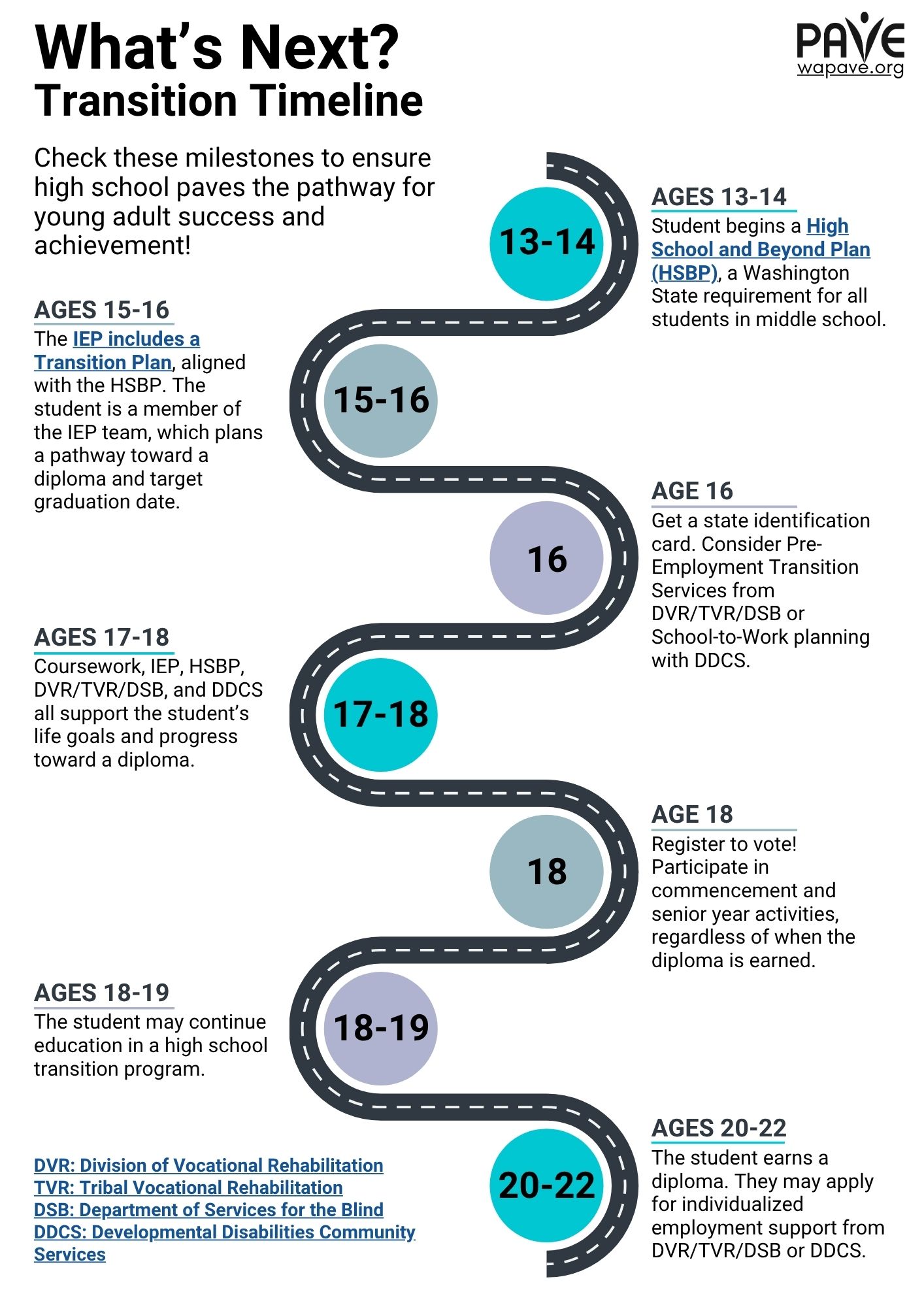
Download the Transition Planning Timeline
English
When a Student Turns 18
A student takes charge of educational planning and programming at the Age of Majority, which is 18 in Washington. According to the Washington Administrative Code (WAC 392-172A-03090), “Beginning not later than one year before the student reaches the age of 18, the IEP must include a statement that the student has been informed of the student’s rights under the act, if any, that will transfer to the student on reaching the age of majority.”
When a person 18 or older has a disability, family members may want to stay involved in helping them make decisions. They have a few options if they wish to continue to have rights to participate in their child’s education:
- The student can choose to include “other individuals who have knowledge or special expertise regarding the student” on the IEP team (WAC 392-172A-03095).
- Supported Decision Making (SDM) is a voluntary option that allows adults with disabilities to choose trusted supporters while retaining their legal rights. Washington law (Revised Code of Washington, RCW 11.130) includes SDM as an option under the Uniform Guardianship, Conservatorship, and Other Protective Arrangements Act.
- More formal options, which may involve legal actions on the part of the family include Adult Guardianship and Conservatorship, Informed Consent (medical), Power of Attorney, and several options for handling finances.
Families should clearly understand what roles and powers parents will retain under any arrangement with the school. Without guardianship or Power of Attorney, the student will need to sign consent for parents to attend meetings, participate in decision-making, and access records.
For youth who struggle with behavioral health, transitions can trigger some additional challenges. These resources may provide some helpful tips:
Student Rights after High School
An IEP ends when a student leaves secondary education. However, the protections of the Americans with Disabilities Act (ADA) and of Section 504 of the Rehabilitation Act of 1973 are ongoing throughout the lifespan.
These laws provide for appropriate accommodations in public programs and facilities. The IEP accommodations page or Section 504 Plan may be shared with colleges, training programs, or employers to help ensure these protections continue. The disability services office at institutions for higher learning includes a staff member responsible for ensuring that disability rights are upheld. PAVE’s College Readiness Workbook includes articles, tools, and worksheets to help students prepare for college, understand disability supports, and request accommodations.
Graduation’s over: Why is school calling?
Schools are responsible for tracking the outcomes of their special education services. They need to ask about a graduate’s life after High School to do so. Here’s an article to help families get ready to talk about how things are going: The School Might Call to Ask About a Young Adult’s Experience After High School: Here’s Help to Prepare
Benefits Planning and Adult Services
A consideration for many families of a youth with disabilities is whether lifelong benefits are needed. Applying for Supplemental Security Income (SSI) just past the young person’s 18th birthday creates a pathway toward a cash benefit and enables the young person to access Medicaid (public health insurance) and various programs that depend on Medicaid eligibility.
The Washington Initiative for Supported Employment (WISE) provides benefit planning information and resources.
Explore Related Tools and Resources
PAVE offers a training video to help you understand the transition process, Life After High School: Tools for Transition, also available in Spanish (La Vida Después de la Preparatoria – Herramientas para la Transición).
PAVE provides a printable Planning My Path Toolkit for youth and young adults that includes:
- Transition Triangle: Accessing Vocational Rehabilitation Services – A visual overview of the systems responsible for coordinating employment-related training, services, and support.
- Glossary of Key Terms for Life After High School Planning: A list of commonly used words, phrases, and acronyms when talking about transition planning.
Students experiencing disabilities can get personalized support from PAVE by filling out a Support Request or call 1-800-572-7368.