
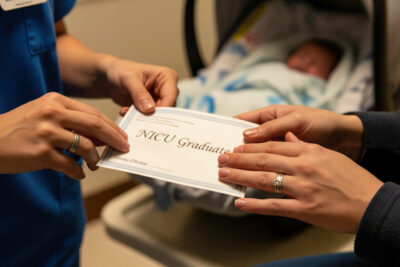
Graduating from NICU: The Joy and Anxiety Finding Your Way to Baby’s Norm

Coming home from the hospital with your baby can be both a joyous and potentially uncertain event, especially for families whose child is graduating from the Neonatal Intensive Care Unit or NICU. As parents, you have had a much different journey home than is typical for most families. Often, a baby is in the NICU because they are born early and need support with getting their bodies up and running because they “joined the world” a little or a lot early. Sometimes a baby is in the NICU because they were born needing medical support before they can go home. It can be because of genetic conditions, trauma during birth, other conditions needing medical support, interventions, and time in the hospital. This article will discuss “graduation” to home, how to shift expectations for caring for your baby, and where to go when it’s overwhelming.

Highlights:

  • Building a transition plan before you leave that includes what’s next at home
  • Talking with your transition team on building a Medical Home for your baby
  • How do I get feeding support if I need it?
  • Where do I go if I just need someone to talk to?
  • What is Birth to Three and is it helpful?

Heading Home

Before your baby leaves the NICU, the doctors and nurses will teach you how to take care of your baby at home. You’ll learn about feeding, sleeping, using medical equipment, and what is expected and when you should bring your baby in to be seen. There is a lot happening while your baby is in the NICU, but if you can get connected with a Developmental Pediatrician or a Pediatrician’s clinic before you leave, you have already set you and your baby up for support outside of the hospital when you have questions. That Pediatrician and their team can also be a hub for connecting you and your baby to the specialists that are needed outside of the hospital.  In the transition meetings before your baby comes home, the first appointments for specialists and follow-ups will be set up by the transition team but the Pediatrician can help keep it going if you pull them into the conversation right away. Ask the transition team to help set up an appointment with the Pediatrician when you and baby get home to help get it started.

Specialists and Therapies

Depending on the health impacts that your child has been diagnosed with, you may be juggling several different kinds of appointments for the first year after bringing your child home from NICU. Some of the specialists could be Pulmonology for breathing, because many premature babies need extra time for their lungs to catch up, Cardiology for any heart issues, and a Neurologist for any developmental delays, and to help families keep track of where their child is if there is no diagnosis of a developmental disability or a genetic disorder.

Often, there are feeding challenges, and a baby may need a feeding tube. There are specialists who can help with tracking everything that needs to happen for the care of feeding tubes, and with where and how to get formulas. The UW/Seattle Children’s Feeding Program has nutritionists to support families and resources that families and pediatricians can access.

Occupational and Physical Therapists also support a child’s developmental needs and can be part of the team that adds components to strengthen mind and body development over the year post-NICU. Depending on where you live and what NICU your baby was in, those pediatric specialists could be at Mary Bridge, Seattle Children’s, Children’s Village in Yakima, Sacred Heart in Spokane, or Madigan if you are a Military family. If your baby has a rare condition or disorder, you may need to travel to Seattle Children’s or Mary Bridge, no matter where you live in the state, because of the limited availability of specialists for some diagnoses. Establishing a Medical Home by setting up connections for your baby with a Pediatric clinic can help with referrals, keeping track of who the specialists are, and having someone to call if you have a question, rather than going to the emergency room for every medical concern.

Another help for families that can also lessen the volume of therapy appointments that may come with NICU graduation is having your baby in the Birth to Three services. Some NICUs can and do enroll a family before they leave as part of transition supports, but not all families are ready, and just getting home is the priority. If you get home and decide you are ready to enroll your baby, you can get started by visiting Early Support for Infants and Toddlers (ESIT) online or by calling 360-725-3500. Your baby, having been in the NICU, meets the qualifications for early intervention services. Many of the Occupational, physical, and feeding/nutrition therapies you would need to coordinate on your own are part of the ESIT program, and they come to your door. For many families, this takes a huge burden of some of the care coordination off their plates and gives them some respite. Parents also get skill-building to increase their confidence and knowledge in caring for their child’s unique needs from experts who take more than 15 minutes during a doctor’s visit.

Community Supports

Juggling all of this can be very overwhelming, even if this isn’t your first baby. This is all new, the expectations are different, it’s more complicated and time-consuming. There are some peer supports to call, text, or email if you need someone to help with navigating this new parent landscape. Two Statewide supports you can connect with, no matter where you live, are PAVE and a Family-to-Family support navigator. They are the parents of a child with special healthcare needs who have experience with navigating complex needs. They have supported many families in learning and understanding the next steps. Another is the Statewide Parent to Parent program. There is a Parent-to-Parent program in almost every county in our state, specializing in supporting families new to a diagnosis. While their main focus is developmental disability, Parent to Parent coordinators can and do connect families to resources, regardless of the need. If your child has impacted hearing, a family support organization in Washington State is Hands and Voices. They provide peer support, training, and a family toolkit for families once they receive a diagnosis. They also work with ESIT and later with the schools if a family requests.

Keeping Records

One final difference that becomes an enormous help down the line is starting a Care or Medical Notebook. It is like a traditional baby book in some ways, but it pulls together all the important medical and care documents and instructions related to your baby’s care. There are several templates available, including some online. If you go to a clinic that shares the same electronic chart system as the hospital and specialist that your baby sees, it is easy for them to access notes, medication recommendations, and surgery charts. If they are in different systems, then the burden of bridging that information goes to you. Even though a release of information is signed, it doesn’t necessarily mean that notes or information are faxed or emailed. It helps to request the notes from a visit and put them in your baby’s care notebook, so you have accurate information to share if things get delayed or lost in the system. There will be a couple of templates shared in the helpful resources below, as well as a couple of NICU information packets that have good general information. A simple information-sharing “roadmap” will be attached to the article and can also be taken to each Doctor so that information can be shared and you can stay on track. Here are a couple of Care Notebook articles to give you some ideas:

Early Intervention: How to Access Services for Children Birth to 3 in Washington

New parents often worry about their child’s growth and development, especially when comparing with other children. Early intervention can be crucial for children with developmental delays or disabilities. In Washington, families can connect with a Family Resource Coordinator (FRC) for guidance and access free developmental screenings. The Department of Children, Youth and Families (DCYF) offers services through Early Support for Infants and Toddlers (ESIT), providing evaluations and individualized plans (IFSP) to support eligible children from birth to age three. These services, protected under the Individuals with Disabilities Education Act (IDEA), are typically free and aim to help children thrive in various settings. 

A Brief Overview

  • PAVE provides downloadable toolkits specifically designed for parents and families of young children, including From Birth to Three Toolkit and Transition Toolkit for Ages 3-5
  • Families concerned about a child’s development can call the Family Health Hotline at 1-800-322-2588, with support in multiple languages. Parents can complete a free developmental screening online at Parent Help 123. 
  • Washington’s Department of Children, Youth and Families (DCYF) administers family-focused services for eligible children from birth to age 3 through Early Support for Infants and Toddlers (ESIT). 
  • The Individualized Family Service Plan (IFSP), funded by Part C of the Individuals with Disabilities Education Act, is a whole family plan developed with input from caregivers and professionals. It includes goals, services, and progress monitoring, and is reviewed regularly. 
  • To qualify, a parent must provide written permission for ESIT to conduct an early intervention evaluation of their child. If the evaluation results indicate that the child has a developmental delay or disability, ESIT will develop an IFSP. PAVE provides a Next Steps Checklist: When Your Child is Found Eligible for Early Intervention Services (EIS)
  • Early intervention services (EIS) are designed to meet the child’s individual needs, including various therapies and support services. Services are typically provided in the child’s home or other natural environments. 
  • Various dispute resolution options are available, including mediation and due process. Parents can contact their ESIT Family Resource Coordinator (FRC) if they have concerns or disagreements. 
  • Most early intervention services are provided at no cost to families. Some services may be billed to insurance with family consent, but certain services are always free under IDEA. 
  • Active-duty servicemembers whose dependents receive EIS must enroll in the Exceptional Family Member Program (EFMP) for their branch, or the Coast Guard’s Special Needs Program (SNP).  

Introduction 

New parents may struggle to know whether their child’s growth and development are on track. They may have a feeling that a milestone is missed, or they may observe siblings or other children learning and developing differently. Sometimes a parent just needs reassurance. Other times, a child has a developmental delay or a disability. In those cases, early interventions can be critical to a child’s lifelong learning. 

Seek guidance from a Family Resource Coordinator (FRC) 

Washington families concerned about a young child’s development can call the Family Health Hotline at 1-800-322-2588 (TTY 1.800.833.6384) to connect with a Family Resource Coordinator (FRC). Support is provided in English, Spanish and other languages. Families can access developmental screening online for free at HelpMeGrow Washington

Several state agencies collaborated to publish Early Learning and Development Guidelines. The booklet includes information about what children can do and learn at different stages of development, focused on birth through third grade. Families can purchase a hard copy of the guidelines from the State Department of Enterprise Services. A free downloadable version is available in English, Spanish, and Somali from DCYF’s Publication Library. Search by title: Washington State Early Learning and Development Guidelines, or publication number: EL_0015. 

Washington early intervention services are provided by ESIT 

In Washington, the Department of Children, Youth and Families (DCYF) administers services for eligible children from birth to age 3 through Early Support for Infants and Toddlers (ESIT). Families can contact ESIT directly, or they can reach out to their local school district to request an evaluation to determine eligibility and consider what support a child might need. The ESIT website includes videos to guide family caregivers and a collection of Parent Rights and Leadership resources, with multiple language options. 

Early intervention services (EIS) are provided in the child’s “natural environment,” which includes home and community settings where children would be participating if they did not have a disability. According to ESIT, “Early intervention services are designed to enable children birth to 3 with developmental delays or disabilities to be active and successful during the early childhood years and in the future in a variety of settings—in their homes, in childcare, in preschool or school programs, and in their communities.” 

Early services are delivered through an IFSP 

Children who qualify receive services through an Individualized Family Service Plan (IFSP). The right to an IFSP is protected by Part C of the Individuals with Disabilities Education Act (IDEA). The IDEA is a federal grant program that provides funding for states to implement early learning and special education programs. Part B of the IDEA protects an eligible school-age student’s right to an Individualized Education Program (IEP). Part A includes general guidance about the educational rights of children 0-22. 

Family caregivers, childcare professionals, teachers, or anyone else can refer a child for an early learning evaluation if there is reason to suspect that a disability or developmental delay may be impacting the child’s growth and progress. The school district’s duty to seek out, evaluate and potentially serve infants, toddlers or school-aged students with known or suspected disabilities is guaranteed through the IDEA’s Child Find Mandate

First Step: Evaluate to determine eligibility 

Early intervention is intended for infants and toddlers who have a developmental delay or disability. Eligibility is determined by evaluating the child (with parental consent) to see if the little one does, in fact, have a delay in development or a disability. Eligible children can receive early intervention services from birth to the third birthday. PAVE provides an article that describes What Happens During an Early Intervention Evaluation, and a checklist for When Your Child is Found Eligible for Early Intervention Services (EIS)

Next Step: Develop a service plan 

If an infant or toddler is eligible, early intervention services are designed to meet the child’s individual needs. Options might include, but are not limited to:   

  • Assistive technology (devices a child might need) 
  • Audiology or hearing services 
  • Speech and language services 
  • Counseling and training for a family 
  • Medical services 
  • Nursing services 
  • Nutrition services 
  • Occupational therapy 
  • Physical therapy 
  • Psychological services 

Services are typically provided in the child’s home or other natural environment, such as daycare. They also can be offered in a medical hospital, a clinic, a school, or another community space.  

Individualized Family Service Plan (IFSP): What is the plan? 

The IFSP is a whole family plan, with the child’s primary caregivers as major contributors to its development and implementation. Parents/custodial caregivers must provide written consent for services to begin. In Washington, Family Resource Coordinators (FRCs) help write the IFSP. Team members may include medical professionals, therapists, child development specialists, social workers, and others with knowledge of the child and recommendations to contribute.  

The IFSP includes goals, and progress is monitored to determine whether the plan is supporting appropriate outcomes. The plan is reviewed every six months and is updated at least once a year but can be reviewed at any time by request of parents or other team members. The IFSP includes: 

  • The child’s current developmental levels and needs in physical, cognitive, communication, social/emotional, and adaptive areas 
  • Family information: resources, priorities, and concerns of parents/caregivers. 
  • Major results/outcomes expected from the child and family 
  • Specific services: 
  • Where services are provided—any services provided outside the child’s “natural environment” of home/daycare/community require a statement explaining the rationale for the placement 
  • When the child receives services—the number of days or sessions for each service, and how long each session will last 
  • Who pays for the services 
  • Name and contact information for the Family Resource coordinator (FRC) responsible for IFSP implementation 
  • Steps to begin at age 2.5 to support the child’s transition out of early intervention and perhaps into school-based services. 
  • If relevant, additional services or information for the family—such as financial guidance or parenting support 

PAVE provides a downloadable checklist to help parents familiarize themselves with the IFSP.  

Dispute resolution options are available 

If parents have a concern or disagree with any part of the early intervention process, they can contact their Family Resource Coordinator (FRC). If issues remain unresolved, families may choose from a range of dispute resolution options that include mediation, due process, and more. ESIT provides access to a downloadable parent rights brochure with information about dispute resolution options in multiple languages. 

Most services are free to families 

Washington State provides most early intervention services at no cost to families of eligible children. Some services covered by insurance are billed to a child’s health insurance provider, with the signed consent of a family caregiver. The early intervention system may not use health care insurance (private or public) without express, written consent. 

Part C of the IDEA requires states to provide the following services at no cost to families: Child Find (outreach and evaluation), assessments, IFSP development and review, and service coordination. 

Early intervention services for military families 

Military-connected infants and toddlers receiving early intervention services must be enrolled in the Exceptional Family Member Program (EFMP) while their servicemember is on active-duty orders. The Exceptional Family Member Program (EFMP) is a mandatory program for all branches of the U.S. Armed Forces that helps military dependents with special medical or educational needs. The Army, Navy, Air Force, Marine Corps, and Space Force each have an EFMP and the Coast Guard, which operates under the authority of the Department of Homeland Security, has a similar program called the Special Needs Program (SNP). 

The Early Childhood Technical Assistance Center (ECTA), funded by the U.S. Department of Education’s Office of Special Education (OSEP), builds state and local capacity to improve outcomes for young children with disabilities and their families. Military-connected families and others relocating or living outside of Washington State can contact the early intervention services program in their new state with the help of ECTA’s Early Childhood Contacts by State directory

Military families moving from or to installations that have Department of Defense Education Activity (DoDEA) schools will receive their early intervention services from Educational and Developmental Intervention Services (EDIS). Referrals may come to EDIS from any military medical provider or the parents. Upon receipt of a referral to EDIS, an initial service coordinator is assigned to contact and assist the Family. The initial service coordinator gathers information to understand the family’s concern, shares information about early intervention, and makes arrangements to proceed with the process. In EDIS, any member of the early intervention team can serve as an initial service coordinator. EDIS is provided in locations where DoDEA is responsible for educational services, including some installations on the eastern side of the United States.  

Learn More 

PAVE provides downloadable toolkits specifically designed for parents and families of young children: 

  • From Birth to Three Toolkit: This toolkit provides places to begin if caregivers suspect that a baby or young child may need services due to a developmental delay or disability. 
  • Transition Toolkit for Ages 3-5: This toolkit encompasses a collection of our informative articles, complemented by sample letters to provide you with a solid foundation as you navigate through this crucial transition period. 

For additional information: 

  • The Learn the Signs. Act Early. website provides tools for tracking milestones and materials for families to learn more and plan home-based activities that promote skill development. “Early intervention services can change a child’s developmental path and improve outcomes for children, families, and communities,” the CDC encourages. “Help your child, help your family! Families benefit from early intervention by being able to better meet their children’s needs from an early age and throughout their lives.” 
  • Check the PAVE calendar for trainings and events, including the Starting Strong webinar about how IDEA supports the rights of infants and toddlers with developmental delays or disabilities and their families. 

Infant Early Childhood Mental Health

A Brief Overview

  • Infant and Early Childhood Mental Health (IECMH) is a term that describes how young children develop socially and emotionally. They learn about their emotions form close and secure relationships with their caregivers and family members. They learn and explore the environment – all in the context of family, community, and culture.
  • Families concerned about a child’s development can call the Family Health Hotline at 1-800-322-2588, with support in multiple languages. Parents can complete a developmental screening online for free at Parent Help 123.
  • PAVE provides an article for next steps after age 3: What’s Next when Early Childhood Services End at Age 3? Another PAVE article for families new to special education: Steps to Read, Understand, and Develop an Initial IEP.
  • PAVE’s Parent Training and Information (PTI) staff help families understand and navigate service systems for children 0-26. Click Get Help on the PAVE website or call 800-572-7368.
  • Early Support for Infants and Toddlers (ESIT) helps young children with disabilities or delays to learn and supports their unique development.

Full Article

New parents may struggle to know whether their child’s emotional development is on track. They may have a feeling that a milestone is missed, or they may observe siblings or the emotional well-being of other children and notice their child is developing differently. Sometimes a parent just needs reassurance. Other times, a child may have a developmental delay or a disability. In those cases, early support, including Infant Early Childhood Mental Health (IECMH) can be critical to a child’s lifelong learning and development.

IECMH is a term that describes how very young children develop socially and emotionally. They form relationships with other people. They learn about their emotions and how to control them. This happens in the settings of their family, community, and culture. (Zero to Three, Basics of Early Childhood Mental Health, 2017).

According to Best Starts for Kids, relationships are at the heart of human development and thriving for infants, toddlers, and young children. Relationships with parents and caregivers give very young children the social and emotional foundations they need to learn and thrive.

The Washington Health Care Authority reports around 1 in 6 young children has a diagnosed mental, behavioral, or developmental condition (Cree et al., 2018). These conditions may be treated with infant early childhood mental health (IECMH) services.

Services work to improve the quality of the child’s relationship with parents or caregivers. They can:

  • Help the distress of the mental health concern.
  • Support the return to healthy development and behavior.

When families receive Early Support for Infants and Toddlers (ESIT) services for a child, the child is tested as part of an Individualized Family Service Plan (IFSP).

The evaluation looks at the child’s ability to:

  • Identify and understand their own feelings;
  • Accurately notice and understand other people’s emotional states.
  • Manage strong emotions in a positive way.
  • Control their behavior.
  • Develop empathy (understand how people feel based on the child’s own experience)
  • Make and support relationships.

The evaluation may show the child is not developing well in some of these areas.  IECMH services may help.

Some examples of Infant and Early Childhood Mental Health services include:

  • Early Childhood Mental Health Consultation
  • Parent training
  • Childcare provider training
  • Group training
  • Parent Behavioral Therapy
  • Cognitive Behavioral Therapy
  • Infant/Child – Parent Psychotherapy
  • Play therapy

If you are concerned about a child’s development:

  • To learn about typical development, read the birth-to-6 pre-screening chart in English or Spanish
  • Please Ask is a three-minute video that shows the importance of referring infants and toddlers for early intervention. ESIT is a part if the Department of Children, Youth and Families
  • Families can call the ESIT local lead agency: Local Lead Agencies by County
  • Family Health Hotline: 1-800-322-2588. This statewide, toll-free number offers help in English, Spanish, and other languages.
  • Early Learning Transition: When Birth-3 Services End

More Resources:

Disability Rights for Littles: Key Information for Families of Babies, Preschoolers, and Primary-School Children

This two-part video series provides information about the rights of babies, toddlers, and young children with developmental delays or disabilities.

Part 1 provides information about early support services for babies through age 3. An interactive exercise is included to help families better understand how to participate in development of functional outcomes as part of the Individualized Family Service Plan (IFSP). The video includes information about how early support services are provided and delivered in Washington State and where to begin. Keep in mind that early services are provided in the natural environment—places where babies and toddlers would spend their days if there was no disability.

Part 2 includes information about the transition from early services into preschool and primary school. Families will learn how decisions are made about eligibility for an Individualized Education Program (IEP) and how to participate in educational decision-making for their child. Inclusion in general education is covered, with information about federal requirements for services in the Least Restrictive Environment, to the maximum extent appropriate. The video explains the components of an IEP and provides advocacy tips to support parents and children throughout their educational years.

Families can reach out for individualized assistance from our Parent Training and Information (PTI) staff at PAVE. Click Get Help or call 800-572-7368.

After you view the video, please take a quick moment to complete our survey. Your feedback is valuable!