
Life After High School: Tools for Transition

Planning for life after high school doesn’t happen all at once—it takes thoughtful coordination and clear next steps. With the right tools and support, students can explore their strengths, set meaningful goals, and build a path toward adulthood with confidence. Connecting planning efforts across school, family, and community helps create a smoother, more supported transition.

A Brief Overview

  • Transition planning brings together school, family, and community supports to prepare students for adult life.
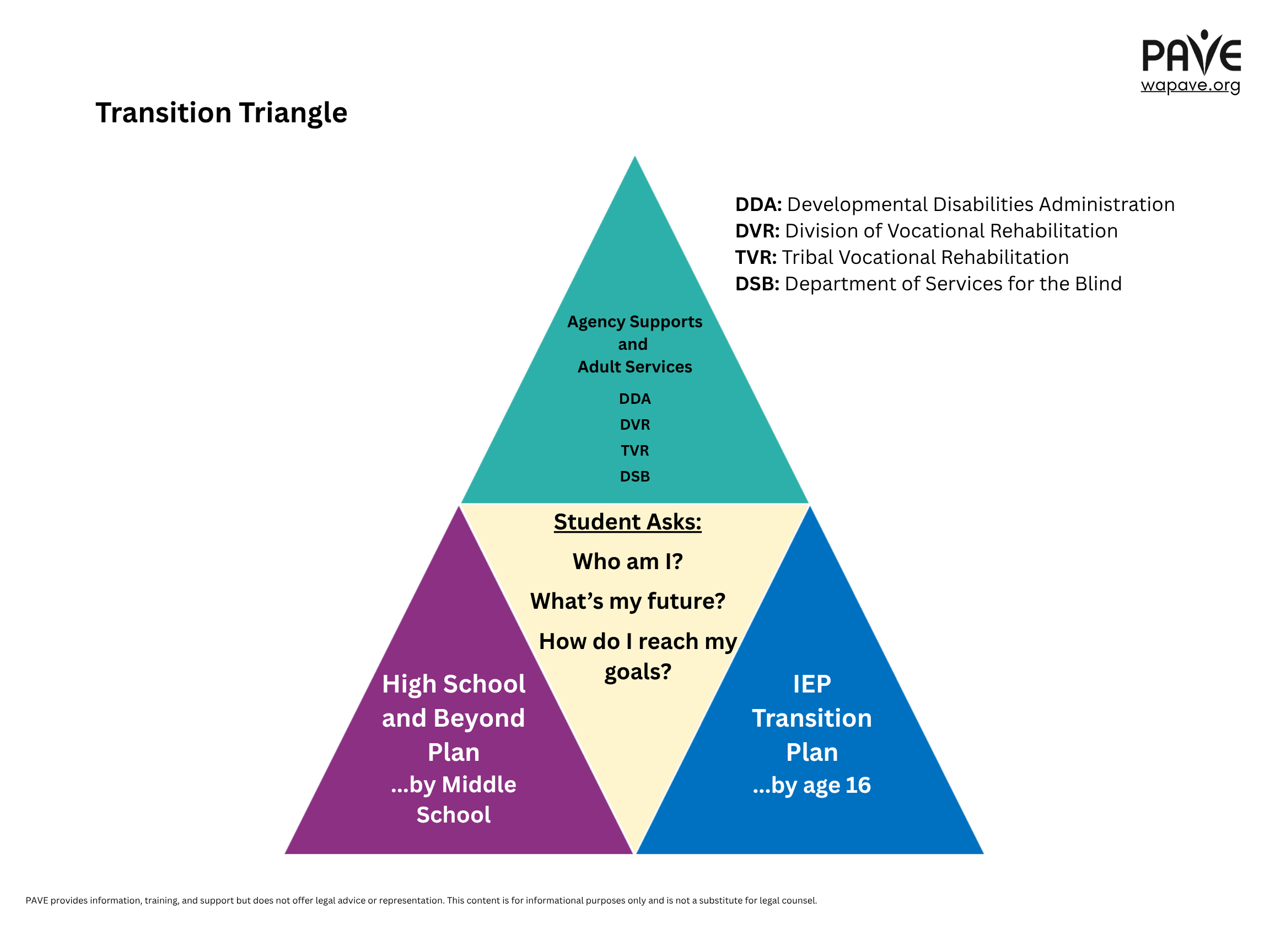
  • The “Transition Triangle” highlights tools to guide students in developing and meeting goals for their life after high school.
  • The High School and Beyond Plan (HSBP) helps students explore interests, strengths, and future goals while creating a roadmap for after graduation.
  • Students use guiding questions to better understand who they are, what they want for their future, and how to begin working toward those goals.
  • The IEP Transition Plan provides individualized goals and services focused on education, employment, and independent living for students with disabilities.
  • Agency supports and adult services help students prepare for adult responsibilities and opportunities.

Introducing the Transition Triangle

Helping a student with disabilities prepare for life after high school requires thoughtful organization and planning. This graphic provides a visual overview of the work and who is responsible to help.

The transition triangle talks about the relationship between the High School and Beyond Plan , the IEP transition plan and Agency supports from DDA, DVR and DSB. within that triangle of support is the student asking themselves: Who they are, what is their future and their goals.

The three colored triangles on the corners of the graphic represent three tools that help students ask and answer these questions. This article explains these tools, starting with a video presentation.

Tools for Transition Video

This presentation describes three ways to support this important time of life:

  1. High School and Beyond Plan: Helps students identify their interests, strengths, goals, and future plans.
  2. IEP Transition Plan: Helps students with disabilities prepare for adult life through individualized transition services and goals.
  3. Agency Supports and Adult Services: Connects students and families to community agencies and adult-service systems before leaving school. (The infographic section previously labeled “Agency Help” in the video presentation has been updated to “Agency Supports and Adult Services.”)

Transcript for Life After High School Tools for Transition:

Helping a student with disabilities prepare for Life After High School requires thoughtful organization and planning. This presentation describes three ways to support this important time of life. This triangle shows the three tools we’re going to talk about.

Helping a student with disabilities prepare for life after high school requires thoughtful organization and planning. This presentation describes three ways to support this important time of life. This triangle shows the three tools we’re going to talk about. Notice that the center of the triangle includes three questions for a young person to consider: who am I, what’s my future, and how do I reach my goals? The three colored triangles show different ways that adults can help a student ask and answer those questions. We’re going to talk about all three tools in this training. Let’s start with the purple triangle on the bottom left corner. This tool is called high school and beyond plan. Schools in Washington state are required to help students start high school and beyond plan before they leave middle school. The school’s counseling staff is usually responsible to support each student in building a high school and beyond plan. Think of the high school and beyond plan as a personalized pathway through school. This tool is provided for all students, not just students with disabilities. By the end of 8th grade, a student has completed a career interest and skills inventory to consider education and career goals. That’s part of the plan. The student might be considering going to a university or a technical college. They might want to do an apprenticeship program or get an industry standard certificate to do a specific job. Maybe they’re thinking about military training, on the job training, or something else. All are considered as part of high school and beyond planning. Thinking about the future helps with decisions about what to focus on now. Of course, most students change their plans many times.

That’s why the high school and beyond plan is reviewed at least once a year. Keep in mind that the students vision for their future is the focus of the plan. These are the three questions every high school and beyond plan is required to address: who am I, what can I become, how do I become that? You might notice these questions match the questions in the center of our transition triangle. This is where the whole process begins, with these questions. It’s never too early to start talking to a student about these questions. Discussing these questions with many different people in many different settings is part of high school and beyond planning. This is not a single interview. It’s a long-term discussion that happens while a student is moving through school and toward graduation. If the high school and beyond plan is a new concept for you, take a moment to pause and consider who at your school might provide more information about this process.

Perhaps take a moment to write yourself a reminder note to get more information. Could you contact your students counselor, the IEP case manager, a school administrator, or maybe a favorite teacher? Could you ask your student? The state instructs schools to include family caregivers in this process. Remember that a completed high school and beyond plan is required for a student to graduate from a high school in Washington state. Let’s look at the blue triangle on the lower right side of our transition triangle so we can talk about the IEP transition plan. The individualized education program, IEP, is required to include a transition plan by the school year when a student turns 16. This plan is an IEP team project.

Keep in mind that the student and parents are important members of the IEP team. Here’s some information to better understand this required part of a student’s school services program. The federal law that governs special education is the Ida, which stands for individuals with disabilities education act. Laws about IEP process are mostly from idea part B. Part A is also important when we’re talking about adult life planning. Part A of the idea describes the laws purpose. The statement on this slide is from idea part A. It says that special education is provided to ensure that all children with disabilities have available to them a free and appropriate public education designed to meet their individual needs and prepare them for further education, employment, and independent living. In simpler words, supporting students with disabilities to make a smooth transition into adult life is part of a school’s basic responsibility.

Here’s some information about the IEP transition plan. Most importantly, the plan is built from the students needs, preferences, interests, and strengths. Once the plan is written into the IEP, it drives the program. The annual goals all connect in some way to the students adult life plan. The IEP transition plan includes adult living objectives in three areas: postsecondary education, acquisition of daily living skills, and vocational evaluation and support. Washington schools receive guidance from the office of superintendent of public instruction, OS Pi, our state educational agency. OSPI provides model forms to support schools and families when developing an IEP. This form shows what to include in an IEP when transition programming is added.

This section of the model form shows that a student must be invited to IEP meetings once transition planning is included, and an age appropriate transition assessment is required. Transition assessments include a range of tools, including surveys and questionnaires, profiles and portfolios, vocational assessments, interviews, and more. This form makes clear that a transition plan is not built from a quick meeting but is a multi-part process. State guidance is clear that the IEP transition plan is intended to support rather than replace the students high school and beyond plan. Here’s some questions you can consider to make sure the transition plan is well written: is the plan age appropriate? Goals should be achievable but not too easy, based on the age and abilities of the student. Is information provided by more than one source? This is a long-term project with many participants. Is a target graduation date included? The IEP team decides when a student will graduate, and the family is part of that decision process. Are the annual goals relevant to the long-term goals? Do the postsecondary goals consider all areas of life after high school? And keep this one in mind: does the IEP align with the students high school and beyond plan? The state educational agency ospi provides information about how the high school and beyond plan and the IEP transition plan are supposed to work together.

Here’s a visual list of the four areas to cover in transition planning: employment, further education, independent living, and community engagement. Remember the three questions for for our student. They are, who am I, what’s my future, and how do I reach the go my goals? Adults can help the student ask and answer those questions for each of these four areas of learning and life. Here’s something else to remember. The IEP ends when a student graduates from high school or ages out of services at 21. However, accommodations on the IEP can travel with the student into higher education, vocational programming, or work. The accommodations are protected by federal civil rights laws, including Section 504 of the Rehabilitation Act. Those protections are for the lifespan. High school is a great time to make sure accommodations are individualized and well written, and that the student knows what they are and how to ask for them.

Let’s look at the last part of our transition triangle. The teal triangle at the top represents public agencies that might support a young person to get a job. I will explain what each of these means in a few moments. All these agencies provide individualized support that may help a young person get ready for work, get a job, or keep a job. Eligibility criteria IA for each of these agencies is a little bit different, and you must apply to access their services. Some agencies offer programs to help students with disabilities explore work and self advocacy while they are still in school. Those services are called pre-employment transition services. Pre-employment transition services might include job EX exploration, work-based learning, counseling about higher education and how to gear up for college, workplace readiness, and self-advocacy, like special education rights. Vocational rehabilitation rights are protected by law.

If these service agencies are new to you, consider if you want to get more information about how to involve an outside public agency in life after high school planning. Maybe a school counselor, administrator, or teacher could help, or maybe it’s a question for your IEP team. Sometimes special education district staff can help contact these agencies with you. Staff at pave can also help you research your options. Click get help at our website wapave.org to request our support. So take a moment, if you want to write down an idea so you remember to follow up. I’m going to tell you more about each of these agencies on the next

slide. You may want to reach out directly to one of these agencies by looking them up online. DDA is the developmental disabilities administration. DVR is the division of vocational rehabilitation. TVR is tribal vocational rehabilitation for Native Americans with disabilities. dsb is the department of services for the blind, for people with blindness or low vision. The next few slides have additional information to help with your students life after high school planning. Everyone in the family needs to keep in mind that when a student turns 18 in Washington, they are responsible for their own educational decisions. If the student is ready and able to take charge, nothing needs to happen. If the student still wants parents involved, then the student signs a letter of consent for parents to attend meetings and continue participating on the IEP team. Parents who have legal guardianship have a larger role in decision making and may not need their student to sign consent.

In Washington state, one legal option for supporting an adult with disabilities is called supported decision making. This slide shows an article available on PA’s website with more information about supported decision making and how to access a sample form. Families need to know that their students can participate in commencement and other senior year activities with their classmates even if they aren’t yet earning a diploma. That state right is protected by Kevin’s Law. School staff recommend that families plan early for senior year activities so appropriate accommodations can be provided. Listed on this slide are places that schools and families might get more help.

The three O’s are the Office of Superintendent of Public Instruction, the Office for Civil Rights, and the Governor’s Office of the Educational Ombuds. Another option is to reach out to one of the state’s nine educational service districts, the ESD’s. If the school district doesn’t have everything your student needs, you and the school might seek additional resources from the ESD that serves your area. Each ESD has a behavioral health navigator, for example, and some ESD’s are licensed to provide behavioral health services.

Another place to get help for supporting a loved one with a disability is the DD ombuds. This agency provides advocacy to support quality of life for people with developmental disabilities. Their staff can help individuals file complaints related to disability discrimination.

This training has been provided by parent training and information, PTI, a program of pave. We provide information, resources, and direct support. Click get help at wapave. org and one of our staff will contact you. You can also leave a message by phone to request help, and that number is 800 572 7368. If you need help with the accessibility of any of our resources, please let us know. We provide language translation options. Additional information on this topic is available as part of PAVE’s online toolkit called school to adulthood transition planning toolkit for high school life and work. Look for the button under the calendar on our website. Please note that pave is not a legal service organization and cannot give you legal advice or represent you. PTI’s funding comes from a US Department of Education grant, but the government doesn’t review our training materials in order to endorse them. We’d love to know whether this video was helpful for you. On the page where you found this video, there’s a link to a short survey. Thank you for sharing your feedback. Thank you for listening and learning, and please contact us if you need individualized assistance or further training opportunities.

La Vida Después de la Preparatoria – Herramientas para la Transición (Spanish)

High School and Beyond Plan (HSBP)

The purple triangle on the bottom left represents the High School and Beyond Plan (HSBP). In Washington State, all students begin developing an HSBP before they leave middle school. This plan helps students think about strengths, goals, and the steps needed for life after high school.

Students think about questions such as:

  1. What am I interested in?
  2. What kind of job or career might I want in the future?
  3. What skills, education, or training will I need to reach my goals?

The HSBP helps students create a roadmap for life after high school, connecting classroom learning, workforce exploration, and post-secondary education planning to the students’ future goals.  

Learn more about the HSBP in this PAVE article: Students’ Guide to the High School & Beyond Plan.

Key Questions for Students

At the center of the Transition Triangle are three key questions to help students guide transition planning and think about who they want to become in the future.

  1. Who am I?

Answers include:

  • What is the student interested in?
  • What are they good at?
  • What do they struggle with?
  • How do they see themselves?
  1. What is my future?

Students can begin to imagine:

  • Where might they work?
  • Will higher education be part of their future?
  • Where do they want to live?
  1. How do I reach my goals?

The answers are a long-term project. A good planning process ensures that work done today is moving the student toward their vision for adult life.

  • What skills do they need to learn?
  • Who can support them?
  • What can they do now to prepare?

PAVE has made a fillable worksheet to help you answer these questions.

Download the Transition Triangle worksheet

The Transition Plan

The blue triangle on the bottom right represents the transition plan. Students receiving special education services; transition planning must be included in the IEP no later than the school year in which they turn 16. A student with disabilities may receive services under a transition plan until they earn a diploma or turn 22.

These goals typically include:

  • Education and Training: college, vocational training, and apprenticeship.
  • Employment: exploring careers, gaining work experience, and preparing for a job.
  • Independent Living: building skills for daily life, transportation, housing, and community participation.

The Office of Superintendent of Public Instruction (OSPI) provides an example of the transition plan in there Model Forms, labeled as “IEP Form with Secondary Transition.”

Agency Support and Adult Services

The teal triangle on top of the pyramid represents agencies that provide Vocational Rehabilitation (VR) services, including:

  1. Developmental Disabilities Administration (DDA)
  2. Provides home and community-based services for eligible students with intellectual and developmental disabilities through Medicaid waivers.
  3. Provides person-centered service planning to identify individualized supports for building community and planning for major life transitions, such as graduation from high school, independent living, and career goals.
  4. Division of Vocational Rehabilitation (DVR)
  5. Provides Student and Youth VR Transition Services for students with disabilities, ages 14-22.
  6. Provides Pre-Employment Transition Services (Pre-ETS) for students still in school as well as vocational rehabilitation services for adults with disabilities.
  7. Tribal Vocational Rehabilitation (TVR): Provides employment and vocational rehabilitation services to American Indians and Alaska Natives with disabilities living in tribal service areas.
  8. Department of Services for the Blind (DSB): Provide services to people of all ages who are blind, deaf-blind, or have low vision, helping them gain the skills, resources, and support they need to live independently at home, in school, at work, and in their communities.

Staff from these agencies may work alongside the student’s IEP team, school staff, and family to ensure everyone is working together toward the student’s goals.

The Transition Triangle works best when all parts are connected. When schools, families, community agencies, and the student collaborate, they can provide coordinated support that helps the student successfully transition to adult life, including education, employment, independent living, and community participation.

Learn More

OSPI provides information about graduation requirements for a student in Washington State.

Legal decision-making rights, including educational rights, transfer to the student when they turn 18 (WAC 392-172A-03090). PAVE provides an article about Supported Decision Making for individuals who may need support with understanding options, making informed choices, and communicating their decisions while maintaining their independence.

Each Education Service Districts (ESDs) has a behavioral health navigator, and some are licensed to provide behavioral health services.

PAVE provides toolkits ready for you, including Planning My Path – A User-Friendly Toolkit for Young Adults. In addition, PAVE has a college readiness workbook ready for you to use. 

The Office of the Educational Ombuds (OEO) provides online resources and 1:1 support. For additional support, fill out our Get Support request to connect with a PAVE team member. The Office for Civil Rights (OCR) can help with questions about equity and access.

Recipe for Navigating School

Great takeaways:

  1. Gain as much knowledge as possible.
  2. Know your rights as a parent and your child’s rights, as a student.
  3. Know the framework for an IEP and 504 Plans.

“So that when you are ready to navigate the schools you are ready for what may come up and assure your child’s rights!  You – the parent/guardian – are the only constant while members of the team will rotate.” – Nadine

We hope you enjoyed this short video, one parent to another, one child at a time. Its why PAVE exists. 

With your help, we hope others will invest in our mission with a year-end financial gift, if possible.  What matters most is to pass on this recipe for empowerment!  Share the recipe of Nadine and Grayson! 

Five Tips for a Smooth PCS

Planning ahead and staying organized can make a military move much smoother, especially for families with children who have special needs. These key strategies and ready-to-use tools can help reduce stress and support your child’s success at the next duty station.

Transcript of the video: 5 Tips for a Smooth PCS

Hey military families here are five tips for a smooth PCS.

Military families are likely to switch schools more often than other families this can require learning new rules and finding new resources.

To help plan here are five valuable tips for a smooth PCS with a child with special educational or medical needs.

Number one, organizing your files records are critical for planning and stability accessing records. Once you have left a duty station, is far more complex than getting copies to take with you save copies of evaluations educational plans and programs work samples and behavior plans.

Number two, know your resources when you are moving to a new place it is important to know who can help you contact the school liaison and Exceptional Family Member Program EFMP family service office as soon as possible. It is also good to know your child’s rights as a military student when switching schools between states. Learn about the protections under the interstate compact on educational opportunity for military children when resolving School issues.

Number three, keep open lines of communication. Keep communication lines open by responding promptly and respectfully and reach out to school staff with positive feedback as well as for problem-solving concerns.

Number four, ask questions. The individualized family service plan IFSP and individualized education program IEP or Section 504 accommodations plan are the heart of how your child will receive Services accommodations and modifications tailored to their unique needs. Never feel that you shouldn’t ask questions since you will be the single consistent factor in your child’s educational career the more you know the better you can collaborate and plan within the IEP or 504 teams.

Number five, include your student all people need the ability to understand and communicate their needs and wants. The ultimate goal for our children is to help them become self-advocates to the best extent they are capable and comfortable providing them with tools early and on an ongoing basis will help them plan for their future. In the long run it will help them to be the driver of services they need and want need. More information to support you PAVE is here to help visit us at wapave.org and find videos articles and links useful to you thanks for listening.

Introduction

Military families are likely to switch schools more often than other families. This can require learning new rules and finding new resources. To help plan, here are five valuable tips for a smooth PCS (permanent change of station, which is the military language for “relocation”) with a special educational or medical needs child.

Tip 1: Organize your files.

Records are critical for planning and stability. Accessing records once you have left a duty station is far more complex than getting copies to take with you. Keeping track of your child’s records can make the transition to a new assignment far easier. With your child’s information and records organized and up to date, you can quickly find any new trends, needs, or program changes to consider when you PCS.

  • Save copies of evaluations, educational plans and programs, work samples, and behavior plans.
  • Monitor regression by comparing student work samples and grades before, during, and after your PCS.
  • Note what has worked to support your student through previous transitions and share these successes with the Individualized Family Service Plan (IFSP), Individualized Education Program (IEP), or Section 504 team.

If your student comes from a Department of Defense Education Activity (DoDEA) school, you may also have records and evaluations from a Student Support Team (SST) or Case Study Committee (CSC).

Tip 2: Know your resources.

When you are moving to a new place, it is important to know who can help you. Contact the School Liaison and Exceptional Family Member Program (EFMP) family service office as soon as possible. They have useful information about things that can support your child’s health, well-being, and quality of life, like assignment locations, schools, housing, and other essentials. In your new state, you can also reach out to the Family Voices program. They can help you apply for public benefits such as extra money (SSI) and healthcare (Medicaid). It is also good to know your child’s rights as a military student when switching schools between states. Learn about the protections under the Interstate Compact on Educational Opportunity for Military Children and use this Step-by-Step Checklist for resolving school issues with the Interstate Compact.

Download the Essential Contact Form
English | German Deutsch | French Français | Spanish Español | Tagalog

Tip 3: Keep open lines of communication.

Building strong communication links with your child’s teachers and other school officials can be critical. Remember to keep track of notes, emails, texts, and conversations. Always follow up on agreements with a note summarizing what was agreed to and any timelines. Building a solid relationship with your child’s teachers will help you address potential difficulties while they are minor issues and build trust among all team members. Discuss all the efforts that are helping your child. Keep communication lines open by responding promptly and respectfully, and reach out to school staff with positive feedback, as well as for problem-solving concerns.

Tip 4: Ask questions.

The Individualized Family Service Plan (IFSP) and Individualized Education Program (IEP), or Section 504 Accommodations Plan, are the heart of how your child will receive services, accommodations, and modifications tailored to their unique needs. Never feel that you shouldn’t ask questions. Terms can change from place to place, but what the service includes will follow strict guidelines set up through the Individuals with Disabilities Education Act (IDEA) and the Americans with Disabilities Act (ADA). Since you will be the single consistent factor in your child’s educational career, the more you know, the better you can collaborate and plan within the IEP or 504 teams. Locate and contact the Parent Training and Information (PTI) center in your new state to assist you in navigating this process. Students and families in Washington State may contact PAVE for one-on-one support, information, and training through our Get Help request form.

Tip 5: Include your student.

All people need the ability to understand and communicate their needs and wants. The ultimate goal for our children is to help them become self-advocates to the best extent they are capable and comfortable. Providing them with tools early and on an ongoing basis will help them plan for their future. In the long run, it will help them to be the driver of services they need and want.

It’s PCS Time! Social Story

This original social story, “It’s PCS Time!”, is made to help military kids understand and handle the feelings that come with moving. A PCS can be confusing and emotional for children who might not know why they have to leave their home, friends, and routines. This story uses simple words and pictures to explain what happens during a move, helping kids feel more ready and less worried. Parents can read this story with their child to talk about the move, help them feel understood, and make the change feel a little less scary. Reading it before, during, and after the move can help kids feel more comfortable in their new home.

Download It’s PCS Time! Social Story:
English | German Deutsch | French Français | Spanish Español | Tagalog

Learn More

These are just a few tips on navigating the special education and medical systems when PCS’ing. If you want to learn more, visit our event calendar for upcoming trainings and register today. The Events page lists upcoming opportunities to learn on-demand (recorded), online learning, and with peers. You can choose from a range of topics and select what’s best for you – self-paced, peer-to-peer, in-person, or virtual learning.  These events cover topics like special education, advocacy, disability rights, and family support. It’s a place to stay connected, learn new skills, engage with others in the disability community, and share your wisdom with others.

Are you looking for something more personalized and at your pace? Check out our on demand Learning Library!

Simple Instructions on How to Get Help From PAVE!

How to Get Help from PAVE (Simple Instructions)

This page shares a short video that shows how to request help from PAVE. If you prefer not to watch the video, a text version of the instructions is included below.

Text version (step-by-step)

  1. Go to wapave.org.
  2. Select Get Help.
  3. Scroll to Select your role, then choose the option that best fits you.
  4. Fill out the support request form (fields marked with an asterisk * are required). Be sure to include your name and at least one way to contact you (phone and/or email).
  5. Complete the “I’m not a robot” check (CAPTCHA), then select Submit.
  6. After you submit, check your email and voicemail for a response from PAVE.

Accessibility note: Captions are available in the video player. A transcript is not posted on this page, but PAVE can provide one upon request (and can share information in another format if needed).

Need Help Another Way?

  • If you can’t use the online form, you can contact PAVE by phone or email.
  • Share your name, the best way to reach you, the best time to call, and a short description of what you need help with.
  • If your situation is an emergency, call 911.

Student Rights, IEP, Section 504 and More

Getting the right help for students with disabilities is made easier when families learn key vocabulary and understand how to use it. PAVE provides videos to support learning about student rights and how to work with the school to get individualized support.

Video number 1: Pyramid of Rights Protections for Students With Disabilities

The first video provides a visual to help—a pyramid of student rights. Learn about special education rights, civil rights, and general education rights. Students with Individualized Education Programs (IEPs) are protected by the full pyramid of rights. Students with IEPs and Section 504 Plans have civil rights that protect their right to be accommodated and supported at school. All children in the United States have the right to access a free public education. Learn key terms from these rights: Free Appropriate Public Education (FAPE), equity, and access, and how to use those words to help a student get their needs met.

Here are resource links referenced in the video:

The video mentions that a civil rights complaint can be filed at the local, state, or federal level and may include elements of more than one civil rights protected area, such as disability discrimination, racism, and/or sexual discrimination. Here are resources with more information about civil rights complaint options and how to access forms:

  • Local: OSPI maintains a list of school officials responsible for upholding student civil rights. Families can reach out to those personnel to request a complaint form for filing a civil rights complaint within their district.
  • State: OSPI provides a website page with direct links to step-by-step instructions for filing a civil rights complaint with the state Equity and Civil Rights Office, or the Human Rights Commission.
  • Federal: The U.S. Department of Education provides guidance about filing a federal complaint. The U.S. Department of Agriculture is another option for dispute resolution related to civil rights.

The video provides information about some special education dispute resolution options. Here are related resources:

The Youth Education Law Collaborative offers some free legal assistance on topics related to educational equity, with a priority for students and their families who demonstrate financial need. They can be reached by telephone at 1-206-707-0877 or 1-844-435-7676.

Video number 2: Accommodations and Modifications

Our second video shares more detail about the rights of students under Section 504 of the Rehabilitation Act. Key to protecting those rights is the accommodations, modifications, and supports that enable a student with a disability to access what typically developing students can access without support. Non-discriminatory practices related to bullying, student discipline, and attendance are protected rights. Click on the video to learn more about what the right to equity means.

Here are resource links related to this video:

PAVE article: Section 504: A Plan for Equity, Access and Accommodations

Video number 3: IEP Goal Setting

Our third video provides more detail about the rights of a student with an IEP. A three-step process is provided to help family caregivers make sure a student’s IEP goals are supporting the right help in the right way. Learn about Present Levels of Performance (PLOP), Specially Designed Instruction (SDI), and SMART goals to become a well-trained partner in the IEP team process. PAVE provides a fillable worksheet to assist parents in developing suggestions to share with the IEP team.

To get help from PAVE’s Parent Training and Information staff, click Get Help to complete an online Help Request Form.

We’d love to know whether these trainings are helpful. Please share your feedback by completing a short survey.

For more trainings and events, check out your options on the PAVE Calendar.

Healthcare Transition and Medical Self-Advocacy

When young people turn 18, a lot happens. Adult responsibilities and decisions can feel scary and confusing for the unprepared. Becoming responsible for medical care is part of growing up, and that process is so critical that there’s a specific name for it: healthcare transition.

For example, at age 18 a young adult is responsible to sign official paperwork to authorize procedures or therapies. They must sign documents to say who can look at their medical records, talk to their doctors, or come to an appointment with them. Those rules are part of HIPAA, which stands for the Health Insurance Portability and Accountability Act. HIPAA is a federal law that protects confidentiality, regardless of disability.

In this video, young adults living with various disability and medical conditions talk about their journeys in the adult healthcare system. They talk about how they make decisions and how they ask for help. Their ability to explain their needs, make decisions, and speak up for themselves is called self-advocacy. Take a look and listen to what they have to say in their own words!

For more information and resources around healthcare transition and self-advocacy, follow these links to the Family to Family Health Information website.

PAVE also has a Healthcare In Transition article that will give you detailed information for individuals transitioning from Pediatric (Children’s) to adult health care including information on health insurance and providers.

Another place for information is the Informing Families website, which includes a section called got transition.

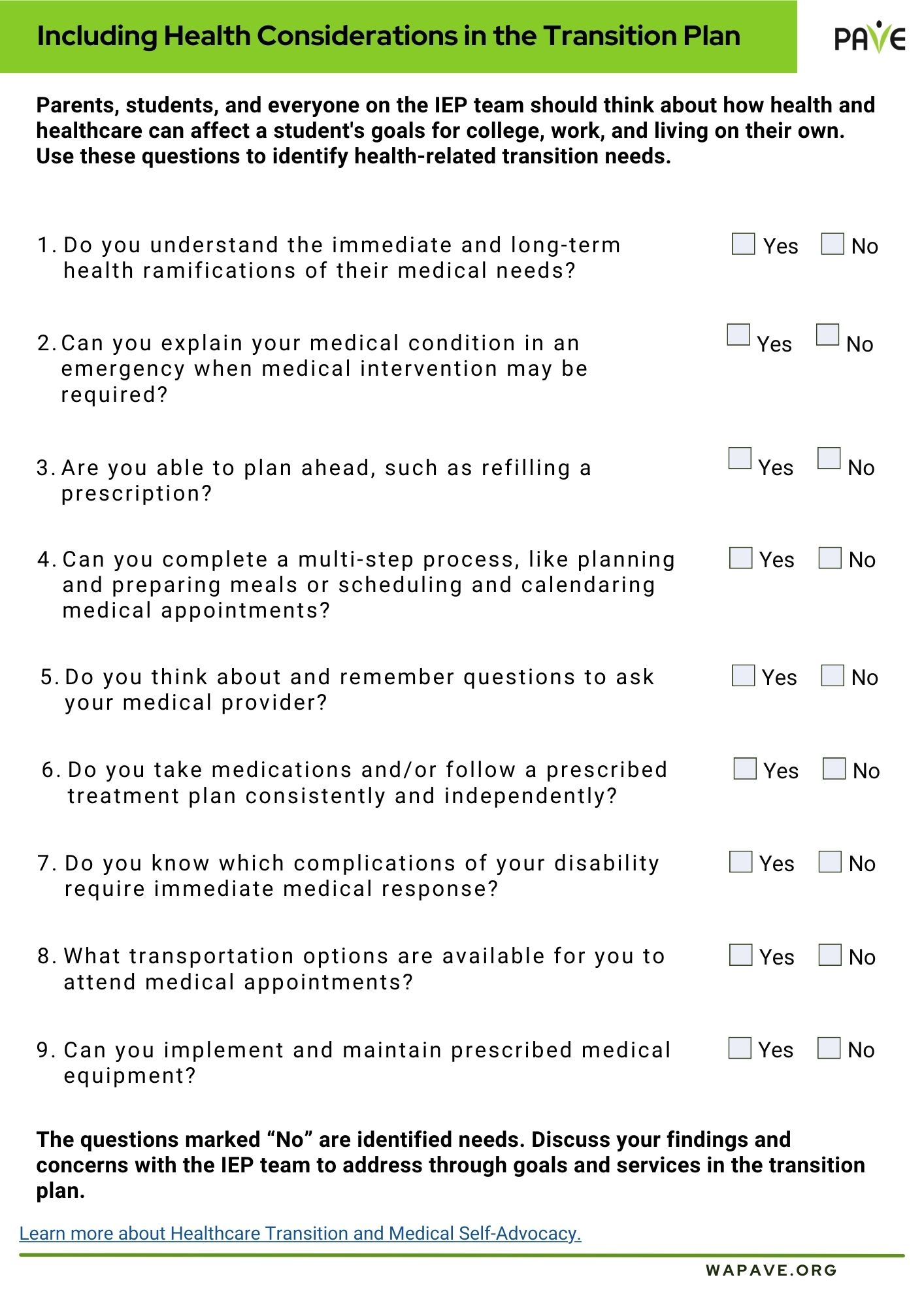
Including Health Considerations in the Transition Plan

Parents, Students, and everyone on the IEP team should think about how health and healthcare can affect a student’s goals for college, work and living on their own. PAVE has made a fillable form that you can download when starting to think about this area in transition.

Including Health Considerations in the Transition Plan

IEP Tips: Evaluation, Present Levels, SMART goals

Getting services at school starts with evaluation. Eligible students get an individualized Education Program (IEP), which describes a student’s present levels of performance and how specially designed instruction supports progress toward annual goals.

This article provides a quick overview of the basic IEP process and provides tips for family caregivers to get more involved. PAVE offers a fillable worksheet to assist parents in developing suggestions to share with the IEP team.

Step 1: Evaluate

To determine eligibility for special education, the school district collects data to answer 3 primary questions:

  1. Does the student have a disability?
  2. Does the disability adversely impact education?
  3. Does the student need Specially Designed Instruction (SDI)?

If the answer to all three questions is ‘Yes’, the student qualifies for an Individualized Education Program (IEP).

If the answer to any of the three questions is ‘No’, the student may be eligible for support through a Section 504 Plan.

TIP: Does the data being collected capture information in all areas of concern? District special education staff can provide input if more specialized evaluation tools are needed.

Step 2: Write the Present Levels of Performance (PLOP)

(Also referred to Present Levels of Educational Performance (PLEP)

When an IEP is drafted, information from the evaluation transfers to the present levels of academic achievement and functional performance (PLOP for short). Students, family members, and outside providers may contribute additional information. There are required elements, depending on age:

  • Preschool: how disability affects participation in appropriate activities within the natural environment​
  • School-age: how disability affects involvement and progress in general education​

​​TIP: Does the PLOP list talents and skills to encourage a strength-based IEP? This section of the IEP can describe how teaching strategies support a student and create opportunities for progress toward goals.

Step 3: Write Goals to Measure Effectiveness of Specially Designed Instruction (SDI)

Goals are written for each area of SDI that a student is eligible to receive. Remember that the 3-part evaluation determines whether SDI is needed. Evaluation, PLOP, and goals are tied to the same data points.

TIP: Here are some questions to consider when reading/writing goals with the IEP team:

  • Are a student’s natural talents and curiosity described and appreciated as part of goal setting?
  • What is the SDI to support the goal, and why is it a good approach or strategy for this learner?
  • Are goals providing opportunity for appropriate progress, given the child’s circumstances?
  • Do the goals properly address the concerns revealed through evaluation and explained in the PLOP?
  • Can the students use their own words to describe IEP goals and how they are making progress? Student goal-tracking worksheets are readily available online.
  • Is the goal SMART: Specific, Measurable, Achievable, Relevant, Time-Bound?

Grid for Goal Development

In accordance with the Individuals with Disabilities Education Act (IDEA), an IEP goal is reasonably calculated to enable a child to make progress appropriately, in light of the child’s circumstances. Parents/students have the right to participate in goal setting and progress monitoring.

These points can be used to design a grid to outline goal setting and to note whether written goals are SMART. A downloadable PDF shows these points in a grid format. A family participant on an IEP team can draft rewritten or proposed goals for the IEP team to consider. Submitting those suggestions to IEP team members before a meeting might help ensure that a parent’s suggestions are a critical part of the agenda.

  • Challenge: Identify the learning barrier/issue.
  • Skill: What needs to be learned?
  • SDI (Specially Designed Instruction): What is the teaching strategy?
  • SMART Goal: Yes/No? Use the following questions to determine whether the goals need improving.

Review whether IEP Goals are SMART:

  • Specific: Is the targeted skill clearly named or described? How will it be taught?
  • Measurable: How will progress toward the goal be observed or measured?
  • Achievable: Is a goal toward this skill realistic for the student, considering current abilities?
  • Relevant: Is the skill something that is useful and necessary for the student’s success in school and life?
  • Time-Bound: What specific date is set to determine whether the goal is met?

Learn more about SMART Goals in this short video:

Support a Child’s Resilience by Pointing to the Positive

Transcript:


Children learn best when they feel safe, relaxed, loved, and confident. Emotions that are the opposite can make learning a struggle.

Researchers who study Adverse Childhood Experiences, often referred to as ACEs, are flipping some of their work upside down to see what happens when children have Positive Childhood Experiences.

What their evidence shows is that healthy relationships, safe spaces, emotional intelligence, and feelings of belonging support HOPE—H.O.P.E. That acronym stands for Healthy Outcomes from Positive Experiences.

Here are some questions you can ask your child regularly to support HOPE. You might also make sure adults at school are asking questions like these, too.

  • Tell me, what is going well?
  • What is fun?
  • Where are you successful?
  • Can you tell me something that makes you proud?
  • Where do you feel like you belong?
  • Please, tell me something about how important you are.

Do you want to ask better questions that are more relevant for teenagers? Here are some examples to get you started: 

  1. Instead of asking “What went well for your child today?”, you could ask “What made you happy or proud today?” 
  1. Instead of asking “What did your child learn from a challenging situation?”, you could ask “Have you faced any difficulties recently, and how did you handle them?” 
  1. Instead of asking “What are your child’s strengths and how did they use them today?”, you could ask “What do you think you’re good at, and how did you show it today?” 
  1. Instead of asking “What are your child’s goals and what progress did they make towards them?”, you could ask “What are some things you’re working towards right now, and what steps have you taken to get there?” 
  1. Instead of asking “What positive things did your child notice in others or the world today?”, you could ask “Did you see anything that made you feel hopeful or inspired today?” 
  1. Instead of asking “How did your child show kindness or gratitude today?”, you could ask “Did you do anything nice for someone else today, or did someone do something nice for you?” 
  1. Instead of asking “What activities or hobbies did your child enjoy today?”, you could ask “What have you been doing lately that you really enjoy or find interesting?” 

Remember to make your questions relatable and create a safe space for teenagers to share their thoughts and feelings. 

Myth and Misunderstanding in Special Education

A Brief Overview

  • Everyone has moments when they hear something and pause to wonder, Is that true? This article and its companion videos describe some special education topics that may be misunderstood. Included is an explanation of what is fact.
  • Topics relate to special education eligibility, placement, support personnel, bullying, student discipline, and more.
  • Read on to see if there are things you haven’t quite understood about your student’s rights or educational services. PAVE hopes to empower families with information to make sure students with disabilities have their best chance for an appropriate and meaningful education.
  • The final myth described in this article is that PAVE provides advocacy on behalf of families—we don’t! But we can help you learn to be your child’s most important advocate. Click Get Help at wapave.org to request 1:1 assistance.

Full Article

Everyone has moments when they hear something and pause to wonder, Is that true?

Parents/caregivers in meetings with their child’s school can feel particularly confused when something doesn’t sound right. They might wonder whether it’s appropriate to question school authorities. They might not understand all the words being spoken. Fear of not knowing something can make it uncomfortable to speak up.

At PAVE, we encourage families to ask questions and make sure they understand the words school staff use. Ask for important answers in writing, and plan to research explanations that are confusing.

For example, if you ask for something and the school says no because of a law or policy, ask for a written copy of the relevant parts of that law or policy. Try to understand the school’s reason for saying no. Write down what you understand and send a reflective email to school staff to make sure you understand their position correctly.

Having everything in writing is important, especially if filing a complaint is a possible next step.

This article describes myths and misunderstandings some people might experience when navigating school-based services for students with disabilities. These topics apply to students with Individualized Education Programs (IEPs), students with Section 504 Plans, and students with possible disability conditions impacting their educational access.

Parent Participation

MYTH: The school must hold a meeting without a parent if the parent is unavailable before an annual renewal deadline because the student’s IEP, 504 Plan, or eligibility will expire or lapse.
FACT: Parent participation is a higher priority than deadlines. Schools are required to accommodate parents/caregivers to ensure their attendance and participation at meetings where their child’s special education services are discussed. Those rights are affirmed in a court decision from 2013: Doug C. Versus Hawaii. If a meeting is delayed because a family member is temporarily unavailable because of illness, work, travel, or something else, services continue uninterrupted until the meeting. PAVE provides an article: Parent Participation in Special Education Process is a Priority Under Federal Law.

Evaluation

MYTH: The school is not required to evaluate a student who gets passing grades.
FACT: If there is a known or suspected disability condition that may be significantly impacting a student’s access to any part of their education—academic, social-emotional, behavioral, or something else—then the school district is responsible under Child Find to evaluate the student to determine eligibility for services and support. Child Find is an aspect of federal law, the Individuals with Disabilities Education Act (IDEA).

MYTH: Section 504 doesn’t apply for a student without a plan or program.
FACT: Section 504, which is part of the federal Rehabilitation Act of 1973, includes protections for students with suspected or known disability conditions that warrant evaluation. For example, if a student consistently misses school for reasons that may be connected to disability, the school may be accountable under the civil rights protections of Section 504 if an evaluation referral isn’t initiated.

MYTH: Section 504 eligibility does not involve an evaluation.
FACT: An evaluation process is required to determine whether a student has a disability condition impacting a major life activity. That evaluation process may include a review of grades, test scores, attendance, health room visits, parent and student input, teacher observations, medical or psychological evaluations, special education data, medical information, and more. If the student meets criteria, evaluation documents are used to support the design of accommodations and other individualized supports to ensure equity. The state provides a family-friendly handout, downloadable in multiple languages, to describe 504 eligibility, evaluation process, plan development, and civil rights complaint options.

Medical Diagnosis

MYTH: A student cannot be identified as eligible for services under the autism category unless they have a medical diagnosis of autism.
FACT: If there is a suspected disability condition and reason to believe there is a significant educational impact, the school is responsible under Child Find to evaluate the student to determine eligibility for services. Schools have evaluation tools to determine characteristics of autism, its possible educational impacts, and student needs. Medical information might help an IEP team design interventions, but families are not required to share medical information with the school, a medical diagnosis is not required, and doctors may not “prescribe” an IEP.

Placement

MYTH: Special Education is a location within the school.
FACT: Special Education is a Service, Not a Place, and PAVE provides an article by that title to further explain a student’s right to educational services in general education—the Least Restrictive Environment (LRE)—to the maximum extent appropriate.

MYTH: The school district is in charge of placement decisions.
FACT: The IEP team determines a student’s placement. If placement in general education, with support, is not meeting the student’s needs, the IEP team is responsible to locate or design a placement that best supports the student in accessing their Free Appropriate Public Education (FAPE). Placement might be general education, a segregated classroom setting where special education services are provided, day treatment, alternative learning environment, residential, home-based, something else, or a combination of any of these options. Once an IEP team designs a placement, the school district has some leverage in choosing a location. For example, if an elementary-age student who is struggling to read needs individualized services from a reading specialist, the district might bus them to a school in another neighborhood where a specially trained teacher provides reading instruction in a smaller classroom. The district doesn’t have to offer every placement or service within every building, but it does need to serve the IEP as written by the IEP team.

MYTH: Preschool IEPs are not required to serve students in the Least Restrictive Environment to the maximum extent appropriate.
FACT: An IEP is required to serve a student with a Free Appropriate Public Education (FAPE) in the Least Restrictive Environment (LRE), to the maximum extent appropriate, regardless of age or grade level. WAC 392-172A-02050 provides specific language about state requirements for LRE, including for preschool students.

Adult Aids at School

MYTH: A 1:1 creates a “restrictive environment” for a special education student.
FACT: Least Restrictive Environment (LRE) refers to placement. A helper is an aid, not a placement. Supplementary aids and services, including 1:1 support from an adult staff member, may support access to the Least Restrictive Environment (LRE) for some students. If having a 1:1 enables a student to appropriately access learning in the general education setting, then that support is provided to ensure FAPE (Free Appropriate Public Education). FAPE within LRE is required by federal special education law, the Individuals with Disabilities Education Act (IDEA).

MYTH: Support personnel should regularly rotate in their roles to ensure a student does not become “dependent” on specific individuals or relationships.
FACT: Healthy interpersonal relationships enable humans of any age to feel safe and secure. Because of the way our brains work, a person doesn’t learn well when a fight/flight nervous system response is activated. Connecting to trusted adults and receiving consistent help from safe, supportive people enhances learning. PAVE provides a collection of articles about Social Emotional Learning (SEL) and Washington State’s SEL Standards.

Section 504

MYTH: A 504 Plan is a watered down IEP.
FACT:
Section 504 is part of a civil rights law called the Rehabilitation Act, passed by the US Congress in 1973. The anti-discrimination protections of Section 504 apply to any person identified as having a disability condition that impacts their life in a significant way. Public agencies, including schools, are responsible to provide individualized accommodations and support to enable the person with a disability to access the service, program, or building in a way that affords them an equitable chance to benefit from the opportunity. A 504 Plan at school ensures the right to a Free Appropriate Public Education (FAPE). Section 504 FAPE rights are upheld by the US Department of Education’s Office for Civil Rights. PAVE provides a video series: Student Rights, IEP, Section 504 and More.

MYTH: Section 504 doesn’t apply to a student with an IEP
FACT: Section 504 protections apply to students with IEPs and those with Section 504 Plans. The civil rights protections of Section 504 are threaded throughout the IEP, especially within sections that describe accommodations and modifications. Section 504 includes specific provisions to ensure students are not discriminated against within student discipline, by unmitigated bullying, or through denial of support that is needed for access to what non-disabled students access without support. All aspects of school are protected, including athletic events, field trips, enrichment activities, specialized learning academies, and more—everything the school is offering to all students. PAVE provides a comprehensive article about Section 504 and its protections for all students with disabilities.

MYTH: If the student has found ways to cope with their disability, they don’t need support.
FACT: Section 504 forbids schools from using “mitigating measures” to justify denial of evaluation or support. A mitigating measure is a coping mechanism—for example, a deaf student who reads lips or a student with an attention deficit whose symptoms are improved by medication. PAVE’s article about Section 504 provides more detail about mitigating measures.

Bullying

MYTH: The best way to help a student with a disability who is being bullied is to remove them from the bully’s classroom.
FACT: Section 504 protects a student with disabilities in their right to be protected from bullying. That means the school must stop the bullying and support the victim to feel safe again. Schools may not punish or disadvantage the victim. OCR says: “Any remedy should not burden the student who has been bullied.” PAVE provides a video: Bullying at School: Key Points for Families and Students with Disabilities.

MYTH: An informal conversation is the best way to address bullying.
FACT: The best way to hold a school accountable to stop bullying and support the victim is to file a formal HIB Complaint. HIB stands for Harassment, Intimidation, and Bullying. Washington State’s 2019 Legislature passed a law that requires school districts to write formal HIB policies and appoint a HIB Compliance Officer to spread awareness and uphold the laws. Families can contact their district’s HIB Compliance Officer for support with a complaint and to ensure student civil rights are upheld.

IEP Goals and Process

MYTH: An IEP provides education to a student with a disability.
FACT: An IEP is not the student’s education. An IEP provides educational services to enable a student to access their education. IEP goals target areas of learning that need support in order for the student to move toward grade-level curriculum and learning standards. Included are services for academics, adaptive skills, social-emotional skills, behavior—all areas of learning that are impacted by disability.

MYTH: If an IEP team agrees to change something about a student’s services or placement, the team must submit that idea to the district for approval or denial.
FACT: An IEP team has decision-making authority. The team is required to include a person knowledgeable about district resources (WAC 392-172A-03095) so decisions about program and placement can be made at the meeting. If a required IEP team member is not in attendance, the family participant must sign consent for the absence. The family can request a new meeting because a key team member, such as a district representative, is missing. PAVE provides more information and a Sample Letter to Request an IEP meeting.

Behavior and Discipline

MYTH: A Functional Behavioral Assessment (FBA) is used to figure out how to discipline a student more effectively.
FACT: An FBA is an evaluation focused on behavior. It helps IEP teams understand the needs behind the student’s behavior. A Behavior Intervention Plan (BIP) is built from the FBA to provide positive behavioral supports, teach new or missing skills, and reduce the need for discipline. PAVE provides a video about the FBA/BIP process.

MYTH: A school isn’t responsible to track exclusionary discipline if a parent agrees to take the child home and no paperwork is filed when the school calls to report a behavior incident.
FACT: “Off books” or informal suspensions count as exclusionary discipline for students with disabilities. If a student with a disability misses more than 10 cumulative days of school because of their behavior, the school is responsible to hold a manifestation determination meeting to decide whether the behaviors are directly connected to the disability and whether school staff are following the IEP and/or behavior plan. If services or placement need to change, this formal meeting is a key opportunity to make those changes. PAVE provides a video: Discipline and Disability Rights: What to do if Your Child is Being Sent Home.

Privacy

MYTH: A parent or provider who visits school to support or evaluate an individual student is violating the privacy rights of other students just by being there.
FACT: Federal laws protect private medical or educational records. Visiting a classroom or other school space should not expose student records for inappropriate viewing. The Department of Education provides a website page called Protecting Student Privacy to share resources and technical assistance on topics related to the Family Educational Rights and Privacy Act (FERPA). The confidentiality of medical records is protected by the Health Insurance Portability and Accountability Act (HIPAA). Understanding HIPAA and FERPA can help parents /caregivers ask their school for documented explanations whenever these laws are cited as reasons for a request being denied.

Literacy

MYTH: Schools cannot provide individualized instruction in reading through a student’s IEP unless the student is diagnosed by a medical provider as having dyslexia.
FACT: No medical diagnosis is needed for a school to evaluate a student for any suspected disability that may impact access to learning and school. An educational evaluation might show that a student has a Specific Learning Disability in reading, with characteristics of dyslexia. When a disability that impacts education is identified through evaluation, the school is responsible to provide services to meet the identified needs and enable appropriate progress. PAVE provides an article: Dyslexia Screening and Interventions: State Requirements and Resources and a video: Supporting Literacy for Students with Learning Disabilities.

Graduation

MYTH: The school has to withhold credits for a student to receive services beyond a traditional senior year.
FACT: Credits do not need to be withheld, and a student doesn’t automatically earn a diploma by reaching the required number of credits. The IEP team determines the target graduation date for a student receiving services through an IEP and how transition programming for a student ages 18-21 might support learning and life planning. Receiving the required number of credits is only part of what a student needs to earn a diploma, and the IEP team individualizes a plan for the student with a disability to earn their diploma within the state’s options for graduation pathways. PAVE provides a Toolkit for life after high school planning.

Private School and Home School

MYTH: Public schools do not have to do anything for students with disabilities who are home schooled or enrolled in private schools by parent choice.
FACT: Child Find applies to all students with known or suspected disabilities who live within a district’s boundaries, including those who are home schooled or enrolled in private schools. Child Find means the public district is responsible to seek out and evaluate all students with known or suspected disabilities. If the student is found eligible for services, parents/caregivers can choose to enroll the student in the public school to receive special education services, even if the primary educational setting is a private or home placement. If the student is fully educated in the private setting, by parent choice, the private school provides equitable services.

Parent Support from PAVE

MYTH: PAVE gives the best advice and advocates on behalf of families.
FACT: PAVE does not give legal advice or provide advocacy. We support families in their work.  Staff from our Parent Training and Information (PTI) program provide information and resources to empower family advocates. Our goal is to ensure that family advocates have knowledge, understand options, and possess tools they need to work with schools to ensure that student rights are upheld and the needs of students with disabilities are met. Click Get Help at wapave.org to request 1:1 assistance. Help us help you by reading your student’s educational documents and having those documents handy when you connect with us!

Support PAVE! A Board Member’s Perspective

From A Board Member’s Perspective

We’re working to lift up youth with disabilities by investing in youth who want to facilitate person-centered-plans for their peers! Every donation through Dec. 31, 2022, will be matched by our generous donors! For every $1, a donor will match so it equals $2 dollars!

Bullying at School: Key Points for Families and Students with Disabilities

Transcript of this video is below:

When students with disabilities are bullied, schools are legally responsible to end the bullying.

By law, schools must act to restore the safety and well-being of students who are harmed by harassment, intimidation, and bullying.

Those words—harassment, intimidation, and bullying, make an acronym: HIB. This video is about HIB protections for students with disabilities.

Please note that bullying increases the risks for suicide and self-harming behaviors.

For a mental health crisis, call 988

For crisis help on topics related to sexual orientation and identity, call The Trevor Project: 866-488-7386

What law says the school has to end the bullying and help my student?

Specific anti-bullying protections for students with disabilities come from Section 504, which is part of a federal law, the Rehabilitation Act of 1973.

The civil right to be protected from bullying applies to all students with disabilities, regardless of whether they have a Section 504 Plan or an Individualized Education Program (IEP). These rights are upheld by the Office for Civil Rights—OCR.

Anyone who knows about an incident of harassment, intimidation, and bullying at school or during a school-sponsored activity can file an OCR complaint at the local, state, or federal level.

What does state law require?

Washington State’s 2019 Legislature passed a law that requires school districts to write formal HIB policies and appoint a person called a HIB Compliance Officer to spread awareness and uphold the laws.

What can parents do?

If your child is bullied at school, ask for the name of your district’s HIB Compliance Officer. Talk to that person about your options and request a HIB complaint form.

If the act included a physical assault or serious property damage, file a police report.

Request an emergency meeting of the IEP or Section 504 team to add supports for the student to ensure emotional and physical safety at school.

What counts as harassment, intimidation, or bullying?

Washington State defines a HIB violation as an intentional act that:

  • Physically harms a student or damages the student’s property
  • Has the effect of substantially disrupting a student’s education
  • Is so severe, persistent, or pervasive that it creates an intimidating or threatening educational environment
  • Or has the effect of substantially disrupting the orderly operation of school

A HIB act may be electronic, written, verbal, or physical.

What does a school have to do when a child with a disability is bullied?

The Office for Civil Rights (OCR) requires schools to take immediate and appropriate action to investigate what happened. That means they talk to everyone involved and any witnesses and write a detailed report.

OCR requires the school to stop the bullying now and into the future.

OCR also says that schools must make sure the student who was bullied is helped and not further injured by actions taken in response. The victim should not be suspended, for example.

OCR says: “Any remedy should not burden the student who has been bullied.”

To learn more about federal laws and complaints, contact OCR at 800-421-3481.

Type the word Bullying or Discipline into the search bar at wapave.org to find additional resources.

Discipline and Disability Rights: What to do if Your Child is Being Sent Home

Learning the skills to maintain expected behavior and follow school rules is part of education. All students learn social, emotional and behavioral skills. Students with disabilities may get extra help in these areas of learning. Some have individualized behavior support plans.

When the pre-teaching and interventions fail to stop a behavior from causing a problem, the school might call a parent to say, “Take them home.” What happens next could depend on how well-informed parents are about the rights of students with disabilities.

This video provides key information about what to do if your child is being sent home. The first thing to ask is, “Are they being suspended?” If the answer is yes, the school is required to file specific paperwork. If the answer is no, a parent has choices and may support better long-term outcomes by carefully documenting what happens next.

Below are links to resources referenced in the video:

Transcript of Discipline and Disability Rights: What to do if Your Child is Being Sent Home

Learning the skills to maintain expected behavior and follow school rules is part of education. All students learn social, emotional and behavioral skills. Students with special needs may get extra help in these areas of learning. Some have individualized behavior support plans.

When the pre-teaching and interventions fail to stop behavior from causing a problem, the school might call a parent to say, “Take them home.” What happens next could depend on how well-informed parents are about the rights of students with disabilities. This video provides key information to help.

First let’s talk about what exclusionary discipline means. If school staff remove a student from the place they are supposed to be during school, because of their behavior, then it’s exclusionary discipline. Out-of-school suspensions, expulsions, and in-school suspensions count. An in-school suspension might mean getting sent to the office, for example.

Informal removals like when the school calls parents to take a child home because of their behavior is exclusionary discipline if parents feel they have no choice. A regularly shortened school day also may be a form of exclusionary discipline if the school offers this as the only option.

These final two points might seem like a surprise. Let’s clarify a few things. It’s important to know who is making the decisions. If the family chooses to take a child home early because they aren’t feeling well physically or mentally, then it’s not exclusionary discipline.

If an IEP or Section 504 team decides it’s in the student s best interests to attend school for fewer hours, then it’s not disciplinary. If a teacher takes a student into the hallway for a short chat before returning to class, then it likely doesn’t count as a disciplinary action.

Disciplinary removal from school is a decision made unilaterally by the school. If the family

believes they have no option but to take their child home or if the school imposes a shorter

day without having a meeting to talk it through, then it counts as exclusionary discipline.

The school would essentially be changing a student s placement without the consent of

the school-and-family team in charge of those decisions.

We need to know a few things about student rights to fully unpack this topic, so here’s a quick take  on student rights. They are shown here as a pyramid. All students have rights at the bottom. Students with special educational services are at the top and have all these rights.

Special education rights are protected by a federal law called the IDEA the Individuals with Disabilities Education Act. IDEA protects the rights of students with Individualized Education Programs IEPs. IDEA has specific rules about what has to happen when a student with an IEP is excluded from school for behavior.

A student s Civil Rights are protected by federal laws also. The United States Office for Civil Rights OCR upholds these laws and provides specific guidance about what schools have to do when they discipline students with disabilities. Civil Rights laws protect students with IEPs, students with Section 504 Plans, and students with known or suspected disabilities who need to be evaluated to see if they are eligible for services. Sometimes discipline is the reason a student is evaluated to determine eligibility for services.

General Education Rights are protected by ESSA, which stands for Every Student Succeeds Act. Every child in the United States has the right to attend school, regardless of life circumstances that might include disability, poverty, racism, unstable housing, citizenship status, or something else. The public school responsible for serving a student cannot send them away without following specific state and federal rules.

To uphold the rights of students, schools are responsible to teach expected behavior in culturally appropriate ways and to help students stay in school and learning. The US Department of Education provides information about student rights. In July 2022, the Departments Office for Civil Rights published a 41-page document describing the rules schools must follow when they discipline students with disabilities. That document is called Supporting  Students with Disabilities and Avoiding the Discriminatory Use of Student Discipline under Section 504 of the Rehabilitation Act of 1973.

The document includes information that students with disabilities and students who are Black, Indigenous, or People of Color are disciplined at higher rates. BIPOC students with disabilities are the most impacted by discriminatory policies and practices. As part of their responsibility to support inclusion, schools may not exclude students in ways that discriminate. Knowing that schools are responsible to teach and cannot send students away without going through a formal, well-documented process, what’s a parent to do if the school calls and says to take the student home?

The rest of this presentation provides some guidance, summarized on this slide. The first step is to ask whether the student is being suspended. Requesting paperwork and tracking missed time is critical to hold the school accountable. An important number in this process is 10 that s how many days a student with a disability can miss due to discipline before the school is responsible to host a specific meeting called manifestation determination.

More about that in a moment. Communication is critical to improving outcomes when a student’s behavior is interfering with school. Families can ask for regular information about a student s behavior, and schools can send data tracking sheets home to make sure everyone knows how things are going. Let’s unpack these five points.

For a student to be sent home, the behavior must be severely disruptive or dangerous. If that’s what’s happening, then your child is being suspended or emergency expelled. Schools must report suspensions and expulsions to the family and to the state. If the school calls and asks you to take your student home, Step 1 is to ask: Are they being suspended?

If a student is being formally excluded from school because of their behavior, state law requires written notice to parents that includes: A description of what they did wrong including what school rule was broken Dates that the suspension starts and ends What the school tried first that didn’t work and why they chose to send the child home How the student will be provided education while away from school Information that the student and parents have the right to meet with a school administrator to talk about what happened And information about the family s right to appeal the action.

Note that all this information must be provided in a language and format that is accessible to the family. If the school says the student isn’t being formally suspended, then parents have choices. They can take the student home and call it a mental health day. Washington law requires schools to accept behavioral health reasons for students to be absent. On this slide are

a few questions families may want to consider asking:

  • Parents can ask for a meeting to talk about services. If the student doesn’t have a Section
  • 504 Plan or an IEP, it might be time to request an evaluation to see about eligibility for services. If the student doesn’t have a positive behavior support plan, a meeting could be arranged to talk about that option.
  • Parents might say they want the student to stay at school and ask for information about how and where education will be provided if the student stays. Parents can request paperwork about what happened and what the school tried before calling home.
  • Be sure to ask how the school will record the absence if the student leaves school.
  • Will it be excused, unexcused, or recorded as exclusionary discipline?

One reason it’s important to document every time a student is sent away for behavior is a specific special education process called Manifestation Determination. Manifestation Determination is a formal name for a meeting where the school and family talk about what happened and decide whether the behavior was directly related to the student s disability.

If yes, the team determines that the behavior was a manifestation of disability. In that case, it’s especially important to consider what additional supports are needed to scaffold the student’s behavior doesn’t keep interrupting school and learning. Manifestation Determination is required when a student with disabilities misses 10 or more days of school because of behavior. Those days might include partial days, informal suspensions, and in-school suspension.

A Manifestation Determination meeting includes discussion about whether an IEP, Section 504 Plan, or behavior support plan is being followed appropriately and whether it’s got everything the student needs to successfully learn expected behaviors. If no, the team is responsible to make changes. That might mean gathering more information through an evaluation or bringing together more expertise from the district or outside providers. The team may discuss changing the student s placement.

Washington s state educational agency, OSPI, provides detailed information about manifestation determination and other disciplinary rules for students with disabilities. One place to get that information is a Technical Assistance Paper called TAP #2, available through OSPI s website, which is k12.wa.gov. PAVE provides a link on the page where you clicked to watch this video.

Here is a general tip for parents to prepare for ups and downs. If parents tell the school they want to know the good, the bad, and the ugly, they are setting up a communication pathway for whatever happens. Hopefully, collaborative problem-solving will result. For example, knowing what’s going well will help everyone support the student to build on strengths. Knowing what’s not going well might prevent problems from getting worse. Saying you want to know the ugly might help the school understand that you want to work together and don’t want them to gloss over a behavioral incident by sending your student home without an official suspension, for example. When every trouble is treated as a chance to learn and improve, progress can accelerate.

Here s a PAVE resource that might provide additional information you’re looking for. On our home page, under the calendar, is a Behavioral Health Toolkit, with information about crisis systems, school-based services, medical systems, family support agencies, advocacy opportunities, and more. Within the behavioral health toolkit is a video about best practices for supporting behavior at school. A Functional Behavioral Assessment is called an FBA. That assessment can gather information for schools and families to develop a positive behavior support plan.

The name for that plan is BIP Behavior Intervention Plan. PAVE s video can help families and schools work to make sure the FBA and BIP are unbiased and built to teach a student what they can choose instead of behaviors that are leading to problems. PAVE provides a sample letter requesting an FBA. Look for it within our toolkit of sample letters.

This training is provided by Parent Training and Information (PTI), a program of PAVE. Our non-profit has been helping families in Washington State since 1979. Students, family members, and professionals can get direct assistance by going to our website, wapave.org, and clicking Get Help. We provide language translation options. Your can also leave a message by phone to request help: 800-572-7368. If you need help with the accessibility of any of our resources, please let us know. This slide is a reminder that PAVE is not a legal service agency and cannot provide advocacy, advice or legal representation. Our goal is to empower families by providing information and access to resources.

Thank you for listening and learning today and for being an advocate for someone with unique needs! Remember that it’s not your job to hold up the entire world and that you need time to care for yourself and recharge your batteries. Please practice self-care and make sure your own social-emotional needs are a priority. PAVE is here to help at wapave.org.