

New Funding for Children and Youth Behavioral Health Respite

A Brief Overview

  • Respite care (short breaks) is important for all parents and other family caregivers. Being overwhelmed by caregiving tasks with no breaks is not good for the family caregiver and the person getting care.
  • WA State has been approved for additional Medicaid funding to provide respite for family caregivers of youth with high (complex) behavioral/mental health needs
  • This short article is advance notice about this new funding and who may be eligible.
  • There will be an important public hearing at 10 AM July 21, 2026 about this new respite program, to help the state decide how it will work. Family caregivers’ feedback at this hearing will help decide how the new respite program will work.

Article

In 2026, respite care for family caregivers of children and youth with behavioral health needs was approved by the Centers for Medicare and Medicaid Services through a 1115 (Medicaid Demonstration) Waiver. Caregiver respite will be a service through WA State’s Department of Heath’s (DOH) Health-Related Social Needs. DOH is still planning how this will work, but overworked family caregivers are advised to be aware of the situation and start the process for receiving respite.

Part of the planning is the rulemaking process. Rulemaking means creating rules or guidelines for a new program. A public hearing on this matter is scheduled for July 21 at 10am, and is open to all. It’s important for family caregivers to share their opinions during the hearing so that rules and guidelines include their point of view and needs. The rulemaking process for caregiver respite is currently being led by the Department of Social and Health Services (DSHS).

The current goal date for caregiver respite to go into effect is January 2027.

The first groups to be served are children and youth up to age 20 with complex behavioral health needs requiring supervision by an unpaid (usually family) caregiver. Examples of programs serving this population include but are not limited to: Wraparound with Intensive Services (WISe), Mobile Response and Stabilization Services (MRSS), and outpatient community behavioral health programs. If your child or youth are served by these or very similar programs, you, as the family caregiver, may qualify for the new respite services.

To receive these respite services, families with children or youth with behavioral health issues need to be screened and approved by the Health Related Social Needs (HRSN) services.  This can be done by a direct referral by a healthcare provider or social worker, a Community Care hub, or by a care coordinator from an MCO (Managed Care Organization). To find a local Community Care Hub, use this sheet from the Washington Health Care Authority (HCA). Community Care Hubs provide many services in addition to respite referrals, so any family on, or that is eligible for, Medicaid or Apple Heath who is struggling with housing, food, and other necessities, are advised to look into those options.
Keeping Kids Busy Through Summer: Summer Camp Alternatives

Summer camp is an excellent way for children to spend the long summer days. However, camps often fill quickly, and many are too expensive for families. Here are some alternatives to summer camps to entertain children and give caregivers some much needed respite.

A Brief Overview

  • There are many inexpensive ways to entertain children over the summer 
  • Check with local parks and recreation for activities, including those for children and youth with disabilities 
  • Washington State Parks are wonderful for families to explore 
  • Check with family organizations, schools, and teachers for ideas and information on programs 

Full Article

Local parks and recreation departments often increase children’s activity programs for the summer. These can include sports, preschool classes, and outdoor activities. Some of the parks and rec departments, especially in larger communities, have adaptive or accessible classes, for those with disabilities and/or sensory issues. Cities and towns who have parks and recreation departments usually have information on the city or town website, or you can call the city or town main office. Some counties have similar programs, both summer and year-round. Check out the county website (usually the name of the county plus “.gov”). 

Several national non-profits have low-cost options for families during the summer, and year-round. Boys and Girls Clubs have activities, classes, and day camps, and membership fees are on a sliding scale. Their Find a Club interactive map will let you locate the nearest club. The YMCA may offer day camp options, along with their usual sports and recreation options. They have scholarships to help pay for enrollment and camps. 4H, the nation’s largest youth development organization, has many opportunities for children and youth to engage in hands-on learning, skill building, and community interaction. Various branches of 4H offer Science, Technology, Engineering & Math (STEM) activities, civic engagement, animal science, environmental science, performance arts, nutrition and health, and many, many more activities are available through your local camps. 

Washington State Parks provide for a wide range of outdoor activities this summer and even have special events that can be viewed on their calendar. For children four and up, the Junior Ranger Program has activities to print out, along with ideas for indoor and outdoor fun. For those with physical limitations, an interactive ADA map of park facilities shows the wheelchair accessible options throughout the State Park system. 

Libraries often have surprisingly varied options, including reading programs, arts and crafts, educational classes, and movie nights. Many libraries now have take-home kits for creative activities to do with the whole family. Summer reading lists are available both on library websites and in-person. A full listing of libraries in the state is available from library technology. 

Movie theaters sometimes offer sensory-friendly film viewing at certain scheduled times, check with the theater. Good for those hot afternoons! Information about these screenings can be found on the websites of the theatres, including major chains such as AMC and Regal. 

Parent groups and family organizations are often up to date on the latest summer activity offerings around the community. The Arc of Washington and Parent to Parent are both focused on families with children with disabilities or special health care needs, are aware of many opportunities, and may even offer some events for families and kids.  

Some school districts have enrichment activities over the summer beyond the extended school year (summer school) options. Local school district websites will have full listings for anything they may offer. Often schools and school districts also have recommendations for summer activities and information on summer events. Teachers are a useful resource for summer ideas and information, as they have heard a lot about what their students are doing this summer, so a quick chat with them may be in order. 

Several websites focus on community events and classes that children and youth can be involved in over the summer. The most prominent is Macaroni KID, but others include Parent Map, and Family Day Out. The local Chamber of Commerce and local newspapers will also post some event highlights and may list on their community calendars. Summer is also the time for County Fairs and other events, many of which take place in August. 

There are children’s museums, large and small, around the state. They have increased offerings during summer months; some even have camps. Most are geared towards younger children through elementary school age. The most prominent museums include the Seattle Children’s Museum, the Hands On Children’s Museum of Olympia, the Imagine Children’s Museum in Everett, the Children’s Museum at JBLM, Children’s Museum of Tacoma, KidsQuest Children’s Museum in Bellevue, KiDiMu on Bainbridge Island, Children’s Museum of Skagit County, Tree Fort Children’s Museum in Moses Lake, and the Children’s Museum of Walla Walla. 

Lifespan Respite WA (a program of PAVE) has a list of registered providers that is accessible to everyone, where it is possible to find recreation and respite options by county, age served, disabilities served, and respite type. The options listed under Recreation on the “Respite Type” menu has an array of interesting options that may have flown under a family’s radar, such as equine therapy, music classes, and sensory-friendly playgrounds. Check out their page “Creative Options for a Respite Break” for more low-cost and free ideas for summer (and year-round) activities. Visit their How to Apply for Respite page to find out if you qualify for a small grant for short respite breaks! 

Kinship Caregiving

Relatives raising the child(ren) of a family member (Kinship Families)

Kinship families are families in which children live with and are being raised by grandparents, other extended family members, or other adults with whom they have a close family-like relationship such as close family friends. Many kinship caregivers don’t necessarily think of themselves that way–it’s natural to step in and raise children when the parents can’t. Even though most of the challenges that come with raising children are the same for a kinship family, there is an important difference. Kinship caregivers do not have automatic legal rights and responsibilities for the children. Raising children when they are not the child’s parent was not necessarily planned or expected. It’s often related to a family crisis, and the child welfare system is not always involved.

Kinship caregivers can often use help with all of the practical issues surrounding a suddenly larger family: large enough housing, paying for the extra food, ensuring medical care, and registering children at a different school. Legal issues may come up–powers of attorney to get things done, custody, guardianship of the children, parental rights and visitation.

There is help available! Kinship caregivers can get help with:

  • Health insurance and health care
  • Financial assistance (including food)
  • Other public benefits
  • Legal assistance
  • Tax credits
  • Schooling–especially if the child or children are now in a new school district
  • Support groups where other kinship caregivers share concerns, experiences, and ideas

WA State’s Department of Social and Health Services (DSHS) supports for Kinship Families, including Tribal Families.

More Help:

If the child or children have a disability or special health care need:

PAVE Family Voices of Washington Get Help (works for both programs)

If the child may be experiencing a developmental delay, or you have concerns about that:

“Developmental Screening (Birth to Three and Medically needed developmental screening)”

If the child’s special education needs are not being met: Get Help

If you need a break (respite): Lifespan Respite WA

Respite Offers a Break for Caregivers and Those They Support

Respite offers a short-term break for caregivers and those they support. This article provides information and resources to get started seeking respite services. Resources and links include sources of respite in WA State.

A Brief Overview

  • What family caregiving is
  • What respite care is, and why it’s important for family caregivers
  • Types of respite
  • How to decide on the best type of respite services for your family
  • Free and low-cost respite in WA State, including links to Veterans Administration and options for active duty military families.
  • Paying out-of-pocket for respite in WA State

What is family caregiving?

Modern families come in many styles. The primary caregivers of a person with a disability or special health care need might be parents or spouses or adult children, and they might be other relatives (kinship caregivers), friends, or neighbors.

They can also be described as “family caregivers”. This term is used widely by social service professionals, medical providers, and organizations and agencies that offer respite services and decide on respite care eligibility.

Some professionals use the term “care recipient” to describe the person who needs care from the family caregiver. However, in this article we will use the term “loved one” or “loved ones”, because family caregivers are usually not paid workers providing a service. They give care because families love and care for one another, and because “That’s what family is for”.

What is respite care? Why is it important for family caregivers?

Respite care is a short break from caregiving tasks for the family caregiver. It might last a few hours or include 24-hour a day care that lets the family caregiver (s) have a vacation.
Family caregiving can create deep bonds, be emotionally fulfilling and full of loving acts of kindness. It’s also physically, emotionally, and mentally tiring. Family caregivers don’t just run errands or do housecleaning for loved ones; they organize medical care, take loved ones to appointments, provide personal hygiene, handle finances, arrange after-school and childcare, wrestle with health insurance companies, Apple Health, or Medicare, and may have legal responsibilities such as being a court-appointed guardian or an agent under a Durable Power of Attorney.  

These responsibilities often add up to a full-time job in addition to paid employment and caring for other family members.  Respite breaks from caregiving are one of the top requests family caregivers make when they apply for caregiver supports and benefits, along with financial help. 

Family caregivers often wait until they are burnt out before looking for respite care. They may not realize it’s available for their situation, or their loved one may not like the idea of getting help from anyone but family. Putting everyone else’s needs before your own can take care of an immediate problem; in the long term, it can lead to increased anxiety, frustration, resentment, depression and even illness. Whether you think of yourself as a family caregiver or not, these are all signs of caregiver burnout and stress.

Time apart can boost well-being for both the family caregiver and their loved one. While caregivers temporarily shift their focus to necessary self-care, loved ones can meet new people and explore new interests.


What respite services would be most helpful?

Respite includes a wide variety of programs and services, such as:

  • In-Home Services (errands, light chores, personal care, companionship, medication reminders, etc.) *
  • Recreation (sports, exercise, crafts, and other leisure activities)
  • Day or Overnight Camps which serve individuals with disabilities
  • Day Services (dementia or memory centers, after-school and weekend programming for adults, children, and youth, daycares, etc.)
  • Education/Classes (may include preschools, nature schools, art, music, recreational skills, academics, etc.)
  • Organizations offering therapeutic benefits for a loved one (social skills groups, music therapy, equine/animal therapy, etc.)
  • 24-hour care

* In-home respite care does not include services that need to be performed by a nurse, occupational therapist or physical therapist. Some home-care agencies can provide services from those professionals, but most of the time, such services are arranged for and covered by health insurance.

Tools can help you decide which type or types of respite will work for you and your family:

Washington’s Pathways to Respite booklet includes “fill-in-the-blanks” tools to help define needs, like these examples:

“I would like to take a break, but I am concerned that___________” and “If I had some time to myself, I would _____________.”

This respite planning guide is from the Veterans Administration, but can work for any caregiver, civilian or military: https://www.caregiver.va.gov/CAREGIVER/support/docs/docs2024/Caregiver-Respite-Tool-2022.pdf#.

Ways to pay for respite and find respite providers:

If a family will pay out of pocket for respite services, they can find respite providers online. Here are some ideas to start a search:

  • “Adult Day Services Washington State”
  • “After-school programs children with special health care needs Washington State”
  • “In-home care agencies near me”
  • Check the listings at Lifespan Respite WA; listed agencies meet state standards for background checks and liability insurance.

Care.com is a paid private, online service connecting respite or personal care workers with potential care recipients and their families. Families are on their own to follow up on an individual worker’s qualifications, references, and background, although some listings will show someone has passed a background check. This service requires payment and a subscription, but it is easy to cancel once a caregiver has been hired. They also offer a program to manage tax withholding and payments for the independent workers hired.

If a care recipient is eligible for respite through private medical insurance, the insurance company will list approved providers or caregivers may call their insurance company representative.

When researching a respite agency, caregivers can check whether the agency meets standards and follows appropriate safety measures.

Here are a few examples of questions you might ask:

  • How are the workers chosen and trained?
  • Can the respite worker give medicine or help with medical tasks?
  • How are emergencies and problems handled?

A thorough guide is available at the ARCH National Respite Network and Resource Center: How to Choose a Respite Provider.

Free and low-cost respite services:

In Washington State, eligibility for free or low-cost respite services may depend on the caregiver or loved one’s circumstances or category of disability.

Seniors and Adults with Disabilities

Seniors 65 and older who meet functional and financial eligibility can get a variety of services through Department of Social and Health Services Home and Community Services Administration (HCSA).

Unpaid (family) caregivers of adults who are 55 and older who meet functional and financial eligibility can get respite care and other needed support services like caregiver education, support groups, housework and errands and other services.

The easiest way to learn about services and eligibility is to contact the county or regional Area Agency on Aging, which administers many of HCSA’s services. They are also listed at Washington’s Community Living Connections/waclc.org.

Some programs are:

Medicaid Alternative Care (MAC) and Tailored Supports for Older Adults (TSOA), Medicaid Demonstration Projects funded through Department of Health. Information and applications are handled through the Aging and Disability Resource Centers/Are Agencies on Aging (DSHS). These are WA’s most direct programs for unpaid family caregivers of people age 55 and older. They fund caregiver’s needs including respite care, caregiver training, and supplies. MAC serves people who are Medicaid-eligible but choose not to enroll in CFC. TSOA serves people who are not financially eligible for Medicaid, with higher income and asset limits, and does not require an unpaid caregiver.

As of September 2026, these programs have an automatic waitlist. Check back with the agency where you applied for updates.

Family Caregiver Support Program (FCSP)  An eligible caregiver is a spouse, relative, or friend who has responsibility for the care of an adult with a functional disability and does not receive financial compensation for the care provided. This program is administered by Aging and Disability Resource Centers/Area Agencies on Aging across the state. Respite funds vary by source, and availability of respite funding varies by location.

Catholic Community Services in WA are non-denominational in the services they offer. In addition to in-home supports, many other community/social service programs are available such as housing support, mental health support and treatment, food and financial assistance, teen and youth support, and more.

Catholic Community Services of Western WA

Catholic Charities of Central WA

Catholic Charities Eastern WA

Don’t forget to look in your community and nearby for memory cafes, volunteer-based dementia or disability day programs, and senior center offerings!

Respite for All Ages:

American Indian and Alaska Native Caregivers:

Lifespan Respite WA Voucher Programis open to all eligible American Indian and Alaskan Native caregivers.

Contacts for Tribal programs in WA State can be found on the HCLA Tribal Affairs website at Washington’s Department of Social and Health Services (DSHS). Individual Tribes direct their own caregiving and/or respite programs.

Community First Choice (CFC): your loved one is eligible if:

  • Financial Eligibility: must be financially eligible for Medicaid (Apple Health)
  • Functional Eligibility: require an “institutional level of care” (such as nursing home placement or an intermediate care facility) but choose to receive care at home or in an alternative living facility.
  • Medicaid Enrollment: Must be enrolled in Washington Apple Health (Medicaid) under a categorically needy (CN) or alternative benefit plan (ABP) scope of care.
  • If your loved one is age 65 or older, blind, disabled, or on Medicare, apply at WashingtonConnection.org.
  • If your loved one is under age 65 or not eligible for Medicare, apply using the WA HealthPlan Finder.
  • You can also apply in-person at a local Home and Community Services office.

COPES: a wraparound service for individuals on the Community First Choice plan. Individuals must have needs that exceed what is available in Community First Choice. Eligible individuals are in the Community First Choice Program. 

Home and Community-Based Services for individuals with developmental disabilities, which may include respite for their caregivers (through the Developmental Disabilities Administration/DDA)

Eligibility is based on the presence of one of four developmental disabilities (Intellectual disability, Cerebral palsy, Epilepsy, Autism) or associated disabilities, an age of onset prior to diagnostic criteria or age 18, and evidence of substantial limitations.

Important:

  • An individual must first apply to see if they are eligible (family member may apply for the individual).
  • Once eligible, the individual or family must apply for specific services.

Detailed information on the application process and on specific programs (“waivers”) can be found on the Informing Families website.

Lifespan Respite WA: offers a voucher (small grant) for unpaid family caregivers who support a family member, friend, or neighbor who needs assistance with daily living activities. The voucher is used to pay for services or programs that allow the caregiver to have respite, or short breaks from caregiving tasks. Lifespan Respite vouchers are for temporary short-term respite. 

Eligibility: the caregiver

  • Is not paid to care for their family member, friend, or neighbor;  
  • Provide 40 or more hours per week of care or support for someone with a special need or condition (the person can be any age), and the 40 or more hours must include supervision of the person receiving care;
  • Live in Washington State; 
  • Not be able to afford respite care on their own;
  • The caregiver or the person they care for are not enrolled in any program that provides respite services, unless they are on a wait list and not scheduled to receive services within 30 days of the voucher application.

Read more about Lifespan Respite WA and apply online.

Department of Children Youth and Families (DCYF):

Foster parents provide temporary homes for children whose parents are unable to care for them. DCYF and the family court system authorize placement of a child or youth in foster care when it is necessary for a child’s safety and well-being. More than half of children and youth using foster care in WA State are cared for by a kinship caregiver—a grandparent, other relative, unrelated close friend or “chosen family”. Federally recognized Tribes in WA decide who is a relative of a child who needs foster care.

Three types of respite are available through DCYF for Licensed Foster Parents, Unlicensed Relative Caregivers and “Other Suitable Persons”  (definitions at DCYF): Retention Respite (monthly breaks, emergent situations); Exchange Respite (arranged between licensed caregivers, approved by case workers and is not financially reimbursed); and Child-Specific Respite for relief from caregiving responsibilities linked to medical, behavioral or special needs of an individual child or youth.

Informal kin caregivers who do not have any contact with the foster care system may receive access to some benefits through the Kinship Program at WA’s Department of Social and Health Services. They may also be eligible if they or their kin child qualifies under any of the other programs listed under “All Ages”.

The WA Cares Fund is a public long-term care insurance program. All working Washingtonians contribute a small percentage of their income into the fund. Benefits can fund respite care and many in-home services. If a family caregiver retired prior to the program start in 2023, or if they left to care for their loved one, they may not be eligible for this program. If they did work from the start of the program but need respite services sooner than later, they may not have accumulated much in the fund. The maximum amount for benefits is $36,500, which will be adjusted for inflation.

Veterans and Military Family Caregivers

Active duty family members’ loved ones may be eligible for respite under Tricare Echo, a benefit under the military healthcare plans.

Exceptional Family Member Program: Provides all four military branches with care and respite support for families with a member who has a special need or disability. When military respite is not available, military families should know they are also eligible to apply for civilian respite services while living in Washington State.

Coast Guard Special Needs Program: provides Coast Guard family members who have special needs or a disability with care and support. Coast Guard families may also apply to civilian sources of respite care in Washington State.

Financial help paying for respite care may be available through Coast Guard Mutual Assistance. https://mycgma.org/

Veterans Affairs offers the Program of Comprehensive Assistance for Family Caregivers (PCAFC) which offers respite services.

Do you have questions about respite?

Please contact Get Support and select “respite (Lifespan)” as a reason for contacting PAVE, or call Lifespan Respite WA at 253-442-3214.

Self-Care is Critical for Caregivers with Unique Challenges

Caring for individuals with disabilities or complex medical needs can be emotionally and physically draining, making intentional self-care essential for long-term well-being.  Simple practices like mindfulness, getting enough sleep, going for a walk, or taking a few deep breaths can help reduce stress and build resilience. Talking to others who understand and finding time to rest can also help caregivers stay strong and healthy.

A Brief Overview

  • Self-care is not selfish. Self-care is any activity or strategy that helps you survive and thrive in your life. Without regular self-care, it can become impossible to keep up with work, support and care for others, and manage daily activities.
  • PAVE knows that self-care can be particularly challenging for family members caring for someone with a disability or complex medical condition. This article includes tips and guidance especially for you.
  • PAVE provides a library with more strategies to cultivate resilience, create calm through organization, improve sleep, and more: Self-Care Videos for Families Series.

Introduction

Raising children requires patience, creativity, problem-solving skills and infinite energy. Think about that last word—energy. A car doesn’t keep going if it runs out of gas, right? The same is true for parents and other caregivers. If we don’t refill our tanks regularly we cannot keep going. We humans refuel with self-care, which is a broad term to describe any activity or strategy that gives us a boost.

Self-care is not selfish! Without ways to refresh, we cannot maintain our jobs, manage our homes, or take care of people who need us to keep showing up. Because the demands of caring for someone with a disability or complex medical condition can require even more energy, refueling through self-care is especially critical for caregivers.

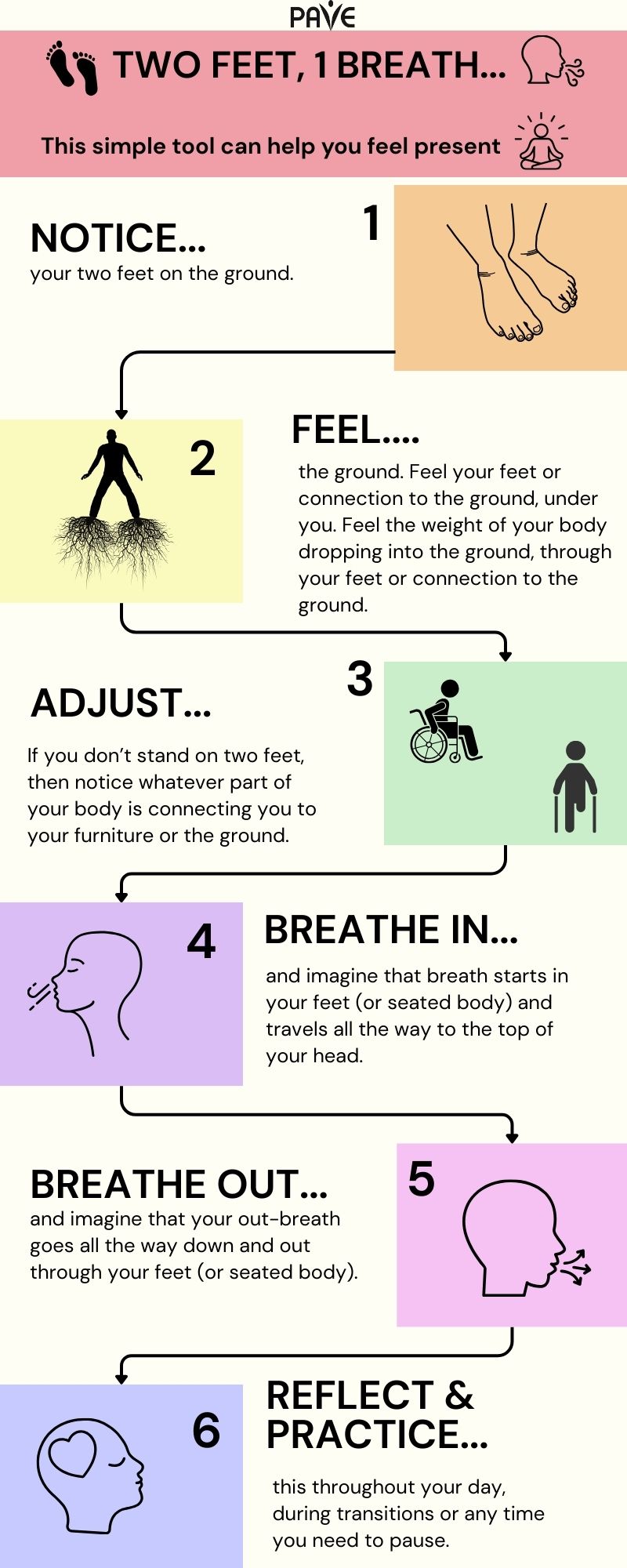
Two Feet, One Breath

Before you read anymore, try this simple self-care tool called Two Feet, One Breath. Doctors use this one in between seeing patients.

Two Feet, One Breath infographic. Calming practice that can help your mental health.

Download this infographic, Two Feet 1 Breath:
English | Chinese (Simplified) 中文 (Zhōngwén) | Korean 한국어 (Hangugeo) | Russian Русский (Russkiy) | Spanish Español | Tagalog | Vietnamese Tiếng Việt

Two Feet, One Breath can become part of every transition in your day: when you get out of bed or the car, before you start a task, after you finish something, or any time you go into a different space or prepare to talk with someone. This simple practice highlights how self-care can become integrated into your day.

Although a day at the spa might be an excellent idea, self-care doesn’t have to be fancy or expensive to have a big impact!

Almost everyone knows or cares for someone with special needs. According to the Centers for Disease Control (CDC), at least 28% of the American population experiences a disability. The result is widespread compassion fatigue, which is a way to talk about burnout from giving more than you get.

Below are some ways to use self-care to avoid burnout!

Connect with others

Building a support network with others who share similar life experiences can be incredibly valuable. When you’re going through a challenging or unique situation—like parenting a child with special needs or managing a family health issue—it can feel isolating. These connections offer emotional validation and a sense of understanding that can be hard to find elsewhere—you don’t have to explain everything because others simply get it. Research shows that social support can significantly reduce stress, anxiety, and depression, enhancing overall well-being and resilience. Beyond emotional comfort, support networks empower individuals by helping them build confidence, understand their rights, and even engage in advocacy efforts that benefit their families and communities.

Here are some communities and resources to help you get connected:

Parent-to-Parent Connections

The Parent-to-Parent network can help by matching parents with similar interests or by providing regular events and group meetings.

Support for Families of Youth Who Are Blind or Low Vision

Washington State Department of Services for the Blind (DSB) offers resources and support for families. You can also hear directly from youth about their experiences in the PAVE story: My story: The Benefits of Working with Agencies like the Washington State Department of Services for the Blind.

Support for Families of Youth Who Are Deaf or Hard of Hearing

Washington Hands and Voices offers opportunities for caregivers of youth who are Deaf or Hard of Hearing (DHH) to connect, share experiences, and find community.

Resources for Families Navigating Behavioral Health Challenges

Several family-serving organizations provide support, education, and advocacy for caregivers of children and youth with behavioral health conditions: 

  • Family, Youth, and System Partner Round Table (FYSPRT). Regional groups are a hub for family networking and emotional support. Some have groups for young people.
  • Washington State Community Connectors (WSCC). WSCC sponsors an annual family training weekend, manages a Substance Use Disorder (SUD) Family Navigator training, and offers ways for families to share their experiences and support one another.
  • COPE (Center of Parent Excellence) offers support group meetings and direct help from lead parent support specialists as part of a statewide program called A Common Voice.
  • Dads Move ​works to strengthen the father’s role in raising children with behavioral health needs through education, peer support and advocacy.
  • Healthy Minds Healthy Futures is an informal network on Facebook.

PAVE provides a comprehensive toolkit for families navigating behavioral health systems, including guidance on crisis response, medical care, education, and family support networks.

Get Enough Sleep

The body uses sleep to recover, heal, and process stress. If anxiety or intrusive thinking consistently interrupts sleep, self-care starts with some sleeping preparations:

Move Your Body

Moving releases feel-good chemicals into the body, improves mood, and reduces the body’s stress response. Walk or hike, practice yoga, swim, wrestle with the kids, chop wood, work in the yard, or start a spontaneous living-room dance party.

The Mayo Clinic has this to say about exercise:

  • It pumps up endorphins. Physical activity may help bump up the production of your brain’s feel-good neurotransmitters, called endorphins. Although this function is often referred to as a runner’s high, any aerobic activity, such as a rousing game of tennis or a nature hike, can contribute to this same feeling.
  • It reduces the negative effects of stress. Exercise can provide stress relief for your body while imitating effects of stress, such as the flight or fight response, and helping your body and its systems practice working together through those effects. This can also lead to positive effects in your body—including your cardiovascular, digestive and immune systems—by helping protect your body from harmful effects of stress.
  • It’s meditation in motion. After a fast-paced game of racquetball, a long walk or run, or several laps in the pool, you may often find that you’ve forgotten the day’s irritations and concentrated only on your body’s movements. Exercise can also improve your sleep, which is often disrupted by stress, depression and anxiety.

Be Mindful

Mindfulness can be as simple as the Two Feet, One Breath practice described at the top of this article. Mindfulness means paying attention or putting your full attention into something. Focusing the mind can be fun and simple and doesn’t have to be quiet, but it should be something that you find at least somewhat enjoyable that requires some concentration.  Some possibilities are working on artwork, cleaning the house or car, crafting, working on a puzzle, cooking or baking, taking a nature walk, or building something.

For more mindfulness ideas, check out PAVE’s Mindfulness Video Series. From this playlist, Get Calm by Getting Organized, explores how getting organized provides satisfaction that releases happiness chemicals and hormones.

Schedule Time

A day can disappear into unscheduled chaos without some intentional planning. A carefully organized calendar, with realistic boundaries, can help make sure there’s breathing room.

Set personal appointments on the calendar for fun activities, dates with kids, healthcare routines, and personal “me time.” If the calendar is full, be courageous about saying no and setting boundaries. If someone needs your help, find a day and time where you might be able to say yes without compromising your self-care. Remember that self-care is how you refuel; schedule it so you won’t run out of gas!

Time management is a key part of stress management! This article, “Stress Management: Managing Your Time” from Kaiser Permanente, gives tips for managing your time well, so you can reduce the pressure of last-minute tasks and make space for the things that matter most to you.

Seek Temporary Relief

Respite care provides temporary relief for a primary caregiver. In Washington State, a resource to find respite providers is Lifespan Respite. PAVE provides an article with more information: Respite Offers a Break for Caregivers and Those They Support.

Parents and caregivers of children with developmental disabilities can seek in-home personal care services and request a waiver for respite care from the Developmental Disabilities Administration (DDA). PAVE provides two training videos about eligibility and assessments for DDA. For more information about the application process, Informing Families provides a detailed article and video.

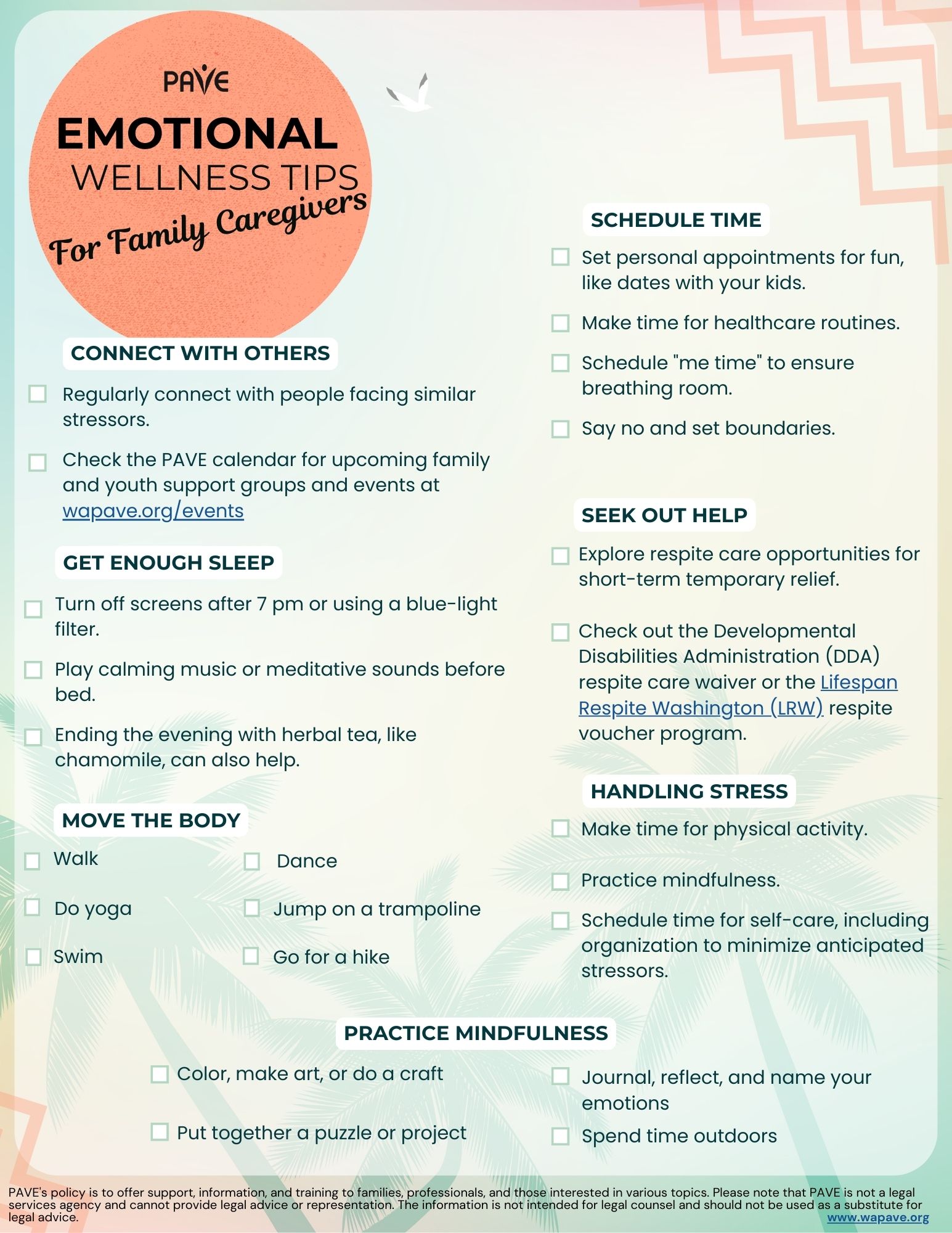
Download the Emotional Wellness Tips for Caregivers