
Behavioral Health and School: Key Information for Families

When a student struggles to maintain well-being, achievement at school can be a challenge. This video provides key information for families to seek school-based services for behavioral health needs. Included are two advocacy statements that this information might empower you to say in a meeting with the school:

  1. “I want to make sure my student’s rights are upheld.”
  2. “I’m providing information and resources to help the school follow the law and educational best practices.”

Included in the video is information about truancy and a new state law that schools must excuse absences for behavioral health reasons. Also included is information from the federal Office for Civil Rights (OCR), which provided new guidance in summer 2022 about school responsibility to help instead of discipline students with behavioral health needs.  

PAVE staff cannot provide advocacy or advice. We share information to empower family members and young people who do have legal advocacy rights. You can learn this information and keep in handy when you aren’t sure whether the school is following the law or educational best practices. Please be patient with yourself while you are learning this information. It can feel like a lot! As you learn a little bit at a time, you can see how your increasing knowledge shifts options and outcomes for your student.

Here are resources from this training, listed in video order:

Helping a Loved One with a Fear of Needles Get Vaccinated

Introduction

Families have different reasons for not vaccinating their children against illnesses. The Washington Department of Health (DOH) reports that vaccination rates dropped 13 percent in 2021. If you’ve put off taking your child to get a vaccine because your child falls apart with fear at the sight of a needle, here are some tips and tricks to break through that barrier.

Tips and Tricks

  • Explain why they are getting a vaccination in words they understand. For example, “If you don’t get vaccinated you might get sick and miss your birthday party.”
  • Bring brave with you. A favorite superhero on a picture, a hat, a shirt, or a mask provides something to look at and makes them feel brave while they get their shot. If Grampa is their superhero, bring a picture of him!
  • Don’t lie. Be honest that this isn’t fun. Let them know you understand their feelings and reassure them that they are brave enough to get this accomplished.
  • Tell their doctor or nurse before the appointment that your loved one has a fear of needles and ask for ideas. Go in with a shared plan for how to calm, distract, or reward your brave one.
  • Ask if there’s a cream or spray to numb the injection site. If yes, use this information to explain why they probably won’t feel a thing.
  • Give them control. When do they want to go? Do they want company? Do they have any ideas about how to feel brave or how to earn a reward?
  • Practice breathing slow and easy and talk about how to use that breath anytime you are feeling afraid or anxious. You might mention that calm breathing reduces pain.
  • Bring a treat or preferred distraction for the waiting room: games, shows on the tablet, a favorite toy…or plan some new jokes.
  • If it’s better not to look at anything, help them close or cover their eyes. You can offer a hand to squeeze or something to hold or touch—like a favorite blanket, pillow or stuffed animal—to direct sensory attention away from the place where the needle goes in.
  • If they want you to stay during the injection, be calm yourself. Calm is contagious.

Resources and Related Information

  • Pediatricians build vaccination schedules for children at specific ages and stages to maximize their effectiveness. Waiting until later might harm your child. The Academy of Pediatrics has information on ages and stages and vaccine suggestions.
  • If a person is allergic to eggs, gelatin, polyethylene glycol, or yeast, let a doctor know. Some vaccines include these ingredients. If you ask, there may be another option.
  • If you have read, heard, or thought about something that makes you nervous, tell your doctor. Always ask where information comes from, and check to make sure the source is trustworthy.

Willa Decides to Get Vaccinated

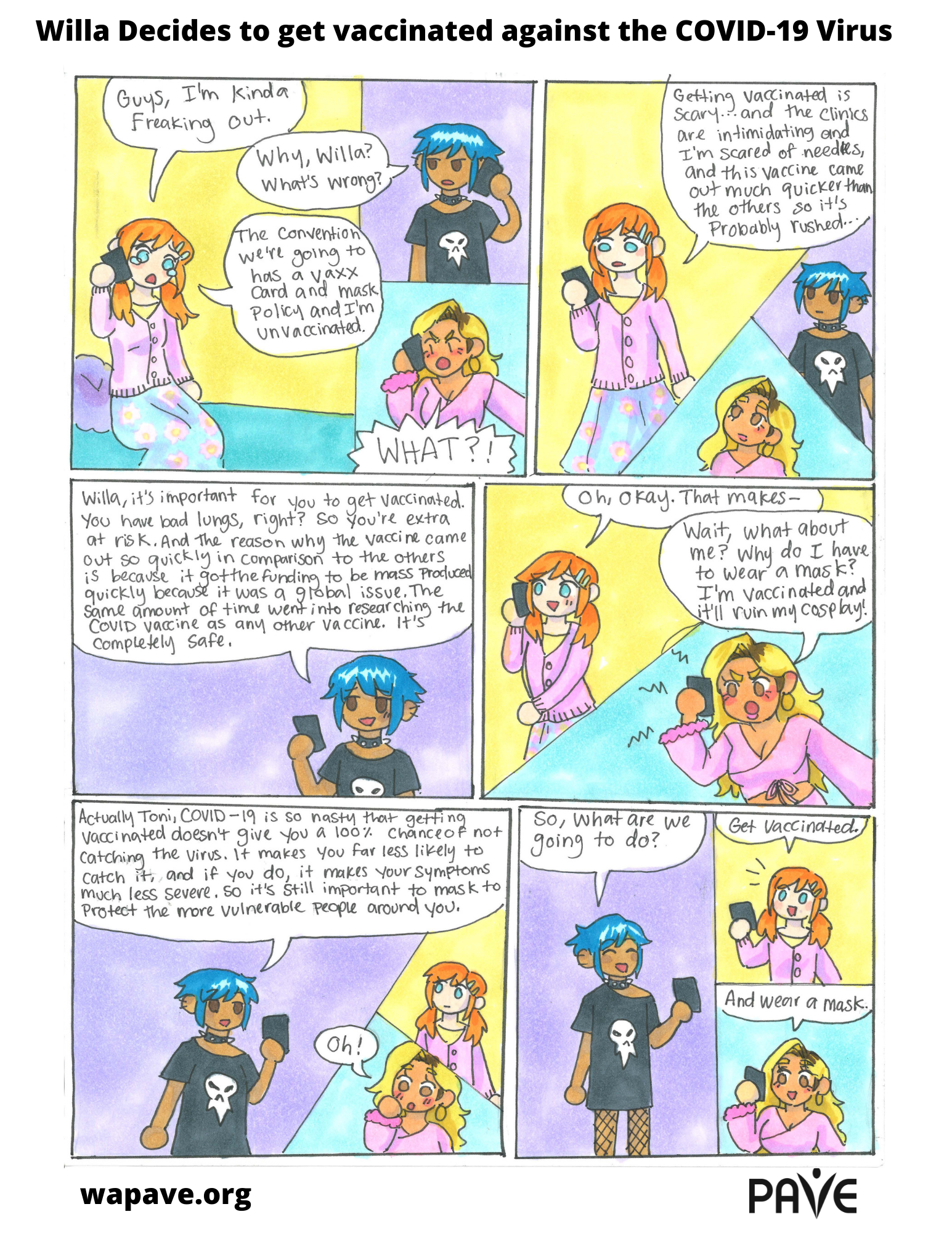
The decision to be vaccinated or when to mask can be confusing for anyone but for and individual that experiences anxiety, Autism, depression, or an Intellectual or Developmental disability the confusion around these decisions can be even more difficult. Willa experiences both High Functioning Autism and severe anxiety and this is a look into how she and her friends came to their own decisions based on learning about vaccinations and masking then talking together on what they felt is right for themselves and safe for the others around them.

Below are two different versions depicting Willa’s comic page in video form.

Willa decides to get vaccinated against the COVID 19 virus (No narration)

Willa decides to get vaccinated against the COVID 19 Virus (With narration)

*Please note, you can view Spanish subtitles by clicking on the cog on the lower right hand of the video, choose subtitles and then click on Spanish!

Willa Decides to get Vaccinated in comic strip

We also have Willa’s experience in a comic strip! Below each image, you will have the option to download the comic strip.

Comic page about Willa a character that decides to get vaccinated against the COVID-19 virus

Willa Decides to get Vaccinated in comic strip (Spanish Version)

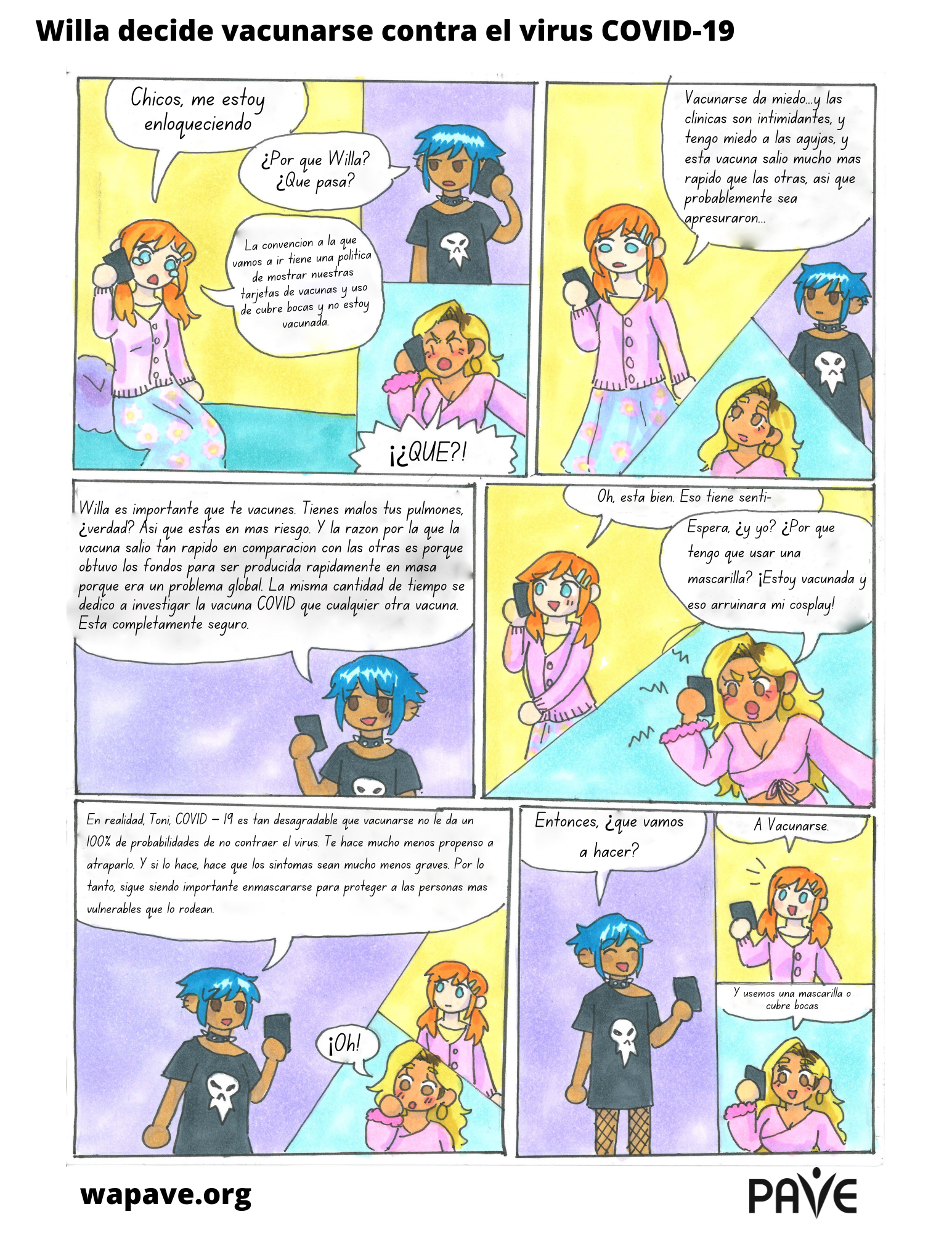
Comic page about Willa a character that decides to get vaccinated against the COVID-19 virus in Spanish

Click to see the comic above in PDF form.

Full text for this comic page:

Willa: Guys, I’m kinda freaking out.

Willa’s Friend: Why Willa? What’s wrong?

Willa: The convention we’re going to has a vaxx card and mask policy and I’m unvaccinated.

Toni: WHAT?!

Willa: Getting vaccinated is scary…and the clinics are intimidating, and I’m scared of needles, and this vaccine came out much quicker than the others, so it’s probably rushed…

Willa’s Friend: Willa it’s important for you to get vaccinated. You have bad lungs, right? So, you’re extra at risk. And the reason why the vaccine came out so quickly in comparison to the others is because it got the funding to be mass produced quickly because it was a global issue. The same amount of time went into researching the COVID vaccine as any other vaccine. It’s completely safe.

Willa: Oh, Okay. That makes-

Toni: Wait, what about me? Why do I have to wear a mask? I’m vaccinated and it’ll ruin my cosplay!

Willa’s Friend: Actually Toni, COVID – 19 is so nasty that getting vaccinated doesn’t give you a 100% chance of not catching the virus. It makes you far less likely to catch it. And if you do, it makes your symptoms much less severe. So, it’s still important to mask to protect the more vulnerable people around you.

Toni: Oh!

Willa’s Friend: So, what are we going to do?

Willa: Get Vaccinated.

Toni: And wear a mask.

Supporting literacy: Text-to-Speech and IEP goal setting for students with learning disabilities

A child who struggles to read can quickly fall behind in school. Nearly every academic area includes some reading, and children might become confused or frustrated when they don’t get help to make sense of their schoolwork. Behavior challenges can result, and sometimes schools and parents struggle to understand why the student is having a hard time.

This video provides information about two primary ways that schools can support students with learning disabilities that impact literacy:

  • Text-to-Speech (technology that provides audio-visual communication)
  • Specially Designed Instruction (SDI)

Student learning accelerates when both strategies work together, and this video provides tips for making that happen.

Washington passed a law in 2018 requiring schools to screen young children for the indicators of weaknesses associated with dyslexia and support literacy across all grades. The law took effect in the 2021-22 school year. PAVE provides an article with more information: Dyslexia Screening and Interventions: State Requirements and Resources.

After you view the video, please take a quick moment to complete our survey. Your feedback is valuable!

Behavior and School: How to Participate in the FBA/BIP Process

This 2-part training has information about how to support a child’s behavior at school. When behavior gets in the way of learning, schools are responsible to figure out what the child is trying to communicate and to teach the child what to do instead.

PAVE’s accessible, fillable worksheet goes with the videos to help with behavior planning.

The process of figuring out why a child is acting out is called a Functional Behavioral Assessment—FBA for short. The first video in this 2-part series is about the FBA process.

A Behavior Intervention Plan—BIP for short—is a working document that the school and family build together and review regularly to make sure the child is supported with positive reinforcement and encouragement for meeting behavioral expectations. The second video in this 2-part series is about BIP development.

PAVE provides a Sample Letter to Request a Functional Behavioral Assessment to help families formally ask the school to assess their child’s behavior and consider how to thoughtfully build a behavior support plan.

Schools are guided by the state to use best practices when evaluating and serving students with special needs. The Office of Superintendent of Public Instruction (OSPI) is the state educational agency in Washington State. OSPI’s website is k12.wa.us. A page called Model Forms for Services to Students in Special Education has links to downloadable forms schools use to develop IEPs, Section 504 Plans, and more.

Here are links to OSPI’s model forms for:

After you view the video, please take a quick moment to complete our survey. Your feedback is valuable!

Procedural Safeguards: How to File a Special Education Complaint

This training has information about parent rights and describes a process for filing a community complaint. When parents believe their child’s school has done something inappropriate related to the Individualized Education Program—their IEP—filing a complaint is one option available.

This training will help you know where to get a community complaint form and walks you through a pretend situation to demonstrate use of the form. The community complaint process is a no-cost option for families of children who receive special education services.

For more information and to access the community complaint form in your language, visit the website of the Office of Superintendent of Public Instruction (OSPI), the state educational agency for Washington State. To find the form, click on the question, “Is there a form for filing a community complaint?” The drop-down menu provides language options to download the form.

After you view the video, please take a quick moment to complete our survey. Your feedback is valuable!

Quick Start Your Advocacy in Two Steps

Asking for something you want or need for yourself or someone you love can take courage and inner strength. The ask is easier when you have basic advocacy tools. This short video provides a two-step process to help advocates step into their role with more confidence.

Here are the words that go with the video:

Being an advocate means speaking up to request something and pressing onward until the goal is met. The best advocates are really clear about two steps you cannot skip:

  1. Know what you want, and;
  2. Know who has the power to make that possible.  

This may sound obvious, but it’s not always easy. Let’s break it down with an example.

This is Julia—she’s a mom. Her 7-year-old son, Jose, isn’t learning to read like other kids his age. Julia wonders if Jose might have a learning disability. She mentions this to the attendance secretary one morning. Nobody contacts her. She assumes her worries are wrong or not important.

Hmmm, that doesn’t sound quite right, does it?

If she applies our two-step guide to advocacy, Julia can try again. She starts here:

  1. What does she want?
  2. Who has the power to make that happen?

First, she wants her son to get more reading help at school. Second, a classroom teacher or a special education teacher might help, but the attendance secretary is not the right person to ask.

It will take some work to press onward. Julia may need an appointment to formally talk with Jose’s teacher or a school administrator to get her advocacy project started. Here are some questions she might ask:

  • What do I do if I think my son might have a learning disability?
  • Is there a form for me to request a special education evaluation?
  • Who should I send my request to?
  • When will I get a response?
  • What’s the process for getting services to help my son?
  • What are my options if I disagree with the school’s decision?

Making a list of questions is an advocate’s homework. Taking careful notes helps with planning and often leads to faster results.

Remember, Julia wants her son to get more help learning to read. Her questions will help her figure out who to work with and what to do next.

Advocacy requires persistence. Don’t give up, and keep your eye on these two questions:

  1. What do I want?
  2. Who has the power to work with me and make that happen?

Friendships & Taking Care of Yourself: PURPAS

Great takeaways:

  • Meet new people, have fun, and talk about what you like to do!
  • Find a good new friend, learn to take the bus, manage your money, and learn how to be more presentable.
  • The gym helped me get more in shape and gave me my first job!

“I just wanted to better myself.  To be like a superhero.  And after doing my resume and sending it to the online site << boom >> I got a job!  And joining PURPAS I got new friends and learn how to take of myself.” – Randy

We envision an inclusive community that values the unique abilities, cultures, voices, contributions, and potential of all individuals.  Please join us in sharing Randy’s Recipe for Empowerment!

And if you, or those you know, can make a year-end donation, of any amount, thank you!

Navigating Life After Early Intervention Services

Great takeaways:

  • Get on waitlists and get engaged in community programs!
  • Connect with other parents
  • Grace for yourself & find what works for you!

“Our children are children.  Sometimes they are not ready, and we’re not ready to handle this now.  For example, cold and flu season can be hard to start or add more therapies.  We learned from our wrong turns.”  – Andrea

We hope you found hope, inspiration, and ideas for you, your child, or others you may know. And if you know We hope you found hope, inspiration, and ideas for you, your child, or others you may know.  And if you know of anyone able to donate…any amount – $5, $10, $50.  All donations will help PAVE provide support, training, information, and resources to empower and give voice to individuals, youth and families impacted by disabilities.   Please pass on Arianna & Andrea’s Recipe for Empowerment!

Make Good Feelings Stick Like Velcro

This video provides a mindfulness practice to make good feelings stick like Velcro. When the mind focuses on what’s going well, stress can slide off like Teflon. We’re sort of hard-wired to do the opposite. Click to understand why and learn a trick to hack your nervous system to spend more time thinking about good stuff and feeling mentally well.

Self-Care Videos for Mindfulness – Families Series

FAPE Fits Like a Proper Outfit

Have you ever felt like your student’s Individualized Education Program—their IEP—just isn’t a good fit? This short video provides an analogy to help families and schools talk about improvements.

Here are the words that go with the video:

Imagine if the school was responsible to provide a suit of clothes for your student. The clothes must fit in size and style. Let’s pretend your child is eligible for this specially tailored suit because clothes off the rack fit so poorly that the child won’t leave home. This problem is impacting everything.

This is sort of like the school’s responsibility to provide a child who has an IEP with FAPE. FAPE stands for Free Appropriate Public Education. The services delivered through an IEP make education appropriate because they are tailored to fit the child based on their strengths and needs. FAPE is what makes school accessible for a student with a disability.

Let’s go back to pretending that the school must provide a well-fitting suit. Imagine that the school opens a closet and says, “Let’s see what we have in here.” What they pull out might be too big, too small, outrageously mismatched or in colors and patterns that make your child grimace and refuse to get dressed. They might find bits and pieces that work, but chances are high that they won’t be able to put together a whole outfit without trying a little harder and getting out the sewing machine.

That’s like the work of an IEP team—to pull out the tools everyone needs to creatively build a program that is a good fit for the student.

The school is responsible under federal law to provide eligible students with FAPE. Tailoring a program to meet individualized needs in light of the child’s circumstances is part of FAPE. If you think your school is digging around in a closet trying to find a program for your student that is ready made, you can remind them that an IEP is individually tailored to fit the student.

Our Parent Training and Information team at PAVE hopes your IEP team designs a program that outfits your child for a successful journey through education. If you’d like our support, click Get Help from PAVE’s website, wapave.org.

Feel What You Feel

When emotions overwhelm us, we sometimes react in ways that we later regret. “Name it to Tame it” is a concept from neuroscientist Dan Siegel. It means that if we identify our emotions and work with them, instead of pushing them away, we are better equipped for self-control. This simple body sensing meditation creates a way to practice emotional self-awareness and build mental muscles for emotional regulation.

For more videos about mindfulness, please go to wapave.org Thanks for watching!

Take a Mindful Walk in Nature

Mindfulness can mean anything that helps you slow down and show up for what’s happening in a moment. This video demonstrates how to notice all of the body’s senses on a nature walk. Once it’s familiar, the concept could be useful in any environment, including indoors. Get creative and if it’s developmentally appropriate, you can encourage children to make up their own journey through their senses.