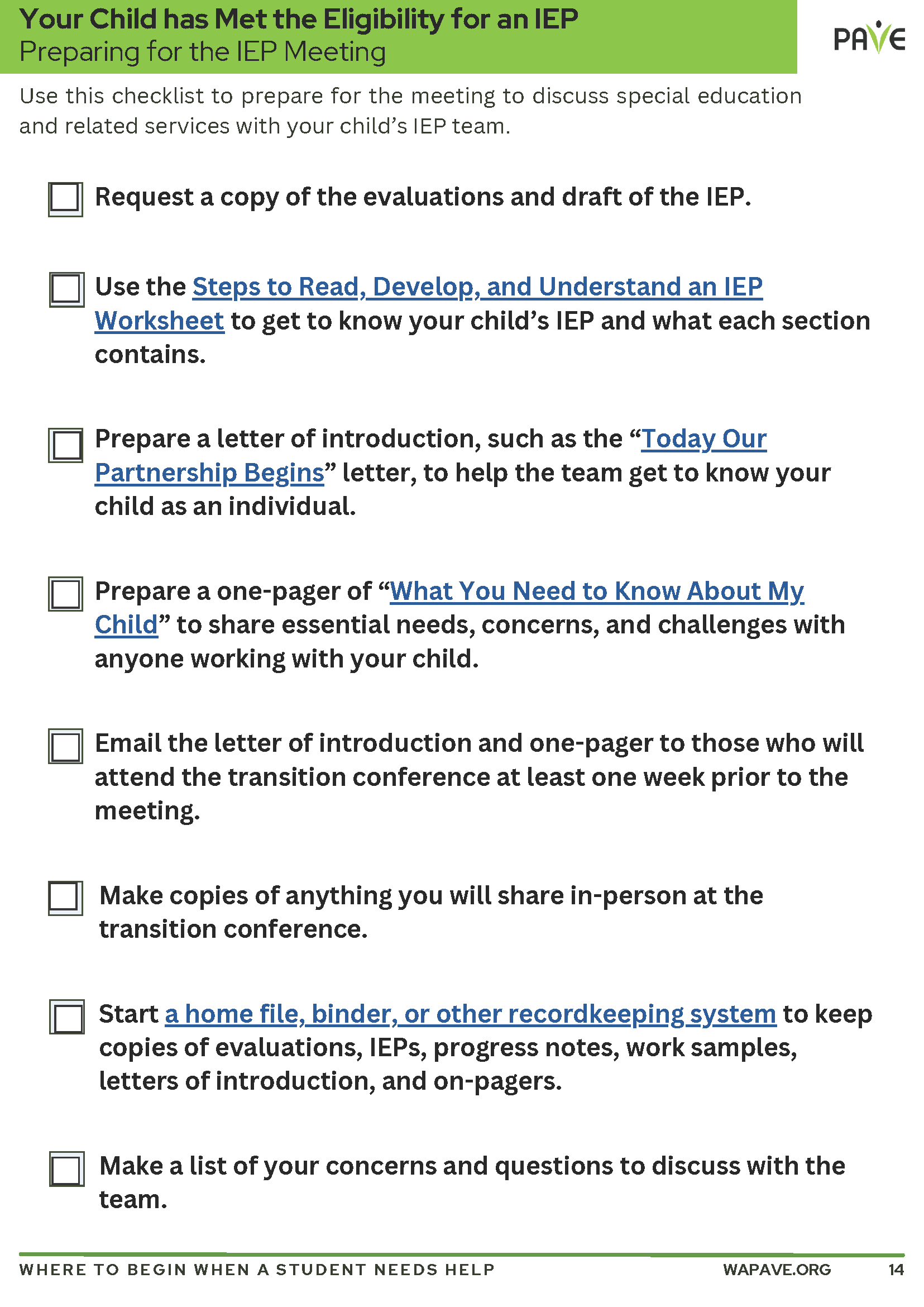

Your Child has Met the Eligibility for an IEP – Preparing for the IEP Meeting

Use this checklist to prepare for the meeting to discuss special education and related services with your child’s IEP team.

Preparing for the IEP Meeting Checklist

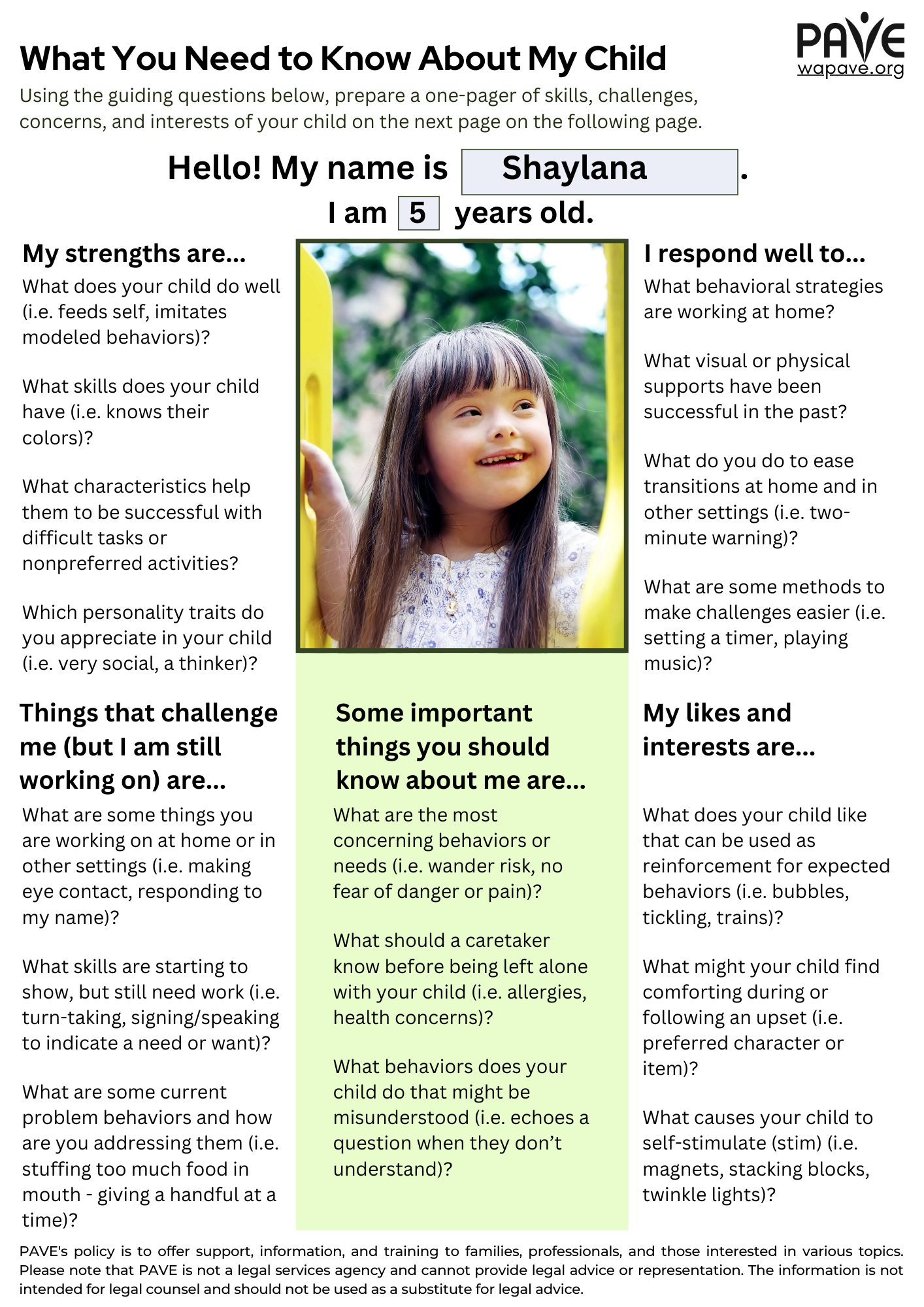
What You Need To Know About My Child

Using the guiding questions below, prepare a one-pager of skills, challenges, concerns, and interests of your child on the next page.


Hello My Name is (Insert name)

I am (insert age) years old.

My strengths are…Some important things you should know about me are…I respond well to…
What does your child do well
(i.e. feeds self, imitates
modeled behaviors)?

What skills does your child
have (i.e. knows their
colors)?

What characteristics help
them to be successful with
difficult tasks or
nonpreferred activities?

Which personality traits do
you appreciate in your child
(i.e. very social, a thinker)?
Attach a picture of your childWhat behavioral strategies
are working at home?

What visual or physical
supports have been
successful in the past?

What do you do to ease
transitions at home and in
other settings (i.e. two minute warning)?

What are some methods to
make challenges easier (i.e.
setting a timer, playing
music)?
Things that challenge me (but I am still working on) are…Some Important things you should know about me are…My likes and interests are…
What are some things you
are working on at home or in
other settings (i.e. making
eye contact, responding to
my name)?

What skills are starting to
show, but still need work (i.e.
turn-taking, signing/speaking
to indicate a need or want)?

What are some current
problem behaviors and how
are you addressing them (i.e.
stuffing too much food in
mouth – giving a handful at a
time)?
What are the most
concerning behaviors or
needs (i.e. wander risk, no
fear of danger or pain)?

What should a caretaker
know before being left alone
with your child (i.e. allergies,
health concerns)?

What behaviors does your
child do that might be
misunderstood (i.e. echoes a
question when they don’t
understand)?
What does your child like
that can be used as
reinforcement for expected
behaviors (i.e. bubbles,
tickling, trains)?

What might your child find
comforting during or
following an upset (i.e.
preferred character or
item)?

What causes your child to
self-stimulate (stim) (i.e.
magnets, stacking blocks,
twinkle lights)?

Sample is below:

About me sample

Now you are ready to fill out and print your own form!

Sample Letter to the IEP Team – Today Our Partnership Begins

This sample letter introduces a child to members of the IEP team by highlighting their strengths and individual personality, while also providing strategies and information about their disability. Use the Today Our Partnership Begins Worksheet to write an introductory letter for your child.

Dear Mr./Mrs./Mx. Teacher,

Today, our partnership begins.

Here are some things about (NAME) that you may not otherwise learn about him/her from his/her file. I invite you to contact me by phone (###-###-####) or email (email@domain.com), anytime you have questions about and how best to reach him/her.

(NAME) is (describe his/her culture and heritage). He/She has lived in Washington State for # months/years. (If you are new to the state, describe where your child has been raised up until this point.)

(If you are a military family, include information about your branch of service and how military moves or operations have impacted your child.)

(NAME) is actively involved in his/her community and he/she enjoys (describe any community participation groups, clubs, activities, or events). Outside of school, (NAME) is interested in (provide a short list of main hobbies, skills, and interests).

Some of my favorite things about (NAME) are his/her (personality and character traits). When he/she has trouble with something, he/she (describe your child’s strengths and existing coping strategies).

(NAME) has (name of disability), which affects him/her by (describe symptoms, challenges, and limitations). He/she has trouble with (list activities and skills that are impacted as a result of the disability). (Use this section to address common assumptions or miscommunications about the diagnosis, such as, “When it seems like he/she is being rebellious, it is really his/her way of showing he/she needs an opportunity to move around for sensory regulation.”)

At home, (NAME) responds well to (explain strategies for supporting your child’s needs, behaviors, sensory regulation, etc.).

I share this with you to start a conversation and share with you what our family has found helpful. We appreciate what you will bring to (NAME)’s life and we want to partner with you to make this a successful school year!

Thank you for taking the time to read this letter and get to know (NAME) a little better. Please feel free to reach out at any time and know that I will contact you as well when I have questions or concerns.

Sincerely

Parent’s Name

Phone number

Email

Differences Between Part B and Part C Services

The Individualized Family Service Plan (IFSP) ends when a child turns 3. Transitioning to a services under an Individualized Education Program (IEP) requires a new evaluation and is a team-led process. Let this handout serve as your cheat sheet for the differences between the IFSP and IEP.

Individualized Family Service Plan
(IFSP)
Individualized Education Program
(IEP)
Ages: Birth (0) to 3 years old
Governed by: Individuals with Disabilities
Education Act (IDEA), Part C
Also known as early intervention services (EIS)
Ages: 3-21 years old
Governed by: Individuals with Disabilities
Education Act (IDEA), Part B
Also known as special education services
Eligibility CriteriaEligibility Criteria
Division 125% or 1.5 SD (Standard Deviation) below the
mean in one or more of the following areas of
development:

1. Cognitive
2. Physical (fine or gross motor)
3. Communication (receptive or expressive language)
4. Social or Emotional
5. Adaptive

or –
Diagnosed physical or medical condition that
has a high probability of resulting in delay, such
as but not limited to:

Chromosomal abnormalities
Genetic or congenital disorders
Sensory impairments
Inborn errors of metabolism
Disorders reflecting disturbance of the
development of the nervous system
Congenital infections
Severe attachment disorders
Disorders secondary to exposure to toxic
substances, including fetal alcohol
syndrome
2 SD (Standard Deviation ) below the mean in
one or more areas of development
or –
1.5 SD below the mean in two or more areas of
development
meaning –

Has one or more of the following disabilities

1. Developmental Delay (ages 3-8)
Upon his/her 8th birthday, your child must
be eligible under a different category
2. Specific Learning Disability
3. Intellectual Disability
4. Autism
5 Hearing Impairment
6. Emotional Disturbance
7. Deaf-blindness
8. Multiple Disabilities
9. Orthopedic Impairment
10. Other Health Impairment
11. Deafness
12. Speech/Language Impairment
13. Traumatic Brain Injury

and –
The disability/disabilities adversely affect
his/her educational performance
and –
His/her unique needs cannot be addressed
through education in general education classes
alone, with or without individual
accommodations, and require specially
designed instruction (SDI)
Administered by: Early Support for Infants and ToddlersAdministered by: Washington Office of
Superintendent of Special Instruction (OSPI)
Focus Subject of ServicesFocus Subject of Services
The IFSP outlines the family’s needs in
supporting the child’s developmental progress.
During the first three years of development,
the child’s needs are closely related to the
needs of the family. Recognizing parents as
major contributors in development, the IFSP
builds upon the individual strengths of the
family to address the needs of the child.
The IEP is a comprehensive plan for school-age
children, addressing their educational needs
and academic goals. The IEP specifies the
special education services, goals, and
accommodations necessary for the child’s
education. Goals are typically related to
academic, functional, and behavioral areas.
Location of ServicesLocation of Services
Infants and toddlers usually spend their days
at home or in childcare settings. These are
their “natural environment”. By receiving their
IFSP services in the natural environment, the
family learns to use natural learning
opportunities (like playtime, meals, or baths) to
create countless opportunities for the child to
practice and develop delayed skills. It also
includes the family’s social and cultural
networks, promoting full participation in
community life.
At age 3, a child becomes eligible for special
education and related services. They may
receive services through a preschool, center based and family
childcare center, Early Childhood Education and Assistance Program
(ECEAP)
, or Transitional Kindergarten. IEP
services must be provided in the “least
restrictive environment”, meaning that the
child should be with typically developing peers
(those without disabilities) as much as the team
agrees is appropriate for the child.
Frequency of Review and Re-EvaluationFrequency of Review and Re-Evaluation
The IFSP has two different types of reviews:

The periodic review occurs at least every six
months, or more frequently if necessary for
the child’s condition. During the review,
the team discusses progress toward family
outcomes (goals), any new assessment
information, and whether the IFSP needs to
be changed or updated.

At the annual meeting, the team will update
the present levels of development, develop
new outcomes bearing in mind the family’s
priorities, and consider services that will be
needed and provided moving forward.
The IEP must be reviewed, at a minimum,
yearly. This annual review allows the IEP team
to assess the student’s progress, make any
necessary adjustments to goals and services,
and ensure that the IEP continues to meet the
student’s needs.
Every three years, a reevaluation is conducted
if deemed necessary. This reevaluation can
help determine if the student’s disability and
needs have changed and if the services and
goals in the IEP need modification.
*Parents may request an IEP meeting at any
time.

This article can be found as pages 5 and 6 of the 3-5 Transition Toolkit

Pathways to Support: Where to Begin If Your Child Receives Services Through Early Support for Infants and Toddlers (ESIT)

When an infant or toddler receiving early intervention services from Washington’s Early Support for Infants and Toddlers (ESIT) program approaches the age of three (3), the Family Resource Coordinator (FRC) begins transition planning for when the child will age out of early intervention services on their third birthday. If the child is potentially eligible for special education and related services, the transition includes evaluation and development of an Individualized Education Program (IEP). Each plan is unique and designed to respond to individual needs.

Transition begins 6-9 months before your child’s third birthday

Transition Planning BeginsTransition ConferenceEvaluation for an IEP
FRC starts talking about transitionScheduled by the FRC for 90 days before your child’s third birthday Begins with parent’s signature of consent for evaluation
FRC transmits your child’s records to the school system, with your written consent, including the most recent IFSP and evaluations/ assessments Explanation of parents rights in special educationSchool receives the records from ESIT
FRC identifies and shares community resourcesDiscussion of options for early childhoods special education and other appropriate servicesFamily provides information and concerns
Development of a transition timelineChild is evaluated for eligibility for an IEP
Writing transition plan into the IFSPEligibility meeting is held within 35 school days

Not all children who qualified for early-learning support will qualify for an IEP. Children who are not eligible for IEP services might be eligible to receive accommodations and support through a Section 504 Plan.

If your child needs support to prepare for school readiness

If a student is having a hard time at school and has a known or suspected disability, the school evaluates to see if the student qualifies for special education, through a process called Child Find. Washington State requires special education referrals to be in writing (WAC 392-172A03005). Anyone with knowledge of a student can write a referral. The state provides a form for making a special education referral, but the form is not required—any written request is valid.

  • Complete the Sample Letter to Request an Evaluation.
  • Make a copy for your records.
  • Call your local school district or go on their website to identify the correct office, person, and address to mail (signed, return receipt requested), email, or hand-deliver your request.
  • Refer to the IEP Referral Timeline to track your child’s progress through the evaluation process.
  • This article forms part of the 3-5 Transition Toolkit

Exceptional Family Member Program (EFMP), Part 2: How Does EFMP Benefit Military Families?

A Brief Overview

  • This is part of a two-part series on this topic of the Exceptional Family Member Program (EFMP). This article continues from Part 1: What Makes a Military Family Exceptional?
  • EFMP consists of three parts that work together for identification and enrollment, assignment coordination, and family support.
  • An off-site centralized office within the branch of service determines eligibility for EFMP and level of need.
  • Enrollment should be updated when there is new medical or educational information, and at least every three years.
  • EFMP enrollment ensures the family member’s needs are considered in the assignment process, although the military requirements take priority.
  • EFMP Family Support provides nonmedical case management, information, resources, and support.
  • Beginning in 2023, eligible families may access 20-32 hours of EFMP respite care per month through their branch of service, depending on level of need and availability of services.
  • Get the most from EFMP by contacting the installation’s Family Support office for information, resources, and support.

Full Article

The Exceptional Family Member Program (EFMP) is a mandatory program for all branches of the U.S. Armed Forces that helps military dependents with special medical or educational needs. The Army, Navy, Air Force, Marine Corps, and Space Force each have an Exceptional Family Member Program (EFMP). The Coast Guard, which operates under the authority of the Department of Homeland Security, has a similar program called the Special Needs Program (SNP).

EFMP is made up of three parts that work together to provide:

  1. Identification and Enrollment
  2. Assignment Coordination
  3. Family Support

Identification and Enrollment 

This is the entry point for EFMP. When the service member turns in the enrollment forms, they are sent for processing to an off-site centralized office within the branch that will determine eligibility and the level of need. The decisions are made by medical document reviewers who do not meet or speak with the dependents. Upon completion, the servicemember will receive a letter of verification from the EFMP program for their branch of service.

The same office will determine eligibility for TRICARE’s Extended Care Health Option (ECHO) supplemental medical insurance plan.

EFMP enrollment should be updated anytime the family member has new medical or educational information, and at least every three years.

Assignment Coordination

Once a family member is enrolled in the program, personnel and medical departments coordinate future duty assignments with consideration of the family member’s medical or educational needs. Although the family member’s needs are considered in the assignment process, military requirements take priority for assignment decisions. Orders that accommodate the family member’s needs may include:

  • Accompanied assignment only to locations that have services and resources to support the family member’s medical or educational needs.
  • Unaccompanied assignment, in which the servicemember relocates to the new duty station without the dependents, for a shorter duration than standard duty rotations.

If a service member disagrees with the availability or lack of availability of services at their next duty station, Department of Defense (DoD) Instruction 1315.19 (issued June 2023) provides them up to 14 calendar days from the date of the original assignment notification to request a second review and submit updated medical or educational information. A service being “available” does not mean the family won’t encounter a waiting list for these services, providers who are no longer taking clients or patients, or other interruptions in services.

Families enrolled in EFMP should ensure their paperwork is complete and current before assignment and permanent change of station (PCS) to a new duty station. Get ahead of assignment coordination and allow time for updates to be processed by updating the enrollment forms before the servicemember’s window opens for selecting orders.

Enrollment in EFMP does not prevent the service member from deploying or taking an assignment on unaccompanied orders.

Family Support

This is the department that directly serves families with nonmedical case management and support, including:

  • Information about local military and community programs, services, and supports.
  • Partnering with the School Liaison to provide information about early intervention services, special education, and school-based supports for students with disabilities.
  • Assistance with navigating DoD medical, educational, and counseling systems.
  • Local programs and activities for the benefit of families enrolled in EFMP, such as support groups, classes, and regional or installation events.
  • Warm handoffs to EFMP programs and School Liaisons at the next duty station.

Beginning in 2023, EFMP family support providers are required to personally contact each family assigned to their caseload and every family using the respective service’s respite care program at least once annually.

Find your EFMP enrollment or family support. In the drop-down menu for “Program or service”, select “EFMP Family Support” or “EFMP Enrollment”. Then, select your location from the drop-down menu labeled “Location based on”.

Respite Care

Eligibility requirements for EFMP respite care differ by branch of service and availability of services varies by location. The 2023 DoD Instruction 1315.19 standardized the respite care hours to 20-32 hours per month, across all branches of service, depending upon level of need of the eligible family member. It also extended coverage to include adult dependents and added the opportunity for eligible families to request additional services based on exceptional circumstances.

EFMP respite care is not an entitlement program, but a benefit available only to those who qualify. However, families who are ineligible for EFMP respite care may be able to access community-based respite care programs. EFMP respite care is also separate from TRICARE’s ECHO respite and ECHO Home Health Care (EHHC) respite programs, both with their own eligibility requirements.

Getting the most benefit from EFMP

Families enrolled in EFMP can get the most benefit from EFMP by contacting their installation’s Family Support office to:

  • Connect with the Family Support office at the new duty station to facilitate services and supports prior to a PCS
  • Locate resources at the state and local levels, such as civilian respite programs and disability-specific events
  • Identify state and federal benefits for which the enrolled family member may be eligible, such as Medicaid waivers, Vocational Rehabilitation, and scholarships for individuals with disabilities

The DoD developed the EFMP Family Support Feedback Tool as a method for families who have accessed their installation’s EFMP Family Support to provide feedback about their experiences. This information applies to the DoD’s Office of Special Needs’ policy development and program improvements for all branches of services.

Download the EFMP Enrollment Checklist.

Learn More about EFMP

This is part of a two-part series on this topic of the Exceptional Family Member Program (EFMP). This article continues from Part 1: What Makes a Military Family Exceptional?

STOMP (Specialized Training of Military Parents) provides information and resources to military families, individuals with disabilities, and both military and civilian professionals serving military families enrolled in EFMP. Register for upcoming STOMP workshops and webinars to learn more about the lifespan of benefits available to military families under federal law and military programs.

Military OneSource is an official DoD website and a information hub for all aspects of military life. EFMP & Me, a companion website managed by Military OneSource, organizes hands-on tools, federal and state information, military and civilian services and resources, and related supports and programs in one place.

Additional Resources

Exceptional Family Member Program (EFMP), Part 1: What Makes a Military Family Exceptional?

A Brief Overview

  • This is part one of a two-part series on this topic of the Exceptional Family Member Program (EFMP). This article continues in Part 2: How Does EFMP Benefit Military Families?
  • Every branch of the U.S. Armed Forces is required to have a program for dependents of active-duty service members (ADSMs) with special medical or educational needs called the Exceptional Family Member Program (EFMP).
  • The Coast Guard is the only branch of service that uses a different name for their program – the Special Needs Program (SNP).
  • Enrollment is mandatory for all dependents of active-duty service members who have a special medical or educational need, regardless of the dependent’s age.
  • The two standardized enrollment forms are available on Military OneSource and, where available, on branch-specific websites.
  • Enrollment support is available on installation at family support centers.

Full Article

The Exceptional Family Member Program (EFMP) is a mandatory program for all branches of the U.S. Armed Forces that helps military dependents with special medical or educational needs. The Army, Navy, Air Force, Marine Corps, and Space Force each have an Exceptional Family Member Program (EFMP). The Coast Guard, which operates under the authority of the Department of Homeland Security, has a similar program called the Special Needs Program (SNP).

Purpose and Intent

The purpose of the EFMP is to –

  • identify dependents of servicemembers with special education or medical needs,
  • make sure the family’s needs are considered during the assignment process,
  • connect families with resources and assistance wherever they are assigned, and
  • assist with questions, concerns, and resources.

Although the purpose of EFMP and SNP are the same across all branches of service, there are some differences with names, procedures, and forms. There are also differences by installation, such as the availability of respite care providers and services provided by EFMP Family Support.

Eligibility

Enrollment in EFMP is mandatory for eligible dependents of active-duty service members (ASDMs). It is not an age-limited or age-specific program; dependent children and adults, including spouses, incapacitated adults (unmarried adult children with disabilities, parents and parents-in-law, and other adult dependents), must be enrolled in EFMP if they meet one of the following criteria:

  • Have special medical needs, including chronic and/or mental health conditions, that require ongoing treatment from medical specialists.
  • Have significant behavioral health concerns.
  • Are eligible for or receive early intervention services (EIS) through an Individualized Family Service Plan (IFSP) for infants and toddlers (ages 0-3).
  • Are eligible for or receive special education services through an Individualized Education Program (IEP) for students aged 3 through 21.

National Guard and Reserve personnel with family members who have special medical or educational needs may be eligible during the time period when the service member is called for active-duty orders under Title 10 (10 U.S.C.).

Enrollment

Enrollment in EFMP or SNP begins with two enrollment forms that are available for download from Military OneSource:

  • DD Form 2792, “Family Member Medical Summary”: This form must be completed by the family member’s TRICARE-authorized primary care provider. This can be either the primary care manager or a specialty care provider.
  • DD Form 2792-1, “Special Education/Early Intervention Summary”: The instructions state that the child’s IFSP or IEP must also be provided with this form. If the child has an IFSP, is not yet enrolled in school, or is home-schooled, the parents may complete and sign the fields reserved for the educational authority.

Medical providers often require a separate appointment for completing the EFMP paperwork. Ask about the provider’s policy for completing paperwork and how to submit the forms before the visit while scheduling the appointment. The family member’s TRICARE plan and how the provider bills the appointment will determine whether there will be a copay for the visit.

Although all branches of service use the same standardized forms, some of the services have developed website platforms for families to submit the forms electronically.

Save time in the future by keeping a copy of the completed enrollment forms and IFSP or IEP in your home records system. Never give away your last copy!

Help with Enrollment

If this is the first time the family has submitted the EFMP forms, it is a good idea to first take them to the branch-specific military and family support centers on installations for review, including:

Reserve components also have branch-specific military and family support centers.  Learn more about what these programs offer and links to the branch-specific Reserve programs in this article from Military OneSource.

Find your EFMP enrollment or family support. In the drop-down menu for “Program or service”, select “EFMP Family Support” or “EFMP Enrollment”. Then, select your location from the drop-down menu labeled “Location based on”.

Download the EFMP Enrollment Checklist

Learn More about EFMP

This is part of a two-part series on this topic of the Exceptional Family Member Program (EFMP). This article continues in Part 2: How Does EFMP Benefit Military Families?

Additional Resources

Step-By-Step Guide to Requesting Accommodations on SAT and ACT Exams

The transition from high school to college can be a daunting experience for any teenager. Part of the transition process is preparing for and taking the entrance exams for college. If the student is receiving accommodations in school, they may qualify to receive special accommodations while taking a college entrance exam.

The ACT and College Board Services for Students with Disabilities (SSD) do not approve accommodations for all college entrance exams. Contact your school, college, or testing center for the CLEP and ACCUPLACER tests. Students with documented disabilities may request accommodations on PSAT-related assessments with the help of their school counselor.

Differences Between SAT and ACT Exams

Most universities accept both SAT and ACT and the length of both tests is approximately the same.  ACT has more questions in that same period, so fast workers may prefer it.  However, the best one for a student is the one they feel best about, so trying sections of both before choosing which one to study for is recommended by most test prep professionals. Both ACT and SAT have free practice sections available.

SATACT
Reading (65 min, 52 Questions)Reading (35 min, 35 Questions)
Writing (35 min, 44 Questions)English (45 min, 75 Questions)
Math (80 min, 58 Questions)Math (60 min, 60 Questions)
Optional essay (50 min)Science (35 min, 40 Questions)
Scored 400-1600Optional essay (30 min)
Scored 1-36

A student must have approval from the College Board SSD (for the SAT) or ACT to use accommodations on an exam. If a student uses extended test time or other accommodations without prior approval, their test results will be invalid.

The process of requesting accommodations varies depending on the exam. These are the steps to request accommodations on SAT and ACT college entrance exams:

Step 1: Document the need for accommodations.

The student must have a documented disability. Documentation can be a current psycho-educational evaluation or a report from a doctor. The type of documentation depends on the student’s circumstances. The disability must impact the student’s ability to participate in the college entrance exams. If the student is requesting a specific accommodation, documentation should demonstrate the difficulty the student has performing the related task. The College Board provides a disability documentation guideline and accommodation documentation guideline, as does the ACT. Doctor notes and Individualized Education Program (IEPs) or 504 plans may not be enough to validate a request for accommodations; you must provide supporting information, such as test scores. 

While students typically only receive accommodations if they have a documented disability, some (very few) students who have a temporary disability or special healthcare need can also be eligible. The request is different in these circumstances for those who wish to take the SAT exam and students are often urged to reregister for a date after they have healed. If the student cannot postpone their test, the request form for temporary assistance must be completed by a school official, student (if over 18) or parent, doctor, and teacher. Then, the form must be faxed or mailed to the College Board for processing.

Step 2: Allow plenty of time for processing.

It takes time to apply for accommodations, including a processing period of up to seven weeks after all required documentation has been submitted to the College Board SSD or ACT. If they request additional documentation, or if a request is resubmitted, approval can take an additional seven weeks. Start as early as possible before the exam date to allow enough time for processing, responding to a request for more documentation, and additional processing time. If the student will take the exam in the fall, they should begin the process in the spring to allow sufficient time for processing.

Step 3: Identify appropriate accommodations.

If the student has a formal education plan, review the current plan, and note accommodations listed throughout, especially (but not only) those the student uses during assessments. Read through recent medical evaluations, prescriptions, and records to ensure all accommodations have been included in the formal education plan, if the student has one, or to locate appropriate accommodations recommended by medical professionals. You may recognize some of the Possible Accommodations for SAT and ACT Entrance Exams.

Some accommodations may only be provided during certain sections of the exam, depending on the specific accommodation requested. For example, a student with dyscalculia may receive extended time during the math section of the exam but not for any other subject.

Step 4: Submit the request for accommodations.

The easiest way to request SAT accommodations is to go through your student’s school. If you choose to go through the school, the school’s Services for Students with Disabilities (SSD) Coordinator (Special Education Coordinator, Guidance/School Counselors, etc.) can go online to review the SAT Suite Accommodations and Supports Verification Checklist and submit the application. Having the coordinator submit the application will help streamline the process. Homeschooled students or those who choose not to go through the school may request accommodations on the SAT exam by printing the Student Eligibility Form and submitting all documentation by fax or postal mail.

Requesting accommodations for the ACT exam requires working with a school official who is a part of the IEP team. The accommodations requested should be similar to the accommodations currently being received in school and must be approved by ACT before the test. All requests, including appeals, must be submitted by the late registration deadline for the preferred test date. Homeschooled students may request accommodations on the ACT exam by creating an ACT account online and submitting the required documents electronically.

Step 5: Register for the college exam.

Once the student is approved for SAT accommodations, they will receive a Service for Students with Disability (SSD) number that must be included when registering for the test. The school’s SSD Coordinator should ensure all the correct accommodations are in place when it is time to take the college exam. Approved accommodations will remain in effect for one year after graduation from high school.

Additional Information

Dyslexia Screening and Interventions: State Requirements and Resources

A Brief Overview

  • Dyslexia is a common condition that makes it hard to work with language. Reading difficulties are one sign of dyslexia.
  • Washington passed a law in 2018 requiring schools to screen young children for indicators of dyslexia. The law took effect in the 2021-22 school year.
  • Dyslexia isSpecific Learning Disability. Students with learning disabilities are eligible for an Individualized Education Program (IEP) if they demonstrate a need for Specially Designed Instruction (SDI). SDI is key when a student isn’t keeping up with grade-level work and standard teaching strategies aren’t working.
  • The Revised Code of Washington (RCW 320.260) requires schools to support literacy with “multi-tiered” programming. That means schools provide different levels of help for all students who need it, regardless of special education eligibility.
  • Washington Office of Superintendent of Public Instruction (OSPI) has handouts about dyslexia screening and supports in WA Schools, some in multiple languages.
    [ ខ្មែរ (Khmer), 한국인(Korean), ਪੰਜਾਬੀ (Punjabi), Русский (Russian), Soomaali (Somali), Español (Spanish), Filipino/Tagalog, 中國人(Traditional Chinese), and Tiếng Việt (Vietnamese)] They are listed at the end of this article.

Full Article

A child who struggles to read can quickly fall behind in school. Nearly every learning area includes some reading, and children might become confused or frustrated when they don’t get help to make sense of their schoolwork. Behavior challenges can result, and sometimes schools and families struggle to understand why the student is having a hard time. Reading difficulties affect a student’s literacy. One definition of literacy is the ability to read, write, speak and listen in ways that let people communicate well. The Revised Code of Washington (RCW 320.260) requires schools to support literacy with “multi-tiered” programming to help with reading difficulties.

One cause of difficulty with reading is a specific learning disability called dyslexia. The state’s definition of dyslexia, adopted in 2018, is similar to a definition promoted by the International Dyslexia Association. According to Washington State’s definition:

“Dyslexia is a specific learning disorder that is neurological in origin and that is characterized by unexpected difficulties with accurate or fluent word recognition and by poor spelling and decoding abilities that are not consistent with the person’s intelligence, motivation, and sensory capabilities.”

Understood.org provides a video and additional materials to learn about dyslexia. Here’s their plain language definition: “Dyslexia is a common condition that makes it hard to work with language.”

Washington State requires dyslexia screenings (tests to find out if a student may have or be at risk for dyslexia) and interventions (help with reading). Lawmakers in 2018 passed Senate Bill 6162 to require schools to screen children from kindergarten through second grade using state-recommended literacy screening tools. The law took effect in 2021-22.

Since reading is used in almost every learning area, this law means schools have a duty to identify students who show signs of possible dyslexia while they are in their early reading years. The law also requires schools to provide “interventions” (help) to students identified through the screening.

OSPI offers a Fact Sheet about the screening in multiple languages. It includes the reason for the screening, who gives the screening, the skills that are screened, the process, and information about dyslexia.

What happens if the screening shows indicators (signs) of dyslexia?

The law requires the school to:

  • Notify the student’s family of the identified indicators and areas of weakness
  • Share with the family the school’s plan for multitiered systems of support to provide supports and interventions (help with reading)
  • The notice should include resources and information about dyslexia for the family’s use.
  • Update families regularly on the student’s progress

How can families tell if a student has trouble, or may have trouble with reading and language? Families can look for these signs in children who are toddlers and pre-kindergarten:

  • Trouble learning simple rhymes
  • Speech delays
  • following direction
  • Difficulty reading short words or leave them out
  • Trouble understanding the difference between left and right
    -Child Mind Institute Parent Guide to Dyslexia.

Screening happens in kindergarten through grade 2. If a student is already older than that, families can check for these signs of reading and language difficulty at home.

Understood.org states: “Dyslexia can also cause trouble with spelling, speaking, and writing. So, signs can show up in a few areas, not just in reading.” Understood.org lists these signs for students older than grade 2: Signs a Student May Have Dyslexia (handout)

The Washington Office of Superintendent of Public Instruction (OSPI) offers a Family and Caregiver Discussion Guide that may help when families are planning to speak to their child’s teacher or school administrators about their student’s reading difficulties, behavior, or other concerns.

What happens if the screening shows a student has signs of dyslexia, or if families or teachers notice signs and want a student to get help?

The school puts multi-tiered systems of support (MTSS) into action. “Multi-tiered systems” usually means beginning reading help as part of regular classroom reading instruction. If a student’s reading difficulties continue, the student may get more intensive instruction in smaller groups, and perhaps move up to intensive one-on-one time with a reading instructor. For any of these levels, the reading instruction must be “evidence-based” methods which means the methods have been tested and shown to be useful in helping with reading difficulties.

This guide for schools from OSPI has details about MTSS.

These more intensive levels of reading help may work very well. Not every reading difficulty is due to dyslexia, and not every person with dyslexia has the same level or type of reading difficulty.

At any point during these interventions, families or teachers may see a student is not making progress and ask that the student be evaluated for special education to see if the student qualifies for an Individualized Education Program (IEP). An IEP can provide Specially Designed Instruction (SDI), which means instruction will be based on the student’s unique needs and provide extra instructional time, assistive technology, and other supports.

The federal law that provides special education eligibility and funding is called the Individuals with Disabilities Education Act (IDEA). According to the IDEA, Dyslexia is a Specific Learning Disability. Specific Learning Disability is a category of eligibility for an Individualized Education Program (IEP). IDEA states that students have the right to a Free, Appropriate Public Education (FAPE), and the IEP is a key factor in a student having FAPE.

What types of help can a student get with reading and literacy?

Multi-tiered systems of support (MTSS) use instruction methods that have been proven to work for many students, starting with help in the general (regular) classroom. If a student doesn’t make progress that way, the student may join a smaller group for that gives each student more time with a teacher or reading specialist and even move on to one-to-one instruction with a reading specialist. These options are available to any student who shows signs of dyslexia or reading difficulty. OSPI offers Dyslexia Guidance (for schools): Implementing MTSS for Literacy with more specific information.


IEP: Students can get Specially Designed Instruction (SDI) based on their unique needs, such as particular areas of language and literacy where they have difficulties. Reading programs offered by the school can be included in an IEP. IEPs can include accommodations, which may include texts and instructions in audio format, text-to-speech/speech to text software, recording oral answers to assignment or test questions, access to distraction-free location for reading, allowing extra time to complete work or tests, and many more. Accommodations for Students with Dyslexia by the International Dyslexia Association lists many other options.

Section 504 Plan: Section 504 plans don’t include Specially Designed Instruction. They do include accommodations.

The National Center on Improving Literacy has information on when a Section 504 plan may make sense for a student with reading difficulties or dyslexia. They note that Section 504 Plans, which fall under Section 504 of the Rehabilitation Act of 1973, do not provide for Specially Designed Instruction. If a student’s reading has improved without an IEP by receiving multitiered systems of support, a Section 504 plan may offer Assistive Technology options, spelling checks, extended time on assignments and testing and other accommodations.

PAVE has articles and a video with more information about special education, IEPs, and Section 504 plans.

Interventions (help with reading) are schoolwide

Not all students who need reading support will need IEPs or a Section 504 Plan. The Revised Code of Washington (RCW 320.260) requires schools to support literacy through “evidence-based multi-tiered” programming. That means schools provide different levels of support for all students who need help, whether or not the student has an IEP or Section 504 Plan.

Some schools have reading programs funded by Title 1, which is part of a federal law called Every Student Succeeds Act (ESSA). Title 1 is funded to close opportunity gaps related to poverty and other measures.  

TIP: Ask about all options for reading support at your school. If a student with an IEP participates in a schoolwide reading program, then the IEP can list that program as part of the student’s services.

Dyslexia can be identified and helped without a diagnosis

Students do not need a diagnosis of dyslexia to be evaluated (tested) for special education eligibility. If the family has concerns, they can ask the school to evaluate the student. Requests should be in writing. PAVE provides a sample letter to help families request an educational evaluation.

Here’s a sentence to include in the evaluation request letter:

“I need my child tested for a specific learning disability. I believe there is a problem with reading that is disability related.”

TIP: When a student’s need for reading help qualifies for an IEP, there are important things that families need to know about how IEPs work, what the goals are for the student’s reading abilities, what type of reading help will be given, where the Specially Designed Instruction will take place, and what the parent’s and student’s roles and responsibilities are when their student has an IEP. These are the basics:

  • IEP Eligibility is based on a student’s needs
  • Specially Designed Instruction (SDI) serves the identified needs
  • The IEP tracks learning progress with specific goals in each area of SDI

What options do families have if they disagree with a school’s decisions about their student’s reading supports or other decisions?

  • If a student has not been screened for signs of dyslexia and the family has concerns, a first step is to meet with the student’s teacher. This article by the International Dyslexia Association offers specific steps families can take.
  • Families can request an evaluation to see if the student qualifies for an IEP or a Section 504 Plan.
  • If families disagree with the evaluation, they can request an Independent Educational Evaluation (IEE) from a provider outside the school. This article from PAVE gives steps and a sample letter to request and IEE: Evaluations Part 2: Next Steps if the School Says ‘No’
  • If the student has an IEP, this article gives specific steps to follow: Parents as Team Partners: Options When You Don’t Agree with the School.
  • For students with a Section 504 Plan, OSPI recommends:
    “The Section 504 coordinator in each district makes sure students with disabilities receive the accommodations they need and respond to allegations of discrimination based on disability. [Section 504 coordinators are members of a school’s Section 504 team which develops 504 Plans to accommodate a child’s needs]. A discussion with your school principal, or Section 504 coordinator at the school district, is often the best step to address your concerns or disagreements about Section 504 and work toward a solution. Share what happened and let the principal or coordinator know what they can do to help resolve the problem. If you cannot resolve the concern or disagreement this way, you can file a complaint.”

What else to know:

Keep in mind that families and schools don’t need to use the term dyslexia at all. They can talk about a student’s learning disability in reading, writing, or math in broader terms such as “Specific Learning Disability.” Under the Individuals with Disabilities Education Act (IDEA), dyslexia is a Specific Learning Disability that qualifies a student for special education.

Specific Learning Disability is defined by the Washington Administrative Code (WAC 392-172A-01035):
“Specific learning disability means a disorder in one or more of the basic psychological processes involved in understanding or in using language, spoken or written, that may manifest itself in the imperfect ability to listen, think, speak, read, write, spell, or to do mathematical calculations, including conditions such as perceptual disabilities, brain injury, minimal brain dysfunction, dyslexia, and developmental aphasia, that adversely affects a student’s educational performance.”

The state’s definition of learning disability excludes “learning problems that are primarily the result of visual, hearing, or motor disabilities, of intellectual disability, of emotional disturbance, or of environmental, cultural, or economic disadvantage.”

Here’s a handout on Accommodations and Modifications for Students with Dyslexia.

Resources

From PAVE:

Special Education is a Service, Not a Place
Student Rights, IEP, Section 504 and More (video)
Steps to Read, Understand, and Develop an Initial IEP
Supporting literacy: Text-to-Speech and IEP goal setting for students with learning disabilities
IEP Tips: Evaluation, Present Levels, SMART goals
Section 504: A Plan for Equity, Access and Accommodations
Evaluations Part 2: Next Steps if the School Says ‘No’
There’s more: just type “Special Education,” “IEP” or “504” in the search bar

From OSPI:

Family and Caregiver Discussion Guide with Educators and Schools
Understand Literacy Screening: Parents and Families
Available in ខ្មែរ (Khmer), 한국인(Korean), ਪੰਜਾਬੀ (Punjabi), Русский (Russian), Soomaali (Somali), Español (Spanish), Filipino/Tagalog, 中國人(Traditional Chinese), and Tiếng Việt (Vietnamese)
Best Practices for Supporting Grades 3 and Above
Section 504 & Students with Disabilities (web page)
Dyslexia Guidance (for schools): Implementing MTSS for Literacy

Dyslexia awareness is promoted by the National Center on Improving Literacy (NCIL), which provides resources designed to support families, teachers, and policy makers. On its website, the agency includes state-specific information, recommends screening tools and interventions and provides research data about early intervention.

The International Dyslexia Association has many detailed resources for families.

Military Interstate Children’s Compact Commission (MIC3), Part 2: Supporting Appropriate Placement and Inclusion of Military Families 

A Brief Overview 

  • This is part of a three-part series on this topic of MIC3, which continues from Military Interstate Children’s Compact Commission (MIC3), Part 1: The Impact of MIC3 on Military Families. The third part of the series is Military Interstate Children’s Compact Commission (MIC3), Part 3: How MIC3 Protects Academic Progress toward Graduation.  
  • MIC3 allows military parents to hand-carry “unofficial” (temporary) school records from the sending school to give to the receiving school for enrollment. 
  • The sending school must provide official records within ten business days of the receiving school’s request. 
  • If students have not been immunized, they have 30 days from enrollment to get the required shots or receive the first shot in a series. 
  • If a child was enrolled and attending kindergarten at the sending school, they must be allowed to enroll and continue at the receiving school, regardless of the school’s age requirement.  
  • A military child can keep going to the school in the school or district they have been attending, even if the person they are living with is in a different school district. 
  • MIC3 allows flexibility concerning extracurricular activities to include military children even if they can’t meet an application deadline. 

Full Article 

The Military Interstate Children’s Compact Commission (MIC3, pronounced “mick three”) is the more commonly used name for the Interstate Compact on Educational Opportunities for Military Children. MIC3’s rules provide consistent guidelines for how public schools address the most common challenges military-connected students experience during a PCS (permanent change of station, the military’s term for “relocation”). Washington codified MIC3 into state policy as RCW 28A.705.010.  

Enrollment 

MIC3 seeks to prevent students from losing academic time with enrollment provisions that address: 

  • Unofficial or hand-carried records. 
  • Official records and transcripts. 
  • Immunization requirements. 
  • Kindergarten and first-grade entrance ages. 

Unofficial or Hand-Carried Records 

MIC3 allows military parents to hand-carry photocopied or “unofficial” (temporary) school records from the sending school to give to the receiving school. Waiting for the original official transcripts can be time-consuming and not beneficial to the student since receiving official documentation from another state or overseas can take weeks. Under MIC3, the receiving school must use the unofficial records for the child’s enrollment. The unofficial records must include attendance records, academic information, and grade placement (part of the primary documents package). 

Official Records and Transcripts 

It is the receiving school’s responsibility to immediately request an official set of records (transcripts) from the sending school. The sending school must send out the official records within ten business days, with extensions allowed for school breaks. After school staff return from a break, the official records must be provided within ten business days.  

Immunization Requirements 

If a child hasn’t already had the immunizations (shots to protect against certain diseases) the receiving school requires, the student has 30 days from enrollment to get the shots. If the child needs a series of shots to be immunized, they must get the first shot within 30 days. The school may require a negative test for tuberculosis, which is not an immunization and, therefore, not covered by MIC3. 

Kindergarten and First Grade Entrance Ages 

When enrolling a child in school, MIC3 enables them to enter the grade they were in at the sending school. Suppose a child was enrolled and already attending kindergarten at their previous school. In that case, the new school must allow the child to enroll in kindergarten even if the age requirement differs. Suppose the child should be starting first grade. In that case, MIC3 says that if the child completed the previous grade in the sending school (including kindergarten), they could enroll in the next grade at the receiving school, even if the age requirements differ. The letter or transcript from the sending school must show the child’s attendance in kindergarten if the concerns is about kindergarten eligibility. 

Eligibility 

Regarding eligibility, MIC3 provides guidance on the issues of: 

  • Special power of attorney with guardianship. 
  • Extracurricular activities. 

Special Power of Attorney with Guardianship 

During deployments and other military mobilizations, children of servicemembers may live with another family member, non-custodial parent, or guardian through a Military Family Care Plan. Under MIC3, a military child can keep going to the school in the school or district they have been attending, even if the person they are living with is in a different school district. The school district cannot charge local tuition for living outside the district under these circumstances, except for optional programs offered by the school or district. The person taking care of the child will be responsible for transporting the student to the school while the child resides out-of-district. At enrollment, if not given to the school earlier, the parent or guardian must be provided with the Military Family Care Plan, Special Powers of Attorney, and/or custody orders. 

Extracurricular Activities 

States and local schools can be flexible so military children can be in sports and extracurricular activities, even if the child can’t meet an application deadline, including tryouts, seasonal conditioning, and other prerequisites instituted by the district or team supervisor. The child will still have to meet the eligibility standards for the activity, such as auditioning for sports or a music program. MIC3 requires that school and district programs make “reasonable efforts” to allow military children to participate in extracurricular activities, but this does not include holding open or creating additional spaces. MIC3 does not apply to state athletic associations, like travel teams or sportsman clubs, which are not a part of state or district education systems. 

Support with MIC3-Related Issues 

Parents can use this Step-by-Step Checklist to resolve issues that fall under the provisions of MIC3. For additional support, parents may contact their School Liaison, Parent Center, or MIC3 State Commissioner. As the parent center of Washington State, PAVE provides training to military-connected families, individuals with disabilities, and professionals through the STOMP program. Parents seeking individualized support may contact PAVE through the Get Help Form

Learn More about MIC3 

This article is part of a three-part series on the topic of MIC3. Military Interstate Children’s Compact Commission, Part 1: The Impact of MIC3 on Military Families introduces the scope and purpose of MIC3. This article outlines MIC3’s guidelines for how public schools address challenges related to enrollment and eligibility. Part 3: How MIC3 Protects Academic Progress toward Graduation explores MIC3’s placement, attendance, and graduation provisions. 

Additional Information 

Movers, Shakers, and Troublemakers: How Technology Can Improve Mobility and Access for Children with Disabilities

A Brief Overview

  • Mobility (the ability to move around) is important for interacting with the world, developing social relationships, and participating in our community
  • Ableism is when people are treated unfairly because of their body or mind differences. This can make people feel ashamed. It can also make it hard for them to move around because places aren’t accessible. This means they have fewer chances to be mobile.
  • Studies show that when kids with disabilities have self-initiated mobility (can start moving on their own), it helps them grow, make friends, and take part in things. This is true no matter how they move around.
  • Many young children with disabilities lack access to mobility technologies such as wheelchairs or supportive walking devices
  • It is important to spread the word about the benefits of mobility technology, and some of the current barriers that limit access to mobility technologies for children with disabilities
  • We need to tell people about how mobility technology can help kids with disabilities. We need to talk about why it can be hard for families to get this technology and work on making it easier to access these tools.
  • There are many ways for families to try mobility devices for children. They can work with their therapy teams to access the technology they need.
  • This article was developed in partnership with PAVE by Heather A. Feldner, PT, PhD, PCS and Kathleen Q. Voss (ed.),  University of Washington CREATE  (Center for Research and Education on Accessible Technology and Experiences)

Connecting to the World through Mobility

I want to invite you to take 30 seconds and think back to when you were a kid. What did you love to do?​ Why did you love it? How did this contribute to who you were, and how see yourself now? For me, it was playing the 80’s childhood game ‘ghosts in the graveyard’ around my neighborhood in the summer. Ghosts in the graveyard combines tag and hide-and-seek…in the dark. What could go wrong?!  I was with my friends, people I trusted. I was in my own yard, and the yards of my neighborhood. Places I knew well. Sure, there was a bit of risk, or what we thought to be risk in our young minds, but I loved to do it. I felt free and safe at the same time.​

So, what did you think of? Maybe for some of you, it was reading. For others, playing with friends at a playground, or in the sand and water at the beach. Maybe you were a dancer, or an artist. Perhaps you were on a sports team of some sort. Maybe it was none of these things. And regardless of how or where, I imagine we all got into some troublemaking. So, what made it all possible? I would guess that whatever it was, it was possible because of your ability to connect to the world, and objects, and people through mobility. ​

Ableism, Troublemaking, and the Importance of Mobility

Though we may have our own special idea of what mobility means, there’s also likely a lot of common ground, too. Let’s start with how the dictionary defines mobility and locomotion. According to Merriam-Webster, locomotion is defined as ‘the act or power of moving from place to place’. For mobility, we find ‘the ability or capacity to move; the ability to change one’s social or socioeconomic position in a community and especially to improve it.’ What stands out to you when you see these definitions? What is or isn’t included?

Note the definitions don’t talk about how people move or who’s moving. But what they do highlight is that mobility is powerful and social. We know society values some types of movement, like walking, more than others. For those with disabilities, this value judgement can lead to harm. This is ableism at work. It is thinking that being normal means being able-bodied. Ableism leads to unfair treatment of those who function differently. This connects to other ‘isms’ and makes things even harder. Even though there are tools like wheelchairs, walkers, scooters, and gait trainers to help with mobility, ableism affects how we see and value this technology in society. Because of this, people with disabilities wait longer for access, pay more, and have fewer choices. Just exploring these options can cause people to feel shame. Even then, many places are still inaccessible. Our mobility isn’t just about getting from one place to another. It helps us connect with others, make friends, explore new things, and have fun. When the mobility of disabled people is limited, it is an equity issue. For children with disabilities, ableism can take away their chance to be troublemakers.

Parents know that toddlers can be a handful. They touch everything, make messes, and often try to run away. But what if a toddler has a physical disability? How can we help them learn about their bodies and the world around them, especially when they might need help or special equipment to move around? Research shows that when kids start moving on their own, they learn a lot. They get better at understanding space, thinking, talking, and moving. Their relationships with parents and caregivers also improve. They show more emotions and hear more language from adults. These benefits happen for all kids, whether they crawl, use a baby walker, or drive a mobility device.

When kids can’t move on their own, either by using their muscles or with technology, they may have trouble starting to play and interacting with others. They may also have slower development in thinking, seeing shapes, and body awareness. Caregivers may not notice when the child tries to move or talk. Kids with disabilities are often described as quieter and better behaved than other kids. They are often placed near the fun but are not always part of the fun. This is not the child’s fault. It’s because our surroundings, technology, and ways of doing things don’t reflect how important it is for very young children with disabilities to move on their own. Parents and disabilities rights groups have worked hard to make schools more inclusive. But we need to do more to see how technology and design can help kids move and truly take part in things. As a pediatric physical therapist for kids and a technology researcher, my goal is to help kids with disabilities have more chances to be movers, shakers, and troublemakers.

Spreading the Word about the Importance of Self-Initiated Mobility

I work at the University of Washington as a researcher and associate director of an accessibility center called CREATE- The Center for Research and Education on Accessible Technology and Experiences. Our center has researchers from many different fields. We all focus on accessibility in different ways. My focus is on helping kids with disabilities access mobility technology. Our team works with children ages 1-5 who have trouble moving because of conditions like cerebral palsy, Down syndrome, spina bifida, muscular dystrophy, spinal muscle atrophy, and genetic conditions. Some kids will learn to walk. But it’s important for them to have other ways to move around while they practice. Sometimes people think using mobility technology keeps children from developing motor skills like walking. This isn’t true. Research shows that using technology can even help kids learn to walk and do other things better! Our work at CREATE is to learn more about how kids use technology to move and to explore new technology together with the disabled community. We want to share how mobility technology helps kids grow and interact with their world.

Trying Out or Obtaining Mobility Technology

  • We know it’s important for kids with disabilities to be able to move around on their own. Mobility technology can help them do that. If families want to try out or get this technology, how can they start? Here are some important things to think about:
  • Talk with your therapy team to see if they have any devices at the clinic that you can try or borrow
  • If they do not have any devices you can try, ask to be put in touch with a local durable medical equipment supplier. In Washington, you can also contact NuMotion, Bellevue Healthcare, or Olympic Pharmacy and Healthcare.
  • Regional equipment lending libraries may mobility technology for children. It is always worth asking. In Washington, Bridge Disability Ministries has locations in Tukwila and Bellevue, The Washington Technical Assistance Program (WATAP) ships mobility technology accessories (not devices themselves) across the state. There are many other libraries throughout the state that are grouped together on the Northwest Access Fund loan program website.
  • When buying mobility technology, there are many things to consider. Think about the size and weight of the device and your transportation needs. Also think about how your home is set up and how your child will grow. An equipment clinic at a local hospital or therapy center can help. They have staff that can help you find the best equipment for your child as they grow.
  • Some people buy mobility technology themselves, but most get it through public or private funding. To get funding, you need a letter from a doctor saying your child needs the equipment. The letter must explain why the equipment is a good match for your child’s needs, how much it costs, and how it will be used at home and in the community. Staff at equipment clinics usually write the letter and send it to the doctor to sign. Then they send it to the funding agency.
  • It can take 3-12 months to get approved for mobility technology, depending on how you’re paying for it. Sometimes the first request is denied, and you have to appeal. It’s important for you and your equipment clinic team to keep fighting for your child’s needs.
  • You can also make your own mobility technology through the University of Washington Go Baby Go! program. This program changes battery-powered toy cars so kids with disabilities can use them. The cars are changed with a switch and special seats to help kids move around on their own. The program is for young kids from 9 months to 5 years old and is free for families.

Families can learn more about mobility technology by taking part in research. This can help them find out what types of technology are available and get practice using it. For example, at CREATE, we have done studies on how kids with Down syndrome move and explore, how young kids learn to use powered mobility devices, and how families use adapted toy cars. Taking part in research is always up to the family. Parents must give permission for their kids to join. Research studies are usually advertised on university websites and at therapy clinics. You can also join a research registry or ask your therapy team for help finding local researchers. Research centers like CREATE partner with people with disabilities and families to find out what research is most important to them.

In conclusion, being able to move around on your own is a basic human right. It is also really important for kids’ development and social life, no matter how they do it! Mobility technology can help children with disabilities, but it can be hard for families to get. Trying out equipment through therapy providers or lending libraries, buying equipment, or taking part in research can all help your child experience the benefits of mobility technology. These benefits can help your child grow, make friends, and take part in things.

References and Additional Resources:

Sabet, A., Feldner, H., Tucker, J., Logan, S. W., & Galloway, J. C. (2022). ON time mobility: Advocating for mobility equity. Pediatric Physical Therapy, 34(4), 546-550.

Feldner, H. A., Logan, S. W., & Galloway, J. C. (2016). Why the time is right for a radical paradigm shift in early powered mobility: the role of powered mobility technology devices, policy and stakeholders. Disability and Rehabilitation: Assistive Technology, 11(2), 89-102.

UNICEF Assistive Products and Inclusive Supplies

Family Information Guide to Assistive Technology

Oregon Family to Family Health Information Center – Wheelchairs for Children and Youth. Safe and Practical Options that Support Dignity and Community Inclusion

Washington State Department of Social and Health Services – Assistive Technology Services

Center for Research and Education on Accessible Technology and Experiences CREATE

Back To School Checklist!

Late summer is the time to gather school supplies, find out what time the school bus will pick up and drop off, and prepare to find new classrooms and meet new teachers. Parents of students with disabilities have some additional things to check off the list to be ready for the year ahead. As August is National Immunization Month, we are adding updated immunizations and flu and covid boosters to the reminders. These are fully covered medical expenses whether you have insurance or not and can go a long way to keeping your child and your family healthy as we move into the fall and winter months. There are multiple events across our state where families can go to for immunizations.  

Super important: As school begins, make sure you know what’s included in your child’s Individualized Education Program (IEP), Section 504 Plan, and/or Behavior Intervention Plan (BIP). For more, see PAVE’s article: Tips to Help Parents Plan for the Upcoming School Year

If you are new to Washington State, perhaps because of military service, you also may want to review some basic information about how education and special education are structured and delivered here. PAVE provides an article: Help for Military Families: Tips to Navigate Special Education Process in Washington State. 

Here’s a checklist to help you get organized:

  1. Create a one-pager about your child to share with school staff
    • Include a picture
    • List child’s talents and strengths—your bragging points
    • Describe behavioral strategies that motivate your child
    • Mention any needs related to allergy, diet, or sensory
    • Highlight important accommodations, interventions, and supports from the 504 Plan, IEP, or BIP
  2. Make a list of questions for your next meeting to discuss the IEP, BIP, or 504 Plan
    • Do you understand the goals and what skills your child is working on?
    • Do the present levels of performance match your child’s current development?
    • Do accommodations and modifications sound likely to work?
    • Do you understand the target and replacement behaviors being tracked and taught by a Behavior Intervention Plan (BIP)?
    • Will the child’s transportation needs be met?
  3. Mark your calendar for about a week before school starts to visit school and/or send an email to teachers, the IEP case manager, and/or your child’s counselor
    • Share the one-pager you built!
    • Ask school staff how they prefer to communicate—email, phone, a notebook sent back and forth between home and school?
    • Get clear about what you want and need, and collaborate to arrange a communication plan that will work for everyone
    • A communication plan between home and school can be listed as an accommodation on an IEP or 504 Plan; plan to ask for your communication plan to be written into the document at the next formal meeting
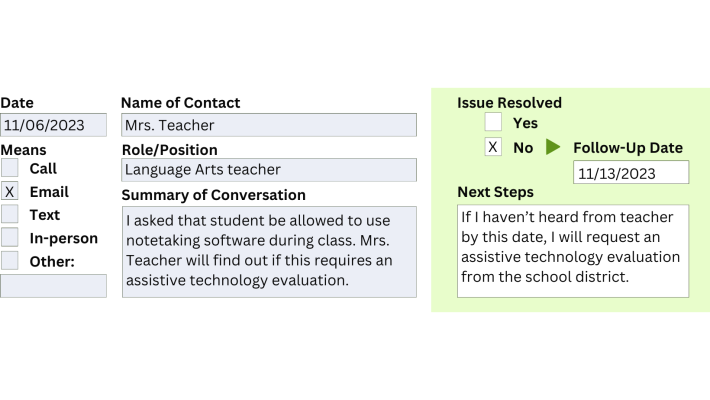
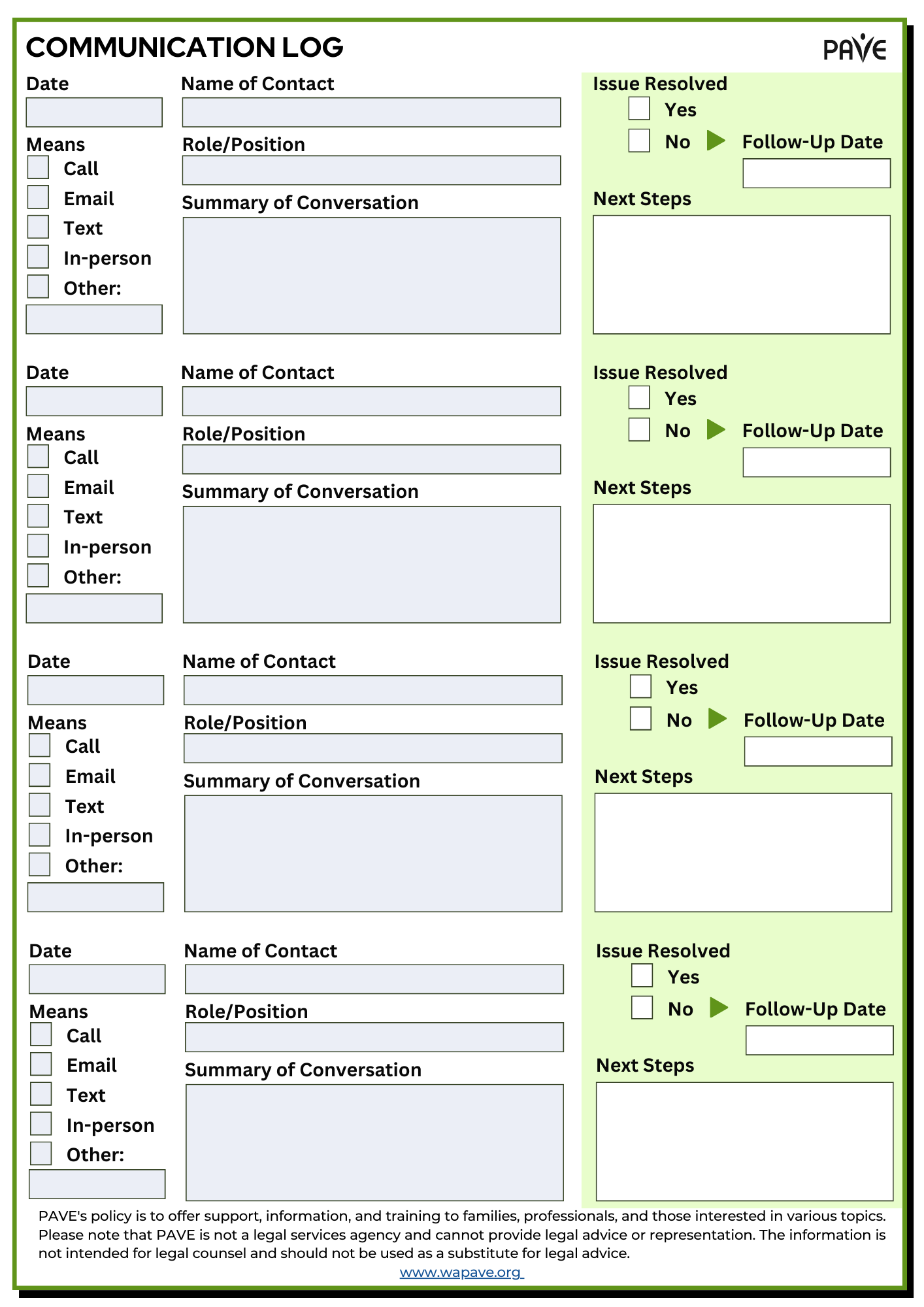
  4. Design a communication log book
    • Can be a physical or digital notebook
    • Plan to write notes every time you speak with someone about your child’s needs or services. Include the date, the person’s full name and title, and information about the discussion
    • Log every communication, whether it happens in the hallway, on the phone, through text, via email, or something else
    • After every communication, plan to send an email thanking the person for their input and reviewing what was discussed and any promised actions—now that conversation is “in writing”
    • Print emails to include in your physical log book or copy/paste to include in a digital file
    • Having everything in writing will help you confirm what did/didn’t happen as promised: “If it’s not written down, it didn’t happen.”
  5. Consider if you want to request more information about the credentials of teachers or providers working with your child. Here are some things you can ask about:
    • Who is providing which services and supports?
    • Who is designing the specially designed instruction (SDI)? (SDI helps a child make progress toward IEP goals)
    • What training did these staff receive, or are there training needs for the district to consider?
  6. Ask  the special education teacher or 504 case manager how you can share information about your child, such as a one-pager, with school team members. This includes paraprofessionals or aids and other members of the school team.
    • Parents have important information that benefit all school team members. Ask who has access to your child’s IEP or 504 Plan and how you can support ensuring team members receive information
  7. Have thank you notes ready to write and share!
    • Keep in mind that showing someone you appreciate their efforts can reinforce good work
  8. Celebrate your child’s return to school
    • Do the bus dance on the first morning back to school!
    • Be ready to welcome your child home with love and encouragement. You can ask questions and/or read notes from your child’s teachers that help your loved one reflect on their day and share about the new friends and helpers they met at school

Below is an infographic of the above information.

Tip! you can click on the image and access an accessible PDF to print and keep handy.

Back to School Checklist click to find the accessible PDF

Click to access an accessible PDF of the infographic above

We also have this infographic in 8.5 x 11 easy to print size! Access it now!

How to Decide on a Post-Secondary Program Worksheet

The following information is part of the college readiness workbook. You can download this and other parts of this workbook for your personal use. Each document is fillable.

Fill in your answers to the questions.

Talk With Each Other

  • What are my abilities?
  • What are my strengths?
  • How does my disability affect my learning and ability to show what I know on tests?
  • What accommodations do I need to be successful?
  • What postsecondary education or training programs do my teachers and school counselors recommend for my areas of interest?

Talk Together About Your Concerns With Student Support Services

  • Where is the school located and does that school setting (urban, suburban, or rural) meet my needs?
  • If I cannot live independently, what is the distance from home?
  • Does the student/instructor ratio ensure I can access office hours with my instructor(s) as needed?

Not all programs provide the same accommodations, and colleges do not make modifications to alter academic requirements.

  1. Does the program offer the accommodations I need to be successful?
  2. Are the housing options accessible for my individual needs?

Do I require someone to assist with:

  1. Self-help (like bathing)?
  2. Managing my medications and medical treatments?
  3. Nutrition and hygiene needs (laundry, washing dishes, cooking?)
  4. Do I have a service animal?

Disclaimer: All content is for informational purposes only. The information on this page is not a substitute for legal advice. When it comes to the law and policy matter, please consult an attorney or advocate on your child’s behalf.

Myth and Misunderstanding in Special Education

A Brief Overview

  • Everyone has moments when they hear something and pause to wonder, Is that true? This article and its companion videos describe some special education topics that may be misunderstood. Included is an explanation of what is fact.
  • Topics relate to special education eligibility, placement, support personnel, bullying, student discipline, and more.
  • Read on to see if there are things you haven’t quite understood about your student’s rights or educational services. PAVE hopes to empower families with information to make sure students with disabilities have their best chance for an appropriate and meaningful education.
  • The final myth described in this article is that PAVE provides advocacy on behalf of families—we don’t! But we can help you learn to be your child’s most important advocate. Click Get Help at wapave.org to request 1:1 assistance.

Full Article

Everyone has moments when they hear something and pause to wonder, Is that true?

Parents/caregivers in meetings with their child’s school can feel particularly confused when something doesn’t sound right. They might wonder whether it’s appropriate to question school authorities. They might not understand all the words being spoken. Fear of not knowing something can make it uncomfortable to speak up.

At PAVE, we encourage families to ask questions and make sure they understand the words school staff use. Ask for important answers in writing, and plan to research explanations that are confusing.

For example, if you ask for something and the school says no because of a law or policy, ask for a written copy of the relevant parts of that law or policy. Try to understand the school’s reason for saying no. Write down what you understand and send a reflective email to school staff to make sure you understand their position correctly.

Having everything in writing is important, especially if filing a complaint is a possible next step.

This article describes myths and misunderstandings some people might experience when navigating school-based services for students with disabilities. These topics apply to students with Individualized Education Programs (IEPs), students with Section 504 Plans, and students with possible disability conditions impacting their educational access.

Parent Participation

MYTH: The school must hold a meeting without a parent if the parent is unavailable before an annual renewal deadline because the student’s IEP, 504 Plan, or eligibility will expire or lapse.
FACT: Parent participation is a higher priority than deadlines. Schools are required to accommodate parents/caregivers to ensure their attendance and participation at meetings where their child’s special education services are discussed. Those rights are affirmed in a court decision from 2013: Doug C. Versus Hawaii. If a meeting is delayed because a family member is temporarily unavailable because of illness, work, travel, or something else, services continue uninterrupted until the meeting. PAVE provies an article: Parent Participation in Special Education Process is a Priority Under Federal Law.

Evaluation

MYTH: The school is not required to evaluate a student who gets passing grades.
FACT: If there is a known or suspected disability condition that may be significantly impacting a student’s access to any part of their education—academic, social-emotional, behavioral, or something else—then the school district is responsible under Child Find to evaluate the student to determine eligibility for services and support. Child Find is an aspect of federal law, the Individuals with Disabilities Education Act (IDEA).

MYTH: Section 504 doesn’t apply for a student without a plan or program.
FACT: Section 504, which is part of the federal Rehabilitation Act of 1973, includes protections for students with suspected or known disability conditions that warrant evaluation. For example, if a student consistently misses school for reasons that may be connected to disability, the school may be accountable under the civil rights protections of Section 504 if an evaluation referral isn’t initiated.

MYTH: Section 504 eligibility does not involve an evaluation.
FACT: An evaluation process is required to determine whether a student has a disability condition impacting a major life activity. That evaluation process may include a review of grades, test scores, attendance, health room visits, parent and student input, teacher observations, medical or psychological evaluations, special education data, medical information, and more. If the student meets criteria, evaluation documents are used to support the design of accommodations and other individualized supports to ensure equity. The state provides a family-friendly handout, downloadable in multiple languages, to describe 504 eligibility, evaluation process, plan development, and civil rights complaint options.

Medical Diagnosis

MYTH: A student cannot be identified as eligible for services under the autism category unless they have a medical diagnosis of autism.
FACT: If there is a suspected disability condition and reason to believe there is a significant educational impact, the school is responsible under Child Find to evaluate the student to determine eligibility for services. Schools have evaluation tools to determine characteristics of autism, its possible educational impacts, and student needs. Medical information might help an IEP team design interventions, but families are not required to share medical information with the school, a medical diagnosis is not required, and doctors may not “prescribe” an IEP.

Placement

MYTH: Special Education is a location within the school.
FACT: Special Education is a Service, Not a Place, and PAVE provides an article by that title to further explain a student’s right to educational services in general education—the Least Restrictive Environment (LRE)—to the maximum extent appropriate.

MYTH: The school district is in charge of placement decisions.
FACT: The IEP team determines a student’s placement. If placement in general education, with support, is not meeting the student’s needs, the IEP team is responsible to locate or design a placement that best supports the student in accessing their Free Appropriate Public Education (FAPE). Placement might be general education, a segregated classroom setting where special education services are provided, day treatment, alternative learning environment, residential, home-based, something else, or a combination of any of these options. Once an IEP team designs a placement, the school district has some leverage in choosing a location. For example, if an elementary-age student who is struggling to read needs individualized services from a reading specialist, the district might bus them to a school in another neighborhood where a specially trained teacher provides reading instruction in a smaller classroom. The district doesn’t have to offer every placement or service within every building, but it does need to serve the IEP as written by the IEP team.

MYTH: Preschool IEPs are not required to serve students in the Least Restrictive Environment to the maximum extent appropriate.
FACT: An IEP is required to serve a student with a Free Appropriate Public Education (FAPE) in the Least Restrictive Environment (LRE), to the maximum extent appropriate, regardless of age or grade level. WAC 392-172A-02050 provides specific language about state requirements for LRE, including for preschool students.

Adult Aids at School

MYTH: A 1:1 creates a “restrictive environment” for a special education student.
FACT: Least Restrictive Environment (LRE) refers to placement. A helper is an aid, not a placement. Supplementary aids and services, including 1:1 support from an adult staff member, may support access to the Least Restrictive Environment (LRE) for some students. If having a 1:1 enables a student to appropriately access learning in the general education setting, then that support is provided to ensure FAPE (Free Appropriate Public Education). FAPE within LRE is required by federal special education law, the Individuals with Disabilities Education Act (IDEA).

MYTH: Support personnel should regularly rotate in their roles to ensure a student does not become “dependent” on specific individuals or relationships.
FACT: Healthy interpersonal relationships enable humans of any age to feel safe and secure. Because of the way our brains work, a person doesn’t learn well when a fight/flight nervous system response is activated. Connecting to trusted adults and receiving consistent help from safe, supportive people enhances learning. PAVE provides a collection of articles about Social Emotional Learning (SEL) and Washington State’s SEL Standards.

Section 504

MYTH: A 504 Plan is a watered down IEP.
FACT:
Section 504 is part of a civil rights law called the Rehabilitation Act, passed by the US Congress in 1973. The anti-discrimination protections of Section 504 apply to any person identified as having a disability condition that impacts their life in a significant way. Public agencies, including schools, are responsible to provide individualized accommodations and support to enable the person with a disability to access the service, program, or building in a way that affords them an equitable chance to benefit from the opportunity. A 504 Plan at school ensures the right to a Free Appropriate Public Education (FAPE). Section 504 FAPE rights are upheld by the US Department of Education’s Office for Civil Rights. PAVE provides a video series: Student Rights, IEP, Section 504 and More.

MYTH: Section 504 doesn’t apply to a student with an IEP
FACT: Section 504 protections apply to students with IEPs and those with Section 504 Plans. The civil rights protections of Section 504 are threaded throughout the IEP, especially within sections that describe accommodations and modifications. Section 504 includes specific provisions to ensure students are not discriminated against within student discipline, by unmitigated bullying, or through denial of support that is needed for access to what non-disabled students access without support. All aspects of school are protected, including athletic events, field trips, enrichment activities, specialized learning academies, and more—everything the school is offering to all students. PAVE provides a comprehensive article about Section 504 and its protections for all students with disabilities.

MYTH: If the student has found ways to cope with their disability, they don’t need support.
FACT: Section 504 forbids schools from using “mitigating measures” to justify denial of evaluation or support. A mitigating measure is a coping mechanism—for example, a deaf student who reads lips or a student with an attention deficit whose symptoms are improved by medication. PAVE’s article about Section 504 provides more detail about mitigating measures.

Bullying

MYTH: The best way to help a student with a disability who is being bullied is to remove them from the bully’s classroom.
FACT: Section 504 protects a student with disabilities in their right to be protected from bullying. That means the school must stop the bullying and support the victim to feel safe again. Schools may not punish or disadvantage the victim. OCR says: “Any remedy should not burden the student who has been bullied.” PAVE provides a video: Bullying at School: Key Points for Families and Students with Disabilities.

MYTH: An informal conversation is the best way to address bullying.
FACT: The best way to hold a school accountable to stop bullying and support the victim is to file a formal HIB Complaint. HIB stands for Harassment, Intimidation, and Bullying. Washington State’s 2019 Legislature passed a law that requires school districts to write formal HIB policies and appoint a HIB Compliance Officer to spread awareness and uphold the laws. Families can contact their district’s HIB Compliance Officer for support with a complaint and to ensure student civil rights are upheld.

IEP Goals and Process

MYTH: An IEP provides education to a student with a disability.
FACT: An IEP is not the student’s education. An IEP provides educational services to enable a student to access their education. IEP goals target areas of learning that need support in order for the student to move toward grade-level curriculum and learning standards. Included are services for academics, adaptive skills, social-emotional skills, behavior—all areas of learning that are impacted by disability.

MYTH: If an IEP team agrees to change something about a student’s services or placement, the team must submit that idea to the district for approval or denial.
FACT: An IEP team has decision-making authority. The team is required to include a person knowledgeable about district resources (WAC 392-172A-03095) so decisions about program and placement can be made at the meeting. If a required IEP team member is not in attendance, the family participant must sign consent for the absence. The family can request a new meeting because a key team member, such as a district representative, is missing. PAVE provides more information and a Sample Letter to Request an IEP meeting.

Behavior and Discipline

MYTH: A Functional Behavioral Assessment (FBA) is used to figure out how to discipline a student more effectively.
FACT: An FBA is an evaluation focused on behavior. It helps IEP teams understand the needs behind the student’s behavior. A Behavior Intervention Plan (BIP) is built from the FBA to provide positive behavioral supports, teach new or missing skills, and reduce the need for discipline. PAVE provides a video about the FBA/BIP process.

MYTH: A school isn’t responsible to track exclusionary discipline if a parent agrees to take the child home and no paperwork is filed when the school calls to report a behavior incident.
FACT: “Off books” or informal suspensions count as exclusionary discipline for students with disabilities. If a student with a disability misses more than 10 cumulative days of school because of their behavior, the school is responsible to hold a manifestation determination meeting to decide whether the behaviors are directly connected to the disability and whether school staff are following the IEP and/or behavior plan. If services or placement need to change, this formal meeting is a key opportunity to make those changes. PAVE provides a video: Discipline and Disability Rights: What to do if Your Child is Being Sent Home.

Privacy

MYTH: A parent or provider who visits school to support or evaluate an individual student is violating the privacy rights of other students just by being there.
FACT: Federal laws protect private medical or educational records. Visiting a classroom or other school space should not expose student records for inappropriate viewing. The Department of Education provides a website page called Protecting Student Privacy to share resources and technical assistance on topics related to the Family Educational Rights and Privacy Act (FERPA). The confidentiality of medical records is protected by the Health Insurance Portability and Accountability Act (HIPAA). Understanding HIPAA and FERPA can help parents /caregivers ask their school for documented explanations whenever these laws are cited as reasons for a request being denied.

Literacy

MYTH: Schools cannot provide individualized instruction in reading through a student’s IEP unless the student is diagnosed by a medical provider as having dyslexia.
FACT: No medical diagnosis is needed for a school to evaluate a student for any suspected disability that may impact access to learning and school. An educational evaluation might show that a student has a Specific Learning Disability in reading, with characteristics of dyslexia. When a disability that impacts education is identified through evaluation, the school is responsible to provide services to meet the identified needs and enable appropriate progress. PAVE provides an article: Dyslexia Screening and Interventions: State Requirements and Resources and a video: Supporting Literacy for Students with Learning Disabilities.

Graduation

MYTH: The school has to withhold credits for a student to receive services beyond a traditional senior year.
FACT: Credits do not need to be withheld, and a student doesn’t automatically earn a diploma by reaching the required number of credits. The IEP team determines the target graduation date for a student receiving services through an IEP and how transition programming for a student ages 18-21 might support learning and life planning. Receiving the required number of credits is only part of what a student needs to earn a diploma, and the IEP team individualizes a plan for the student with a disability to earn their diploma within the state’s options for graduation pathways. PAVE provides a Toolkit for life after high school planning.

Private School and Home School

MYTH: Public schools do not have to do anything for students with disabilities who are home schooled or enrolled in private schools by parent choice.
FACT: Child Find applies to all students with known or suspected disabilities who live within a district’s boundaries, including those who are home schooled or enrolled in private schools. Child Find means the public district is responsible to seek out and evaluate all students with known or suspected disabilities. If the student is found eligible for services, parents/caregivers can choose to enroll the student in the public school to receive special education services, even if the primary educational setting is a private or home placement. If the student is fully educated in the private setting, by parent choice, the private school provides equitable services.

Parent Support from PAVE

MYTH: PAVE gives the best advice and advocates on behalf of families.
FACT: PAVE does not give legal advice or provide advocacy. We support families in their work.  Staff from our Parent Training and Information (PTI) program provide information and resources to empower family advocates. Our goal is to ensure that family advocates have knowledge, understand options, and possess tools they need to work with schools to ensure that student rights are upheld and the needs of students with disabilities are met. Click Get Help at wapave.org to request 1:1 assistance. Help us help you by reading your student’s educational documents and having those documents handy when you connect with us!