
Families Who Receive In-Home Care Services: Take Note of 2022 Changes

A Brief Overview

  • Everyone who gets state-funded in-home care in Washington is affected by a new employment structure for Individual Providers (IPs).
  • The Consumer Direct Care Network of Washington (CDWA) is the new Consumer Directed Employer (CDE) for all individual providers of state purchased in-home care.
  • The CDWA website offers support in multiple ways by online live chat, email, phone, webinars, and in person. See below for direct links and phone numbers.

Full Article

Some individuals with disabilities need help at home for various reasons related to activities of daily living. People who are eligible receive those services as part of a state-funded benefit. A professional who comes to the home to provide that help is called an IP—an Individual Provider.

Washington IPs have historically worked under contracts with various social service agencies, such as Home and Community Services (HCS) and Developmental Disabilities Administration (DDA). Those contracts are changing.

A legal change that takes effect in 2022 means that these employment contracts are managed differently. Every Washingtonian who uses in-home personal care services provided by state agencies is affected, including children and adults with disabilities and people who need in-home help due to aging.

Here’s new vocabulary to describe the change:

Individual Providers (IPs) now work under the Consumer Direct Care Network Washington (CDWA). The CDWA operates as an independent Consumer Directed Employer (CDE).

CDWA will employ approximately 47,000 dedicated caregivers who provide in-home personal care and respite services. Providers are transitioning to this new organization of work in early 2022.  To see what’s happening in your area, check out the map on the CDWA website.  

For information and training materials, and to register for CDWA webinars, please visit the Resources page.

The CDWA website offers multiple ways families and providers can reach out for information:

WISe Provides Team-Based Services for Washington Youth with Severe Behavioral Health Disorders

A Brief Overview

  • WISe behavioral healthcare teams serve children and youth 20 or younger whose conditions are too severe to benefit appropriately from regular visits to a community clinician and/or therapist.
  • To qualify for WISe, the young person must be eligible for Apple Health, which is the public health program for Washington State. WAC 182-505-0210 describes Apple Health eligibility standards.
  • WISe was created as a response to the T.R. et al. lawsuit, settled in 2013.
  • Different agencies manage WISe programs in various regions of the state. The Health Care Authority manages a downloadable list of WISe agencies, organized by county. Families can contact their area agency by calling the phone number on this referral list.
  • Read on for various places families might seek solidarity and support. One option is Family, Youth, and System Partner Round Table (FYSPRT), which is a network of groups that meet to discuss what’s working/not working in behavioral healthcare systems in their communities.

Full Article

Children and youth with intensive needs related to behavioral health may be eligible for services from a statewide program called WISe–Wraparound with Intensive Services. A WISe team includes various clinical and professional staff and certified peers, who may support the emotional needs of family members.  

WISe services are provided in the community—outpatient—for children and youth 20 or younger who are eligible for public insurance, called Apple Health in Washington State. To be assigned to a WISe team, the young person must demonstrate a need for services that are more intensive than what is provided from regular visits to a community clinician and/or therapist.

What does behavioral health mean?

Behavioral health is a broad term describing services for people with conditions based in the brain that impact their behavior. Bipolar disorder, schizophrenia, and substance use disorder (SUD) are examples of severe behavioral health conditions impacting some adults and young people.

Other childhood conditions are many and varied, and not everyone uses the same terms for the same symptoms. The Child Mind Institute is a place for information about childhood symptoms, diagnoses, and options for treatment and support.

Some developmental conditions, such as autism, are considered behavioral health conditions when symptoms have a significant impact on behavior. A person with a complicated behavioral health condition may have impacts in multiple areas and may be given a “dual diagnosis.”

Who is eligible for WISe services?

WISe services are for children and youth until their 21st birthday. WISe is only approved if the patient has used other, less intensive therapies, with little to no improvement.  Once approved for services, a young person may spend time on an “interest list,” receiving limited support, before a full team is formed to serve them.

The young person is evaluated with a Child and Adolescent Needs and Strengths (CANS) intensive mental health screening tool, called the CANS-SCREEN.

Five core areas are evaluated:

  1. Life functioning
  2. Behavioral and emotional needs
  3. Risk behaviors
  4. Caregiver resources and needs
  5. Diagnosis and prognosis

According to the CANS-SCREEN, “The care provider, along with the child/youth and family as well as other stakeholders, gives a number rating to each of these items. These ratings help the provider, child/youth and family understand where intensive or immediate action is most needed, and also where a child/youth has assets that could be a major part of the treatment or service plan.”

WISe requires public health insurance eligibility

In addition to meeting criteria based on their symptoms, a young person must be eligible for Apple Health, which is the name for public health insurance in Washington State. The Washington Administrative Code (WAC 182-505-0210) describes Apple Health eligibility standards for children.

Apple Health is most often administered by Managed Care Organizations (MCOs). In 2022, plans are provided by Amerigroup, Community Health Plan of Washington (CHPW), Coordinated Care, Molina, and United Healthcare. Families can request case management from their MCO to help them navigate and understand healthcare options available to them.

An MCO care coordinator/case manager commonly is the person who refers a young person into WISe, although referrals also can be made by the family, a provider, a county health agency, or someone else with knowledge of the circumstances.

Different agencies manage WISe programs in various regions of the state. The Health Care Authority manages a downloadable list of WISe agencies, organized by county. Families can contact their area agency by calling the phone number on this referral list.

Who is on the WISe team?

Team members include:

  • Natural supports (family, friends, religious leaders…)
  • A Care Coordinator (who oversees clinical aspects of the case)
  • Therapist
  • Professionals (clinicians/prescriber if needed, Child Protective Services, probation officers and others who are relevant)
  • Certified peer support specialist
  • Others upon request (youth peer, school staff…)

The clinical group creates a Team Vision Statement, explaining what they plan to achieve and how they will accomplish it through collaborative work. The family also creates a Vision Statement, showing what strengths they would like to build in their family and what tools they need to make their goals possible.

WISe requires family engagement

The time commitment for WISe is significant. Clinicians engage with the whole household on topics related to school, health, work, relationships, home organization, and more.

WISe publishes data about its service delivery. According to January 2021 Service Intensity Estimates, an average family spends 10 or more hours per week engaged with WISe services. This could be much higher, especially in the beginning. Parents/Caregivers are offered therapy sessions and opportunities to engage with parent peers. 

WISe clinicians are responsible to integrate their work to fit with a family’s schedule, often seeking creative ways to tuck sessions into already busy days. For example, a clinician describes a day when they picked up a child at school and conducted a session in the car while driving the child to their next activity. After work, parent met with the clinician while the adults watched the child swim.

Family experiences with WISe are varied. Some say WISe created a critical turning point that enabled family survival. Others cite high staff turnover as a barrier to ideal therapeutic outcomes. The program is most effective with buy-in from the young person and their caregivers and when services are provided to match family needs and schedules.

Does my child have to agree to WISe services?

WISe is a voluntary program. Families may be able to motivate their child to participate by getting services started through Family Initiated Treatment (FIT). FIT was established as a pathway to treatment for youth 13-17 when Washington passed the Adolescent Behavioral Health Care Access Act in 2019. A parent/caregiver can initiate outpatient services to attempt to get the youth to engage. If after 12 visits (within 3 months) the youth is still unwilling to engage with the treatment, the family must end services. They have the option to engage a different provider to try FIT again.

What if WISe isn’t enough?

The WISe program is the most intensive outpatient program that the state offers. If services don’t seem to be working, the family might check the WISe Service Delivery, Policy, Procedure and Resource Manual to see whether there is more the program could be doing. The family also might check if the child could get additional services from another agency to complement the work with WISe. For example, service providers from a special education program at school or from the Developmental Disabilities Administration (DDA) can collaborate with a WISe team.

If a child needs inpatient services, they may be eligible for a referral into the Children’s Long-term Inpatient Program (CLIP). Children placed on a waiting list for CLIP often receive ongoing services from WISe. PAVE provides an article: Children’s Long-Term Inpatient Program (CLIP) Provides Residential Psychiatric Treatment.

History, Advocacy, and Family Support

WISe was created as a response to the T.R. et al. lawsuit, settled in 2013. The class-action lawsuit named ten plaintiffs who were denied treatment for schizophrenia, depression, bipolar disorder, and other serious psychiatric conditions. Most were institutionalized repeatedly and for extended periods, despite recommendations by therapists and case workers that they return home and receive services in their homes and local communities.

Disability Rights Washington (DRW) provided attorney support for the settlement of the T.R. et al. lawsuit. DRW is monitoring current issues related to children being underserved through WISe and encourages families with concerns to contact attorney Susan Kas: susank@dr-wa.org.

Another result of the legal settlement was a statewide network of stakeholders who meet regularly to discuss what works/doesn’t work within the behavioral health system for youth. That network is called Family, Youth, and System Partner Round Table (FYSPRT). Regional FYSPRTs report to a statewide FYSPRT to share input for system improvement. Regional groups are a hub for family networking and emotional support in addition to serving as a place to engage with community health providers, insurance case managers, and other professionals. Some FYSPRTs have distinct groups for young people to meet and support one another. Many FYSPRT groups use online meeting platforms due to the pandemic.

Another place for families engaged in behavioral health services to network is Washington State Community Connections (WSCC), which sponsors an annual family training weekend, manages an SUD Family Navigator training, and offers a variety of ways for families to share their experiences and support one another. WSCC in 2022 is engaged in work to help build a statewide website to help families navigate behavioral health services across systems. Stay tuned!

Families can get direct support from A Common Voice, a statewide non-profit staffed with Parent Support Specialists who have lived experience parenting a child with challenging behavioral health conditions. The program offers virtual support groups and 1:1 help. A Common Voice is part of the Center of Parent Excellence (COPE), managed by the state’s Health Care Authority. The COPE project website provides a schedule of support group meetings and contact information for regional lead parent support specialists.

An informal place to connect with other families is a Facebook group called Healthy Minds Healthy Futures. Advocates in this group initiated work for an interactive website for parents and are engaged in a push for HB 1800 to expand behavioral health services for minors statewide.

Families wanting to advocate for system change can participate in meetings of the Children and Youth Behavioral Health Work Group (CYBHWG). The work group was created in 2016 by the Legislature (HB 2439) to promote system improvement. CYBHWG supports several advisory groups, including one for Student Behavioral Health and Suicide Prevention. The work groups include representatives from the Legislature, state agencies, health care providers, tribal governments, community health services, and other organizations, as well as parents of children and youth who have received services. Meetings include opportunities for public comment. Meeting schedules and reports are posted on the Health Care Authority (HCA) website.

Parity laws, thoughtful language, stopping stigma

Keep in mind that a healthy mind is part of a healthy body, and U.S. laws protect parity for all illness conditions. Despite those protections, discrimination and stigma are commonly discussed within behavioral healthcare systems. Here are a few tips and considerations to help reduce stigma:

  • All behaviors start in the brain, so an impairment that impacts the brain is going to affect behavior. Some behaviors are not a person’s fault; that’s why they need treatment, support, and services.
  • Specific person-first language can help reduce stigma. For example, instead of calling someone bipolar or schizophrenic, say they are a person with bipolar disorder or schizophrenia.
  • An exception to person-first language is in the autism community, which has collectively agreed to use the term “autistic” to describe someone on the spectrum.
  • Saying that someone has “behavioral health,” or “mental health” does not describe their condition or what they need help with. Everyone has mental health! A better choice is to describe the condition/concern and the need for help: “This youth’s schizophrenia is impacting every aspect of life, and they need a range of services and treatments to recover and move forward with their life plans.”
  • A person who dies from suicide did not commit a crime, so the word “commit” is inappropriate to use when discussing suicide.

For additional information on related topics, including areas where behavioral health impacts school, see PAVE’s article: Mental Health Education and Support at School can be Critical
Civil Rights Protect Language Access for Parent Participation in Child’s Education

Under state and federal law, all parents have the right to information about their child’s education in a language they can understand. This information is translated on handouts in multiple languages from the Office of Superintendent of Public Instruction (OSPI).

Language access includes translated documents and an interpreter for meetings and conversations. Parents have the right to these services even if they speak some English. These rights are unchanged if the student can speak or read English.

Meetings and Conversations 

When families talk with teachers or school employees, the school is responsible to offer an interpreter if one is needed. This includes parent-teacher conferences, meetings about special education, or any other conversations about a student’s education.

The school is responsible to provide competent interpreters who are fluent in English and in the family’s language. Interpreters are responsible to understand any terms or concepts used during the meeting. It’s not appropriate to use students or children as interpreters.

The interpreter communicates everything said during the conversation in a neutral way, without omitting information or adding comments. The school ensures that interpreters understand their role and the need to keep information confidential.

The interpreter may be in person, on the phone, or in a virtual space. The interpreter may be a district employee or an outside contractor.

Translated Information

Schools are responsible to translate important written information into the most common languages spoken within their districts. If a family receives information that is not in their language, they have the right to request a translated copy or for a translator to share the information verbally.

The school is responsible to communicate with parents in their language about:

  • Registration and enrollment in school
  • Grades, academic standards, and graduation
  • School rules and student discipline
  • Attendance, absences, and withdrawal
  • Parent permission for activities or programs
  • School closures
  • Opportunities to access programs or services-including highly capable, advanced placement, and English language learner programs

For students with disabilities, families should expect all documents about a student’s services to be translated into their native language. These may include:

  • Meeting invitations
  • Evaluation results
  • Individualized Education Program (IEP)
  • Section 504 Plan
  • Prior Written Notice (PWN)*

*Prior Written Notice (PWN) is a document schools are required to provide to the family after a meeting. The PWN includes notes from the meeting and describes any changes to a student’s services before those changes take effect. Parents have the right to add information or request changes to the PWN.

Questions, Concerns, and Complaints

Language access is a civil right. Districts have staff members responsible for civil rights compliance and non-discriminatory practices. OSPI provides a list of civil rights compliance coordinators statewide, including their email and phone number. Families can reach out to this person to explain what happened and what would fix the problem.

If the concern or disagreement is not resolved, families may file a discrimination complaint.

How to Navigate School for Youth with Mental Health Concerns

Staff from PAVE’s Parent Training and Information (PTI) program provided a workshop as part of the statewide virtual conference hosted by NAMI Washington October 16, 2021.

This recorded training provides a general overview of student rights in education. Some information is specific to students impacted by mental health conditions.

The formal content begins about four minutes into the video and ends at about 46 minutes.

Here are a few examples of topics addressed:

  • Does my student have the right to be evaluated for special education if they refuse to go to school because of anxiety?
  • What accommodations are reasonable to ask for?
  • What services might be possible for my student who struggles with emotional regulation?
  • Can counseling be a related service?
  • Are there protections for a student because of suicidal thoughts or attempts?
  • What support is available for a student with a disability condition who isn’t prepared for adulthood because high school got interrupted by the pandemic?

Additional information about mental health education and services at school, the overall layout of youth behavioral health in Washington State, and where to find family support is included in a PAVE article: Mental Health Education and Support at School can be Critical.

To seek education, training, and support from the National Alliance on Mental illness, look for a virtual training or information about a local affiliate near you, listed on the NAMI WA website.

One place to access behavioral health services for children and youth anywhere in Washington is through the Seattle Children’s Hospital Mental Health Referral Service: 833-303-5437, Monday-Friday, 8 a.m. to 5 p.m.

Families and young people can reach out for individualized assistance from PAVE’s Parent Training and Information (PTI) staff at PAVE. Click Get Help or call 800-572-7368.

After you view the video, please take a quick moment to complete our survey. Your feedback is valuable!

Disability Rights for Littles: Key Information for Families of Babies, Preschoolers, and Primary-School Children

This two-part video series provides information about the rights of babies, toddlers, and young children with developmental delays or disabilities.

Part 1 provides information about early support services for babies through age 3. An interactive exercise is included to help families better understand how to participate in development of functional outcomes as part of the Individualized Family Service Plan (IFSP). The video includes information about how early support services are provided and delivered in Washington State and where to begin. Keep in mind that early services are provided in the natural environment—places where babies and toddlers would spend their days if there was no disability.

Part 2 includes information about the transition from early services into preschool and primary school. Families will learn how decisions are made about eligibility for an Individualized Education Program (IEP) and how to participate in educational decision-making for their child. Inclusion in general education is covered, with information about federal requirements for services in the Least Restrictive Environment, to the maximum extent appropriate. The video explains the components of an IEP and provides advocacy tips to support parents and children throughout their educational years.

Families can reach out for individualized assistance from our Parent Training and Information (PTI) staff at PAVE. Click Get Help or call 800-572-7368.

After you view the video, please take a quick moment to complete our survey. Your feedback is valuable!

Body Sensing Meditation for Help with Sleep

Anxiety around bedtime is a struggle for many people of all ages. Whether the challenge is to fall asleep or stay asleep, worry doesn’t make getting enough zees any easier. Here is a strategy for calming that uses a body scanning strategy combined with breath awareness.

Parents might share this practice out loud to help a child go to sleep. The child also might learn to use all or parts of the technique on their own. Once you understand the basic strategy you can adapt the wording to meet your own needs or the needs of the person you are sharing this with. Some might even fall asleep before you get through the whole practice!

If you or another person experiencing this practice do not have all of their body parts you can ask whether it feels good to imagine those body parts while doing the body scan or whether it feels better to include only body parts that are present. For a person who is deaf or hard of hearing or for people who respond well to sensory touch, there is the option to gently touch parts of the body while moving through the practice. Once learned, the practice can be silent, internal, and personalized. Be creative about how to make it workable and useful for any person who might benefit.

To help with sleep, body sensing starts with the feet…

Please make yourself comfortable in bed or another space where you can relax and listen to the 10-minute meditation provided in this video.

When you are finished listening, if you are not yet ready for sleep, you may wish to begin again with the body sensing, always starting with your feet and traveling awareness up through the body, noticing the breath throughout your own journey into rest.

The Meditation Script

If you prefer to read this script aloud to someone else or to yourself, here are the words from the video:

Notice that you have two feet. On your feet there are toes, big toes, second toes, middle toes, fourth toes, and baby toes. Notice your feet and toes. Notice what your feet and toes are touching. Is it soft or hard? Cool or warm? Are your toes and feet relaxed? Notice that you have ankles. Your legs have a lower part. You have two knees. Your legs have an upper part. You have hips. Notice what your hips, legs and feet are resting on. Is there anything you could change to be even just a little bit more comfortable?

Notice your tummy. Notice that as you breathe in your tummy goes up. As you breathe out your tummy goes down. Notice what it feels like to breathe in and out of your tummy. As you breathe in, you are noticing that your tummy is filling up. As you breathe out, you are noticing that your tummy is getting empty. What does breathing feel like? Just notice.

Notice that behind your tummy is your back. You have a lower back, a middle back, and an upper back. Inside your back there are ribs, and your ribs have a back part, two sides, and a front part. Your front ribs meet at your chest.

Notice that when you breathe in, your tummy fills up and so does your chest. Your ribs get a little wider. When you breathe out your chest goes down and so does your tummy. Your ribs settle in. See if you can notice what it feels like when your tummy and chest fill up with breath and when they empty of breath. Notice how long it takes for a breath to come all the way in and to go all the way back out again. Your body knows how to breathe all by itself and does this all day long. Notice how it feels to pay attention to your body breathing.

Notice that your chest is in between your shoulders. Your shoulders are connected to your arms.  Your arms have an upper part. You have elbows. Your arms have a lower part, and you have two wrists. Notice your hands. You have fingers. Each hand has a thumb, first finger, second finger, third finger and a baby finger. Your hands have a back part and a palm. Notice what your shoulders, arms and hands are resting on. Is it soft or hard? Cool or warm? Are your arms, hands, and fingers relaxed? Is there anything you could change to be even just a tiny bit more comfortable?

Notice that your heart is beating inside your chest. You are breathing, and your heart is beating. Your body is taking care of its basic needs to be healthy and alive. Notice that right now you are safe. Notice the room you are in and whether there is lightness or darkness or some of both. Notice any sounds that are near or far. Notice that your body is breathing. Your chest and belly fill up each time you breathe in and empty each time you breathe out. Make any little changes that you need to be slightly more comfortable.

Notice that you have a neck and a head. Notice what the back of your head is resting on. Your head has a top part and two sides. You have eyebrows and two eyes. Your eyes can close so that your top eyelashes and your bottom eyelashes touch each other. Imagine that there is a color behind your closed eyes that is a soft dark blue. Notice how you feel when you peer into this deep blue space behind your eyes. Notice if there are any edges to the dark blue or if it seems to stretch forever, like the night sky.

Notice that you have a mouth. Inside your mouth there is a tongue, and you have teeth. Your mouth has a right side and a left side. Your mouth is resting.

Notice that you have a nose with two nostrils. Air comes into your nostrils and goes out through your nostrils. Notice that air traveling into your nostrils moves down into your chest and tummy. After the air empties from your tummy and chest it leaves through your nostrils. Notice the long journey that your breath takes through the body, from the nostrils to the chest and belly. Out from the belly, the chest, and the nostrils. What does it feel like to watch your body breathing?

Notice the shape of your whole body and what your body is resting on. You have feet and legs. You have a tummy and a back. Your arms and hands are resting. Your whole body is comfortable and resting. You are breathing with your nose, your chest and your belly. Your eyes are closed, and there’s a dark blue color behind your eyelids. We’re breathing in and breathing out through our noses. We are safe and resting. We are noticing what it feels like to rest.

Download the meditation script

Tips for Communicating as a Member of the IEP Team

A Brief Overview

  • When families and schools meet to discuss a student’s special education program, they can find Common Ground by remembering that everyone wants the student to receive a Free Appropriate Public Education (FAPE).
  • Two short videos, A Tale of Two Conversations, provide a quick look at how a meeting might feel like one long argument or a helpful collaboration. The difference starts with preparation and approach.
  • Read on for tips about getting ready for a collaborative meeting.
  • The Office of Superintendent of Public Instruction (OSPI) also provides information about parent and student rights.
  • PAVE has prepared a Communications log sample for you to use.

Full Article

Whether on Zoom or around a conference table, sitting down with a team of professionals can feel intimidating to families. When a child’s Individualized Education Program (IEP) is on the agenda, emotions can overtake a meeting. Getting defensive or angry does not usually help, however. This article provides tools for staying organized, open minded, and on topic to improve the work of meetings—and student outcomes.

A basic special education vocabulary boosts empowerment, and empowered families generally feel more confident at their meetings. Here is a key word to know:

Free Appropriate Public Education (FAPE)

A student with an IEP has the right to FAPE. That right is protected by federal law—the Individuals with Disabilities Education Act (IDEA). To meet the standard of FAPE, special education services are accessible to the student. Accessible means the services work as designed to enable progress appropriate, in light of the child’s circumstances.

A student receiving FAPE with appropriate, accessible services demonstrates steady progression toward mastery of skills. Those skills are being taught with specially designed instruction (SDI). As skills are learned, progress is measured through goal tracking. Meaningful progress indicates that the student is accessing FAPE.

Mastery can enable a sense of belonging. When the student feels capable, connected, and responsible within the school community, things generally run more smoothly for everyone.

In other words, FAPE is the result when everyone works together for the benefit of the student and meaningful learning happens. When a student is successful, the IEP team has done its job well and everyone can celebrate!

Here is a more formal way to talk about FAPE: Under the IDEA, FAPE requires an IEP reasonably calculated to provide progress appropriate, in light of the child’s circumstances.

FAPE provides a place to begin

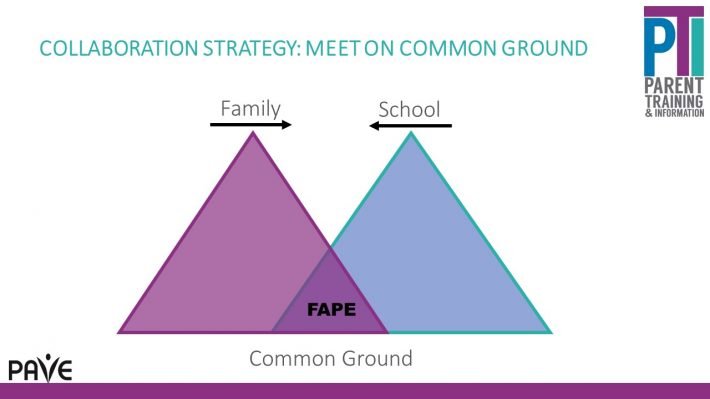
When families and schools meet to talk about a child’s services, everyone can begin with FAPE as the overarching goal. FAPE provides Common Ground for the discussion. Everyone on the team wants FAPE:

  • The school district is required by law to provide FAPE to IEP-eligible students.
  • Teachers are happy when their students are successful.
  • The family wants a child to learn in a meaningful way.
  • The student wants to feel confident and proud.

Common Ground is not always where meetings begin

Problems arise in meetings when school staff and/or family members start the conversation far from Common Ground. The Center for Appropriate Dispute Resolution in Special Education (CADRE) has designed a curriculum to support families and schools in their discussions. Two short videos, A Tale of Two Conversations, provide a quick look at how a meeting might feel like one long argument or a helpful collaboration. The difference starts with preparation and approach.

To avoid a meeting that feels like a fight, the parent may want to start the meeting with some general comments to help school staff better understand the student and to gently remind the team that years of parenting have led to some expertise about a specific child.

For example, an IEP or a behavior plan might say that a student is “defiant” or “refusing” to do work. Those types of statements can make a parent feel defensive. Showing up angry probably will not lead to a productive meeting. Instead, a parent may come to the meeting prepared to explain that the student lacks confidence and would rather appear defiant than “stupid.” Maybe the parent has been able to talk to the student about their frustrations and can bring statements or requests directly from the student.

Another way to find common ground is to prepare open-ended questions and bring those to the table first, before offering suggestions or requests. For example, if a parent shows up and demands a 1:1 right at the start of the meeting, the conversation might quickly devolve into an argument about resource problems. If a parent comes ready to talk about what is not working for the student and concerns for their child’s learning and well-being, there is an opportunity to build empathy and problem-solving.

Climb mountains as a team

Firm predetermined “solutions” from any side can position school staff and family members far from collaboration, like the peeks of two mountains unable to ever meet in the middle.

Consider collaborative problem-solving as a project that starts at the intersecting bases of two mountains, on Common Ground. Shared expectations and assumptions are a good place to begin for an open-minded discussion. Here are a few conversation starters to consider:

  • According to these progress reports, the student is getting good at … How might we use that emerging skill to scaffold skill-building in this other area?
  • My student is not making as much progress as I expected in this area… Can we talk about strategies for improving progress?
  • This assignment, grade, or record shows that the student struggles to … Is there another approach to services or placement that we have not considered yet as a team?
  • I notice that this IEP goal is written to help the student “stop” doing an unwanted behavior. Can you help me understand the skill that is being taught, and can we rewrite the goal to focus on measuring progress toward the expected skill or behavior?
  • From what I see here (data/evidence/observations), this service is not working or is not accessible to the student. My theory about this is… Does anyone here have a different theory about what might be going on?

Here are some big-picture concepts for productive collaboration:

  • Trust is at the heart of positive working relationships.
  • Family members and educators can develop trust by showing personal regard, respect, transparency, and integrity. These may be particularly important for trust to grow among people of different cultures.
  • Blaming, bringing up the past repeatedly, minimizing another’s opinion, or rushing a conversation can create barriers to collaboration.
  • A neutral third party may be needed to resolve issues and rebuild relationships.

Prepare for the meeting

Request any documents that are going to be discussed at the meeting ahead of time. Review the documents in preparation for the meeting and mark down any notes for discussion. Whether meeting to discuss an IEP, a Section 504 Plan, behavior, ancillary services, or something else, families are better served when they prepare. To help families organize their concerns and requests, PAVE offers a format for designing a Handout for the Team Meeting. An alternative version supports self-advocates: Students: Get Ready to Participate in Your IEP Meeting with a Handout for the Team.

Leave with an action plan

At the end of the meeting, review what has been decided and be sure to make notes about any action steps, deadlines, or assignments. Be sure to note:

  1. What is the action?
  2. When will it happen?
  3. Who is responsible?

Schedule a follow-up conversation or a plan to communicate about anything that is not firmly decided. After a formal meeting, the school sends parents a Prior Written Notice (PWN) to describe any changes being made to a student’s services and when those changes will take effect. Parents with their own notes about the action plan will better understand how to read the PWN and whether there are unresolved topics.

Procedural Safeguards provide additional options

If a meeting leaves too many issues unresolved, parents can review their procedural safeguards to make a choice about what to do next. A copy is offered by the school at all formal meetings, and parents can also request a copy any time. The Office of Superintendent of Public Instruction (OSPI) also provides information about parent and student rights.

Parents have the right to disagree with the school and to pursue resolution by:

The collaboration strategy being explained. Meet on common ground. A depiction of two mountains are shown, one represents family and the other mountain represents the school. Both family and school push against each other to form a smaller overlap triangle called FAPE - that represents the common ground.

State Standards Guide Social Emotional Learning for all Ages and Abilities

A Brief Overview

  • Social Emotional Learning (SEL) is a lifelong process through which children and adults effectively manage emotions, reach toward goals, experience empathy, maintain positive relationships, and make responsible decisions.
  • In school, all students participate in SEL as part of Multi-Tiered Systems of Support (MTSS). Specific SEL instruction can also be part of a student’s Individualized Education Program (IEP).
  • Washington State adopted formal Social Emotional Learning Standards January 1, 2020. The Office of Superintendent of Public Instruction (OSPI) provides an SEL website page with resources for educators, families, and community members.
  • A 12-page SEL equity brief focuses specifically on issues of equity as they relate to race, culture, and economic status.
  • A state law that took effect June 11, 2020, further compels work related to SEL. HB 2816, which was inspired and supported by activist parents, requires the Washington State School Directors’ Association (WSSDA) to develop a model policy “for nurturing a positive social and emotional school and classroom climate.”

Full Article

A child’s ability to understand, communicate, and manage emotions is critical to learning. So are skills that enable a child to socialize, self-motivate, empathize, and work collaboratively. Schools call this area of education Social Emotional Learning (SEL).

SEL is not just for children. According to the Collaborative for Academic, Social, and Emotional Learning (CASEL), “SEL is the process through which children and adults understand and manage emotions, set and achieve positive goals, feel and show empathy for others, establish and maintain positive relationships, and make responsible decisions.”

Students with disabilities may qualify for Specially Designed Instruction (SDI) in social and/or emotional areas of learning as part of an Individualized Education Program (IEP). Eligibility for SDI is determined through evaluation, and schools use various instruments to assess whether a student has a disability affecting social or emotional skills to an extent that education is significantly impacted. If so, the student’s IEP will support learning in those social/emotional areas, and goal-monitoring will track skill growth.

Students with IEPs are not the only ones who receive SEL instruction, however. Schools may use curricula to promote emotional understanding, social stories, mindfulness programs, communication circles or other strategies as part of Multi-Tiered Systems of Support (MTSS). MTSS is a framework for improving school-wide social, emotional, and cultural climate. Schools that adopt an MTSS framework deliver SEL to all students (Tier 1) and generally offer Tier 2 and Tier 3 programming to targeted groups or individual students.

Parenting Tip: Ask whether your school uses an MTSS framework

Family caregivers can ask school staff and administrators whether the district operates within an MTSS framework.

  • If the answer is no, ask how school climate is addressed and how SEL is integrated into school-wide programming.
  • If the answer is yes, ask what SEL instruction looks like in the general education classroom (Tier 1) and how specialized lessons are provided to students with higher levels of need (Tiers 2-3). Note that a student who does not qualify for an IEP could demonstrate the need for social/emotional instruction beyond what is provided to most students. Family caregivers can ask for detail about how the school’s MTSS system supports any specific student.

State adopts six SEL standards

Washington State adopted formal Social Emotional Learning Standards January 1, 2020. The Office of Superintendent of Public Instruction (OSPI), which provides guidance to all public and non-public educational agencies in the state, provides an SEL website page with resources for educators, families, and community members. Included is a link to the official letter in which State Superintendent Chris Reykdal adopted the standards, and a collection of resources to support SEL implementation and to further understanding about how families and communities can participate.

A primary document is the 24-page Social Emotional Learning Standards, Benchmarks, and Indicators, which defines the six SEL learning standards and various benchmarks under each. An extensive chart offers practical guidance for assessing each standard for students in Early Elementary, Late Elementary, Middle School, and High School/Adult. The SEL learning standards include:

  1. SELF-AWARENESS – Individuals have the ability to identify their emotions, personal assets, areas for growth, and potential external resources and supports.
  2. SELF-MANAGEMENT – Individuals have the ability to regulate emotions, thoughts, and behaviors.
  3. SELF-EFFICACY – Individuals have the ability to motivate themselves, persevere, and see themselves as capable.
  4. SOCIAL AWARENESS – Individuals have the ability to take the perspective of and empathize with others from diverse backgrounds and cultures.
  5. SOCIAL MANAGEMENT – Individuals have the ability to make safe and constructive choices about personal behavior and social interactions.
  6. SOCIAL ENGAGEMENT – Individuals have the ability to consider others and show a desire to contribute to the well-being of the school and community.

Developmental milestones are charted with a variety of statements that might demonstrate the skill or disposition within an age range.  

  • For example, a late elementary age student might show self-awareness this way: “I can identify and describe physical symptoms and thoughts related to my emotions and feelings (e.g., hot, shoulders tight).”
  • A middle-school student might demonstrate self-efficacy this way: “I can identify specific human and civil rights and freedoms to which everyone is entitled and can understand how to advocate for myself in healthy ways.”

Tip for Parents: Promote SEL at home

Included on the SEL website page is a list of learning activities for families and educators. The eight-page guide includes links to videos, websites, and ready-to-use resources to encourage positive behavior support and helpful communication at home and at school.  Resources are sorted by age and marked to indicate whether they are best suited for family caregivers, teachers, or both.

  • For example, parents of children K-5 might want to click on SEL Games to Play With Your Child to find a resource from Understood.org. One game, Starfish and Tornadoes, helps kids notice how much energy they are feeling inside and when they might need to use their calming skills or ask for help from a trusted adult.
  • A suggestion for grades 5-12 is to Practice Loving-Kindness for Someone you Care About. That exercise from Greater Good in Education provides adaptations for students with disabilities and suggests ways to make the project culturally responsive.

Another document accessible through OSPI’s website is a three-page guide for parents and families, which includes resource linkages to free online training, parenting cue cards with quick answers to typical concerns, and access to other websites with tools and advice specific for various stages of child development. Also included are tips to promote SEL at home by encouraging a child to:

  • Identify and name their emotions, feelings, and thoughts.
  • Identify positive and negative consequences of actions.
  • Demonstrate the ability to follow routines and generate ideas to solve problems.
  • Create a goal and track progress toward achieving that goal.
  • Identify feelings expressed by others.
  • Identify ways that people and groups are similar and different.
  • Demonstrate attentive listening skills without distraction.
  • Identify and take steps to resolve interpersonal conflicts in constructive ways.
  • Demonstrate a sense of community responsibility

SEL guidance supports equity and inclusion

  • Principles listed throughout the state SEL guidance include:
  • Equity: Each child receives what he or she needs to develop his or her full potential.
  • Cultural responsiveness: Culture is viewed as a resource for learning, not a barrier.
  • Universal design: Learning differences are planned for and accommodated.
  • Trauma-informed: Knowledge of the effects of trauma is integrated into policy and practice.

State guidance that describes the SEL standards and benchmarks includes this statement: “Social emotional learning (SEL) happens over the course of a day, a lifetime, and in every setting in which students and adults spend their time.… Effectively supporting social emotional development in schools requires collaboration among families and communities. It also involves building adult capacity to support a school climate and culture that recognizes, respects, and supports differences in abilities, experiences, and ethnic and cultural differences, and celebrates diversity.”

A 12-page SEL equity brief focuses specifically on issues of equity as they relate to race, culture, and economic status. “A white, middle-class model of self that values independence dominates schools,” the brief states. “Students of color and students in low-income communities often experience ‘cultural mismatch’ in education settings that expect forms of expression and participation not aligned with their culture.

“Without explicit attention to equity and cultural diversity, prevalent SEL frameworks, models, and curricula may not adequately reflect the diverse worldviews of students and families.”

Parenting Tip: Attend your local school board meeting to influence decisions

The state’s SEL implementation guide is intended for local districts to use in developing their own school- or community-specific plan to meet the needs of all learners. Because Washington is a local control state, each district is responsible for policy development.

Families have the option of making public comment at meetings to share thoughts or concerns. School board meetings are required monthly and must follow the state’s Open Public Meetings Act (Chapter 42.30 in the Revised Code of Washington). Families can reach out to their local district for information about how and when school boards meet. The Washington State School Directors’ Association provides a guidebook about the rules for Open Public Meetings. The rules apply in any meeting space or platform.

HB 2816 promotes positive school climate

A state law that took effect June 11, 2020, further compels work related to SEL. HB 2816, which was inspired and supported by activist parents, requires the Washington State School Directors’ Association (WSSDA) to develop a model policy “for nurturing a positive social and emotional school and classroom climate.”

The model policy and procedures for its implementation includes specific elements to “recognize the important role that students’ families play in collaborating with the school and school district in creating, maintaining, and nurturing a positive social and emotional school and classroom climate.” In addition, districts “must provide information to the parents and guardians of enrolled students regarding students’ rights to a free public education, regardless of immigration status or religious beliefs; and school districts must provide meaningful access to this information for families with limited English proficiency.”

In accordance with HB 2816, the WSSDA website will post the model policy and procedure by March 1, 2021. School districts are responsible to incorporate the guidance by the beginning of the 2021-22 school year: “School districts may periodically review policies and procedures for consistency with updated versions of the model policy for nurturing a positive social and emotional school and classroom climate.”

SEL is linked to research about Adverse Childhood Experiences

A national movement to incorporate Social Emotional Learning (SEL) is informed by knowledge that trauma profoundly impacts educational outcomes. In the late 1990s, the Centers for Disease Control and Prevention released its first report about Adverse Childhood Experiences (ACEs). Dr. Vincent Felitti, then the CDC’s chief of preventive medicine, boldly proclaimed childhood trauma a national health crisis. The report led to development of an ACEs survey, which scores a person’s likelihood of suffering lifelong physical and mental health impairments resulting from trauma. An ACEs score of 4, the study found, makes a child 32 times more likely to have behavior problems at school.

The data inspired researchers and educators to seek new ways to help children cope so they can manage themselves at school—and in life. A variety of new evidence-based practices were developed to support childhood resiliency. The National Research Council issued this statement in 2012: “There is broad agreement that today’s schools must offer more than academic instruction to prepare students for life and work.”

The 2015 Washington State Legislature directed OSPI to convene an SEL Benchmarks workgroup, and Senate Bill 6620 in 2016 authorized development of a free online training module in SEL for school staff. The bill states that, “In order to foster a school climate that promotes safety and security, school district staff should receive proper training in developing students’ social and emotional skills.” Development of the state SEL Standards furthers that work.

Parenting tip: Work on your own SEL skills

Family caregivers play an important role in fostering SEL by working on their own self-regulation skills. The Collaborative for Academic, Social, and Emotional Learning (CASEL) provides a wide array of resources, including some related to stressors from COVID-19. “We need to pay close attention to our own social emotional needs in order to be the community of adults who best serve our young people,” CASEL advises. “Practice continued self-care strategies, including eating healthy, getting enough sleep, exercising, and finding time to take breaks.” CASEL provides a checklist to reframe your thinking, including ideas about “all-or-nothing” or overgeneralization, for example.

PAVE provides a series of short mindfulness videos for all ages and abilities and offers additional mindfulness and parenting ideas in an article, Stay Home Help: Get Organized, Feel Big Feelings, Breathe.

Parents are a child’s primary SEL teachers

Family caregivers can help foster SEL skills by collaborating with the school. OSPI’s guidance includes this statement: “Parents and families are a child’s first teachers of SEL. As children grow, parents and families continue to support the social emotional lives of their children in the home.”

Here are a few questions parents might ask school staff to collaborate on SEL skill development:

  • How are you helping my child learn from mistakes?
  • If behavior is keeping my child from learning, what skill is lacking?
  • What is a best-practice strategy for teaching the skill that my child needs to learn?
  • Do you have a tool for understanding and regulating emotions that we can use at home also?
  • How is my child learning to “name and tame” emotions? (Dan Siegel, neurobiologist and author of Mindsight, suggests that recognizing and naming a feeling gives a person power to regulate the emotion.)
  • What positive reinforcement is being provided when my child demonstrates a new skill? How are those positive reinforcers tracked through data collection?
  • What is the plan to help my child calm down when dysregulation makes problem-solving inaccessible?
  • Would a Functional Behavior Assessment help us understand what my child is trying to communicate through this unexpected behavior?
  • Can we collaborate to develop a Behavior Intervention Plan so that we are using the same cues and language to support expected behavior?
  • What adult at the school is a “champion” for my child? (Dr. Bruce Perry, whose research supports trauma-informed initiatives, says, “Relationships are the agents of change and the most powerful therapy is human love.”)

Map Your Future with Person-Centered Planning

A Brief Overview  

  • Person-Centered Planning (PCP) is a method for helping a person map out a future with intention and support.
  • Read on for more information about what Person-Centered Planning is like.

Full Article  

Everyone dreams about what they might do or become. Individuals with disabilities might need additional support to design the plans, set the goals and recruit help. The Person-Centered Planning (PCP) process is a tool that works like a Global Positioning System (GPS) to help a person figure out where they are starting and how to navigate to a planned destination.   

A PCP session is a gathering that can happen in a specific physical location, such as a school or a community center, or in a virtual space online. The people who get together might include family members, friends, teachers, vocational specialists, coaches—anyone who might help brainstorm ways to plan an enriched, full life for a person of honor.

The first step is to celebrate the gifts, talents, and dreams of the person. Then the group develops action steps to help that person move closer to their dreams and goals.  

Throughout the gathering, the attendees listen, ask questions, and draw pictures or write down words that contribute to the process. Respect for the person’s goals and wishes is a priority, and participants withhold judgment to honor the individual completely.  

Person-Centered Planning explores all areas of a person’s life. All people experience various times in their lives that are transitions. High-school graduation is a major example. Job changes, moving to a new home, entering or leaving a relationship: Those transitions happen for individuals with and without disabilities.

Individuals with disabilities have some additional transitions. For example, when a person leaves the special education system of public education at graduation or after age 21, there is a change in disability protections. A student receiving special education is protected by the Individuals with Disabilities Education Act (IDEA). In adult life, the right to accommodations and non-discrimination is protected solely by the Rehabilitation Act of 1973 (Section 504) and the Americans with Disabilities Act (ADA).

There are specific transitions that occur for individuals who qualify for support from the Developmental Disabilities Administration (DDA), which in Washington is part of the Department of Social and Health Services (DSHS). Employment and workforce training programs often are part of the transition from high school into what happens next.

During major life transitions, many service agencies focus on a person’s inabilities or deficits.  Person-Centered Planning, on the other hand, focuses on what’s positive and possible, based on the dreams and goals of the individual.

A PCP session includes a set of maps where information is collected in words and pictures. Here are some examples:

People in my Life     

This map names important people and their roles in concentric circles. These are people that the individual trusts for help and support and may include paid and unpaid supporters. Those who are closest to the person are in the circles closest to the center of the map.

Who am I?  My Story, My History    

This map is built during the session to describe the person’s story from birth up until the gathering. This map reflects what is most important to the individual. The facilitator might ask:

  • What parts of your life are important for people to know?   
  • What are some stories of your life that would be helpful for a coworker or a friend to know? 
  • Are you a sibling? A spouse? A parent?
  • How old are you? 
  • What activities do you participate in? 
  • Have you had any jobs?
  • Where do you live? Go to school?  
  • Do you have a medical concern that someone spending time with you might need to know about? 

 Likes and Dislikes  

The “Likes” list includes favorites, things that make the person happy. Favorite colors, foods, activities, places, people are listed. 

The “Dislikes” list includes the opposite of all those things and might also list triggers (bright lights, loud noises, angry voices, bullies) or other sensitivities.

What Works/ Doesn’t work 

The first part of this map asks: When learning a new activity or skill, what are steps and learning tools or activities that work for you? Answers might look like these examples: frequent breaks, accommodations, a written schedule, a list of duties, instructions in larger print, a preferred time of day to start something…. 

The second part asks: When learning a new activity or skill what activities do not work for you? Answers might resemble these examples:  waiting in line, too many instructions, too many people barking out orders, standing or sitting for too long, verbal instructions, unclear expectations….  

Gifts, Talents and Strengths  

This map asks several questions: 

  • What are you good at?
  • What can you do that is easy for you? 
  • What are your best qualities? 
  • What do people like about you?   

Examples for answers:  best smile, cleaning, giving, caring, natural dancer, very social, great with computers, good with numbers, great at sports, good listener, good with animals, etc.   

Dreams /Nightmares 

The My Dreams map asks: Where you would like to see yourself in a few years?  Follow-up questions:

  • What will you be doing?
  • What would your dream job be?  
  • Where are you living? 
  • Do you live on your own or with family or a roommate?  
  • How are you keeping in touch with your friends?   
  • What is an action you can take to move toward your dream or goals?    

The Nightmare Map asks:  What do you want to avoid?  Follow-up questions might include this one: Where do you not want to be in a few years? This is not to make the person feel bad but to make an out-loud statement about what the person doesn’t want to happen. This can include actions or thoughts that someone wants to avoid.  

Needs 

The Needs map asks:  What do you need help with to avoid the nightmare?  A follow up question might include: What areas do you need support with? Answers might look like these examples: budgeting money, learning to drive, training to ride the bus, cooking lessons, looking for a job. The goal is to recruit support to help the person stay away from the nightmare and work toward the dream.   

Action Steps  

A map that show Action Steps includes the specific help that will assist the individual in moving toward the dream. This chart typically details what needs to be done, who will do it, and by when. 

Example:    

Goal: To Write a Resume     
Who: Michele 
What: Call Mark to ask for help.  
By When: Next Monday, April 6, 2020 

This process involves many support people in the person’s life and identifies, in a self-directed way, areas where help is needed to meet personal goals. The gathering involves the important people in someone’s life because they can help through the process and step up to offer support for the action steps. 

How to get a Person-Centered Plan  

Here are places that might help you find a PCP facilitator in your area:  

  • Developmental Disabilities Administration (DDA) 
  • Division of Vocational Rehabilitation (DVR)
  • School District 

Here are a few additional places to seek information about Person-Centered Planning:  

Inclusion.com: All My Life’s a Circle  

Inclusion.com: The Path Method 

Video from PAVE, Tools 4 Success  

Informing Families.org