Surrogate Parents Support Unaccompanied Students in Special Education

A Brief Overview

  • Parent participation in IEP process is a protected right for students with disabilities. If a student doesn’t have a family caregiver or legal guardian to advocate in their behalf, a surrogate parent is assigned to fill that role.
  • A surrogate parent is not paid and cannot be employed by the school system, or any other agency involved in the care or education of the child.
  • The provision for a surrogate parent is part of federal special education law, the Individuals with Disabilities Education Act (IDEA Section 300.519).

Full Article

If a student eligible for special education services does not have a family caregiver, adoptive parent, or other legal guardian fulfilling the role of parent, then a surrogate parent is assigned to ensure the student’s rights are protected. The surrogate parent fulfills the family caregiver role on a student’s Individualized Education Program (IEP) team and advocates to ensure the student’s needs are met.

A surrogate parent is an individual appointed by the public agency (usually a school district) responsible for the student’s special education services. Schools are responsible to assign a surrogate parent within 30 days after recognizing the need. Note that a child who is a ward of the state may be assigned a surrogate parent by the judge overseeing their case.

If a private individual, such as a neighbor or friend, has explicit written permission from the student’s parent or guardian to care for the student, a surrogate parent is not required.

A student 18-21 is responsible for their own educational decision-making unless they have a guardian to exercise their legal rights. A school district is responsible to assign a surrogate parent for a student declared legally incompetent or if an adult student with a disability asks for a surrogate parent.

A surrogate parent is required for a minor student when the parent cannot be identified or located or if parental rights have been terminated. A student’s parents are considered to be unknown if their identity cannot be determined from a thorough review of the student’s educational and other agency records.

A student’s parents are considered unavailable if they cannot be located through reasonable effort that includes documented telephone calls, letters, certified letters with return receipts, visits to the parents’ last known address, or if a court order has terminated parental rights. A parent is also considered unavailable if unable to participate in the student’s education due to distance or incarceration.

If a parent is too ill to participate at a meeting, either in person or by phone, that parent has the option of giving another individual written permission to act for them.

An uncooperative or uninvolved parent is not the same as an unavailable one.  A surrogate parent is not assigned because parents choose not to participate in their child’s education.

A child identified as an unaccompanied homeless youth by the McKinney-Vento Homeless Assistance Act is an example of a student who would be assigned a surrogate parent to support them within the special education system. Children with surrogate parents might live in foster homes, nursing homes, public or private group homes, state hospitals, or correctional facilities.

In some cases, a state agency has guardianship of a student with a disability: That student requires the assignment of a surrogate parent. 

Foster parents need to be formally appointed by the school as surrogate parents if they do not have legal guardianship. Relatives without formal kinship rights also can be designated as surrogate parents within the special education process.

A surrogate parent is not paid and cannot be employed by the school system, or any other agency involved in the care or education of the child. However, an unaccompanied homeless youth may be supported by appropriate staff from an emergency shelter, street outreach team, or other agency temporarily until a surrogate parent with no conflict of interest is appointed.

A surrogate parent must have knowledge and skills that ensure adequate representation of the student. A community volunteer, guardian ad litem, or other invested adult might serve as a surrogate parent. The surrogate parent must commit to understanding the student’s strengths and needs and how the educational system is structured to support the student’s services. Ideally, the surrogate parent lives near the student and is a match for providing culturally appropriate help in the student’s language.

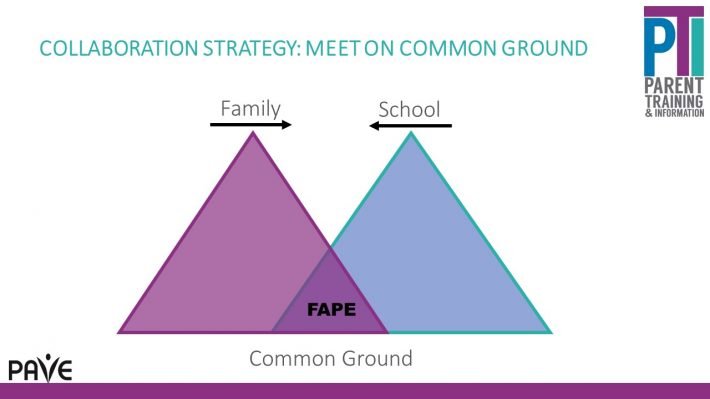
The surrogate parent represents the student in all matters relating to special education identification, evaluation, and placement and works to ensure that the student receives a Free Appropriate Public Education (FAPE) from their school-based services.

The provision for a surrogate parent is part of federal special education law, the Individuals with Disabilities Education Act (IDEA Section 300.519).

Washington’s Office of Superintendent of Public Instruction (OSPI) includes some downloadable resources about the surrogate parent in its Special Education Resource Library.

PAVE is here to help all caregivers, including surrogate parents. For direct assistance, click Get Help to complete an online Help Request Form.

Advocacy Tips for Parents

When a child has a disability, parents often learn that getting their child’s needs met requires persistence, organization, and advocacy. Advocacy is an action. A person is an advocate when they organize the work and press onward until a goal is achieved. Laws that protect the rights of students with disabilities also protect parents as legal advocates for their children.

This article includes tips for parent advocates working with the school. For more about parent rights, read PAVE’s article, Parent Participation in Special Education Process is a Priority Under Federal Law.

Before a meeting…

  • Invite someone to attend with you. A friend or family member can help you take notes, ask questions, and keep track of your agenda.
  • Make sure you understand the purpose of the meeting. Is it to talk about an evaluation, review the Individualized Education Program (IEP), write a Section 504 Plan, consider a behavior support plan, discuss placement, or something else? If you want a certain outcome, make sure it’s within the scope of the meeting. If not, you may need more than one meeting.
  • Make sure you know who will be at your meeting. An IEP team has required attendees. PAVE provides more detail about IEP team requirements in an article that includes a Sample Letter to Request an IEP Meeting.
  • Consider anyone else you want to attend. Parents have the right to invite vocational specialists, related service providers, behavioral health providers, peer support specialists—anyone with knowledge of the student and their needs.
  • Get copies of important documents (evaluation, IEP, 504 Plan, behavior plan, etc.). Read them carefully so you can use these documents to organize your concerns and questions. Keep in mind that a services program/plan is a draft until after you meet.
  • If the school doesn’t provide documents with enough time for you to prepare, consider rescheduling.
  • Mark up a Draft IEP with your suggestions and questions:
    • Read the educational impact statement carefully. Consider if it accurately summarizes your student’s strengths and needs. If not, makes notes about what you want to add or change.
    • Note any changes you want under Medical/Physical or Parent Concerns.
    • If a goal is too hard or too easy, make a note to ask about adjusting it.
    • If a goal is written with jargon and impossible to understand, ask for an explanation and maybe a rewrite
    • Prepare to ask how teachers are using Specially Designed Instruction (SDI) to help your student reach IEP goals.
    • Read the services table, sometimes referred to as a “services grid” or “services matrix” to understand how often and where your student is being served.
    • Consider any questions you have about placement or access to general education settings. If you believe your student could be successful in general education for more of their day, consider what supports would make that possible.
    • Write down any questions about how the classroom or curriculum are adapted to be accessible. You might ask if the teachers are using Universal Design for Learning (UDL) strategies to support multiple types of learners.
    • Write down your questions about progress and how it’s being tracked.
  • For an IEP or 504 Plan, read the accommodations carefully and make notes to ensure they are individualized and implemented to truly support your student.
  • Highlight anything in the behavior plan that sounds like bias or prejudice and consider how it might be rewritten. PAVE provides examples in a video training about development of a Behavior Intervention Plan.
  • To help you organize your questions and concerns, PAVE provides: Get Ready for Your Meeting with a Handout for the Team.
  • Learn about student and family rights and practice the vocabulary that empowers your advocacy. PAVE provides a three-part video training to help: Student Rights, IEP, Section 504 and More.

At your meeting…

  • Do your best to arrive on time to make sure there is time to address concerns. If you notice there may not be enough time to do this, request to schedule another meeting.
  • Make sure the meeting begins with introductions and that you know everyone’s job and what role they serve on the IEP team. If it’s important to you, when you introduce yourself you can ask team members to use your name instead of mom, dad, gramma, or something else other than your name when they refer to you.
  • Ask school staff to explain acronyms or jargon while they are talking because you want to understand what everyone says.
  • If an IEP team member is absent (WAC 392-172A-03095), parents must sign consent for the absence. If someone is missing and you don’t think it’s appropriate to continue, ask to reschedule. If key members need to leave before the meeting is over, consider ending the meeting and schedule an alternative day/time.
  • Keep focus on your student’s needs. Here are a few positive sentence starters: I expect, I understand, My child needs….
  • If you notice the conversation steering into past grievances, the district’s lack of funds, or what “all the other children” are doing, bring focus back to your child and their current needs. Try stating, “I want to focus on [name].”
  • Use facts and information to back up your positions and avoid letting emotion take over. Ask for a break if you need time for some regulated breathing or to review documents or notes.
  • Notice other team members’ contributions that support your child’s needs. Here are a few phrases to consider:
    • “I think what you said is a good idea. I also think it could help to…”
    • “I think you are right, and I would like to add…”
    • “I hear what you are saying, and…”
  • If you don’t understand something, ask questions until the answer is clear.
  • If you disagree about something and your comments aren’t changing anyone’s mind, explain that you want your position included in the Prior Written Notice (PWN), which is the document the school is required to send immediately after an IEP meeting.
  • If you hear something confusing, ask the school to put their position and rationale in writing so you can follow up.
  • Request to end the meeting if it stops being productive. Tell the other team members that you would like to continue working with them and ask to schedule another meeting. This might include adding people to the team to help resolve issues.

After a meeting…

  • Review your notes and highlight or circle places where there is an action or something that needs follow through. Transfer relevant information into your calendar.
  • When the Prior Written Notice (PWN) arrives (usually within a few days), compare it to your notes. Make sure all key agreements, actions, and IEP/504 amendments match what you understood to be the plan when you left the meeting.
  • If you want something changed in the PWN, ask for those changes in writing.
  • If you disagree with the outcome of the meeting, review your Procedural Safeguards (downloadable in multiple languages) and consider your dispute resolution options.
  • If you consider filing a Community Complaint, PAVE provides a video training to walk you through that option.
  • Consider contacting school district special education staff if they didn’t participate in the meeting and you think your team needs more support.
  • Consider asking for another meeting, Mediation, or a Facilitated IEP meeting, if issues are unresolved.

PAVE’s Parent Training and Information (PTI) program can help family caregivers organize their concerns and options. Click Get Help for individualized assistance.

Bullying at School: Key Points for Families and Students with Disabilities

Transcript of this video is below:

When students with disabilities are bullied, schools are legally responsible to end the bullying.

By law, schools must act to restore the safety and well-being of students who are harmed by harassment, intimidation, and bullying.

Those words—harassment, intimidation, and bullying, make an acronym: HIB. This video is about HIB protections for students with disabilities.

Please note that bullying increases the risks for suicide and self-harming behaviors.

For a mental health crisis, call 988

For crisis help on topics related to sexual orientation and identity, call The Trevor Project: 866-488-7386

What law says the school has to end the bullying and help my student?

Specific anti-bullying protections for students with disabilities come from Section 504, which is part of a federal law, the Rehabilitation Act of 1973.

The civil right to be protected from bullying applies to all students with disabilities, regardless of whether they have a Section 504 Plan or an Individualized Education Program (IEP). These rights are upheld by the Office for Civil Rights—OCR.

Anyone who knows about an incident of harassment, intimidation, and bullying at school or during a school-sponsored activity can file an OCR complaint at the local, state, or federal level.

What does state law require?

Washington State’s 2019 Legislature passed a law that requires school districts to write formal HIB policies and appoint a person called a HIB Compliance Officer to spread awareness and uphold the laws.

What can parents do?

If your child is bullied at school, ask for the name of your district’s HIB Compliance Officer. Talk to that person about your options and request a HIB complaint form.

If the act included a physical assault or serious property damage, file a police report.

Request an emergency meeting of the IEP or Section 504 team to add supports for the student to ensure emotional and physical safety at school.

What counts as harassment, intimidation, or bullying?

Washington State defines a HIB violation as an intentional act that:

  • Physically harms a student or damages the student’s property
  • Has the effect of substantially disrupting a student’s education
  • Is so severe, persistent, or pervasive that it creates an intimidating or threatening educational environment
  • Or has the effect of substantially disrupting the orderly operation of school

A HIB act may be electronic, written, verbal, or physical.

What does a school have to do when a child with a disability is bullied?

The Office for Civil Rights (OCR) requires schools to take immediate and appropriate action to investigate what happened. That means they talk to everyone involved and any witnesses and write a detailed report.

OCR requires the school to stop the bullying now and into the future.

OCR also says that schools must make sure the student who was bullied is helped and not further injured by actions taken in response. The victim should not be suspended, for example.

OCR says: “Any remedy should not burden the student who has been bullied.”

To learn more about federal laws and complaints, contact OCR at 800-421-3481.

Type the word Bullying or Discipline into the search bar at wapave.org to find additional resources.

Special Education is a Service, Not a Place

A Brief Overview

  • A student with a disability has the right to a Free Appropriate Public Education (FAPE) in the Least Restrictive Environment (LRE). General education spaces and curriculum are LRE.
  • Services are generally portable, and special education is delivered to the student to enable access to FAPE within the LRE to the maximum extent appropriate.
  • Federal law protects a student’s right to FAPE within the LRE in light of a child’s circumstances, not for convenience of resource allocation.
  • The TIES Center at the University of Minnesota partnered with the Haring Center for Inclusive Education at the University of Washington to build a resource for families and schools writing IEPs to support students within general education: Comprehensive Inclusive Education: General Education and the Inclusive IEP.

Full Article

An ill-informed conversation about special education might go something like this:

  • Is your child in special education?
  • Yes.
  • Oh, so your student goes to school in that special classroom, by the office…in the portable…at the end of the hall…in a segregated room?

This conversation includes errors in understanding about what special education is, how it is delivered, and a student’s right to be included with general education peers whenever and wherever possible.

This article intends to clear up confusion. An important concept to understand is in the headline:

Special Education is a service, not a place!

Services are portable, so special education is delivered to the student in the placement that works for the student to receive a Free Appropriate Public Education (FAPE), in light of the child’s circumstances. A student with a disability has the right to FAPE in the Least Restrictive Environment (LRE).

General education is the Least Restrictive Environment. An alternative placement is discussed by the student’s Individualized Education Program (IEP) team if access to FAPE is not working for the student in a general education setting with supplementary aids and supports.

Keep in mind that genuine inclusion doesn’t just meet a seat in the classroom. Adult support, adaptations to the learning materials, individualized instruction, and more are provided to support access to education within the LRE.

Here is some vocabulary to further understanding:

  • FAPE: Free Appropriate Public Education. The entitlement of a student who is eligible for special education services.
  • IDEA: Individuals with Disabilities Education Act. The entitlement to FAPE is protected by this law that allocates federal funds to support eligible students.
  • LRE: Least Restrictive Environment. A student eligible for special education services has a right to FAPE in the LRE to the maximum extent appropriate. General education is the least restrictive, and an alternative placement is discussed when data indicate that supplementary aids and supports are not working to enable access to FAPE in general education.
  • IEP: Individualized Education Program. School staff and family caregivers make up an IEP team. The team is responsible to develop a program reasonably calculated to enable a student to make progress appropriate toward IEP goals and on grade-level curriculum, in light of the child’s circumstances. Based on a student’s strengths and needs (discovered through evaluation, observation, and review of data), the team collaborates to decide what services enable FAPE and how to deliver those services. Where services are delivered is the last part of the IEP process, and decisions are made by all team members, unless family caregivers choose to excuse some participants or waive the right to a full team process.
  • Equity: When access is achieved with supports so the person with a disability has a more level or fair opportunity to benefit from the building, service, or program. For example, a student in a wheelchair can access a school with stairs if there is also a ramp. A person with a behavioral health condition might need a unique type of “ramp” to access equitable learning opportunities within general education.
  • Inclusion: When people of all abilities experience an opportunity together, and individuals with disabilities have supports they need to be contributing participants and to receive equal benefit. Although IDEA does not explicitly demand inclusion, the requirement for FAPE in the Least Restrictive Environment is how inclusion is built into special education process.
  • Placement: Where a student learns. Because the IDEA requires LRE, an IEP team considers equity and inclusion in discussions about where a student receives education. General education placement is the Least Restrictive Environment. An IEP team considers ways to offer supplementary aids and supports to enable access to LRE. If interventions fail to meet the student’s needs, the IEP team considers a continuum of placement alternatives—special education classrooms, alternative schools, home-bound instruction, day treatment, residential placement, or an alternative that is uniquely designed. 
  • Supplementary Aids and Supports: The help and productivity enhancers a student needs. Under the IDEA, a student’s unique program and services are intended to enable access to FAPE within LRE. Note that an aid or a support is not a place and therefore cannot be considered as an aspect of a restrictive placement. To the contrary, having additional adult support might enable access to LRE. This topic was included in the resolution of a 2017 Citizen Complaint in Washington State. In its decision, OSPI stated that “paraeducator support is a supplementary aid and service, not a placement option on the continuum of alternative placements.”

Note that the IDEA protects a student’s right to FAPE within LRE in light of a child’s circumstances, not in light of the most convenient way to organize school district resources. Placement is individualized to support a student’s strengths and abilities as well as the needs that are based in disability.

Tip: Families can remind the IEP team to Presume Competence and to boost a student from that position of faith. If the team presumes that a student can be competent in general education, how does it impact the team’s conversation about access to FAPE and placement?

LRE does not mean students with disabilities are on their own

To deliver FAPE, a school district provides lessons uniquely designed to address a student’s strengths and struggles (Specially Designed Instruction/SDI). In addition, the IEP team is responsible to design individualized accommodations and modifications. (Links in this paragraph take you to three PAVE training videos on these topics.)

  • Accommodations: Productivity enhancers. Examples: adjusted time to complete a task, assistive technology, a different mode for tracking an assignment or schedule, accessible reading materials with text-to-speech or videos embedded with sign language…
  • Modifications: Changes to a requirement. Examples: an alternative test, fewer problems on a worksheet, credit for a video presentation or vision board instead of a term paper.

Note that accommodations and modifications are not “special favors.” Utilizing these is an exercise of civil rights that are protected by anti-discrimination laws that include the Rehabilitation Act of 1973 (particularly Section 504 as it relates to school) and the Americans with Disabilities Act (ADA—particularly Title II).

Related Services may support LRE and other aspects of equitable access

An IEP may include related services (occupational therapy, speech, nursing, behavioral or mental health support, parent training, transportation, and more). For some students, related services may be part of the support structure to enable inclusion in the Least Restrictive Environment. If an IEP includes related services, then the IEP team discusses how and where they are delivered.

A tool to support inclusion

The TIES Center at the University of Minnesota partnered with the Haring Center for Inclusive Education at the University of Washington to build a resource to support families and schools in writing IEPs that support students within general education classrooms: Comprehensive Inclusive Education: General Education and the Inclusive IEP.

The resource includes a variety of tools and recommendations for how school and family teams can approach their meetings and conversations to support the creation and provision of a program that recognizes:

  • Each child is a general education student. 
  • The general education curriculum and routines and the Individual Education Program (IEP) comprise a student’s full educational program.
  • The IEP for a student qualifying for special education services is not the student’s curriculum.

Who is required on an IEP team?

Keep in mind that IEP teams are required to include staff from general education and special education (WAC 392-172A-03095). All team members are required for formal meetings unless the family signs consent for those absences. Here’s a key statement from the TIES Center resource:

“The IEP is intended to support a student’s progress in general education curriculum and routines, as well as other essential skills that support a student’s independence or interdependence across school, home, and other community environments.  A comprehensive inclusive education program based upon these principles is important because without that focus, a student’s learning opportunities and school and post-school outcomes are diminished. In order to create an effective comprehensive inclusive education program, collaboration between general educators, special educators, and families is needed.”

LRE decisions follow a 4-part process

OSPI’s website includes information directed toward parents: “Placement decisions are made by your student’s IEP team after the IEP has been developed. The term ‘placement’ in special education does not necessarily mean the precise physical building or location where your student will be educated. Rather, your student’s ‘placement’ refers to the range or continuum of educational settings available in the district to implement her/his IEP and the overall amount of time s/he will spend in the general education setting.”

Selection of an appropriate placement includes 4 considerations:

  1. IEP content (specialized instruction, goals, services, accommodations…)
  2. LRE requirements (least restrictive “to the maximum extent appropriate”)
  3. The likelihood that the placement option provides a reasonably high probability of helping a student attain goals
  4. Consideration of any potentially harmful effects the placement option might have on the student, or the quality of services delivered

What are placements outside of general education?

If a student is unable to access appropriate learning (FAPE) in general education because their needs cannot be met there, then the IEP team considers alternative placement options. It’s important to note that a student is placed in a more restrictive setting because the student needs a different location within the school, not because it’s more convenient for adults or because it saves the school district money.

According to IDEA, Sec. 300.114, “A State must not use a funding mechanism by which the State distributes funds on the basis of the type of setting in which a child is served that will result in the failure to provide a child with a disability FAPE according to the unique needs of the child, as described in the child’s IEP.”

IEP teams may discuss whether there’s a need for a smaller classroom setting or something else. Keep in mind that a home-based placement is a very restrictive placement because it segregates a student entirely from their peers.

The continuum of placement options includes, but is not limited to:

  • general education classes
  • general education classes with support services and/or modifications
  • a combination of general education and special education classes
  • self-contained special education classes
  • day treatment, therapeutic school specializing in behavioral health
  • private placement outside of the school district (non-public agency/NPA)
  • residential care or treatment facilities (also known as NPAs)
  • alternative learning experience (ALE)
  • home-based placement  

School districts are not required to have a continuum available in every school building. A school district, for example, might have a self-contained setting or preschool services in some but not all locations. This gives districts some discretion for choosing a location to serve the placement chosen by an IEP team.

Placement and location are different

Note that the IEP team determines the placement, but the school district has discretion to choose a location to serve the IEP.

For example, an IEP team could determine that a student needs a day treatment/behavioral health-focused school in order to access FAPE—an appropriate education. If the IEP team chooses a Day Treatment placement, then the school district is responsible to find a location to provide that placement. Following this process, a public-school district might pay for transportation and tuition to send a student to a private or out-of-district facility. If a request for a specialized placement is initiated by the family, there are other considerations.

OSPI’s website includes this information:

“… if you are requesting that your student be placed in a private school or residential facility because you believe the district is unable to provide FAPE, then you must make that request through a due process hearing.”

Resources about inclusionary practices

An agency called Teaching Exceptional Children Plus features an article by a parent about the value of inclusion in general education. The January 2009 article by Beth L. Sweden is available for download online: Signs of an Inclusive School: A Parent’s Perspective on the Meaning and Value of Authentic Inclusion.

Understood.org offers an article and a video about the benefits of inclusion.

An agency that promotes best-practice strategies for school staff implementing inclusive educational programming is the IRIS Center, a part of Peabody College at Vanderbilt University in Nashville, Tenn.

As stated earlier, The TIES Center at the University of Minnesota partnered with the Haring Center for Inclusive Education at the University of Washington to build a resource for families and schools writing IEPs to support students within general education: Comprehensive Inclusive Education: General Education and the Inclusive IEP.

The Inclusionary Practices Family Engagement Collaborative is a partnership of four non-profit organizations committed to strengthening family-school partnerships to support culturally-responsive approaches that center the experiences of students with disabilities. Watch recorded trainings offered to help you start the conversation.

Behavioral Health and School: Key Information for Families

When a student struggles to maintain well-being, achievement at school can be a challenge. This video provides key information for families to seek school-based services for behavioral health needs. Included are two advocacy statements that this information might empower you to say in a meeting with the school:

  1. “I want to make sure my student’s rights are upheld.”
  2. “I’m providing information and resources to help the school follow the law and educational best practices.”

Included in the video is information about truancy and a new state law that schools must excuse absences for behavioral health reasons. Also included is information from the federal Office for Civil Rights (OCR), which provided new guidance in summer 2022 about school responsibility to help instead of discipline students with behavioral health needs.  

PAVE staff cannot provide advocacy or advice. We share information to empower family members and young people who do have legal advocacy rights. You can learn this information and keep in handy when you aren’t sure whether the school is following the law or educational best practices. Please be patient with yourself while you are learning this information. It can feel like a lot! As you learn a little bit at a time, you can see how your increasing knowledge shifts options and outcomes for your student.

Here are resources from this training, listed in video order:

Transcript for this video: Behavioral Health and School: Key Information for Families

When a student struggles to maintain well-being, achievement at school can be a challenge. This training provides key information for families to seek school-based services for behavioral health needs. Let’s start with two advocacy statements that this information might empower you to say in a meeting with the school.

Here s one statement to consider: I want to make sure my student s rights are upheld.

When it severely impacts a student s life and learning, a behavioral health condition may be determined to be a disability. Don t let stigma or bias get in the way. Using the term disability can be critical when you want more help for someone you care about.

Students with disabilities have rights within the special education system as well as federally protected civil rights. Any student has the right to a free public education, and those basic educational rights protect students with disabilities too, regardless of the nature or severity of a disability condition. In this training, we’re going to talk about student rights and how to use this information in your advocacy. Knowing about these rights can be the secret sauce for helping your student gets their needs met.

Here’s a second advocacy phrase to consider: I’m providing information and resources to help the school follow the law and educational best practices.  Keep in mind that best practice is to support students in their behavior as a priority over punishment.

PAVE staff cannot provide advocacy or advice, but we share information to empower family members and young people who do have legal advocacy rights. Our articles and training materials include resources from state and federal agencies. You can learn this information and keep in handy when you aren’t sure whether the school is following the law or educational best practices. Please be patient with yourself while you are learning this information. It can feel like a lot. As you learn a little bit at a time, you can see how your increasing knowledge shifts options and outcomes for your family.

Understanding student and disability rights is a place for us to begin. Education Rights are like a pyramid. Children with disabilities that make them eligible for an IEP at school have all these protections. They’re at the top. Civil Rights for people with any significant disability are in the middle. All children have educational rights that are protected at the base of the pyramid. All these rights are worth considering when a child struggles to maintain expected behavior at school. Let’s break it down a little more.

Special Education Rights are protected at the top of the pyramid by a federal law called the Individuals with Disabilities Education Act IDEA for short. The IDEA requires schools to provide an Individualized Education Program an IEP to any student with a disability condition that makes them eligible through an evaluation process. We’ll talk more about eligibility in a few moments. An IEP is built to support a student s access to education. An IEP is not the student s curriculum. Every IEP is required to support progress toward grade-level learning in ways that set an appropriately high standard in light of the student s life circumstances. IEP goals and services support the whole child and may include support for social, emotional, and behavioral skill-building not just academics.

Civil Rights are protected in the center of the pyramid. Section 504 is part of a federal law called the Rehabilitation Act, which was passed by the US Congress in 1973. This law provides disability protections for people accessing public services and spaces throughout their lives. When we talk about school-age children protected by this law, we might be talking about IEP services, or we might be talking about a 504 Plan to support them with accommodations and other support at school. A 504 Plan can travel with a person into higher education or work.

The other Civil Rights law on our pyramid is the Americans with Disabilities Act the ADA. The ADA protects individuals from disability discrimination by requiring accommodations that support equity. A person in a wheelchair, for example, has the civil right to access their job, a library, or another public building with accessible features. Accommodating behavioral health disabilities can seem more complicated, but the right to an equitable opportunity is protected for all disability conditions.

General Education Rights are protected at the bottom of our pyramid. All students have the right to a free public education that is built to help them learn and make progress toward their life plans and goals. That federal law is called ESSA, which is short for Every Student Succeeds Act. Access to education is a basic right of all children in the United States, and ESSA provides specific protections for students whose lives begin from a place of disadvantage due to poverty, language access, racism, or something else. If a student has unmet behavioral health needs and is therefore not going to school all day, every day, there may be considerations related to ESSA. Later in this presentation, we’ll talk more about shortened school days and disciplinary red flags if you have questions about whether a student s rights are being upheld.

Here’s another look at the student rights pyramid all put together. Remember that students at the top have all the protections all the way down. Any person with a disability condition that significantly impacts their life has the civil rights protections in the middle. All children are protected at the bottom. Let’s pause here so you might think about how to use this pyramid of rights in a situation you might be managing.

Here are a few questions that might help you think about how to use this information:

  Is your student s IEP built to help them access a curriculum that meets or approaches grade-level content?

  Are your child s accommodations helping them experience all that school has to offer?

  Is your student getting the benefit of a full school experience, with learning in academic, social-emotional, and behavioral skills?

You may want to pause the video and get a piece of paper to make a note for yourself about a question you have or an action you wish to take. You might think about someone at the school who might help you consider your concern or question. If you need to request a meeting with a person or your IEP or Section 504 team, make a note to remind yourself to schedule that appointment.

Let’s go deeper into some special education topics that might be important to know if a child s behavior is significantly impacting how they show up for school.

Here are four concepts that have to do with Special Education Rights.

  First is Child Find Mandate. Child Find is part of federal special education law, the IDEA. Child Find protects a student s right to be evaluated to see if they are eligible for an IEP. Child Find makes it the school s responsibility to evaluate a student if disability may be a factor in school struggles. Challenges may be academic, social, behavioral, or something else. If the school is consistently sending a child home for behavior that may be disability related, for example, they are responsible to evaluate that child and figure out what’s going on and what additional help may be needed.

  Our second concept is Referral: Anyone can refer a student to be evaluated for special education. Schools are responsible to notice children who are struggling and begin a referral process. Families and other community members can also make referrals. You don’t have to know if you are referring a child for a 504 Plan or an IEP to request an educational evaluation. Both require the school to assess the student and use data to make decisions about eligibility and services.

  Third is Eligibility. Federal special education eligibility categories are broad and include disabilities related to behavioral health. We’ll look at those options in a few minutes.

  The fourth concept listed here is Related Services. When we’re talking about children with behavioral health needs, it’s important to note that related services provided by the school may include psychological services, counseling, behavioral services, school social work services, parent training, and more.

We’re going to talk about each of these concepts with more information.

Here’s more about Child Find. The school district has an affirmative duty that means they are responsible to do this whether families ask for help or not. That duty is to seek out to look for and evaluate students who might be struggling in school because of a disability. Federal law, the IDEA, states that a disability might be known or suspected. That means the child doesn’t have to have a diagnosis from a doctor for the school to pay attention and get more information about what’s going on and what the student might need in terms of support.

If the student is struggling to learn, show up for school, stay in class without being disciplined, or participate fully in their educational opportunities, then that s called  educational impact.  If that educational impact could be disability related, then the school is responsible under Child Find to figure out what’s going on and what services or accommodations the student may need.

Students with behavioral health needs are not always identified as needing special educational services when they start school. Sometimes concerns crop up for older students because they are struggling to maintain expected behavior. They may be getting referred or suspended, or so anxious about school that they refuse to go. It’s important to figure out how behaviors might be an expression of an unmet need. If a child is too anxious to go to school, that demonstrates impact and a need for support and is not a reason to avoid evaluation, for example.

Child Find protects students of all ages in their right to be evaluated. The evaluation itself determines whether the student is eligible for an IEP, a Section 504 Plan, or other school supports that might not be special education.

Anyone with knowledge of a student can refer them for a special education evaluation.

The state educational agency, which in Washington is the Office of Superintendent of Public Instruction OSPI for short provides a form schools and families can use for referrals. A picture from page 2 of that form is on this slide.

[Click 2 times] The expanded box lists some of the physical or behavioral concerns that might be included. Attention, focus, mood swings, social challenges, and trouble with motivation are examples.

State law in Washington requires evaluation requests to be in writing. If a family member asks the school to evaluate their child, the school must provide a form to put the request into writing. The family can use whatever format they choose to document their request, and they also have the option to ask the school to help them write down their request. If the family needs a different format for language access, the school must accommodate that need.

If a student you support needs to be evaluated, take a moment to make a note. Consider whether you know who to contact at your school district. If you aren’t sure, you can go to the district website or call a general number to get the name and contact for someone from the special education services staff. Evaluation requests should go to someone at the district and an administrator at your school, such as a principal. Remember that your request must be in writing. You might mention Child Find to show that you understand your student has a right to be evaluated.

In Washington State, schools have 25 school days to respond to a special education referral. If the school schedules a meeting to discuss whether to evaluate, parents must be invited. If the school district refuses to do an evaluation, they must provide that decision in writing. Parents have the right to appeal. The school must provide a copy of the Procedural Safeguards, which describes complaint options and family and student rights. Make a note for yourself right now if you need to ask for a copy of your Procedural Safeguards.

When they agree to evaluate, the school has 35 school days to get it done. An eligible student is supposed to have an IEP in place within 30 calendar days after they are found eligible. Parents must sign consent for the evaluation and for services begin.

Note that this evaluation process can begin any time of year. A referral can be made near the end of the school year or before a holiday break, and all the school days count toward the deadlines that resume when school reopens.

Schools evaluate students to ask and answer these three questions:

  • Does the student have a disability?
  • Does the disability adversely impact education?
  • Does the student need Specially Designed Instruction which is often shortened to SDI? SDI is a unique way of teaching to meet a student s individualized needs.

If all three answers are Yes, the student gets an IEP.

If the first two are Yes and the third answer is a No, the student might get services through a Section 504 Plan. More about that later, but it’s important to know that students eligible under Section 504 need to be formally evaluated to see what’s going on and what they need.

Evaluations can collect data in many areas of development and learning, including areas related to social-emotional learning and behavior. 

A student can get an IEP by meeting criteria in any of the 13 categories listed on this slide. On the left side of the slide are categories that have the most to do with behavioral health. Keep in mind that these categories are used to identify children who need more support. They aren’t meant to label or stigmatize students and should never be used to define a student or their IEP. For example, there’s no such thing as a behavior IEP or an ED kid.

Emotional Disturbance is the name of a federal category that Washington State calls Emotional Behavioral Disability. This category is sometimes the best fit for serious emotional dysregulation or mental illness. Other Health Impairment or OHI might be the category chosen to qualify a student with anxiety or depression, or another diagnosis such as ADHD or Tourette s Syndrome. Traumatic Brain Injury and Autism are eligibility categories for students with those specific conditions.

It’s important to know that once a student is identified as eligible for services, the IEP serves the whole student. The IEP team determines what is needed and how to provide it. A new evaluation for eligibility is not necessary for every additional service. For example, if a student eligible under EBD also needs reading support, they can get that help without being reevaluated to determine eligibility in reading.

An evaluation might determine that a student needs a service from someone other than a teacher. Schools call services that lie outside the scope of traditional teaching related services.  Another term is ancillary services.  Related services help children with disabilities benefit from their special education by providing extra help and support.

This slide lists related service options that are included in federal and state laws. Many of these aren’t provided frequently in Washington schools. By becoming aware of possibilities, family advocates can use this information to ask for what they believe their student needs. A student s IEP or 504 Plan can include any of these or more than one if the school and family team decide they are educationally necessary.

Notice that psychological services, counseling, and support from a social worker are included. Also included is parent training, which might mean the school teaches parents a strategy for behavioral management or emotional regulation, for example. A related service be included in the evaluation process. If school staff cannot properly understand a serious mental illness such as schizophrenia or selective mutism, for example, an outside provider can do an assessment to inform the process and make recommendations.

PAVE provides an article with more information: Type Related Services into the search bar at wapave.org for more information

This slide has a lot of words on it, but I share it to show where many of the terms from the previous slide come from. This is wording from the Washington Administrative Code the WAC that lists related services that might be included in a student s IEP. In purple are ones from the previous slide. Psychological services, mental health counseling, and social work services are possibilities that not all schools suggest. Families can remember that school-based services are provided based on student needs, not available resources. An IEP team has the authority to custom-build a services program. Creative problem-solving might be necessary.

You can find a link to look up this WAC on the page where you found this video on PAVE s website.

Washington State’s Health Care Authority manages a program to reimburse schools for services provided to students who are eligible for Apple Health when those services are delivered as part of their IEP.

HCA s website page includes a link to this booklet published in 2022 to describe options for School-Based Health Services (SBHS). Families might ask their school if they are participating in this optional program.

In August 2022, OSPI issued guidance to remind schools and families that all IEP services, including related services, start when school starts unless the student needs something different to happen. OSPI s tip sheet includes this statement: A school district policy mandating that services for all students eligible for special education will begin at a specific time after the beginning of the school year (such as the third week of the school year) would not be consistent with the IDEA and its implementing regulations.  Remember that IDEA is the federal law that protects the rights of students with IEPs. A link to this tip sheet is provided on PAVE s website where you clicked to watch this video.

Let’s take a step back to talk about an important, odd word: FAPE. FAPE stands for Free Appropriate Public Education. You might be thinking, what’s FAPE, and why should I care?

Well, here’s a question PAVE hears a lot from parents: What does the school have to provide?

FAPE is the answer to that question! The school has to provide FAPE a Free Appropriate Public Education to students with qualifying disabilities. FAPE is the right of students with IEPs and those with Section 504 Plans, although FAPE rights are slightly different within these two options.

This is a great word to add to your advocacy vocabulary. The first part of this training included this advocacy statement: I want to make sure my student s rights are upheld. A student s rights are upheld when they get FAPE. If you don’t think your student is getting FAPE, there’s work to do.

So what does it mean to get FAPE?

The Supreme Court wrestled with that question and in 2017 issued a ruling with a bit of an answer: FAPE is provided when a student s special education program is reasonably calculated to enable a child to make progress appropriate in light of the child s circumstances.

Family advocates can talk about FAPE by asking questions about a student s progress on learning goals including those related to behavioral skills. If there isn’t solid progress, the student may not be getting FAPE.

Let’s take another look at our Student Rights Pyramid. Is there something you want to write down? How about the word FAPE? Do you have questions related to FAPE for your IEP team? Pause the video if you want to make a note.

Now we’re going to go a little deeper into the middle part of the student rights pyramid, where Civil Rights are listed.

A mental health condition, substance use disorder, or something else might impact a student s behavior in ways that significantly impact the way they show up for school. They may have civil rights protections to support their right to receive school-based services and accommodations.

The next few slides have more information about Section 504. That’s the one from the Rehabilitation Act of 1973. Section 504 is relevant in any place or program that gets tax money even just a drop.

A person of any age is eligible for protection under Section 504 if they have a disability that impacts a major life activity. Government leaders who wrote the law didn’t put limits on what that might mean. For example, Long COVID is now recognized as a disability condition with life impacts that make a person eligible for accommodations and support.

Section 504 Plans in school are written to support students when any aspect of their school experience is affected by disability. Their educational impact and needs are determined through an evaluation process, just like for an IEP. Social-Emotional Learning and Behavior are part of the evaluation process and can highlight behavioral health needs that make a student eligible for 504 protections and services.

The two questions asked through evaluation are the same as the first two questions for an IEP evaluation: Is there a disability, and is it causing significant impact?

[click] Here is a short list of life activities that might be impacted by disability: learning, reading, breathing, talking, eating, walking, toileting, socializing, thinking, attention, participation in school or another activity.

This list is endless. If someone’s life is impacted by disability, they have the right to accommodations and support, so their opportunities are not limited by disability. That’s the essence of equity when specific help makes it possible to do something that non-disabled people do without that help.

A person eligible for Section 504 Protections is accommodated to access public places, services, and opportunities.

They also can be supported with Modifications, which change the expectation. A student with anxiety around writing, for example, might show their learning with a video instead. That’s a modified assignment.

At its core, Section 504 is an anti-discrimination law. Supports should be free from stigma for example, it’s not okay to lump students with similar diagnoses into a program or space labeled by their condition. Schools are required to provide individualized services.

Remember that Section 504 protects all people with identified disability conditions, including students with 504 Plans and IEPs.

Here are a few sample accommodations and modifications that might support a student with a mental health need. Accommodations related to behavioral health may support a student s ability to take breaks, meet with preferred staff, or avoid getting called out in class. The accommodation also might reference a behavior plan that has more detail about how the student is being supported.

Again, a modification is a change in expectation. Showing understanding of concepts through an alternative medium, such as visuals or art, might be a helpful modification for some students. Others may need reduced assignments to manage their anxiety while keeping up with schoolwork.

Keep in mind that a student s plan is individualized to meet their specific, unique needs. Cutting and pasting supports from a standardized list is not best practice. The start of this video included this advocacy statement: I’m providing information and resources to help the school follow the law and educational best practices. 

Best practice is to use evaluation tools and information from school staff and family to identify a student’s strengths and needs and build a unique set of supports based on thoughtfully gathered information.

Anti-bullying measures are written explicitly into Section 504. Schools are required to provide restoration, counseling, or whatever a student with a disability needs to recover from a bullying incident that happened during a school-sponsored activity. Families and students can file complaints with their school district related to Harassment, Intimidation, and Bullying. Those are called HIB complaints. Every district must provide a form for filing a HIB complaint.

In some situations, a student with a behavioral health related disability is identified because they’ve gotten into trouble. Schools are required to teach expected behavior and limit the use of punitive discipline to uphold the civil rights of their students.

In July 2022, The US Department of Education s Office for Civil Rights issued a guidance document called Supporting Students with Disabilities and Avoiding the Discriminatory Use of Student Discipline under Section 504 of the Rehabilitation Act of 1973. This booklet is downloadable from the Office for Civil Rights. PAVE provides a link on the page where you clicked to watch this video.

Keep in mind that Section 504 protects:

* Students with Section 504 Plans

* And Students with IEPs

* The law also protects students with known or suspected disability conditions. Those students might be known because of their involvement with student discipline or because they are refusing to go to school.

According to the OCR guidance referenced on the previous slide, frequent disciplinary actions without considering an evaluation to determine eligibility for services might be a violation of student civil rights, including for students who haven’t yet been identified as eligible for services related to their behavioral health needs.

Here are other red flags called out in the OCR guidance. In other words, these might be reasons to question whether the student s civil rights are being upheld:


If the school automatically shortens a student s school day

If the school consistently removes the student from school or their regular classroom without calling it a suspension or filing paperwork. Those are called off book or informal suspensions

If the student experiences isolation/seclusion/or restraint and there is no collaborative meeting process to consider a change to the student s support.

  If a student with disabilities misses 10 or more school days due to behavior and there is no meeting to make changes in services. A Manifestation Determination meeting is required when a student is removed from their regular placement for 10 or more days because of behavior.

  If a student is regularly disciplined and there is no formal evaluation process to figure out what the student might be trying to communicate through their behavior

  If a student is suspended or secluded and the school doesn’t t provide appropriate paperwork to the family

  If the family requests an evaluation or additional services and is turned away with an explanation that the school cannot afford to provide that support due to staffing or other resource shortages

PAVE provides more information on these topics and links to federal and state guidance documents in an article called: What Parents Need to Know when Disability Impacts Behavior and Discipline at School

Note that there is movement in Washington State and nationally to eliminate the use of isolation also called seclusion and reduce the use of restraint. Six states have banned seclusion in some form, including Hawaii, Georgia, Florida, Texas, Nevada, and Pennsylvania.

Parents can tell their school that they want to be involved. Asking school staff to share what’s going well, what’s not going so well, and what’s really a problem can build collaboration from the start. Here s a tip for families: Tell the school you want to know The Good, The Bad, and The Ugly. Catching problems before they escalate can stop practices like off books  suspensions and focus the work on building a support plan before punishment is necessary. Remember, you can tell the school that you are helping them follow the law. Your child has the civil right to be supported in non-discriminatory ways at school. That means they get social-emotional and behavioral skill building and support as part of their education.

Here s more information from OCR. Keep in mind that the Office for Civil Rights manages complaint options for anyone who believes a civil right has been violated. Civil Rights complaints can be handled at the district, state, and national level.

A key point OCR makes is that schools are required to evaluate a student or reconsider the services plan if a student consistently misses school because of behavior. OCR guidance clearly states that schools cannot use resource shortages as a reason to deny or delay an evaluation.

On this slide is a quote from OCR. I ll summarize it for you: The agency would not support a district to delay a student s evaluation because they don t have enough trained staff to get it done and are unwilling to hire an outside expert to do the assessment. Also included in this quote is a reminder that doing well academically does not justify a delay. Referrals and exclusionary discipline can be reasons to do an evaluation to find out what’s going on and where help is needed.

Attendance can also become a challenge when a student is struggling to maintain well-being. New rules in Washington State prioritize support over punishment for students who miss school for behavioral health reasons.

Washington s truancy law is called the Becca Bill. This law requires schools to file truancy petitions if a student 17 or younger misses 7 days of school in a month or 15 days a year without a documented excuse.

A truancy petition can trigger actions to get a student more help. Schools are required to follow up with a special education evaluation or a review of services if disability might be a factor.

This slide includes information from Washington’s state law, the Revised Code of Washington. There’s a link on PAVE s website page where you found this video. In short, if a student who is found truant has a Section 504 Plan or an IEP, the school is required to recruit behavioral specialists and bring them into a meeting process to figure out what needs to change to better support the student. If the student isn’t yet identified as having a disability but disability is likely part of what’s going on, then the school is required to evaluate the student at no cost to the family to see what’s happening and where the student may have unmet service needs.

We’ve been talking about truancy, which relates to unexcused absences. Washington State has a new law directing schools to excuse absences for students who are missing school because of needs related to behavioral health. The point is to focus on help and services and remove the punishing elements of truancy. The point is NOT to give schools a pass on stepping up to help.

The state law that excuses absences for mental health reasons came from passage of HB 1834 in 2022. In a document explaining the law, OSPI states that the new law does not change the rights of students to receive education or the responsibilities of school districts to support students with disabilities. A link to this OSPI document is included in the resources in the article that goes with this video.

Here’s the Washington Administrative Code (the WAC) that was rewritten to incorporate the new law that requires schools to excuse absences for mental health reasons. Highlighted in purple are some of the new words. Notice that mental health symptoms can be cause for a student to be excused for missing school. So can appointments and treatment, including treatment related to substance use.

The state has made clear that doctor s notes are not required. School districts can write their own policies about how many excused absences are allowable before certain consequences happen. The point here is to help students and not punish them for attempting to care for their mental well-being. Families can engage with their district school boards about how these state rules are implemented at the local level.

In August 2022, the Office of Superintendent of Public Instruction (OSPI) provided a webinar to talk about student anxiety and its impacts on attendance. Available on YouTube, the recorded webinar provides information for students, their families, and schools to talk about how to support a student to stay in school or come back after an absence related to anxiety.

Here are a few key takeaways from the webinar. Data show that students furthest from justice have missed the most school since the pandemic began. The training points out that school refusal is separate from truancy and requires very different interventions. Key is always the relationship and communication between family and school.

Pictured on this slide is a snapshot from OSPI s training video. At about 55 minutes, the presentation provides a step-by-step plan for re-integrating a student who has been absent due to school refusal.

Families may be interested in watching this OSPI training and/or sharing it with school staff. The link is included on the page where you clicked to watch this video.

By every state and national measure, the mental health of children and young people got worse because of the COVID-19 pandemic. Because of that, new resources have been released to help schools help the students impacted the most.

The federal Office for Civil Rights (OCR) during summer 2022 published new documents about COVID and how to help students get caught up. PAVE has an article called Recovery Services: What Families Need to Know as Schools Reopen with more detail about that document and the rights of students.

In short, federal money is available to help schools offer additional special education services to students who have been underserved because of the pandemic. Those additional services have more than one name, and in Washington they might be called Recovery Services or Compensatory Services. Students whose well-being was impacted by loss, isolation, illness, and more are prioritized for additional support.

There is no magic formula for deciding who gets these additional services: Decisions are made by IEP and Section 504 teams that include family participants. The key is to consider how a student s learning and development were affected by the pandemic and what is needed to get them back on track. Federal law requires decisions to be individualized in other words, a school cannot build programs for batches of students without meeting with each family to discuss student-specific progress, regression, and needs. For example, a student who started to struggle during the pandemic and wasn’t evaluated promptly because of the pandemic may experience lasting impacts for a team to consider when making decisions about current services that might include recovery services as a component.

These requirements and funds are available into the future, not just in the immediate time after schools reopened their buildings.

This training is provided by Parent Training and Information (PTI), a program of PAVE. Our non-profit has been helping families in Washington State since 1979. This slide shows a picture of our website home page. Our address is wapave.org.

Students, family members, and professionals can get direct assistance by clicking Get Help, highlighted with the yellow circle. You can also leave a message by phone to request help: 800-572-7368.

We provide language translation options. The teal arrow is pointing the place on our website to choose a language for reading our articles online.

If you need help with the accessibility of any of our resources, please let us know. The final few slides describe a few more resources PAVE offers to help you. On our home page, under the calendar, we provide toolkits. One of them is a Behavioral Health Toolkit, with information about crisis systems, school-based services, medical systems, family support agencies, advocacy opportunities, and more.

Within the behavioral health toolkit is a video about best practices for supporting behavior at school. A Functional Behavioral Assessment is called an FBA. That assessment can gather information for schools and families to develop a positive behavior support plan. The name for that plan is BIP Behavior Intervention Plan. PAVE s video can help families and schools work to make sure the FBA and BIP are unbiased and built to teach a student what they can choose instead of behaviors that are leading to problems.

Research shows that students with conditions impacting their mental health and behavior can struggle the most during the transition into adulthood perhaps related to immense changes in the brain during this developmental stage. PAVE provides a School to Adulthood toolkit to support families navigating this important time of life. Look for it under the calendar on our home page. You can also type Transition Triangle into the search bar to find this graphic and an in-depth explanation of its parts.

These are other agencies that can help: The Three O s are OSPI, the Office for Civil Rights, and the Governor s Office of the Educational Ombuds. The state’s nine Educational Services Districts (referred to as ESDs) provide support to school districts. Some are licensed as behavioral health agencies and provide direct help for students who need counseling or other therapeutic services. If the school doesn’t seem equipped to meet a need, families can ask if there are supports available from the ESD.

This slide is a reminder that PAVE is not a legal service agency and cannot provide advocacy, advice or legal representation. Our goal is to empower families by providing information and access to resources.

Thank you for listening and learning today and for being an advocate for someone with unique needs! Remember that it’s not your job to hold up the entire world and that you need time to care for yourself and recharge your own batteries. Please consider your own well-being as a priority throughout every day. PAVE is here to help at wapave.org.


Mental Health Education and Support at School can be Critical

A Brief Overview

  • Alarming statistics indicate the pandemic worsened many behavioral health outcomes for young people. Governor Jay Inslee on March 14, 2021, issued an emergency proclamation declaring children’s mental health to be in crisis.
  • President Joe Biden issued a Fact Sheet about the nation’s mental health crisis on March 1, 2022, as part of his State of the Union message. This article includes some of what the president shared about youth impacts.
  • Washington State’s 2021 Healthy Youth Survey confirms that children and youth are struggling to maintain well-being.
  • These outcomes make adolescence a critical time for mental health promotion, early identification and intervention. Read on for information and resources.
  • The emotional well-being of students may be served through Multi-Tiered Systems of Support (MTSS), which provide a structure for schools to provide education and supports related to student well-being schoolwide.
  • Students with high levels of need may access mental health support through the special education system. Emotional Disturbance is a federal category of disability under the Individuals with Disabilities Education Act (IDEA).

Full Article

Alarming statistics indicate that children and young people are in crisis. Governor Jay Inslee issued an emergency proclamation for children’s mental health on March 14, 2021. Data from Washington’s 2021 Healthy Youth Survey confirm the distressing trends:

Seven out of ten students in tenth grade report feeling nervous, anxious, on edge, or cannot stop worrying. Eight percent said they tried suicide within the past year. Almost 40 percent said their feelings were disturbing enough to interrupt their regular activities, and more than 10 percent of students said they didn’t have anyone to talk to about their feelings. According to the Centers for Disease Control and Prevention (CDC), only about half of young people who need behavioral health services get them.

According to the 2021 statewide survey, students with disabilities struggle more than most. Also over-represented are girls, students from lower income households, and students whose gender or sexuality is non-binary. Non-binary refers to more than two things; it’s a term often used when discussing people who identify as Lesbian, Gay, Bi-sexual, Transgender, Queer, or questioning (LGBTQ+). LGBTQ+ youth can seek crisis help and more from The Trevor Project.

“Reports of our children suffering with mental health issues are a worrisome public health concern,” said Umair A. Shah, MD, MPH, Washington’s Secretary of Health. “Mental health is a part of our children’s overall health and well-being. It is imperative that we all continue to work together to fully support the whole child by providing information and access to behavioral health resources to youth and the trusted adults in their lives.”

Concerns are nationwide. On March 1, 2022, President Joe Biden issued a Fact Sheet stating that grief, trauma, and physical isolation during the past two years have driven Americans to a breaking point:

“Our youth have been particularly impacted as losses from COVID and disruptions in routines and relationships have led to increased social isolation, anxiety, and learning loss.  More than half of parents express concern over their children’s mental well-being. An early study has found that students are about five months behind in math and four months behind in reading, compared with students prior to the pandemic.

“In 2019, one in three high school students and half of female students reported persistent feelings of sadness or hopelessness, an overall increase of 40 percent from 2009. Emergency department visits for attempted suicide have risen 51 percent among adolescent girls.”

Mental Health support to students is a statewide priority

Recognizing the unmet needs, Washington State’s 2022 legislature passed a variety of bills to increase support to children and youth with behavioral health conditions. Here are a few examples:

  • HB 1664: Provides funding and incentives for schools to increase numbers of staff who provide physical, social, and emotional support to students. Schools are responsible to report to the state how these funds were used for hiring staff that directly support students and not something else.
  • HB 1800: Requires Health Care Authority (HCA) to build and maintain a website (“parent portal”) to help families seek out behavioral health services. Also supports growth and training requirements for behavioral health ombuds serving youth through the Office of Behavioral Health Consumer Advocacy.
  • HB 1834: Establishes a student absence from school for mental health reasons as an excused absence.
  • HB 1890: Creates an advisory group under the Children and Youth Behavioral Health Work Group (CYBHWG) to build a strategic plan for children, youth transitioning to adulthood, and their caregivers. Also establishes a $200/day stipend (up to 6 meetings per year) for members of the CYBHWG with lived experience who are not attending in a paid professional capacity.

TIP: Family caregivers can get involved in advocacy work!

Here’s another TIP: Families can ask their school who is on site to support students with their mental health needs. Some school districts seek support from an Educational Service District (ESD) to meet student behavioral health needs, so families can also ask whether ESD supports are available. Some ESDs are licensed as behavioral health providers—just ask.

What is MTSS, and why learn this acronym to ask the school about it?

A priority for agencies involved in statewide work is implementation of Multi-Tiered Systems of Support (MTSS). Through MTSS, schools support well-being for all students and offer higher levels of support based on student need. Social Emotional Learning (SEL) is key to MTSS, which creates a structure for positive behavioral supports and trauma-informed interventions.

The Office of Superintendent of Public Instruction (OSPI) is the state educational agency for Washington schools. In its 2021 budget, OSPI prioritized MTSS as part of a plan to Empower all Schools to Support the Whole Child. In January, 2021, OSPI was awarded a five-year, $5.3 million grant from the U.S. Department of Education help districts implement MTSS. As a local control state, Washington districts determine their own specific policies and procedures.

TIP: Families can ask school and district staff to describe their MTSS work and how students are receiving support through the various levels/tiers.

Special Education is one pathway for more help

Students may access mental health support through the special education system. Emotional Disturbance is a federal category of disability under the Individuals with Disabilities Education Act (IDEA). Appropriate support can be especially critical for these students: According to the U.S. Office of Special Education Programs (OSEP), students eligible for school-based services under the ED category are twice as likely to drop out of high school before graduating.

How a student is supported in their life planning could have an impact. PAVE provides a toolkit of information about how to support a student in their preparations for graduation and beyond: School to Adulthood: Transition Planning Toolkit for High School, Life, and Work.

Note that a student with a mental health condition might qualify for an Individualized Education Program (IEP) under the category of Other Health Impairment (OHI), which captures needs related to various medical diagnoses. Other categories that often overlap with behavioral health are Autism and Traumatic Brain Injury (TBI). IEP eligibility categories are described in the Washington Administrative Codes (WAC 392-172A-01035).

In Washington State, the ED category is referred to as Emotional Behavioral Disability (EBD). If the student’s behavioral health is impaired to a degree that the student is struggling to access school, and the student needs Specially Designed Instruction (SDI), then the student may be eligible for an IEP. Keep in mind that academic subjects are only a part of learning in school: Social Emotional Learning (SEL) is part of the core curriculum. 

An educational evaluation determines whether a student has a disability that significantly impacts access to school and whether Specially Designed Instruction (SDI) and related services are needed for the student to receive a Free Appropriate Public Education (FAPE). FAPE is the entitlement of a student eligible for special education services. An IEP team determines how FAPE/educational services are provided to an individual student.

Behavioral health counseling can be part of an IEP

Counseling can be written into an IEP as a related service. When included in a student’s IEP as educationally necessary for FAPE, a school district is responsible to provide and fund those services. School districts can receive reimbursement for most of the cost of behavioral health services for students who are covered by Medicaid and on an IEP. The Health Care Authority provides information about school-based health services for students who are covered by Medicaid and on an IEP.

A student with a mental health condition who doesn’t qualify for an IEP might be eligible for a Section 504 Plan. A disability that impairs a major life activity triggers Section 504 protections, which include the right to appropriate and individualized accommodations at school. Section 504 is an aspect of the Rehabilitation Act of 1973, a Civil Rights law that protects against disability discrimination. Students with IEPs and 504 plans are protected by Section 504 rights.

Behavioral Health encompasses a wide range of disability conditions, including those related to substance use disorder, that impact a person’s ability to manage behavior. Sometimes students with behavioral health disabilities bump into disciplinary issues at school. Students with identified disabilities have protections in the disciplinary process: PAVE provides a detailed article about student and family rights related to school discipline.

Placement options for students who struggle with behavior

IEP teams determine the program and placement for a student. In accordance with federal law (IDEA), students have a right to FAPE in the Least Restrictive Environment (LRE) to the maximum extent appropriate. That means educational services and supports are designed to help students access their general education classroom and curriculum first. If the student is unable to make meaningful progress there because of their individual circumstances and disability condition, then the IEP team considers more restrictive placement options. See PAVE’s article: Special Education is a Service, Not a Place.

If general education is not working, the IEP team is responsible to consider all placement options to find the right fit. There is not a requirement to rule out every “less restrictive” option before choosing a placement that the team agrees will best serve the student’s needs.

Sometimes the IEP team, which includes family, will determine that in order to receive FAPE a student needs to be placed in a Day Treatment or Residential school. OSPI maintains a list of Non-Public Agencies that districts might pay to support the educational needs of a student. Districts may also consider schools that are not listed. Washington State has almost no residential options for students. Schools almost always send students to other states when residential placement is needed.

On May 23, 2022, a Washington affiliate of National Public Radio (KUOW) provided a report about the lack of residential programs in the state and the challenges for families whose students go out of state for residential education: Washington is sending youth in crisis to out-of-state boarding schools; taxpayers pick up the tab.

Residential placement may be necessary because educational needs cannot be served unless medical needs are fully supported. School districts may be responsible in those situations to pay for a residential placement. A precedent-setting court ruling in 2017 was Edmonds v. A.T. The parents of a student with behavioral disabilities filed due process against the Edmonds School District for reimbursement of residential education. The administrative law judge ruled that the district must pay for the residential services because “students cannot be separated from their disabilities.”

Strategies and safety measures for families and teachers

The Healthy Youth Survey is conducted every other year and was delayed from 2020 to 2021 because of the pandemic. Over the years, results are shared along with tips for families and schools. Here are a few considerations built from various data points within the survey:

Hopeful students:

  • Are more interested in schoolwork: Is there a way to make every day at school more connected to what a child cares about?
  • See people who can help: Who are the adults at school that a student can trust and go to for encouragement or guidance?
  • Believe that school is relevant to life: Who is helping the student connect what they are learning now to who they want to become?
  • Are academically successful: Are supports in place to provide adequate help so the student can succeed in learning? Evidence-based instructional strategies are key when students struggle in reading, writing, or math because of learning disabilities, for example.

TIP: Make sure these four topics are part of a school/family discussion when a student is struggling with emotional well-being or behavior that may be impacted by hopelessness.

A 2018 handout includes tips for parents and other adults who support teens who feel anxious or depressed:

  • Bond with them: Unconditional love includes clear statements that you value them, and your actions show you want to stay involved in their lives.
  • Talk with teens about their feelings and show you care. Listen to their point of view. Suicidal thinking often comes from a wish to end psychological pain.
  • Help teens learn effective coping strategies and resiliency skills to deal with stress, expectations of others, relationship problems, and challenging life events.
  • Have an evening as a family where everyone creates their own mental health safety plan.
  • Learn about warning signs and where to get help
  • Ask: “Are you thinking about suicide?” Don’t be afraid that talking about it will give them the idea. If you’ve observed any warning signs, chances are they’re already thinking about it.
  • If you own a firearm, keep it secured where a teen could not access it.
  • Lock up medications children shouldn’t have access to.

A press for school-based services and mental health literacy

Advocacy for direct school-based mental health services and education about mental health topics comes from the University of Washington’s SMART Center. SMART stands for School Mental Health Assessment Research and Training. The SMART center in 2020 provided a report: The Case for School Mental Health. The document includes state and national data that strongly indicate school-based behavioral health services are effective:

“Increased access to mental health services and supports in schools is vital to improving the physical and psychological safety of our students and schools, as well as academic performance and problem-solving skills. Availability of comprehensive school mental health promotes a school culture in which students feel safe to report safety concerns, which is proven to be among the most effective school safety strategies.”

The SMART Center in partnership with the non-profit Chad’s Legacy Project in 2021 established an online Student/Youth Mental Health Literacy Library. Intended for staff at middle and high schools, the library provides resources to help schools choose curricula for mental health education on topics that include Social Emotional Learning, Substance Use Disorder, and Suicide Prevention.

Goals of mental health literacy are:

  • Understanding how to foster and maintain good mental health
  • Understanding mental disorders and their treatments
  • Decreasing Stigma
  • Understanding how to seek help effectively for self and others

TIP: Families can direct their schools to this resource to support development or growth of a mental health education program.

For information, help during a crisis, emotional support, and referrals:  

  • Suicide Prevention Lifeline (1-800-273-TALK): After July 16, 2022, call 988
  • Text “HEAL” to 741741 to reach a trained Crisis Text Line counselor
  • Trevor Project Lifeline (LGBTQ) (1-866-488-7386)
  • The Washington Recovery Help Line (1-866-789-1511)
  • TeenLink (1-866-833-6546; 6pm-10pm PST)
  • Seattle Children’s Hospital has a referral helpline. Families can call 833-303-5437, Monday-Friday, 8-5, to connect with a referral specialist. The service is free for families statewide

Further information on mental health and suicide:  

Family Support

  • PAVE’s Family-to-Family Health Information Center provides technical assistance to families navigating health systems related to disability. Click Get Help at wapave.org or call 800-572-7368 for individualized assistance. Family Voices of Washington provides further information and resources.
  • A Facebook group called Healthy Minds Healthy Futures provides a place to connect with other families.
  • Family caregivers can request support and training from COPE (Center of Parent Excellence), which offers support group meetings and direct help from lead parent support specialists as part of a statewide program called A Common Voice.
  • Washington State Community Connectors (WSCC) sponsors an annual family training weekend, manages an SUD Family Navigator training, and offers ways for families to share their experiences and support one another. With passage of HB 1800 in 2022, WSCC is working with the Health Care Authority to build a statewide website to help families navigate behavioral health services.
  • Family, Youth, and System Partner Round Table (FYSPRT) is a statewide hub for family networking and emotional support. Some regions have distinct groups for young people.

Supporting literacy: Text-to-Speech and IEP goal setting for students with learning disabilities

A child who struggles to read can quickly fall behind in school. Nearly every academic area includes some reading, and children might become confused or frustrated when they don’t get help to make sense of their schoolwork. Behavior challenges can result, and sometimes schools and parents struggle to understand why the student is having a hard time.

This video provides information about two primary ways that schools can support students with learning disabilities that impact literacy:

  • Text-to-Speech (technology that provides audio-visual communication)
  • Specially Designed Instruction (SDI)

Student learning accelerates when both strategies work together, and this video provides tips for making that happen.

Washington passed a law in 2018 requiring schools to screen young children for the indicators of weaknesses associated with dyslexia and support literacy across all grades. The law took effect in the 2021-22 school year. PAVE provides an article with more information: Dyslexia Screening and Interventions: State Requirements and Resources.

After you view the video, please take a quick moment to complete our survey. Your feedback is valuable!

Parent Participation in Special Education Process is a Priority Under Federal Law

A Brief Overview

  • Schools are required to accommodate parents to ensure their attendance and participation at meetings where their child’s special education services are discussed. Those rights are affirmed in a court decision from 2013: Doug C. Versus Hawaii.
  • A meeting that includes family is a higher priority than a renewal deadline.
  • If a deadline is missed, a student’s IEP services continue uninterrupted while meeting schedules are arranged to include family participation. The student’s eligibility does not expire.
  • The Washington Administrative Code (WAC) describes the participation rights of parents (WAC 392-172A-05001).
  • Failure to accommodate parent access to meetings when a child’s eligibility or services are discussed is a denial of the student’s right to a Free Appropriate Public Education (FAPE).

Full Article

Parents have the right to participate in all meetings where a student’s special education services are discussed. Those rights are protected by federal and state laws.

Students have a right to attend meetings about their school services at any age. Schools must invite students once their Individualized Education Program (IEP) includes a Transition Plan—a legal requirement by the school year when a student turns 16. The student is not required to attend but must be invited and accommodated to participate if they choose to.

A court decision in 2013 includes statements that family rights are more important than other legal requirements, such as renewal deadlines. More information about that case, Doug C. Versus Hawaii, is included later in this article.

Accessibility is a right

When inviting families to participate in meetings, the school is required to accommodate their needs related to scheduling, language access, parent or student disability, or something else. If a parent is ill, for example, the school is responsible to wait until the parent is well enough to meet. The school is responsible to provide a meeting format to meet the family’s needs, including through in person, virtual, or telephone attendance with any interpretation services needed for full participation.

IEP eligibility and services do not lapse or expire because the school delayed a meeting to accommodate the family. If a deadline is missed, a student’s services continue uninterrupted while meeting schedules are arranged to include family participation.

Here are examples of meetings where a parent/guardian must be invited and accommodated to participate:

  • Referral meeting to discuss whether to evaluate a student for eligibility
  • Evaluation review meeting
  • IEP meeting
  • Placement meeting
  • Transition conference to discuss moving into a new school or level of school (preschool into kindergarten, for example)
  • Meeting to discuss a Functional Behavioral Assessment (FBA) or Behavior Intervention Plan (BIP)
  • Meetings related to discipline, truancy, or complaints about Harassment, Intimidation, and Bullying (HIB)
  • Any other meeting where school-based services are discussed

What does the state say about parent rights to participate?

The Washington Administrative Code (WAC) describes the participation rights of parents (WAC 392-172A-05001).

The WAC explains that schools are not required to invite parents for “informal or unscheduled conversations involving school district personnel and conversations on issues such as teaching methodology, lesson plans, or coordination of service provision. A meeting also does not include preparatory activities that school district personnel engage in to develop a proposal or response to a parent proposal that will be discussed at a later meeting.”

The WAC includes information about a parent’s right to visit school: “A parent of a student eligible for special education services may request permission to observe their student’s current educational placement, and to observe any educational placement proposed or under consideration either by a parent or a group that makes decisions on the educational placement of the parent’s child, in accordance with applicable school district policy and state law.”

Here is a key statement from the WAC related to parent participation:

“The parents of a student eligible for special education services must be afforded an opportunity to participate in meetings with respect to the identification, evaluation, educational placement and the provision of FAPE to the student.”

What is FAPE?

The statement above includes the word FAPE. FAPE stands for Free Appropriate Public Education. FAPE is what a student with a disability is entitled to receive. The school district is responsible to deliver FAPE.

The district must ensure that students with disabilities receive accessible, equitable, and appropriate services: All are elements of FAPE. PAVE provides a video training with more information about these key features of student rights: Student Rights, IEP, Section 504, and More.

An IEP provides FAPE through specially designed instruction and goal setting, progress monitoring, supplementary aids and services, accommodations, a thoughtfully chosen placement, and more. The IEP team meets to discuss all of this and make sure FAPE is being provided. Parents are equal partners for discussing all aspects of a student’s education.

TIP: Ask for a draft copy of the IEP or any other documents that will be discussed with enough time to review them before a meeting. The draft IEP is unfinished until it’s been reviewed and finalized in a team meeting that includes family participation.

Families have always been a priority under the law

The collaborative process of an IEP team that includes the family has been part of special education since federal laws were written to protect a student’s right to receive an education designed just for them. Parent participation is one of six primary principles of the federal Individuals with Disabilities Education Act (IDEA).

Here’s more language that describes FAPE: The IEP must be “reasonably calculated to enable a child to make progress appropriate in light of the child’s circumstances.”

This phrase—progress appropriate in light of the child’s circumstances—comes from another court decision, referred to as Endrew F. That Supreme Court decision established that meaningful progress must be tracked and monitored, and that the IEP must be adjusted if meaningful progress isn’t being made.

The IEP meeting is where families participate in tracking and monitoring that progress. Parents contribute important information about the progress or unmet needs of their children. Their observations provide critical information for team decision-making, and the federal laws were written to acknowledge the value of those contributions. That’s why parent participation is required for FAPE

TIP: Here’s a way to talk about parent rights within the process of special education: Failure to accommodate parent access to meetings when a child’s eligibility or services are discussed is a denial of FAPE.

What if parents cannot attend a meeting by the required renewal deadline?

Legal protections for students and families require a timely process. Schools are responsible to host a meeting that includes the family to update a student’s IEP at least every year. The IEP lists an “annual renewal date” on its cover page.

The school is also responsible to re-evaluate the student at least every three years to determine ongoing eligibility and to ensure that information about the student’s strengths and needs is up-to-date and the student is appropriately served through the IEP.

Sometimes there is a conflict when an evaluation or IEP renewal date sneaks up on the team and meetings aren’t scheduled early enough to accommodate the family and meet the deadline. It’s also possible that a family emergency or illness could prevent their timely participation.

In those situations, federal law has made it clear that the family’s participation is more important than the re-evaluation or IEP renewal deadline. The school can document the reason that the deadline is delayed, and a student’s services can continue without interruption until the meeting happens with family participants.

A student’s IEP eligibility does not expire because an evaluation is delayed, and the IEP does not lapse. Families can share this article and information about the federal court ruling if there is confusion.

What did Doug C. Versus Hawaii say?

The Ninth Circuit Court of Appeals handed down a decision on June 13, 2013, that reversed rulings by lower courts. The final ruling meant that the school in Hawaii was held accountable for having an IEP meeting without a parent. 

The court explained that schools must include parents at meetings unless they “affirmatively refused to attend.” Other legal language uses the phrase “good faith effort” to describe how schools must attempt to include families.

In the case of Doug C., the court found the school did not try hard enough to include the parent. In a hearing, the parent was able to share documentation showing he had provided the school with explanations each time he was unable to attend a meeting at the school’s suggested time and location. One documented explanation was that he was ill. In that case, the school held the meeting without him because they believed the IEP was about to “expire.”

The court said this rationale was based on a flawed premise. Earlier court rulings already had found that services do not end because an IEP renewal deadline is missed.  

In its decision, the court stated, “Parental participation is key to the operation of the IDEA for two reasons: Parents not only represent the best interests of their child in the IEP development process; they also provide information about the child critical to developing a comprehensive IEP and which only they are in a position to know.”

A place to get more information about court rulings related to special education is Wrightslaw.com. A Wrightslaw analysis of Doug C. Versus Hawaii includes a question-and-answer summary of the case. Here are highlights from that information:

Question: If a meeting is held after an annual renewal deadline, do IEP services lapse?

Answer: No. A child’s IEP does not lapse. Continuing to provide services based on the most recent IEP does not deny FAPE or “deprive a student of any educational benefit,” the court determined. The court further explained that there is no basis for assuming a school cannot provide services for a student whose annual IEP review is overdue.

Question: If there are scheduling conflicts, is priority given to school staff or the parent?

Answer: Priority is given to the parent. The court stated, “The attendance of [the]. . . parent, must take priority over other members’ attendance . . . an agency cannot exclude a parent from an IEP meeting in order to prioritize its representatives’ schedules.”

Question:  If the school has a meeting without the parent, can they make it okay by having another meeting within 30 days?

Answer:  No. The court found that parental involvement after-the-fact is not enough because “the IDEA contemplates parental involvement in the creation process.”

Question:  If a school district violates a procedural safeguard, such as parental involvement in meetings, does there need to be another finding of fault to show denial of FAPE? For example, would a court need to show that a child wasn’t receiving meaningful educational benefit from the services?

Answer:  No. The court does not need to determine a second violation. The denial of a parent’s right to participate in meetings is a violation of FAPE.

A parent’s right to participate in IEP process is part of the Procedural Safeguards that are written into the Individuals with Disabilities Education Act (IDEA). Schools are responsible for sharing a copy of the Procedural Safeguards at every formal meeting or whenever a parent requests them.

A copy of the Procedural Safeguards is downloadable from the website of the Office of Superintendent of Public Instruction (OSPI). An OSPI page titled Parent and Student Rights lists multiple translated versions of the Procedural Safeguards available for download.

FAPE Fits Like a Proper Outfit

Have you ever felt like your student’s Individualized Education Program—their IEP—just isn’t a good fit? This short video provides an analogy to help families and schools talk about improvements.

Here are the words that go with the video:

Imagine if the school was responsible to provide a suit of clothes for your student. The clothes must fit in size and style. Let’s pretend your child is eligible for this specially tailored suit because clothes off the rack fit so poorly that the child won’t leave home. This problem is impacting everything.

This is sort of like the school’s responsibility to provide a child who has an IEP with FAPE. FAPE stands for Free Appropriate Public Education. The services delivered through an IEP make education appropriate because they are tailored to fit the child based on their strengths and needs. FAPE is what makes school accessible for a student with a disability.

Let’s go back to pretending that the school must provide a well-fitting suit. Imagine that the school opens a closet and says, “Let’s see what we have in here.” What they pull out might be too big, too small, outrageously mismatched or in colors and patterns that make your child grimace and refuse to get dressed. They might find bits and pieces that work, but chances are high that they won’t be able to put together a whole outfit without trying a little harder and getting out the sewing machine.

That’s like the work of an IEP team—to pull out the tools everyone needs to creatively build a program that is a good fit for the student.

The school is responsible under federal law to provide eligible students with FAPE. Tailoring a program to meet individualized needs in light of the child’s circumstances is part of FAPE. If you think your school is digging around in a closet trying to find a program for your student that is ready made, you can remind them that an IEP is individually tailored to fit the student.

Our Parent Training and Information team at PAVE hopes your IEP team designs a program that outfits your child for a successful journey through education. If you’d like our support, click Get Help from PAVE’s website, wapave.org.

Family Advocacy and Student Rights

PAVE provided a virtual parent training in collaboration with the Washington State School for the Blind, posted to YouTube May 24, 2021. This Talk o Tuesday presentation includes an overview of student rights, IEP trouble-shooting tips for family advocates, and key information about the process of an Individualized Education Program (IEP). A few tips are specific to students with visual impairment, and most of the information is relevant to any family whose student has special education needs.

Support for Youth Whose Post-High School Plans were Impacted by COVID-19

A Brief Overview

  • Students who did not make adequate progress on IEP goals due to COVID-19 may be eligible for Recovery Services. IEP teams are responsible to make individualized, student-centered decisions about this option for additional educational services.
  • Students who turned 21 and “aged out” of their IEP services during the pandemic may be eligible for Transition Recovery Services. Read on for information and resources.
  • Transition Recovery Services are funded through a combination of state and federal sources, including through the American Rescue Plan. Transition Recovery will be an option for several years—beyond Summer 2021.

Full Article

For students with disabilities, getting ready for life after high school can include work-based learning, career cruising, job shadowing, college tours, training for use of public transportation, community networking, agency connections, and much more. A student’s Individualized Education Program (IEP) is built to guide a student toward unique post-graduation goals.

COVID-19 halted the high-school transition process for many students. IEP teams are required to consider Transition Recovery Services to help those students get back on track toward post-secondary goals, including if they “aged out” by turning 21.

Transition Recovery Services are funded through a combination of state and federal sources, including through the American Rescue Plan. Transition Recovery will be an option for years—beyond summer 2021.

Keep in mind that Transition Recovery Services are uniquely designed for a specific student, and the “school day” may look quite different than traditional high school.

Eligibility for Transition Recovery Services is an IEP team decision

To consider Recovery Services, the IEP team reviews what a student was expected to achieve or access before COVID-19. The team then compares those expectations to the student’s actual achievements and experiences. If a service was “available,” but not accessible to the student due to disability, family circumstances, or something else, the team considers that.

Recovery Services are provided to enable students to get another chance on their transition projects and goals. According to guidance from Washington’s Office of Superintendent of Public Instruction (OSPI), IEP teams are responsible to discuss these topics in good faith and not rely solely on specific data measures for decision-making:

“Recovery Services should focus on helping the student achieve the level of progress on IEP goals expected if the pandemic had not occurred. These services should not be based on a percentage or formula calculation; the timeline and amount of recovery services should be an individualized decision for every student with an IEP.”

Keep in mind that schools are required to include family members on the IEP team. OSPI’s guidance also states, “Parents and families are key partners in identifying the need for Recovery Services, as they generally have current information about the student from the time of the school facility closures and since. As with all special education processes, school districts must provide language access supports, including interpretation and translation as needed, to support decisions about recovery services.

“School districts must ensure parents have the information and supports necessary to participate in the decision-making process.”

Here’s a set of questions for IEP teams to consider:

  1. What did we hope to accomplish?
  2. What did we accomplish?
  3. What was the gap, and how can we fill that gap?

OSPI’s guidance was shared with families at a May 26, 2021, webinar. OSPI shares its webinars publicly on a website page titled Monthly Updates for Districts and Schools.

Every IEP team should talk about Recovery Services

OSPI makes clear that school staff are responsible to discuss Recovery Services with every family that is part of an IEP team. “Families should not have to make a special request for this process to occur,” according to Washington’s Roadmap for Special Education Recovery Services: 2021 & Beyond.

The urgency of the discussion depends on a student’s circumstances. IEP teams supporting students at the end of their high-school experiences may need to meet promptly. Other teams may wait until the new school year or until the annual IEP review.

According to state guidance, “To be clear, OSPI is not requiring districts to immediately schedule and hold IEP meetings for every student with an IEP. These decisions may need to take place prior to the start of the 2021–22 school year, prior to the annual IEP review date, or could happen at the upcoming annual review date if the district and parent agree.”

The key question to bring to the meeting

TIP: Families and schools will consider this big-picture question, so write this one down and carry it into the IEP meeting:

“How will the school provide the services that the individual student needs to complete all of the experiences and learning that the IEP team had planned before a pandemic interrupted the high-school transition process?”

Transition Recovery Services are documented with PWN

OSPI guides IEP teams to document a support plan for a post-21 student through Prior Written Notice (PWN), which is a way schools notify families about actions related to a special education program. The school is responsible to provide PWN to family participants after any IEP meeting.

TIP: Review the PWN carefully to ensure that the discussion, decisions, and action steps are accurate. Family members can submit amendments to a PWN.

The IEP document itself cannot be amended to include post-21 services because federal law supports the right to a Free Appropriate Public Education (FAPE) for eligible students only through age 21.

What can families do?

  1. Reach out to the IEP case manager to discuss when to meet to discuss Recovery Services as part of a team meeting. If there is urgency, make that clear in a written request.
  2. Ask for documentation about progress made toward IEP annual and post-secondary goals during COVID-impacted school days. If there is no documentation, ask for a review of pre-pandemic data and an evaluation to determine present levels of performance.
  3. Share observations about what worked or didn’t work during remote or hybrid learning, and any missed opportunities caused by the pandemic. Ask for the school to formally document family and student concerns as part of the IEP team record.
  4. Procedural Safeguards include family rights to dispute resolution, including the right to file a formal complaint when there is reason to suspect a special education student’s rights were violated.

What if my student’s Transition Plan wasn’t fully formed?

An IEP can include transition planning any time the student, family, or teachers decide that life planning needs to be considered as an aspect of IEP services. The IEP Transition Plan aligns with a student’s High School and Beyond Plan, which Washington requires to begin before a student leaves Middle School. Therefore, some IEPs include a transition plan by about age 14.

Federal law (Individuals with Disabilities Education Act/IDEA) requires an IEP to include a Transition Plan by age 16. Although students aren’t required to participate, schools are required to invite students to participate in IEP meetings once transition is part of the program. PAVE provides an article to encourage youth participation on the team.

If the Transition Plan didn’t get built in a timely way due to the pandemic, IEP teams can begin that process and then consider whether Transition Recovery Services are warranted.

How are graduation requirements impacted by COVID?

On March 2, 2021, Governor Jay Inslee signed into law HB 1121, which allows for individual students to waive credit or testing requirements if their ability to complete them was disrupted by the pandemic. Temporary waivers were granted in 2020, and the new law gives the State Board of Education (SBE) permanent authority to grant school districts emergency waivers for cohorts of graduating seniors into the future. Schools are expected to help students meet requirements before falling back on the emergency waiver as a last resort.

To meet graduation requirements in Washington State, students choose from Graduation Pathways. For a student receiving special education services, the IEP team (including student and family) determines which pathway a student will follow and the target graduation date.

All students have the right to participate in Commencement

Students with disabilities have the right to participate in commencement ceremonies with same-age peers regardless of when they complete requirements for a diploma: See information about Kevin’s Law.

Tips for Communicating as a Member of the IEP Team

A Brief Overview

  • When families and schools meet to discuss a student’s special education program, they can find Common Ground by remembering that everyone wants the student to receive a Free Appropriate Public Education (FAPE).
  • Two short videos, A Tale of Two Conversations, provide a quick look at how a meeting might feel like one long argument or a helpful collaboration. The difference starts with preparation and approach.
  • Read on for tips about getting ready for a collaborative meeting.
  • The Office of Superintendent of Public Instruction (OSPI) also provides information about parent and student rights.
  • PAVE has prepared a Communications log sample for you to use.

Full Article

Whether on Zoom or around a conference table, sitting down with a team of professionals can feel intimidating to families. When a child’s Individualized Education Program (IEP) is on the agenda, emotions can overtake a meeting. Getting defensive or angry does not usually help, however. This article provides tools for staying organized, open minded, and on topic to improve the work of meetings—and student outcomes.

A basic special education vocabulary boosts empowerment, and empowered families generally feel more confident at their meetings. Here is a key word to know:

Free Appropriate Public Education (FAPE)

A student with an IEP has the right to FAPE. That right is protected by federal law—the Individuals with Disabilities Education Act (IDEA). To meet the standard of FAPE, special education services are accessible to the student. Accessible means the services work as designed to enable progress appropriate, in light of the child’s circumstances.

A student receiving FAPE with appropriate, accessible services demonstrates steady progression toward mastery of skills. Those skills are being taught with specially designed instruction (SDI). As skills are learned, progress is measured through goal tracking. Meaningful progress indicates that the student is accessing FAPE.

Mastery can enable a sense of belonging. When the student feels capable, connected, and responsible within the school community, things generally run more smoothly for everyone.

In other words, FAPE is the result when everyone works together for the benefit of the student and meaningful learning happens. When a student is successful, the IEP team has done its job well and everyone can celebrate!

Here is a more formal way to talk about FAPE: Under the IDEA, FAPE requires an IEP reasonably calculated to provide progress appropriate, in light of the child’s circumstances.

FAPE provides a place to begin

When families and schools meet to talk about a child’s services, everyone can begin with FAPE as the overarching goal. FAPE provides Common Ground for the discussion. Everyone on the team wants FAPE:

  • The school district is required by law to provide FAPE to IEP-eligible students.
  • Teachers are happy when their students are successful.
  • The family wants a child to learn in a meaningful way.
  • The student wants to feel confident and proud.

Common Ground is not always where meetings begin

Problems arise in meetings when school staff and/or family members start the conversation far from Common Ground. The Center for Appropriate Dispute Resolution in Special Education (CADRE) has designed a curriculum to support families and schools in their discussions. Two short videos, A Tale of Two Conversations, provide a quick look at how a meeting might feel like one long argument or a helpful collaboration. The difference starts with preparation and approach.

To avoid a meeting that feels like a fight, the parent may want to start the meeting with some general comments to help school staff better understand the student and to gently remind the team that years of parenting have led to some expertise about a specific child.

For example, an IEP or a behavior plan might say that a student is “defiant” or “refusing” to do work. Those types of statements can make a parent feel defensive. Showing up angry probably will not lead to a productive meeting. Instead, a parent may come to the meeting prepared to explain that the student lacks confidence and would rather appear defiant than “stupid.” Maybe the parent has been able to talk to the student about their frustrations and can bring statements or requests directly from the student.

Another way to find common ground is to prepare open-ended questions and bring those to the table first, before offering suggestions or requests. For example, if a parent shows up and demands a 1:1 right at the start of the meeting, the conversation might quickly devolve into an argument about resource problems. If a parent comes ready to talk about what is not working for the student and concerns for their child’s learning and well-being, there is an opportunity to build empathy and problem-solving.

Climb mountains as a team

Firm predetermined “solutions” from any side can position school staff and family members far from collaboration, like the peeks of two mountains unable to ever meet in the middle.

Consider collaborative problem-solving as a project that starts at the intersecting bases of two mountains, on Common Ground. Shared expectations and assumptions are a good place to begin for an open-minded discussion. Here are a few conversation starters to consider:

  • According to these progress reports, the student is getting good at … How might we use that emerging skill to scaffold skill-building in this other area?
  • My student is not making as much progress as I expected in this area… Can we talk about strategies for improving progress?
  • This assignment, grade, or record shows that the student struggles to … Is there another approach to services or placement that we have not considered yet as a team?
  • I notice that this IEP goal is written to help the student “stop” doing an unwanted behavior. Can you help me understand the skill that is being taught, and can we rewrite the goal to focus on measuring progress toward the expected skill or behavior?
  • From what I see here (data/evidence/observations), this service is not working or is not accessible to the student. My theory about this is… Does anyone here have a different theory about what might be going on?

Here are some big-picture concepts for productive collaboration:

  • Trust is at the heart of positive working relationships.
  • Family members and educators can develop trust by showing personal regard, respect, transparency, and integrity. These may be particularly important for trust to grow among people of different cultures.
  • Blaming, bringing up the past repeatedly, minimizing another’s opinion, or rushing a conversation can create barriers to collaboration.
  • A neutral third party may be needed to resolve issues and rebuild relationships.

Prepare for the meeting

Request any documents that are going to be discussed at the meeting ahead of time. Review the documents in preparation for the meeting and mark down any notes for discussion. Whether meeting to discuss an IEP, a Section 504 Plan, behavior, ancillary services, or something else, families are better served when they prepare. To help families organize their concerns and requests, PAVE offers a format for designing a Handout for the Team Meeting. An alternative version supports self-advocates: Students: Get Ready to Participate in Your IEP Meeting with a Handout for the Team.

Leave with an action plan

At the end of the meeting, review what has been decided and be sure to make notes about any action steps, deadlines, or assignments. Be sure to note:

  1. What is the action?
  2. When will it happen?
  3. Who is responsible?

Schedule a follow-up conversation or a plan to communicate about anything that is not firmly decided. After a formal meeting, the school sends parents a Prior Written Notice (PWN) to describe any changes being made to a student’s services and when those changes will take effect. Parents with their own notes about the action plan will better understand how to read the PWN and whether there are unresolved topics.

Procedural Safeguards provide additional options

If a meeting leaves too many issues unresolved, parents can review their procedural safeguards to make a choice about what to do next. A copy is offered by the school at all formal meetings, and parents can also request a copy any time. The Office of Superintendent of Public Instruction (OSPI) also provides information about parent and student rights.

Parents have the right to disagree with the school and to pursue resolution by:

The collaboration strategy being explained. Meet on common ground. A depiction of two mountains are shown, one represents family and the other mountain represents the school. Both family and school push against each other to form a smaller overlap triangle called FAPE - that represents the common ground.

Special Education Process Demystified in 10 Steps

Here is basic guidance about how special education works. For a bit more detail, visit How Special Education Works A 10-Step Guide to the Special Education Process provided by Washington’s Office of Superintendent of Public Instruction (OSPI). Procedural Safeguards protect family and student rights throughout the process.

  1. Referral: Is there a known or suspected disability condition that may significantly impact educational access? If yes, family or anyone with knowledge of the student can request an evaluation from the school district in writing.
  2. Consent to evaluate: The school district has 25 school days to consider the referral and whether to evaluate. Family signs consent for an evaluation to begin.
  3. Initial Evaluation: The district has 35 school days to conduct an evaluation that comprehensively addresses all areas of suspected disability.
  4. Initial Evaluation Report: Family and school meet to review the findings. Discussion includes:
    • What did the evaluation find?
    • Is the student eligible?
    • What category of disability is the right fit for eligibility?
    • What services is the student eligible for?
    • Does the family have suggestions for goal areas or accommodations that school staff can consider for the initial IEP draft?
  5. Eligibility and Consent: For special education and related services to begin, family signs consent.
  6. Creating an Individualized Education Program (IEP): An IEP team meets within 30 days of the eligibility determination to write the IEP.
    • A DRAFT IEP may be reviewed and discussed. Family can request a copy of the DRAFT before meeting.
    • The team decides what the final IEP includes.
    • School provides family with Prior Written Notice after the meeting to reflect the discussion and actions being taken.
    • Family has an opportunity to request further changes or more meetings.
  7. Special Education Begins: All teachers and service providers receive a copy of the IEP and implement the services, accommodations, and other elements of the program.
  8. Progress Monitoring and Annual IEP Review: The IEP team meets to discuss the program at least once a year. Changes can be made then or any time a team meeting is called because of concerns raised by the family or school.
  9. Reevaluation: The student is re-evaluated at least every 3 years to determine ongoing eligibility and to assess any needed changes to the program. If a student’s needs change, reevaluation can happen sooner.
  10. Transition: By the time a student turns 16, the IEP must have a plan in place for when the student will either graduate from high school or continue to receive school-based services, an option through age 21. Postsecondary goals drive the IEP process from that point forward.

Transition Training Series: Preparing for High School and Beyond (In English and Spanish)

English Video

Last month, PAVE partnered with Clark County to start the Family Training Series for families and educators supporting individuals with disabilities.  It is offered by the Clark County Developmental Disabilities Program, the Clark County Parent Coalition, the Vancouver, Camas, and Evergreen School Districts, PAVE, and ESD 112. While the information in the sessions are targeted for families and educators, it is valuable information for any county you find yourself in! Below is this training in Spanish.

Additional ideas and information are provided by ReadyWA.org, a coalition of state education agencies, associations, and advocacy organizations focused on student success beyond graduation. The agency provides an article: High School and Beyond Planning: What’s New for 2020-21. The article includes a section about aligning general education future planning with the IEP transition planning process and includes links to key documents in English and Spanish.  

Video en español

El mes pasado, PAVE se asoció con el Condado de Clark para iniciar la Serie de Capacitaciones para familias y educadores que apoyan a las personas con discapacidades.  Este entrenamiento fue ofrecido por el Programa del condado de Clark para discapacidades del desarrollo, la Coalición de Padres del Condado de Clark, los Distritos Escolares Vancouver, Camas y Evergreen, así como organizaciones como PAVE y ESD 112. ¡Aunque que la información de las sesiones está dirigidas a familias y educadores, es información valiosa para cualquier condado en el que usted se encuentre! Este video está en español para el apoyo de familias latinas.

Usted puede encontrar sugerencias e información en ReadyWA.org, que es una coalición de agencias estatales de educación, asociaciones y organizaciones que tienen como propósito ayudar a los padres de familia a defender a los derechos de sus hijos. También les ayuda a enfocarse en el éxito estudiantil que va más allá de la graduación de secundaria. Esta misma, proporciona un reportaje llamado:  High School and Beyond Planning: What’s New para 2020-21. Este reportaje incluye una sección que prepara a las familias en como planificar el proceso de transición del IEP e incluye enlaces o links claves proporcionados en inglés y español.

State Standards Guide Social Emotional Learning for all Ages and Abilities

A Brief Overview

  • Social Emotional Learning (SEL) is a lifelong process through which children and adults effectively manage emotions, reach toward goals, experience empathy, maintain positive relationships, and make responsible decisions.
  • In school, all students participate in SEL as part of Multi-Tiered Systems of Support (MTSS). Specific SEL instruction can also be part of a student’s Individualized Education Program (IEP).
  • Washington State adopted formal Social Emotional Learning Standards January 1, 2020. The Office of Superintendent of Public Instruction (OSPI) provides an SEL website page with resources for educators, families, and community members.
  • A 12-page SEL equity brief focuses specifically on issues of equity as they relate to race, culture, and economic status.
  • A state law that took effect June 11, 2020, further compels work related to SEL. HB 2816, which was inspired and supported by activist parents, requires the Washington State School Directors’ Association (WSSDA) to develop a model policy “for nurturing a positive social and emotional school and classroom climate.”

Full Article

A child’s ability to understand, communicate, and manage emotions is critical to learning. So are skills that enable a child to socialize, self-motivate, empathize, and work collaboratively. Schools call this area of education Social Emotional Learning (SEL).

SEL is not just for children. According to the Collaborative for Academic, Social, and Emotional Learning (CASEL), “SEL is the process through which children and adults understand and manage emotions, set and achieve positive goals, feel and show empathy for others, establish and maintain positive relationships, and make responsible decisions.”

Students with disabilities may qualify for Specially Designed Instruction (SDI) in social and/or emotional areas of learning as part of an Individualized Education Program (IEP). Eligibility for SDI is determined through evaluation, and schools use various instruments to assess whether a student has a disability affecting social or emotional skills to an extent that education is significantly impacted. If so, the student’s IEP will support learning in those social/emotional areas, and goal-monitoring will track skill growth.

Students with IEPs are not the only ones who receive SEL instruction, however. Schools may use curricula to promote emotional understanding, social stories, mindfulness programs, communication circles or other strategies as part of Multi-Tiered Systems of Support (MTSS). MTSS is a framework for improving school-wide social, emotional, and cultural climate. Schools that adopt an MTSS framework deliver SEL to all students (Tier 1) and generally offer Tier 2 and Tier 3 programming to targeted groups or individual students.

Parenting Tip: Ask whether your school uses an MTSS framework

Family caregivers can ask school staff and administrators whether the district operates within an MTSS framework.

  • If the answer is no, ask how school climate is addressed and how SEL is integrated into school-wide programming.
  • If the answer is yes, ask what SEL instruction looks like in the general education classroom (Tier 1) and how specialized lessons are provided to students with higher levels of need (Tiers 2-3). Note that a student who does not qualify for an IEP could demonstrate the need for social/emotional instruction beyond what is provided to most students. Family caregivers can ask for detail about how the school’s MTSS system supports any specific student.

State adopts six SEL standards

Washington State adopted formal Social Emotional Learning Standards January 1, 2020. The Office of Superintendent of Public Instruction (OSPI), which provides guidance to all public and non-public educational agencies in the state, provides an SEL website page with resources for educators, families, and community members. Included is a link to the official letter in which State Superintendent Chris Reykdal adopted the standards, and a collection of resources to support SEL implementation and to further understanding about how families and communities can participate.

A primary document is the 24-page Social Emotional Learning Standards, Benchmarks, and Indicators, which defines the six SEL learning standards and various benchmarks under each. An extensive chart offers practical guidance for assessing each standard for students in Early Elementary, Late Elementary, Middle School, and High School/Adult. The SEL learning standards include:

  1. SELF-AWARENESS – Individuals have the ability to identify their emotions, personal assets, areas for growth, and potential external resources and supports.
  2. SELF-MANAGEMENT – Individuals have the ability to regulate emotions, thoughts, and behaviors.
  3. SELF-EFFICACY – Individuals have the ability to motivate themselves, persevere, and see themselves as capable.
  4. SOCIAL AWARENESS – Individuals have the ability to take the perspective of and empathize with others from diverse backgrounds and cultures.
  5. SOCIAL MANAGEMENT – Individuals have the ability to make safe and constructive choices about personal behavior and social interactions.
  6. SOCIAL ENGAGEMENT – Individuals have the ability to consider others and show a desire to contribute to the well-being of the school and community.

Developmental milestones are charted with a variety of statements that might demonstrate the skill or disposition within an age range.  

  • For example, a late elementary age student might show self-awareness this way: “I can identify and describe physical symptoms and thoughts related to my emotions and feelings (e.g., hot, shoulders tight).”
  • A middle-school student might demonstrate self-efficacy this way: “I can identify specific human and civil rights and freedoms to which everyone is entitled and can understand how to advocate for myself in healthy ways.”

Tip for Parents: Promote SEL at home

Included on the SEL website page is a list of learning activities for families and educators. The eight-page guide includes links to videos, websites, and ready-to-use resources to encourage positive behavior support and helpful communication at home and at school.  Resources are sorted by age and marked to indicate whether they are best suited for family caregivers, teachers, or both.

  • For example, parents of children K-5 might want to click on SEL Games to Play With Your Child to find a resource from Understood.org. One game, Starfish and Tornadoes, helps kids notice how much energy they are feeling inside and when they might need to use their calming skills or ask for help from a trusted adult.
  • A suggestion for grades 5-12 is to Practice Loving-Kindness for Someone you Care About. That exercise from Greater Good in Education provides adaptations for students with disabilities and suggests ways to make the project culturally responsive.

Another document accessible through OSPI’s website is a three-page guide for parents and families, which includes resource linkages to free online training, parenting cue cards with quick answers to typical concerns, and access to other websites with tools and advice specific for various stages of child development. Also included are tips to promote SEL at home by encouraging a child to:

  • Identify and name their emotions, feelings, and thoughts.
  • Identify positive and negative consequences of actions.
  • Demonstrate the ability to follow routines and generate ideas to solve problems.
  • Create a goal and track progress toward achieving that goal.
  • Identify feelings expressed by others.
  • Identify ways that people and groups are similar and different.
  • Demonstrate attentive listening skills without distraction.
  • Identify and take steps to resolve interpersonal conflicts in constructive ways.
  • Demonstrate a sense of community responsibility

SEL guidance supports equity and inclusion

  • Principles listed throughout the state SEL guidance include:
  • Equity: Each child receives what he or she needs to develop his or her full potential.
  • Cultural responsiveness: Culture is viewed as a resource for learning, not a barrier.
  • Universal design: Learning differences are planned for and accommodated.
  • Trauma-informed: Knowledge of the effects of trauma is integrated into policy and practice.

State guidance that describes the SEL standards and benchmarks includes this statement: “Social emotional learning (SEL) happens over the course of a day, a lifetime, and in every setting in which students and adults spend their time.… Effectively supporting social emotional development in schools requires collaboration among families and communities. It also involves building adult capacity to support a school climate and culture that recognizes, respects, and supports differences in abilities, experiences, and ethnic and cultural differences, and celebrates diversity.”

A 12-page SEL equity brief focuses specifically on issues of equity as they relate to race, culture, and economic status. “A white, middle-class model of self that values independence dominates schools,” the brief states. “Students of color and students in low-income communities often experience ‘cultural mismatch’ in education settings that expect forms of expression and participation not aligned with their culture.

“Without explicit attention to equity and cultural diversity, prevalent SEL frameworks, models, and curricula may not adequately reflect the diverse worldviews of students and families.”

Parenting Tip: Attend your local school board meeting to influence decisions

The state’s SEL implementation guide is intended for local districts to use in developing their own school- or community-specific plan to meet the needs of all learners. Because Washington is a local control state, each district is responsible for policy development.

Families have the option of making public comment at meetings to share thoughts or concerns. School board meetings are required monthly and must follow the state’s Open Public Meetings Act (Chapter 42.30 in the Revised Code of Washington). Families can reach out to their local district for information about how and when school boards meet. The Washington State School Directors’ Association provides a guidebook about the rules for Open Public Meetings. The rules apply in any meeting space or platform.

HB 2816 promotes positive school climate

A state law that took effect June 11, 2020, further compels work related to SEL. HB 2816, which was inspired and supported by activist parents, requires the Washington State School Directors’ Association (WSSDA) to develop a model policy “for nurturing a positive social and emotional school and classroom climate.”

The model policy and procedures for its implementation includes specific elements to “recognize the important role that students’ families play in collaborating with the school and school district in creating, maintaining, and nurturing a positive social and emotional school and classroom climate.” In addition, districts “must provide information to the parents and guardians of enrolled students regarding students’ rights to a free public education, regardless of immigration status or religious beliefs; and school districts must provide meaningful access to this information for families with limited English proficiency.”

In accordance with HB 2816, the WSSDA website will post the model policy and procedure by March 1, 2021. School districts are responsible to incorporate the guidance by the beginning of the 2021-22 school year: “School districts may periodically review policies and procedures for consistency with updated versions of the model policy for nurturing a positive social and emotional school and classroom climate.”

SEL is linked to research about Adverse Childhood Experiences

A national movement to incorporate Social Emotional Learning (SEL) is informed by knowledge that trauma profoundly impacts educational outcomes. In the late 1990s, the Centers for Disease Control and Prevention released its first report about Adverse Childhood Experiences (ACEs). Dr. Vincent Felitti, then the CDC’s chief of preventive medicine, boldly proclaimed childhood trauma a national health crisis. The report led to development of an ACEs survey, which scores a person’s likelihood of suffering lifelong physical and mental health impairments resulting from trauma. An ACEs score of 4, the study found, makes a child 32 times more likely to have behavior problems at school.

The data inspired researchers and educators to seek new ways to help children cope so they can manage themselves at school—and in life. A variety of new evidence-based practices were developed to support childhood resiliency. The National Research Council issued this statement in 2012: “There is broad agreement that today’s schools must offer more than academic instruction to prepare students for life and work.”

The 2015 Washington State Legislature directed OSPI to convene an SEL Benchmarks workgroup, and Senate Bill 6620 in 2016 authorized development of a free online training module in SEL for school staff. The bill states that, “In order to foster a school climate that promotes safety and security, school district staff should receive proper training in developing students’ social and emotional skills.” Development of the state SEL Standards furthers that work.

Parenting tip: Work on your own SEL skills

Family caregivers play an important role in fostering SEL by working on their own self-regulation skills. The Collaborative for Academic, Social, and Emotional Learning (CASEL) provides a wide array of resources, including some related to stressors from COVID-19. “We need to pay close attention to our own social emotional needs in order to be the community of adults who best serve our young people,” CASEL advises. “Practice continued self-care strategies, including eating healthy, getting enough sleep, exercising, and finding time to take breaks.” CASEL provides a checklist to reframe your thinking, including ideas about “all-or-nothing” or overgeneralization, for example.

PAVE provides a series of short mindfulness videos for all ages and abilities and offers additional mindfulness and parenting ideas in an article, Stay Home Help: Get Organized, Feel Big Feelings, Breathe.

Parents are a child’s primary SEL teachers

Family caregivers can help foster SEL skills by collaborating with the school. OSPI’s guidance includes this statement: “Parents and families are a child’s first teachers of SEL. As children grow, parents and families continue to support the social emotional lives of their children in the home.”

Here are a few questions parents might ask school staff to collaborate on SEL skill development:

  • How are you helping my child learn from mistakes?
  • If behavior is keeping my child from learning, what skill is lacking?
  • What is a best-practice strategy for teaching the skill that my child needs to learn?
  • Do you have a tool for understanding and regulating emotions that we can use at home also?
  • How is my child learning to “name and tame” emotions? (Dan Siegel, neurobiologist and author of Mindsight, suggests that recognizing and naming a feeling gives a person power to regulate the emotion.)
  • What positive reinforcement is being provided when my child demonstrates a new skill? How are those positive reinforcers tracked through data collection?
  • What is the plan to help my child calm down when dysregulation makes problem-solving inaccessible?
  • Would a Functional Behavior Assessment help us understand what my child is trying to communicate through this unexpected behavior?
  • Can we collaborate to develop a Behavior Intervention Plan so that we are using the same cues and language to support expected behavior?
  • What adult at the school is a “champion” for my child? (Dr. Bruce Perry, whose research supports trauma-informed initiatives, says, “Relationships are the agents of change and the most powerful therapy is human love.”)