Family Advocacy and Student Rights

PAVE provided a virtual parent training in collaboration with the Washington State School for the Blind, posted to YouTube May 24, 2021. This Talk o Tuesday presentation includes an overview of student rights, IEP trouble-shooting tips for family advocates, and key information about the process of an Individualized Education Program (IEP). A few tips are specific to students with visual impairment, and most of the information is relevant to any family whose student has special education needs.

Support for Youth Whose Post-High School Plans were Impacted by COVID-19

A Brief Overview

  • Students who did not make adequate progress on IEP goals due to COVID-19 may be eligible for Recovery Services. IEP teams are responsible to make individualized, student-centered decisions about this option for additional educational services.
  • Students who turned 21 and “aged out” of their IEP services during the pandemic may be eligible for Transition Recovery Services. Read on for information and resources.
  • Transition Recovery Services are funded through a combination of state and federal sources, including through the American Rescue Plan. Transition Recovery will be an option for several years—beyond Summer 2021.

Full Article

For students with disabilities, getting ready for life after high school can include work-based learning, career cruising, job shadowing, college tours, training for use of public transportation, community networking, agency connections, and much more. A student’s Individualized Education Program (IEP) is built to guide a student toward unique post-graduation goals.

COVID-19 halted the high-school transition process for many students. IEP teams are required to consider Transition Recovery Services to help those students get back on track toward post-secondary goals, including if they “aged out” by turning 21.

Transition Recovery Services are funded through a combination of state and federal sources, including through the American Rescue Plan. Transition Recovery will be an option for years—beyond summer 2021.

Keep in mind that Transition Recovery Services are uniquely designed for a specific student, and the “school day” may look quite different than traditional high school.

Eligibility for Transition Recovery Services is an IEP team decision

To consider Recovery Services, the IEP team reviews what a student was expected to achieve or access before COVID-19. The team then compares those expectations to the student’s actual achievements and experiences. If a service was “available,” but not accessible to the student due to disability, family circumstances, or something else, the team considers that.

Recovery Services are provided to enable students to get another chance on their transition projects and goals. According to guidance from Washington’s Office of Superintendent of Public Instruction (OSPI), IEP teams are responsible to discuss these topics in good faith and not rely solely on specific data measures for decision-making:

“Recovery Services should focus on helping the student achieve the level of progress on IEP goals expected if the pandemic had not occurred. These services should not be based on a percentage or formula calculation; the timeline and amount of recovery services should be an individualized decision for every student with an IEP.”

Keep in mind that schools are required to include family members on the IEP team. OSPI’s guidance also states, “Parents and families are key partners in identifying the need for Recovery Services, as they generally have current information about the student from the time of the school facility closures and since. As with all special education processes, school districts must provide language access supports, including interpretation and translation as needed, to support decisions about recovery services.

“School districts must ensure parents have the information and supports necessary to participate in the decision-making process.”

Here’s a set of questions for IEP teams to consider:

  1. What did we hope to accomplish?
  2. What did we accomplish?
  3. What was the gap, and how can we fill that gap?

OSPI’s guidance was shared with families at a May 26, 2021, webinar. OSPI shares its webinars publicly on a website page titled Monthly Updates for Districts and Schools.

Every IEP team should talk about Recovery Services

OSPI makes clear that school staff are responsible to discuss Recovery Services with every family that is part of an IEP team. “Families should not have to make a special request for this process to occur,” according to Washington’s Roadmap for Special Education Recovery Services: 2021 & Beyond.

The urgency of the discussion depends on a student’s circumstances. IEP teams supporting students at the end of their high-school experiences may need to meet promptly. Other teams may wait until the new school year or until the annual IEP review.

According to state guidance, “To be clear, OSPI is not requiring districts to immediately schedule and hold IEP meetings for every student with an IEP. These decisions may need to take place prior to the start of the 2021–22 school year, prior to the annual IEP review date, or could happen at the upcoming annual review date if the district and parent agree.”

The key question to bring to the meeting

TIP: Families and schools will consider this big-picture question, so write this one down and carry it into the IEP meeting:

“How will the school provide the services that the individual student needs to complete all of the experiences and learning that the IEP team had planned before a pandemic interrupted the high-school transition process?”

Transition Recovery Services are documented with PWN

OSPI guides IEP teams to document a support plan for a post-21 student through Prior Written Notice (PWN), which is a way schools notify families about actions related to a special education program. The school is responsible to provide PWN to family participants after any IEP meeting.

TIP: Review the PWN carefully to ensure that the discussion, decisions, and action steps are accurate. Family members can submit amendments to a PWN.

The IEP document itself cannot be amended to include post-21 services because federal law supports the right to a Free Appropriate Public Education (FAPE) for eligible students only through age 21.

What can families do?

  1. Reach out to the IEP case manager to discuss when to meet to discuss Recovery Services as part of a team meeting. If there is urgency, make that clear in a written request.
  2. Ask for documentation about progress made toward IEP annual and post-secondary goals during COVID-impacted school days. If there is no documentation, ask for a review of pre-pandemic data and an evaluation to determine present levels of performance.
  3. Share observations about what worked or didn’t work during remote or hybrid learning, and any missed opportunities caused by the pandemic. Ask for the school to formally document family and student concerns as part of the IEP team record.
  4. Procedural Safeguards include family rights to dispute resolution, including the right to file a formal complaint when there is reason to suspect a special education student’s rights were violated.

What if my student’s Transition Plan wasn’t fully formed?

An IEP can include transition planning any time the student, family, or teachers decide that life planning needs to be considered as an aspect of IEP services. The IEP Transition Plan aligns with a student’s High School and Beyond Plan, which Washington requires to begin before a student leaves Middle School. Therefore, some IEPs include a transition plan by about age 14.

Federal law (Individuals with Disabilities Education Act/IDEA) requires an IEP to include a Transition Plan by age 16. Although students aren’t required to participate, schools are required to invite students to participate in IEP meetings once transition is part of the program. PAVE provides an article to encourage youth participation on the team.

If the Transition Plan didn’t get built in a timely way due to the pandemic, IEP teams can begin that process and then consider whether Transition Recovery Services are warranted.

How are graduation requirements impacted by COVID?

On March 2, 2021, Governor Jay Inslee signed into law HB 1121, which allows for individual students to waive credit or testing requirements if their ability to complete them was disrupted by the pandemic. Temporary waivers were granted in 2020, and the new law gives the State Board of Education (SBE) permanent authority to grant school districts emergency waivers for cohorts of graduating seniors into the future. Schools are expected to help students meet requirements before falling back on the emergency waiver as a last resort.

To meet graduation requirements in Washington State, students choose from Graduation Pathways. For a student receiving special education services, the IEP team (including student and family) determines which pathway a student will follow and the target graduation date.

All students have the right to participate in Commencement

Students with disabilities have the right to participate in commencement ceremonies with same-age peers regardless of when they complete requirements for a diploma: See information about Kevin’s Law.

Tips for Communicating as a Member of the IEP Team

A Brief Overview

  • When families and schools meet to discuss a student’s special education program, they can find Common Ground by remembering that everyone wants the student to receive a Free Appropriate Public Education (FAPE).
  • Two short videos, A Tale of Two Conversations, provide a quick look at how a meeting might feel like one long argument or a helpful collaboration. The difference starts with preparation and approach.
  • Read on for tips about getting ready for a collaborative meeting.
  • The Office of Superintendent of Public Instruction (OSPI) also provides information about parent and student rights.
  • PAVE has prepared a Communications log sample for you to use.

Full Article

Whether on Zoom or around a conference table, sitting down with a team of professionals can feel intimidating to families. When a child’s Individualized Education Program (IEP) is on the agenda, emotions can overtake a meeting. Getting defensive or angry does not usually help, however. This article provides tools for staying organized, open minded, and on topic to improve the work of meetings—and student outcomes.

A basic special education vocabulary boosts empowerment, and empowered families generally feel more confident at their meetings. Here is a key word to know:

Free Appropriate Public Education (FAPE)

A student with an IEP has the right to FAPE. That right is protected by federal law—the Individuals with Disabilities Education Act (IDEA). To meet the standard of FAPE, special education services are accessible to the student. Accessible means the services work as designed to enable progress appropriate, in light of the child’s circumstances.

A student receiving FAPE with appropriate, accessible services demonstrates steady progression toward mastery of skills. Those skills are being taught with specially designed instruction (SDI). As skills are learned, progress is measured through goal tracking. Meaningful progress indicates that the student is accessing FAPE.

Mastery can enable a sense of belonging. When the student feels capable, connected, and responsible within the school community, things generally run more smoothly for everyone.

In other words, FAPE is the result when everyone works together for the benefit of the student and meaningful learning happens. When a student is successful, the IEP team has done its job well and everyone can celebrate!

Here is a more formal way to talk about FAPE: Under the IDEA, FAPE requires an IEP reasonably calculated to provide progress appropriate, in light of the child’s circumstances.

FAPE provides a place to begin

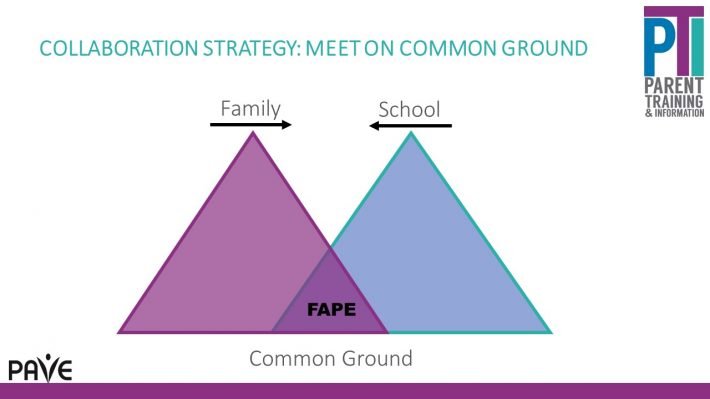
When families and schools meet to talk about a child’s services, everyone can begin with FAPE as the overarching goal. FAPE provides Common Ground for the discussion. Everyone on the team wants FAPE:

  • The school district is required by law to provide FAPE to IEP-eligible students.
  • Teachers are happy when their students are successful.
  • The family wants a child to learn in a meaningful way.
  • The student wants to feel confident and proud.

Common Ground is not always where meetings begin

Problems arise in meetings when school staff and/or family members start the conversation far from Common Ground. The Center for Appropriate Dispute Resolution in Special Education (CADRE) has designed a curriculum to support families and schools in their discussions. Two short videos, A Tale of Two Conversations, provide a quick look at how a meeting might feel like one long argument or a helpful collaboration. The difference starts with preparation and approach.

To avoid a meeting that feels like a fight, the parent may want to start the meeting with some general comments to help school staff better understand the student and to gently remind the team that years of parenting have led to some expertise about a specific child.

For example, an IEP or a behavior plan might say that a student is “defiant” or “refusing” to do work. Those types of statements can make a parent feel defensive. Showing up angry probably will not lead to a productive meeting. Instead, a parent may come to the meeting prepared to explain that the student lacks confidence and would rather appear defiant than “stupid.” Maybe the parent has been able to talk to the student about their frustrations and can bring statements or requests directly from the student.

Another way to find common ground is to prepare open-ended questions and bring those to the table first, before offering suggestions or requests. For example, if a parent shows up and demands a 1:1 right at the start of the meeting, the conversation might quickly devolve into an argument about resource problems. If a parent comes ready to talk about what is not working for the student and concerns for their child’s learning and well-being, there is an opportunity to build empathy and problem-solving.

Climb mountains as a team

Firm predetermined “solutions” from any side can position school staff and family members far from collaboration, like the peeks of two mountains unable to ever meet in the middle.

Consider collaborative problem-solving as a project that starts at the intersecting bases of two mountains, on Common Ground. Shared expectations and assumptions are a good place to begin for an open-minded discussion. Here are a few conversation starters to consider:

  • According to these progress reports, the student is getting good at … How might we use that emerging skill to scaffold skill-building in this other area?
  • My student is not making as much progress as I expected in this area… Can we talk about strategies for improving progress?
  • This assignment, grade, or record shows that the student struggles to … Is there another approach to services or placement that we have not considered yet as a team?
  • I notice that this IEP goal is written to help the student “stop” doing an unwanted behavior. Can you help me understand the skill that is being taught, and can we rewrite the goal to focus on measuring progress toward the expected skill or behavior?
  • From what I see here (data/evidence/observations), this service is not working or is not accessible to the student. My theory about this is… Does anyone here have a different theory about what might be going on?

Here are some big-picture concepts for productive collaboration:

  • Trust is at the heart of positive working relationships.
  • Family members and educators can develop trust by showing personal regard, respect, transparency, and integrity. These may be particularly important for trust to grow among people of different cultures.
  • Blaming, bringing up the past repeatedly, minimizing another’s opinion, or rushing a conversation can create barriers to collaboration.
  • A neutral third party may be needed to resolve issues and rebuild relationships.

Prepare for the meeting

Request any documents that are going to be discussed at the meeting ahead of time. Review the documents in preparation for the meeting and mark down any notes for discussion. Whether meeting to discuss an IEP, a Section 504 Plan, behavior, ancillary services, or something else, families are better served when they prepare. To help families organize their concerns and requests, PAVE offers a format for designing a Handout for the Team Meeting. An alternative version supports self-advocates: Students: Get Ready to Participate in Your IEP Meeting with a Handout for the Team.

Leave with an action plan

At the end of the meeting, review what has been decided and be sure to make notes about any action steps, deadlines, or assignments. Be sure to note:

  1. What is the action?
  2. When will it happen?
  3. Who is responsible?

Schedule a follow-up conversation or a plan to communicate about anything that is not firmly decided. After a formal meeting, the school sends parents a Prior Written Notice (PWN) to describe any changes being made to a student’s services and when those changes will take effect. Parents with their own notes about the action plan will better understand how to read the PWN and whether there are unresolved topics.

Procedural Safeguards provide additional options

If a meeting leaves too many issues unresolved, parents can review their procedural safeguards to make a choice about what to do next. A copy is offered by the school at all formal meetings, and parents can also request a copy any time. The Office of Superintendent of Public Instruction (OSPI) also provides information about parent and student rights.

Parents have the right to disagree with the school and to pursue resolution by:

The collaboration strategy being explained. Meet on common ground. A depiction of two mountains are shown, one represents family and the other mountain represents the school. Both family and school push against each other to form a smaller overlap triangle called FAPE - that represents the common ground.

State Standards Guide Social Emotional Learning for all Ages and Abilities

A Brief Overview

  • Social Emotional Learning (SEL) is a lifelong process through which children and adults effectively manage emotions, reach toward goals, experience empathy, maintain positive relationships, and make responsible decisions.
  • In school, all students participate in SEL as part of Multi-Tiered Systems of Support (MTSS). Specific SEL instruction can also be part of a student’s Individualized Education Program (IEP).
  • Washington State adopted formal Social Emotional Learning Standards January 1, 2020. The Office of Superintendent of Public Instruction (OSPI) provides an SEL website page with resources for educators, families, and community members.
  • A 12-page SEL equity brief focuses specifically on issues of equity as they relate to race, culture, and economic status.
  • A state law that took effect June 11, 2020, further compels work related to SEL. HB 2816, which was inspired and supported by activist parents, requires the Washington State School Directors’ Association (WSSDA) to develop a model policy “for nurturing a positive social and emotional school and classroom climate.”

Full Article

A child’s ability to understand, communicate, and manage emotions is critical to learning. So are skills that enable a child to socialize, self-motivate, empathize, and work collaboratively. Schools call this area of education Social Emotional Learning (SEL).

SEL is not just for children. According to the Collaborative for Academic, Social, and Emotional Learning (CASEL), “SEL is the process through which children and adults understand and manage emotions, set and achieve positive goals, feel and show empathy for others, establish and maintain positive relationships, and make responsible decisions.”

Students with disabilities may qualify for Specially Designed Instruction (SDI) in social and/or emotional areas of learning as part of an Individualized Education Program (IEP). Eligibility for SDI is determined through evaluation, and schools use various instruments to assess whether a student has a disability affecting social or emotional skills to an extent that education is significantly impacted. If so, the student’s IEP will support learning in those social/emotional areas, and goal-monitoring will track skill growth.

Students with IEPs are not the only ones who receive SEL instruction, however. Schools may use curricula to promote emotional understanding, social stories, mindfulness programs, communication circles or other strategies as part of Multi-Tiered Systems of Support (MTSS). MTSS is a framework for improving school-wide social, emotional, and cultural climate. Schools that adopt an MTSS framework deliver SEL to all students (Tier 1) and generally offer Tier 2 and Tier 3 programming to targeted groups or individual students.

Parenting Tip: Ask whether your school uses an MTSS framework

Family caregivers can ask school staff and administrators whether the district operates within an MTSS framework.

  • If the answer is no, ask how school climate is addressed and how SEL is integrated into school-wide programming.
  • If the answer is yes, ask what SEL instruction looks like in the general education classroom (Tier 1) and how specialized lessons are provided to students with higher levels of need (Tiers 2-3). Note that a student who does not qualify for an IEP could demonstrate the need for social/emotional instruction beyond what is provided to most students. Family caregivers can ask for detail about how the school’s MTSS system supports any specific student.

State adopts six SEL standards

Washington State adopted formal Social Emotional Learning Standards January 1, 2020. The Office of Superintendent of Public Instruction (OSPI), which provides guidance to all public and non-public educational agencies in the state, provides an SEL website page with resources for educators, families, and community members. Included is a link to the official letter in which State Superintendent Chris Reykdal adopted the standards, and a collection of resources to support SEL implementation and to further understanding about how families and communities can participate.

A primary document is the 24-page Social Emotional Learning Standards, Benchmarks, and Indicators, which defines the six SEL learning standards and various benchmarks under each. An extensive chart offers practical guidance for assessing each standard for students in Early Elementary, Late Elementary, Middle School, and High School/Adult. The SEL learning standards include:

  1. SELF-AWARENESS – Individuals have the ability to identify their emotions, personal assets, areas for growth, and potential external resources and supports.
  2. SELF-MANAGEMENT – Individuals have the ability to regulate emotions, thoughts, and behaviors.
  3. SELF-EFFICACY – Individuals have the ability to motivate themselves, persevere, and see themselves as capable.
  4. SOCIAL AWARENESS – Individuals have the ability to take the perspective of and empathize with others from diverse backgrounds and cultures.
  5. SOCIAL MANAGEMENT – Individuals have the ability to make safe and constructive choices about personal behavior and social interactions.
  6. SOCIAL ENGAGEMENT – Individuals have the ability to consider others and show a desire to contribute to the well-being of the school and community.

Developmental milestones are charted with a variety of statements that might demonstrate the skill or disposition within an age range.  

  • For example, a late elementary age student might show self-awareness this way: “I can identify and describe physical symptoms and thoughts related to my emotions and feelings (e.g., hot, shoulders tight).”
  • A middle-school student might demonstrate self-efficacy this way: “I can identify specific human and civil rights and freedoms to which everyone is entitled and can understand how to advocate for myself in healthy ways.”

Tip for Parents: Promote SEL at home

Included on the SEL website page is a list of learning activities for families and educators. The eight-page guide includes links to videos, websites, and ready-to-use resources to encourage positive behavior support and helpful communication at home and at school.  Resources are sorted by age and marked to indicate whether they are best suited for family caregivers, teachers, or both.

  • For example, parents of children K-5 might want to click on SEL Games to Play With Your Child to find a resource from Understood.org. One game, Starfish and Tornadoes, helps kids notice how much energy they are feeling inside and when they might need to use their calming skills or ask for help from a trusted adult.
  • A suggestion for grades 5-12 is to Practice Loving-Kindness for Someone you Care About. That exercise from Greater Good in Education provides adaptations for students with disabilities and suggests ways to make the project culturally responsive.

Another document accessible through OSPI’s website is a three-page guide for parents and families, which includes resource linkages to free online training, parenting cue cards with quick answers to typical concerns, and access to other websites with tools and advice specific for various stages of child development. Also included are tips to promote SEL at home by encouraging a child to:

  • Identify and name their emotions, feelings, and thoughts.
  • Identify positive and negative consequences of actions.
  • Demonstrate the ability to follow routines and generate ideas to solve problems.
  • Create a goal and track progress toward achieving that goal.
  • Identify feelings expressed by others.
  • Identify ways that people and groups are similar and different.
  • Demonstrate attentive listening skills without distraction.
  • Identify and take steps to resolve interpersonal conflicts in constructive ways.
  • Demonstrate a sense of community responsibility

SEL guidance supports equity and inclusion

  • Principles listed throughout the state SEL guidance include:
  • Equity: Each child receives what he or she needs to develop his or her full potential.
  • Cultural responsiveness: Culture is viewed as a resource for learning, not a barrier.
  • Universal design: Learning differences are planned for and accommodated.
  • Trauma-informed: Knowledge of the effects of trauma is integrated into policy and practice.

State guidance that describes the SEL standards and benchmarks includes this statement: “Social emotional learning (SEL) happens over the course of a day, a lifetime, and in every setting in which students and adults spend their time.… Effectively supporting social emotional development in schools requires collaboration among families and communities. It also involves building adult capacity to support a school climate and culture that recognizes, respects, and supports differences in abilities, experiences, and ethnic and cultural differences, and celebrates diversity.”

A 12-page SEL equity brief focuses specifically on issues of equity as they relate to race, culture, and economic status. “A white, middle-class model of self that values independence dominates schools,” the brief states. “Students of color and students in low-income communities often experience ‘cultural mismatch’ in education settings that expect forms of expression and participation not aligned with their culture.

“Without explicit attention to equity and cultural diversity, prevalent SEL frameworks, models, and curricula may not adequately reflect the diverse worldviews of students and families.”

Parenting Tip: Attend your local school board meeting to influence decisions

The state’s SEL implementation guide is intended for local districts to use in developing their own school- or community-specific plan to meet the needs of all learners. Because Washington is a local control state, each district is responsible for policy development.

Families have the option of making public comment at meetings to share thoughts or concerns. School board meetings are required monthly and must follow the state’s Open Public Meetings Act (Chapter 42.30 in the Revised Code of Washington). Families can reach out to their local district for information about how and when school boards meet. The Washington State School Directors’ Association provides a guidebook about the rules for Open Public Meetings. The rules apply in any meeting space or platform.

HB 2816 promotes positive school climate

A state law that took effect June 11, 2020, further compels work related to SEL. HB 2816, which was inspired and supported by activist parents, requires the Washington State School Directors’ Association (WSSDA) to develop a model policy “for nurturing a positive social and emotional school and classroom climate.”

The model policy and procedures for its implementation includes specific elements to “recognize the important role that students’ families play in collaborating with the school and school district in creating, maintaining, and nurturing a positive social and emotional school and classroom climate.” In addition, districts “must provide information to the parents and guardians of enrolled students regarding students’ rights to a free public education, regardless of immigration status or religious beliefs; and school districts must provide meaningful access to this information for families with limited English proficiency.”

In accordance with HB 2816, the WSSDA website will post the model policy and procedure by March 1, 2021. School districts are responsible to incorporate the guidance by the beginning of the 2021-22 school year: “School districts may periodically review policies and procedures for consistency with updated versions of the model policy for nurturing a positive social and emotional school and classroom climate.”

SEL is linked to research about Adverse Childhood Experiences

A national movement to incorporate Social Emotional Learning (SEL) is informed by knowledge that trauma profoundly impacts educational outcomes. In the late 1990s, the Centers for Disease Control and Prevention released its first report about Adverse Childhood Experiences (ACEs). Dr. Vincent Felitti, then the CDC’s chief of preventive medicine, boldly proclaimed childhood trauma a national health crisis. The report led to development of an ACEs survey, which scores a person’s likelihood of suffering lifelong physical and mental health impairments resulting from trauma. An ACEs score of 4, the study found, makes a child 32 times more likely to have behavior problems at school.

The data inspired researchers and educators to seek new ways to help children cope so they can manage themselves at school—and in life. A variety of new evidence-based practices were developed to support childhood resiliency. The National Research Council issued this statement in 2012: “There is broad agreement that today’s schools must offer more than academic instruction to prepare students for life and work.”

The 2015 Washington State Legislature directed OSPI to convene an SEL Benchmarks workgroup, and Senate Bill 6620 in 2016 authorized development of a free online training module in SEL for school staff. The bill states that, “In order to foster a school climate that promotes safety and security, school district staff should receive proper training in developing students’ social and emotional skills.” Development of the state SEL Standards furthers that work.

Parenting tip: Work on your own SEL skills

Family caregivers play an important role in fostering SEL by working on their own self-regulation skills. The Collaborative for Academic, Social, and Emotional Learning (CASEL) provides a wide array of resources, including some related to stressors from COVID-19. “We need to pay close attention to our own social emotional needs in order to be the community of adults who best serve our young people,” CASEL advises. “Practice continued self-care strategies, including eating healthy, getting enough sleep, exercising, and finding time to take breaks.” CASEL provides a checklist to reframe your thinking, including ideas about “all-or-nothing” or overgeneralization, for example.

PAVE provides a series of short mindfulness videos for all ages and abilities and offers additional mindfulness and parenting ideas in an article, Stay Home Help: Get Organized, Feel Big Feelings, Breathe.

Parents are a child’s primary SEL teachers

Family caregivers can help foster SEL skills by collaborating with the school. OSPI’s guidance includes this statement: “Parents and families are a child’s first teachers of SEL. As children grow, parents and families continue to support the social emotional lives of their children in the home.”

Here are a few questions parents might ask school staff to collaborate on SEL skill development:

  • How are you helping my child learn from mistakes?
  • If behavior is keeping my child from learning, what skill is lacking?
  • What is a best-practice strategy for teaching the skill that my child needs to learn?
  • Do you have a tool for understanding and regulating emotions that we can use at home also?
  • How is my child learning to “name and tame” emotions? (Dan Siegel, neurobiologist and author of Mindsight, suggests that recognizing and naming a feeling gives a person power to regulate the emotion.)
  • What positive reinforcement is being provided when my child demonstrates a new skill? How are those positive reinforcers tracked through data collection?
  • What is the plan to help my child calm down when dysregulation makes problem-solving inaccessible?
  • Would a Functional Behavior Assessment help us understand what my child is trying to communicate through this unexpected behavior?
  • Can we collaborate to develop a Behavior Intervention Plan so that we are using the same cues and language to support expected behavior?
  • What adult at the school is a “champion” for my child? (Dr. Bruce Perry, whose research supports trauma-informed initiatives, says, “Relationships are the agents of change and the most powerful therapy is human love.”)

Map Your Future with Person-Centered Planning

A Brief Overview  

  • Person-Centered Planning (PCP) is a method for helping a person map out a future with intention and support.
  • Read on for more information about what Person-Centered Planning is like.

Full Article  

Everyone dreams about what they might do or become. Individuals with disabilities might need additional support to design the plans, set the goals and recruit help. The Person-Centered Planning (PCP) process is a tool that works like a Global Positioning System (GPS) to help a person figure out where they are starting and how to navigate to a planned destination.   

A PCP session is a gathering that can happen in a specific physical location, such as a school or a community center, or in a virtual space online. The people who get together might include family members, friends, teachers, vocational specialists, coaches—anyone who might help brainstorm ways to plan an enriched, full life for a person of honor.

The first step is to celebrate the gifts, talents, and dreams of the person. Then the group develops action steps to help that person move closer to their dreams and goals.  

Throughout the gathering, the attendees listen, ask questions, and draw pictures or write down words that contribute to the process. Respect for the person’s goals and wishes is a priority, and participants withhold judgment to honor the individual completely.  

Person-Centered Planning explores all areas of a person’s life. All people experience various times in their lives that are transitions. High-school graduation is a major example. Job changes, moving to a new home, entering or leaving a relationship: Those transitions happen for individuals with and without disabilities.

Individuals with disabilities have some additional transitions. For example, when a person leaves the special education system of public education at graduation or after age 21, there is a change in disability protections. A student receiving special education is protected by the Individuals with Disabilities Education Act (IDEA). In adult life, the right to accommodations and non-discrimination is protected solely by the Rehabilitation Act of 1973 (Section 504) and the Americans with Disabilities Act (ADA).

There are specific transitions that occur for individuals who qualify for support from the Developmental Disabilities Administration (DDA), which in Washington is part of the Department of Social and Health Services (DSHS). Employment and workforce training programs often are part of the transition from high school into what happens next.

During major life transitions, many service agencies focus on a person’s inabilities or deficits.  Person-Centered Planning, on the other hand, focuses on what’s positive and possible, based on the dreams and goals of the individual.

A PCP session includes a set of maps where information is collected in words and pictures. Here are some examples:

People in my Life     

This map names important people and their roles in concentric circles. These are people that the individual trusts for help and support and may include paid and unpaid supporters. Those who are closest to the person are in the circles closest to the center of the map.

Who am I?  My Story, My History    

This map is built during the session to describe the person’s story from birth up until the gathering. This map reflects what is most important to the individual. The facilitator might ask:

  • What parts of your life are important for people to know?   
  • What are some stories of your life that would be helpful for a coworker or a friend to know? 
  • Are you a sibling? A spouse? A parent?
  • How old are you? 
  • What activities do you participate in? 
  • Have you had any jobs?
  • Where do you live? Go to school?  
  • Do you have a medical concern that someone spending time with you might need to know about? 

 Likes and Dislikes  

The “Likes” list includes favorites, things that make the person happy. Favorite colors, foods, activities, places, people are listed. 

The “Dislikes” list includes the opposite of all those things and might also list triggers (bright lights, loud noises, angry voices, bullies) or other sensitivities.

What Works/ Doesn’t work 

The first part of this map asks: When learning a new activity or skill, what are steps and learning tools or activities that work for you? Answers might look like these examples: frequent breaks, accommodations, a written schedule, a list of duties, instructions in larger print, a preferred time of day to start something…. 

The second part asks: When learning a new activity or skill what activities do not work for you? Answers might resemble these examples:  waiting in line, too many instructions, too many people barking out orders, standing or sitting for too long, verbal instructions, unclear expectations….  

Gifts, Talents and Strengths  

This map asks several questions: 

  • What are you good at?
  • What can you do that is easy for you? 
  • What are your best qualities? 
  • What do people like about you?   

Examples for answers:  best smile, cleaning, giving, caring, natural dancer, very social, great with computers, good with numbers, great at sports, good listener, good with animals, etc.   

Dreams /Nightmares 

The My Dreams map asks: Where you would like to see yourself in a few years?  Follow-up questions:

  • What will you be doing?
  • What would your dream job be?  
  • Where are you living? 
  • Do you live on your own or with family or a roommate?  
  • How are you keeping in touch with your friends?   
  • What is an action you can take to move toward your dream or goals?    

The Nightmare Map asks:  What do you want to avoid?  Follow-up questions might include this one: Where do you not want to be in a few years? This is not to make the person feel bad but to make an out-loud statement about what the person doesn’t want to happen. This can include actions or thoughts that someone wants to avoid.  

Needs 

The Needs map asks:  What do you need help with to avoid the nightmare?  A follow up question might include: What areas do you need support with? Answers might look like these examples: budgeting money, learning to drive, training to ride the bus, cooking lessons, looking for a job. The goal is to recruit support to help the person stay away from the nightmare and work toward the dream.   

Action Steps  

A map that show Action Steps includes the specific help that will assist the individual in moving toward the dream. This chart typically details what needs to be done, who will do it, and by when. 

Example:    

Goal: To Write a Resume     
Who: Michele 
What: Call Mark to ask for help.  
By When: Next Monday, April 6, 2020 

This process involves many support people in the person’s life and identifies, in a self-directed way, areas where help is needed to meet personal goals. The gathering involves the important people in someone’s life because they can help through the process and step up to offer support for the action steps. 

How to get a Person-Centered Plan  

Here are places that might help you find a PCP facilitator in your area:  

  • Developmental Disabilities Administration (DDA) 
  • Division of Vocational Rehabilitation (DVR)
  • School District 

Here are a few additional places to seek information about Person-Centered Planning:  

Inclusion.com: All My Life’s a Circle  

Inclusion.com: The Path Method 

Video from PAVE, Tools 4 Success  

Informing Families.org  

Isolation and Restraint Practices Attract Media Attention

Disability Rights Washington (DRW) has published a video about school use of isolation and restraint. The video, which is posted to YouTube, was produced by DRW’s media program called Rooted in Rights. DRW is a private non-profit organization with a mission to advance the dignity, equality, and self-determination of people with disabilities. The agency is staffed with attorneys who pursue justice on matters related to human and legal rights.

In Washington State, isolation and restraint may be used if “reasonably necessary to control spontaneous behavior that poses an imminent likelihood of serious harm,” as defined in the Revised Code of Washington (RCW 70.96B.010). The isolation/restraint ends when the imminent likelihood of harm has passed. These practices are considered emergency responses and not disciplinary actions.

The Office of Superintendent of Public Instruction (OSPI) describes specific reporting requirements for schools to inform parents and the state about isolation and restraint incidents.

PAVE’s website, wapave.org, provides several articles that include information about isolation and restraint practices. Articles also describe ways to incorporate positive behavior supports into school programs to reduce the need for emergency response. An article titled, Ideas and Resources to Support Your Child’s Behavior at School, is a place to start.

Another option to research information on the topic is to type the word “Behavior” into the search bar at wapave.org to find additional articles. A comprehensive article about policies related to discipline is titled, What Parents Need to Know when Disability Impacts Behavior and Discipline at School.

Educators and policy makers generally agree that an evidence-based method to keep everyone safe and learning at school is to incorporate Positive Behavior Interventions and Supports (PBIS) into a school-wide program that focuses on a healthy school climate. PBIS is described in several of PAVE’s articles, including one contributed by University of Washington researcher Kelcey Schmitz: Positive Behavioral Interventions & Supports (PBIS) in Schools.

Implementation of PBIS varies widely across the state. Parents can ask their school district administrators about whether a PBIS framework is being used within the district.