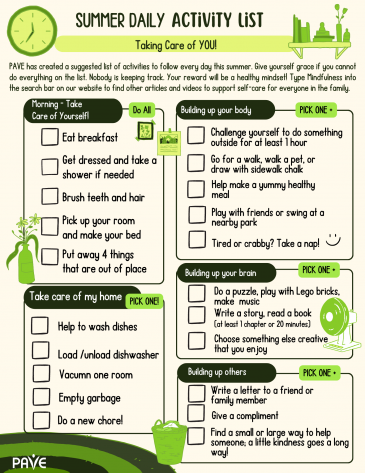
Summer Daily Activity List – Taking care of YOU!

PAVE has created a suggested list of activities to follow every day this summer. Give yourself grace if you cannot do everything on the list. Nobody is keeping track. Your reward will be a healthy mindset! Type Mindfulness into the search bar on our website to find other articles and videos to support self-care for everyone in the family. 

List of Daily Activities for the Summer Print list on wapave.org

Click to view this list in PDF form

Start the day with a self-care routine – Do all!

  • Eat breakfast
  • Get dressed and take a shower if needed
  • Brush teeth and hair
  • Pick up your room and make your bed
  • Put away four things that are out of place

Take care of your home – Pick one!

  • Help to wash dishes
  • Load /unload the dishwasher
  • Vacuum one room
  • Empty the garbage
  • Do a new chore!

Build your body – Pick one or more!

  • Challenge yourself to do something outside for at least one hour
  • Go for a walk, walk a pet, or draw with sidewalk chalk
  • Help make a yummy healthy meal
  • Play with friends or swing at a nearby park
  • Tired or crabby? Take a nap!

Build your brain

Build your brain – Pick one or more!

  • Do a puzzle, play with Lego bricks, make music
  • Write a story, read a book (at least 1 chapter or 20 minutes)
  • Choose something else creative that you enjoy

Build up others – Pick one or more!

  • Write a letter to a friend or family member
  • Give a compliment
  • Find a small or large way to help someone: a little kindness goes a long way!

Mental Health Education and Support at School can be Critical

A Brief Overview

  • Alarming statistics indicate the pandemic worsened many behavioral health outcomes for young people. Governor Jay Inslee on March 14, 2021, issued an emergency proclamation declaring children’s mental health to be in crisis.
  • President Joe Biden issued a Fact Sheet about the nation’s mental health crisis on March 1, 2022, as part of his State of the Union message. This article includes some of what the president shared about youth impacts.
  • Washington State’s 2021 Healthy Youth Survey confirms that children and youth are struggling to maintain well-being.
  • These outcomes make adolescence a critical time for mental health promotion, early identification and intervention. Read on for information and resources.
  • The emotional well-being of students may be served through Multi-Tiered Systems of Support (MTSS), which provide a structure for schools to provide education and supports related to student well-being schoolwide.
  • Students with high levels of need may access mental health support through the special education system. Emotional Disturbance is a federal category of disability under the Individuals with Disabilities Education Act (IDEA).

Full Article

Alarming statistics indicate that children and young people are in crisis. Governor Jay Inslee issued an emergency proclamation for children’s mental health on March 14, 2021. Data from Washington’s 2021 Healthy Youth Survey confirm the distressing trends:

Seven out of ten students in tenth grade report feeling nervous, anxious, on edge, or cannot stop worrying. Eight percent said they tried suicide within the past year. Almost 40 percent said their feelings were disturbing enough to interrupt their regular activities, and more than 10 percent of students said they didn’t have anyone to talk to about their feelings. According to the Centers for Disease Control and Prevention (CDC), only about half of young people who need behavioral health services get them.

According to the 2021 statewide survey, students with disabilities struggle more than most. Also over-represented are girls, students from lower income households, and students whose gender or sexuality is non-binary. Non-binary refers to more than two things; it’s a term often used when discussing people who identify as Lesbian, Gay, Bi-sexual, Transgender, Queer, or questioning (LGBTQ+). LGBTQ+ youth can seek crisis help and more from The Trevor Project.

“Reports of our children suffering with mental health issues are a worrisome public health concern,” said Umair A. Shah, MD, MPH, Washington’s Secretary of Health. “Mental health is a part of our children’s overall health and well-being. It is imperative that we all continue to work together to fully support the whole child by providing information and access to behavioral health resources to youth and the trusted adults in their lives.”

Concerns are nationwide. On March 1, 2022, President Joe Biden issued a Fact Sheet stating that grief, trauma, and physical isolation during the past two years have driven Americans to a breaking point:

“Our youth have been particularly impacted as losses from COVID and disruptions in routines and relationships have led to increased social isolation, anxiety, and learning loss.  More than half of parents express concern over their children’s mental well-being. An early study has found that students are about five months behind in math and four months behind in reading, compared with students prior to the pandemic.

“In 2019, one in three high school students and half of female students reported persistent feelings of sadness or hopelessness, an overall increase of 40 percent from 2009. Emergency department visits for attempted suicide have risen 51 percent among adolescent girls.”

Mental Health support to students is a statewide priority

Recognizing the unmet needs, Washington State’s 2022 legislature passed a variety of bills to increase support to children and youth with behavioral health conditions. Here are a few examples:

  • HB 1664: Provides funding and incentives for schools to increase numbers of staff who provide physical, social, and emotional support to students. Schools are responsible to report to the state how these funds were used for hiring staff that directly support students and not something else.
  • HB 1800: Requires Health Care Authority (HCA) to build and maintain a website (“parent portal”) to help families seek out behavioral health services. Also supports growth and training requirements for behavioral health ombuds serving youth through the Office of Behavioral Health Consumer Advocacy.
  • HB 1834: Establishes a student absence from school for mental health reasons as an excused absence.
  • HB 1890: Creates an advisory group under the Children and Youth Behavioral Health Work Group (CYBHWG) to build a strategic plan for children, youth transitioning to adulthood, and their caregivers. Also establishes a $200/day stipend (up to 6 meetings per year) for members of the CYBHWG with lived experience who are not attending in a paid professional capacity.

TIP: Family caregivers can get involved in advocacy work!

Here’s another TIP: Families can ask their school who is on site to support students with their mental health needs. Some school districts seek support from an Educational Service District (ESD) to meet student behavioral health needs, so families can also ask whether ESD supports are available. Some ESDs are licensed as behavioral health providers—just ask.

What is MTSS, and why learn this acronym to ask the school about it?

A priority for agencies involved in statewide work is implementation of Multi-Tiered Systems of Support (MTSS). Through MTSS, schools support well-being for all students and offer higher levels of support based on student need. Social Emotional Learning (SEL) is key to MTSS, which creates a structure for positive behavioral supports and trauma-informed interventions.

The Office of Superintendent of Public Instruction (OSPI) is the state educational agency for Washington schools. In its 2021 budget, OSPI prioritized MTSS as part of a plan to Empower all Schools to Support the Whole Child. In January, 2021, OSPI was awarded a five-year, $5.3 million grant from the U.S. Department of Education help districts implement MTSS. As a local control state, Washington districts determine their own specific policies and procedures.

TIP: Families can ask school and district staff to describe their MTSS work and how students are receiving support through the various levels/tiers.

Special Education is one pathway for more help

Students may access mental health support through the special education system. Emotional Disturbance is a federal category of disability under the Individuals with Disabilities Education Act (IDEA). Appropriate support can be especially critical for these students: According to the U.S. Office of Special Education Programs (OSEP), students eligible for school-based services under the ED category are twice as likely to drop out of high school before graduating.

How a student is supported in their life planning could have an impact. PAVE provides a toolkit of information about how to support a student in their preparations for graduation and beyond: School to Adulthood: Transition Planning Toolkit for High School, Life, and Work.

Note that a student with a mental health condition might qualify for an Individualized Education Program (IEP) under the category of Other Health Impairment (OHI), which captures needs related to various medical diagnoses. Other categories that often overlap with behavioral health are Autism and Traumatic Brain Injury (TBI). IEP eligibility categories are described in the Washington Administrative Codes (WAC 392-172A-01035).

In Washington State, the ED category is referred to as Emotional Behavioral Disability (EBD). If the student’s behavioral health is impaired to a degree that the student is struggling to access school, and the student needs Specially Designed Instruction (SDI), then the student may be eligible for an IEP. Keep in mind that academic subjects are only a part of learning in school: Social Emotional Learning (SEL) is part of the core curriculum. 

An educational evaluation determines whether a student has a disability that significantly impacts access to school and whether Specially Designed Instruction (SDI) and related services are needed for the student to receive a Free Appropriate Public Education (FAPE). FAPE is the entitlement of a student eligible for special education services. An IEP team determines how FAPE/educational services are provided to an individual student.

Behavioral health counseling can be part of an IEP

Counseling can be written into an IEP as a related service. When included in a student’s IEP as educationally necessary for FAPE, a school district is responsible to provide and fund those services. School districts can receive reimbursement for most of the cost of behavioral health services for students who are covered by Medicaid and on an IEP. The Health Care Authority provides information about school-based health services for students who are covered by Medicaid and on an IEP.

A student with a mental health condition who doesn’t qualify for an IEP might be eligible for a Section 504 Plan. A disability that impairs a major life activity triggers Section 504 protections, which include the right to appropriate and individualized accommodations at school. Section 504 is an aspect of the Rehabilitation Act of 1973, a Civil Rights law that protects against disability discrimination. Students with IEPs and 504 plans are protected by Section 504 rights.

Behavioral Health encompasses a wide range of disability conditions, including those related to substance use disorder, that impact a person’s ability to manage behavior. Sometimes students with behavioral health disabilities bump into disciplinary issues at school. Students with identified disabilities have protections in the disciplinary process: PAVE provides a detailed article about student and family rights related to school discipline.

Placement options for students who struggle with behavior

IEP teams determine the program and placement for a student. In accordance with federal law (IDEA), students have a right to FAPE in the Least Restrictive Environment (LRE) to the maximum extent appropriate. That means educational services and supports are designed to help students access their general education classroom and curriculum first. If the student is unable to make meaningful progress there because of their individual circumstances and disability condition, then the IEP team considers more restrictive placement options. See PAVE’s article: Special Education is a Service, Not a Place.

If general education is not working, the IEP team is responsible to consider all placement options to find the right fit. There is not a requirement to rule out every “less restrictive” option before choosing a placement that the team agrees will best serve the student’s needs.

Sometimes the IEP team, which includes family, will determine that in order to receive FAPE a student needs to be placed in a Day Treatment or Residential school. OSPI maintains a list of Non-Public Agencies that districts might pay to support the educational needs of a student. Districts may also consider schools that are not listed. Washington State has almost no residential options for students. Schools almost always send students to other states when residential placement is needed.

On May 23, 2022, a Washington affiliate of National Public Radio (KUOW) provided a report about the lack of residential programs in the state and the challenges for families whose students go out of state for residential education: Washington is sending youth in crisis to out-of-state boarding schools; taxpayers pick up the tab.

Residential placement may be necessary because educational needs cannot be served unless medical needs are fully supported. School districts may be responsible in those situations to pay for a residential placement. A precedent-setting court ruling in 2017 was Edmonds v. A.T. The parents of a student with behavioral disabilities filed due process against the Edmonds School District for reimbursement of residential education. The administrative law judge ruled that the district must pay for the residential services because “students cannot be separated from their disabilities.”

Strategies and safety measures for families and teachers

The Healthy Youth Survey is conducted every other year and was delayed from 2020 to 2021 because of the pandemic. Over the years, results are shared along with tips for families and schools. Here are a few considerations built from various data points within the survey:

Hopeful students:

  • Are more interested in schoolwork: Is there a way to make every day at school more connected to what a child cares about?
  • See people who can help: Who are the adults at school that a student can trust and go to for encouragement or guidance?
  • Believe that school is relevant to life: Who is helping the student connect what they are learning now to who they want to become?
  • Are academically successful: Are supports in place to provide adequate help so the student can succeed in learning? Evidence-based instructional strategies are key when students struggle in reading, writing, or math because of learning disabilities, for example.

TIP: Make sure these four topics are part of a school/family discussion when a student is struggling with emotional well-being or behavior that may be impacted by hopelessness.

A 2018 handout includes tips for parents and other adults who support teens who feel anxious or depressed:

  • Bond with them: Unconditional love includes clear statements that you value them, and your actions show you want to stay involved in their lives.
  • Talk with teens about their feelings and show you care. Listen to their point of view. Suicidal thinking often comes from a wish to end psychological pain.
  • Help teens learn effective coping strategies and resiliency skills to deal with stress, expectations of others, relationship problems, and challenging life events.
  • Have an evening as a family where everyone creates their own mental health safety plan.
  • Learn about warning signs and where to get help
  • Ask: “Are you thinking about suicide?” Don’t be afraid that talking about it will give them the idea. If you’ve observed any warning signs, chances are they’re already thinking about it.
  • If you own a firearm, keep it secured where a teen could not access it.
  • Lock up medications children shouldn’t have access to.

A press for school-based services and mental health literacy

Advocacy for direct school-based mental health services and education about mental health topics comes from the University of Washington’s SMART Center. SMART stands for School Mental Health Assessment Research and Training. The SMART center in 2020 provided a report: The Case for School Mental Health. The document includes state and national data that strongly indicate school-based behavioral health services are effective:

“Increased access to mental health services and supports in schools is vital to improving the physical and psychological safety of our students and schools, as well as academic performance and problem-solving skills. Availability of comprehensive school mental health promotes a school culture in which students feel safe to report safety concerns, which is proven to be among the most effective school safety strategies.”

The SMART Center in partnership with the non-profit Chad’s Legacy Project in 2021 established an online Student/Youth Mental Health Literacy Library. Intended for staff at middle and high schools, the library provides resources to help schools choose curricula for mental health education on topics that include Social Emotional Learning, Substance Use Disorder, and Suicide Prevention.

Goals of mental health literacy are:

  • Understanding how to foster and maintain good mental health
  • Understanding mental disorders and their treatments
  • Decreasing Stigma
  • Understanding how to seek help effectively for self and others

TIP: Families can direct their schools to this resource to support development or growth of a mental health education program.

For information, help during a crisis, emotional support, and referrals:  

  • Suicide Prevention Lifeline (1-800-273-TALK): After July 16, 2022, call 988
  • Text “HEAL” to 741741 to reach a trained Crisis Text Line counselor
  • Trevor Project Lifeline (LGBTQ) (1-866-488-7386)
  • The Washington Recovery Help Line (1-866-789-1511)
  • TeenLink (1-866-833-6546; 6pm-10pm PST)
  • Seattle Children’s Hospital has a referral helpline. Families can call 833-303-5437, Monday-Friday, 8-5, to connect with a referral specialist. The service is free for families statewide

Further information on mental health and suicide:  

Family Support

  • PAVE’s Family-to-Family Health Information Center provides technical assistance to families navigating health systems related to disability. Click Get Help at wapave.org or call 800-572-7368 for individualized assistance. Family Voices of Washington provides further information and resources.
  • A Facebook group called Healthy Minds Healthy Futures provides a place to connect with other families.
  • Family caregivers can request support and training from COPE (Center of Parent Excellence), which offers support group meetings and direct help from lead parent support specialists as part of a statewide program called A Common Voice.
  • Washington State Community Connectors (WSCC) sponsors an annual family training weekend, manages an SUD Family Navigator training, and offers ways for families to share their experiences and support one another. With passage of HB 1800 in 2022, WSCC is working with the Health Care Authority to build a statewide website to help families navigate behavioral health services.
  • Family, Youth, and System Partner Round Table (FYSPRT) is a statewide hub for family networking and emotional support. Some regions have distinct groups for young people.

Navigating Special Education in Private School

A Brief Overview

  • When a family chooses to enroll their student with disabilities in a private school, they have different rights. Those rights are summarized in this article and further explained by U.S. Department of Education guidance issued in February 2022.
  • School districts are responsible to seek out and evaluate all students suspected of having disabilities impacting their education, including those who are home schooled or placed in private schools by their parents. That right is mandated by Child Find.
  • Public schools are responsible to re-evaluate students eligible for services at least every 3 years and to include them in their “child count,” regardless of where they attend school and whether they receive any services.
  • Upon recommendation by an IEP team, a school might place a student with specific needs into a private school in order to provide a Free Appropriate Public Education (FAPE). Private placement based on an IEP team process is different, and this article is not about those placements.

Full Article

When a family chooses to enroll their student with disabilities in a private school, they have different rights. The vocabulary is also different. Here are some key terms:

  • Equitable Services: Special education services provided to privately enrolled students. Equitable services are the responsibility of the public district where the student’s private school is located.
  • Services Plan: The arrangement agreed upon by the private school, the public school, and the family. A Services Plan can include services at the private school, a public school, or somewhere else; transportation necessary to access services is generally the responsibility of the public district. 
  • Consultation: Federal law requires public school district staff to meet consistently with private school providers and parents/stakeholders in the community to discuss which services to prioritize for children with disabilities placed by their families into private schools in the area.
  • Proportionate Share: Federal law requires public school districts to set aside funds to serve students with disabilities enrolled by their parents in private schools. The amount of the set-aside funds is determined through a calculation called “proportionate share.” Families/stakeholders can ask for specific details about the local requirements for proportionate share by attending a consultation (see above definition).

Evaluation rights are upheld

Like all children in the United States, students placed in private schools are protected in their right to be evaluated if there is reason to believe a disability condition might impact how they learn and participate in school.

That protection is mandated by Child Find, which is part of the federal Individuals with Disabilities Education Act (IDEA). A comprehensive evaluation determines whether a student is eligible for special education services because of a disability that impacts the student’s access to education to the extent that Specially Designed Instruction (SDI) is needed.

A parent has the right to request an Independent Educational Evaluation (IEE) at public district expense if they disagree with an evaluation conducted by the public district.

Private school students have an Equitable Services plan, not an IEP

If their parents choose to enroll them in private school, a student eligible for services under IDEA is not served through an Individualized Education Program (IEP). They instead are served through a plan for Equitable Services.

What those services provide depends on what the student needs, resources available, and priorities identified within the local community. They might include special education services in a specific area of learning and/or related services provided by a professional, such as an occupational, physical, or speech-language therapist.

What rights to parents have?

Federal law protects parents in their right to participate in the development of an Equitable Services plan. According to federal guidance (question E-3), “Given the emphasis on parent involvement in IDEA, the Department believes that parents should have the opportunity to participate in meetings to review and develop the services plan for their child.”

Parents have the right to file complaints if they disagree with the way services are provided. In Washington State, that process is called filing a Community Complaint. Other dispute resolution options are somewhat limited. For example, the right to file Due Process is limited to complaints related to Child Find. Mediation is offered only for complaints related to Child Find or a Community Complaint, and a family cannot demand compensatory services if a district has run out of proportionate share funds. Compensatory services are additional services provided when a student was available to receive services as written by a program or plan; however, the school failed to provide them.

Where services are provided depends on a range of circumstances. The U.S. Department of Education advises public school districts to serve students at their private schools. Here is language from the February 2022 guidance (Section F):

“The Department generally believes that, unless there is a compelling rationale for these services to be provided off-site, [Lead Education Agencies/public school districts] should provide services on-site, at the child’s private school, to not unduly disrupt the child’s educational experience.”

It’s possible that students with disabilities in private schools may not receive any special education services. One reason might be that their family doesn’t want them. In those situations, the local public district is still responsible to keep track of that student and include them in their records—called a “child count.” The district is also responsible to re-evaluate those students for eligibility at least every 3 years.

Not all needs must be met through Equitable Services

The public school district or “lead education agency/LEA” responsible for services to privately enrolled students is the LEA where the private school is located, not necessarily the district where the student lives. This includes situations where a student goes to school in another county, state, or even country (a Canadian student attending a U.S. private school, for example, may access Equitable Services).

The local district is not responsible to provide services that cost more than the funds they have available through their “proportionate share” formula. Another reason certain services are not provided may be that stakeholders in the community decide to prioritize certain services over others during their “consultation” process. For example, a consultation may result in a district choosing to fund speech/language services but not occupational therapy.

In summary, there is not a guarantee of equitable access to all aspects of school and learning within a voluntary private school placement.

Keep in mind that the word “equity” does not mean equal. In general, equity is provided when a person who needs assistance gets the help they need to access an opportunity that people who don’t have disabilities can access without that assistance. In the case of Equitable Services, the term suggests equity but does not guarantee equity.

Parentally placed private school students do not have IEPs or receive FAPE

Equity is guaranteed for public school students with disabilities who are eligible for IEPs. The public-school student’s IEP is designed to support their access to a Free Appropriate Public Education (FAPE). Equity and help that enables appropriate access to school are part of FAPE. So is an individualized education designed to enable progress appropriate in light of the child’s circumstances.

Private school students are not entitled to FAPE or its specific entitlements and protections.

What if a child attends a private school as part of their IEP placement?

This article is about IDEA protections for students who are placed in private schools by their parents/caregivers because of a family preference. Under different circumstances, a student might go to a private school because their IEP team decides they need to be there in order to receive a Free Appropriate Public Education (FAPE). Those students retain all of the rights of a public education student under special education law.

Reminder: A student placed in private school by their parents does not have an IEP and is not entitled to FAPE.

All students with disabilities have the right to accommodations

Private schools are required to provide accommodations to children who qualify for them under Section 504 of the Rehabilitation Act of 1973 and the Americans with Disabilities Act (ADA). Examples might include a ramp for a child in a wheelchair, Braille texts or audible books, additional time or an alternative space for testing. Each school has a staff member assigned to support compliance with these federal requirements.

PAVE provides on demand video trainings: Student Rights, IEP, Section 504 and More.

Adolescent Health Care Act Provides Options for Families Seeking Mental Health and Substance Use Help for Young People Resistant to Treatment

A Brief Overview

  • The Adolescent Behavioral Health Care Access Act, passed into law by the Washington Legislature in 2019, gives parents and providers more leverage in treating a young person who will not or cannot independently seek medical help for a behavioral health condition.
  • The Washington State Health Care Authority (HCA) hosts website links with information about the law, which allows Family Initiated Treatment (FIT). The landing page includes an email address: hcafamilyinitiatedtreatment@hca.wa.gov.
  • Access to FIT is a topic of the state’s Children and Youth Behavioral Health Work Group. CYBHWG supports several sub-work groups, including one focused on school-based services and suicide prevention. Information about group membership, public meetings, resources, events and training is available on the HCA website.
  • If a person ages 15-40 is newly experiencing psychosis, Washington offers a wraparound-style program called New Journeys. This website link includes access to a referral form.

Full Article

Getting mental health help for a youth in crisis can be complicated, frustrating, and frightening.

Mental Health America ranks states based on the incidence of mental illness and access to services. The 2022 youth rankings list Washington 39th in the nation. Various measures indicate a high prevalence of major depression, substance use disorder, and/or emotional disturbance as a category of disability on the Individualized Education Program (IEP). Barriers to treatment consider insurance as well as availability of services.  

Sometimes a barrier to treatment involves a complicated balance of youth autonomy and parental responsibility. The most severe psychiatric conditions often include a symptom called anosognosia, which blocks the brain’s ability to see the impairment or understand why professional help could be of benefit. In youth whose brains are still forming, symptoms that impact insight and choice-making are particularly problematic.

New Journeys is an option when psychosis is present

Sometimes anosognosia co-occurs with psychosis, which indicates a person has lost touch with reality. Delusions and hallucinations may be present. If a person is newly experiencing psychosis, Washington offers a wraparound-style program called New Journeys: This link provides access to information for clients and families and includes an online referral form.

Causes of psychosis are the subject of ongoing research, but some theories suspect the brain is trying to make sense out of a world that does not make sense. Synapses fire errantly, and the brain tries to organize them into stories to calm itself. Synaptic loops get built during these firestorms of neural activity, and the stories that emerge become reality to the person whose brain is narrating the experience, even if they are untrue or grounded in false perceptions. Choice-making in the empirical world is often compromised.

Family education about psychosis is an aspect of New Journeys, which is for youth and adults ages 15-40 who have experienced psychotic symptoms for more than or equal to 1 week and less than or equal to 2 years. Staff from the University of the Washington contribute support to the state’s New Journeys program, which is offered in various but not all regions of the state.

University staff also support a program called Psychosis REACH, which provides evidence-based skill-building for relatives and friends of individuals with psychotic disorders. The practices are based in cognitive behavioral therapy (CBT). The program’s website includes information about training opportunities and resources.

Age of Consent in Washington is 13

In Washington State, the age of medical consent is 13. That means that a person 13-17 years old can independently seek medical treatment, without the consent or knowledge of parents.

Age of consent laws also have meant that Washington youth could say no to behavioral health treatment, regardless of whether parents and providers agreed that such treatment was necessary to protect the safety and well-being of the adolescent. Exceptions are made when there is a threat of imminent danger or grave disability due to psychiatric deterioration. Read on for more information about involuntary treatment/commitment.

The Adolescent Behavioral Health Care Access Act, passed by the Washington legislature in 2019, gives parents and providers more leverage when a young person is struggling with behavioral health and does not independently engage with treatment. The law allows parents/caregivers to bring a youth, ages 13-17, to a provider for evaluation without requiring consent from the youth.

The law includes elements introduced by the state Senate and House of Representatives, which originally titled the bill as HB 1874. In 2020, passage of HB 2883 added residential treatment as an additional option under Family Initiated Treatment (FIT).

The law does not limit an adolescent’s ability to initiate treatment on their own.

Parents have felt shut out of their teenager’s care

January 8, 2020, article in Crosscut profiles several families impacted by the new law. “Until the new law,” the article states, “parents often were shut out of their teenager’s care and treatment plans and couldn’t push a teen toward necessary outpatient or inpatient care without their consent.”

Passage of FIT marks a win for the Children and Youth Behavioral Health Work Group, which studied and reviewed recommendations from a stakeholder advisory group authorized by the 2018 legislature. Final language in the law was impacted by family members, youth, clinicians, hospital staff and many others who met dozens of times.

“Parent” is broadly defined, and information sharing is more open

Under the law, the definition of parent is expanded to include a wide range of family caregivers, guardians and others who have authority to initiate treatment. The Revised Code of Washington (RCW 9A.72.085) provides standards for “subscribing to an unsworn statement” that can apply to a caregiver initiating treatment. 

The law enables providers to share information with parents without an adolescent’s consent, if the provider determines that information sharing with family is in the best interests of the adolescent patient. A list of information-sharing guidelines is included below.

Note that parents retain the right to make medical decisions for children younger than 13, and adults 18 and older are responsible for medical decision-making if there is no guardianship.

In accordance with RCW 71.34.375, providers are required to provide notice to parents of all available treatment options, including Family Initiated Treatment. The state Health Care Authority provides a fact sheet to clarify those requirements.

Family-Initiated Treatment (FIT)

The FIT law allows a parent/caregiver to escort their adolescent child to certain licensed behavioral health facilities and request that a professional person examine the adolescent to determine whether treatment is medically necessary. That treatment might include outpatient, inpatient, or residential care.

According to the Health Care Authority (HCA), FIT is not a guarantee of immediate services, and no provider is obligated to provide services under FIT. Each provider has processes, procedures, and requirements pertaining to evaluation and admission to services. However, the only reason for not providing services cannot be the youth’s lack of consent (RCW 71.34.600).

If a facility covered by this law does not have a professional person available to perform the examination, the facility is not required to make staff available on demand. Additionally, if the professional determines the adolescent needs in-patient treatment but the facility does not have a bed available, the facility is not required to make a bed available. Included are those facilities that house children and youth under the Children’s Long-term Inpatient Program (CLIP). CLIP beds are generally subject to a waiting list and a multi-step referral process.

According to staff at Washington’s Health Care Authority, staffing shortages and other limitations within the behavioral health system have slowed implementation of the law. Families are encouraged to contact providers before taking an adolescent to a facility to determine if the provider has the capacity or ability to perform an assessment.

FIT in a community setting

If medical necessity is found by an outpatient provider who evaluates a young person brought into care through FIT, the provider is limited to 12 sessions over 3 months to attempt to work with the adolescent. If the young person still refuses to engage with treatment, then the period of Family-Initiated Treatment with that provider ends. The family at that point could seek treatment elsewhere.

State laws continue to encourage autonomy for young people, despite recognition that family involvement is important. According to the Revised Code of Washington (RCW 71.34.010):

 “Mental health and chemical dependency professionals shall guard against needless hospitalization and deprivations of liberty, enable treatment decisions to be made in response to clinical needs in accordance with sound professional judgment, and encourage the use of voluntary services. Mental health and chemical dependency professionals shall, whenever clinically appropriate, offer less restrictive alternatives to inpatient treatment. Additionally, all mental health care and treatment providers shall assure that minors’ parents are given an opportunity to participate in the treatment decisions for their minor children.”

For children and youth eligible for Apple Health, Wraparound with Intensive Services (WISe) is Washington’s most intensive outpatient treatment. PAVE provides an article: WISe Provides Team-Based Services for Washington Youth with Severe Behavioral Health Disorders.

The Health Care Authority (HCA) maintains a website page with information about WISe in multiple languages. Families can discuss their options for FIT with WISe staff and HCA leadership.

FIT in a hospital setting

An inpatient or residential facility can detain the adolescent under Family-Initiated Treatment (FIT) if medically necessary for a mental health condition. In these settings, FIT may last up to 30 days. Then the adolescent must be discharged, unless:

  • they agree to stay voluntarily, or
  • a designated crisis responder (DCR) initiates involuntary commitment proceedings

What is required for involuntary treatment?

The Involuntary Treatment Act (ITA) can apply to persons of any age who are determined to be gravely disabled or at imminent risk of harm to self, others, or property. Under Ricky’s Law, community members of any age who are a danger or gravely disabled due to a drug or alcohol problem may be involuntarily detained to a secure withdrawal management and stabilization facility—also known as secure detox.

For substance use disorder treatment, due to Federal Privacy Laws, a parent/caregiver can only provide consent for an assessment. The youth would have to consent to the results of the assessment being shared with their parent/caregiver and volunteer for ongoing treatment if it is deemed medically necessary.

Guidance for Information Sharing

Federal law, 42 CFR Part 2, restricts information sharing related to substance use, and clinicians cannot share that information without a patient’s written consent, regardless of whether the substance use co-occurs with mental illness.

Providers have discretion in determining what information about mental health diagnoses and treatment is clinically appropriate to share with parents of an adolescent 13-17. A provider retains discretion in withholding information from family/caregivers to protect an adolescent’s well-being. In general, however, the Adolescent Behavioral Healthcare Access Act encourages sharing information to support collaboration between the clinical setting and home. Specifically, providers and families are encouraged to discuss:

  • Diagnosis
  • Treatment Plan and Progress
  • Recommended medications, including risks, benefits, side effects, typical efficacy, dosages, and schedule
  • Education about the child’s mental health condition
  • Referrals to community resources
  • Coaching on parenting or behavioral management strategies
  • Crisis prevention planning and safety planning

To support family caregiving for individuals of all ages, the Washington State Hospital Association provides general guidance about exceptions to federal confidentiality laws (HIPAA): Permitted disclosures of mental health information and substance use disorder information without patient consent.

Family Support

For individualized, non-emergency support, please click Get Help and someone from PAVE will contact you. Family Voices of Washington, PAVE’s Family-to-Family Health Information Center, is another place for information and resources.

In addition to PAVE, here are places for family support:

  • COPE (Center of Parent Excellence) offers support group meetings and direct help from lead parent support specialists as part of a statewide program called A Common Voice.
  • Family, Youth, and System Partner Round Table (FYSPRT). Regional groups are a hub for family networking and emotional support. Some have distinct groups for young people.
  • Washington State Community Connectors (WSCC) sponsors an annual family training weekend, manages an SUD Family Navigator training, and offers ways for families to share their experiences and support one another. With passage of HB 1800 in 2022, WSCC is working with the Health Care Authority to build a statewide website (Parent Portal) to help families navigate behavioral health services.
  • Healthy Minds Healthy Futures is an informal network of family caregivers on Facebook. The group advocated for Family Initiated Treatment (FIT) and is part of the work to build the Parent Portal website.

Additional Resources

The  Health Care Authority (HCA) provides a range of information about behavioral health services for children and youth, including this downloadable resource: Parent’s Guide to Family Initiated Treatment.

Families can direct specific questions to: hcafamilyinitiatedtreatment@hca.wa.govPlease note that this business email is not intended for crisis response.

An agency called CaseText organizes links related to Family Initiated Treatment for direct access to various statutes.

Parent Participation in Special Education Process is a Priority Under Federal Law

A Brief Overview

  • Schools are required to accommodate parents to ensure their attendance and participation at meetings where their child’s special education services are discussed. Those rights are affirmed in a court decision from 2013: Doug C. Versus Hawaii.
  • A meeting that includes family is a higher priority than a renewal deadline.
  • If a deadline is missed, a student’s IEP services continue uninterrupted while meeting schedules are arranged to include family participation. The student’s eligibility does not expire.
  • The Washington Administrative Code (WAC) describes the participation rights of parents (WAC 392-172A-05001).
  • Failure to accommodate parent access to meetings when a child’s eligibility or services are discussed is a denial of the student’s right to a Free Appropriate Public Education (FAPE).

Full Article

Parents have the right to participate in all meetings where a student’s special education services are discussed. Those rights are protected by federal and state laws.

Students have a right to attend meetings about their school services at any age. Schools must invite students once their Individualized Education Program (IEP) includes a Transition Plan—a legal requirement by the school year when a student turns 16. The student is not required to attend but must be invited and accommodated to participate if they choose to.

A court decision in 2013 includes statements that family rights are more important than other legal requirements, such as renewal deadlines. More information about that case, Doug C. Versus Hawaii, is included later in this article.

Accessibility is a right

When inviting families to participate in meetings, the school is required to accommodate their needs related to scheduling, language access, parent or student disability, or something else. If a parent is ill, for example, the school is responsible to wait until the parent is well enough to meet. The school is responsible to provide a meeting format to meet the family’s needs, including through in person, virtual, or telephone attendance with any interpretation services needed for full participation.

IEP eligibility and services do not lapse or expire because the school delayed a meeting to accommodate the family. If a deadline is missed, a student’s services continue uninterrupted while meeting schedules are arranged to include family participation.

Here are examples of meetings where a parent/guardian must be invited and accommodated to participate:

  • Referral meeting to discuss whether to evaluate a student for eligibility
  • Evaluation review meeting
  • IEP meeting
  • Placement meeting
  • Transition conference to discuss moving into a new school or level of school (preschool into kindergarten, for example)
  • Meeting to discuss a Functional Behavioral Assessment (FBA) or Behavior Intervention Plan (BIP)
  • Meetings related to discipline, truancy, or complaints about Harassment, Intimidation, and Bullying (HIB)
  • Any other meeting where school-based services are discussed

What does the state say about parent rights to participate?

The Washington Administrative Code (WAC) describes the participation rights of parents (WAC 392-172A-05001).

The WAC explains that schools are not required to invite parents for “informal or unscheduled conversations involving school district personnel and conversations on issues such as teaching methodology, lesson plans, or coordination of service provision. A meeting also does not include preparatory activities that school district personnel engage in to develop a proposal or response to a parent proposal that will be discussed at a later meeting.”

The WAC includes information about a parent’s right to visit school: “A parent of a student eligible for special education services may request permission to observe their student’s current educational placement, and to observe any educational placement proposed or under consideration either by a parent or a group that makes decisions on the educational placement of the parent’s child, in accordance with applicable school district policy and state law.”

Here is a key statement from the WAC related to parent participation:

“The parents of a student eligible for special education services must be afforded an opportunity to participate in meetings with respect to the identification, evaluation, educational placement and the provision of FAPE to the student.”

What is FAPE?

The statement above includes the word FAPE. FAPE stands for Free Appropriate Public Education. FAPE is what a student with a disability is entitled to receive. The school district is responsible to deliver FAPE.

The district must ensure that students with disabilities receive accessible, equitable, and appropriate services: All are elements of FAPE. PAVE provides a video training with more information about these key features of student rights: Student Rights, IEP, Section 504, and More.

An IEP provides FAPE through specially designed instruction and goal setting, progress monitoring, supplementary aids and services, accommodations, a thoughtfully chosen placement, and more. The IEP team meets to discuss all of this and make sure FAPE is being provided. Parents are equal partners for discussing all aspects of a student’s education.

TIP: Ask for a draft copy of the IEP or any other documents that will be discussed with enough time to review them before a meeting. The draft IEP is unfinished until it’s been reviewed and finalized in a team meeting that includes family participation.

Families have always been a priority under the law

The collaborative process of an IEP team that includes the family has been part of special education since federal laws were written to protect a student’s right to receive an education designed just for them. Parent participation is one of six primary principles of the federal Individuals with Disabilities Education Act (IDEA).

Here’s more language that describes FAPE: The IEP must be “reasonably calculated to enable a child to make progress appropriate in light of the child’s circumstances.”

This phrase—progress appropriate in light of the child’s circumstances—comes from another court decision, referred to as Endrew F. That Supreme Court decision established that meaningful progress must be tracked and monitored, and that the IEP must be adjusted if meaningful progress isn’t being made.

The IEP meeting is where families participate in tracking and monitoring that progress. Parents contribute important information about the progress or unmet needs of their children. Their observations provide critical information for team decision-making, and the federal laws were written to acknowledge the value of those contributions. That’s why parent participation is required for FAPE

TIP: Here’s a way to talk about parent rights within the process of special education: Failure to accommodate parent access to meetings when a child’s eligibility or services are discussed is a denial of FAPE.

What if parents cannot attend a meeting by the required renewal deadline?

Legal protections for students and families require a timely process. Schools are responsible to host a meeting that includes the family to update a student’s IEP at least every year. The IEP lists an “annual renewal date” on its cover page.

The school is also responsible to re-evaluate the student at least every three years to determine ongoing eligibility and to ensure that information about the student’s strengths and needs is up-to-date and the student is appropriately served through the IEP.

Sometimes there is a conflict when an evaluation or IEP renewal date sneaks up on the team and meetings aren’t scheduled early enough to accommodate the family and meet the deadline. It’s also possible that a family emergency or illness could prevent their timely participation.

In those situations, federal law has made it clear that the family’s participation is more important than the re-evaluation or IEP renewal deadline. The school can document the reason that the deadline is delayed, and a student’s services can continue without interruption until the meeting happens with family participants.

A student’s IEP eligibility does not expire because an evaluation is delayed, and the IEP does not lapse. Families can share this article and information about the federal court ruling if there is confusion.

What did Doug C. Versus Hawaii say?

The Ninth Circuit Court of Appeals handed down a decision on June 13, 2013, that reversed rulings by lower courts. The final ruling meant that the school in Hawaii was held accountable for having an IEP meeting without a parent. 

The court explained that schools must include parents at meetings unless they “affirmatively refused to attend.” Other legal language uses the phrase “good faith effort” to describe how schools must attempt to include families.

In the case of Doug C., the court found the school did not try hard enough to include the parent. In a hearing, the parent was able to share documentation showing he had provided the school with explanations each time he was unable to attend a meeting at the school’s suggested time and location. One documented explanation was that he was ill. In that case, the school held the meeting without him because they believed the IEP was about to “expire.”

The court said this rationale was based on a flawed premise. Earlier court rulings already had found that services do not end because an IEP renewal deadline is missed.  

In its decision, the court stated, “Parental participation is key to the operation of the IDEA for two reasons: Parents not only represent the best interests of their child in the IEP development process; they also provide information about the child critical to developing a comprehensive IEP and which only they are in a position to know.”

A place to get more information about court rulings related to special education is Wrightslaw.com. A Wrightslaw analysis of Doug C. Versus Hawaii includes a question-and-answer summary of the case. Here are highlights from that information:

Question: If a meeting is held after an annual renewal deadline, do IEP services lapse?

Answer: No. A child’s IEP does not lapse. Continuing to provide services based on the most recent IEP does not deny FAPE or “deprive a student of any educational benefit,” the court determined. The court further explained that there is no basis for assuming a school cannot provide services for a student whose annual IEP review is overdue.

Question: If there are scheduling conflicts, is priority given to school staff or the parent?

Answer: Priority is given to the parent. The court stated, “The attendance of [the]. . . parent, must take priority over other members’ attendance . . . an agency cannot exclude a parent from an IEP meeting in order to prioritize its representatives’ schedules.”

Question:  If the school has a meeting without the parent, can they make it okay by having another meeting within 30 days?

Answer:  No. The court found that parental involvement after-the-fact is not enough because “the IDEA contemplates parental involvement in the creation process.”

Question:  If a school district violates a procedural safeguard, such as parental involvement in meetings, does there need to be another finding of fault to show denial of FAPE? For example, would a court need to show that a child wasn’t receiving meaningful educational benefit from the services?

Answer:  No. The court does not need to determine a second violation. The denial of a parent’s right to participate in meetings is a violation of FAPE.

A parent’s right to participate in IEP process is part of the Procedural Safeguards that are written into the Individuals with Disabilities Education Act (IDEA). Schools are responsible for sharing a copy of the Procedural Safeguards at every formal meeting or whenever a parent requests them.

A copy of the Procedural Safeguards is downloadable from the website of the Office of Superintendent of Public Instruction (OSPI). An OSPI page titled Parent and Student Rights lists multiple translated versions of the Procedural Safeguards available for download.

Children’s Long-Term Inpatient Program (CLIP) Provides Residential Psychiatric Treatment

A Brief Overview

  • CLIP serves children ages 5-17 by providing mental-health treatment and school in a secure, residential facility. Read on for more information about CLIP eligibility and how to initiate a referral.
  • Young people placed in CLIP could not recover adequately with the most intensive outpatient services available, which in Washington are provided through Wraparound with Intensive Services (WISe).
  • Family caregivers of young people with intensive behavioral health needs can request support from A Common Voice, staffed by lead parent support specialists. Find their contact information on the Center of Parent Excellence (COPE) page of the Health Care Authority’s website.

Full Article

Families have few options to help a child with a psychiatric illness that makes in-home, community-based care unworkable. Local hospitals are designed to provide crisis care and generally do not keep a patient for mental health treatment and recovery beyond a few days or weeks. Sometimes those short hospitalizations are not long enough for lasting stability.

One choice for children 5-17 is the Children’s Long-Term Inpatient Program (CLIP), which provides intensive mental health services and school in a secure residential setting. A CLIP stay is usually about 6 months long. Eligibility for CLIP ends on the child’s 18th birthday.

Most CLIP referrals are for children with Medicaid—public health insurance, which is called Apple Health in Washington State. Families with private health insurance have access to CLIP but may be referred first to private facilities for long-term, inpatient care. Medicaid is the payer of last resort.

Who is Eligible for CLIP?

  • Youth ages 5 to 18
  • Legal residents of Washington State
  • Youth diagnosed with a severe psychiatric disorder
  • Youth at risk to themselves or others or gravely disabled due to a psychiatric condition
  • Youth who are not successfully treated through community-based mental health resources

Families are involved and children get school at CLIP

Parents/legal guardians engage with the treatment team while a child is at CLIP. The goal is to help the child stabilize and provide the family with skills and tools for a successful return to the home, school and community.

Children attend school while at CLIP. Teachers at the residential facility manage the student’s Individualized Education Program (IEP), or Section 504 plan, and help with transitions from and back into the student’s local school.

CLIP referrals may be voluntary or involuntary

Parents and legal guardians can refer children to CLIP. The first step is to know whether the referral is voluntary or involuntary. Parents can volunteer their children younger than 13 for residential treatment. Youth 13 and older must voluntarily go to CLIP unless they meet criteria for involuntary commitment.

The Revised Code of Washington (RCW 71.34.010) establishes that an adolescent 13-18 may be committed for up to 180 days of involuntary inpatient psychiatric treatment if commitment criteria are met. Residential placement at CLIP is one way to carry out a commitment order, which may be based on a standard of imminent threat (to self or others) or grave disability/severe psychiatric deterioration. Seattle Children’s Hospital provides a Guide to the Involuntary Treatment Act (ITA).

To refer a child or youth to CLIP for voluntary admission, the parent, legal guardian, or youth may get help by following a CLIP administration menu that starts with the name of the child’s heath plan. A child’s mental health provider or social worker also can support a CLIP application.

The family can request a hearing with a regional committee, which may then refer the case to the CLIP Administration for final approval. Sometimes a child is put on a waiting list for an available bed.

CLIP is a step up from WISe

Young people placed in CLIP have a record of being unable to access an appropriate level of care within their community. That usually means failure to recover with services from our state’s most intensive outpatient option for children and youth, which is Wraparound with Intensive Services (WISe).

The WISe program was begun as part of the settlement of a class-action lawsuit, TR v Dreyfus, in which a federal court found that Washington wasn’t providing adequate mental-health services to youth. WISe teams provide a wide range of therapies and supports with a goal to keep the young person out of the hospital.

Families engaged in WISe and/or CLIP services are encouraged to participate in their regional Family, Youth, and System Partner Roundtable (FYSPRT), which provides a place to share resources, solidarity, and feedback about the behavioral health system. See PAVE’s article: Families and Youth Have a Voice on Mental Health Matters Through FYSPRT.

Organize and prepare for a CLIP application process

Families need an organized set of medical and school paperwork to complete CLIP applications. Refer to PAVE’s article about document management for guidance about how to create a care notebook or other filing system for this and other purposes.

The regional CLIP committee includes care providers from managed care organizations and other agencies that may provide additional support and resources to the family, regardless of whether a CLIP referral is recommended. Generally, the committee determines that all community-care options have been exhausted before recommending a more restrictive placement through CLIP. The team will also make a recommendation based on whether the child is likely to benefit from the therapeutic program, which is mental health based and may not be a good fit for an individual with a severe form of developmental or intellectual disability.

Where is CLIP located?

The largest CLIP facility is the Child Study and Treatment Center (CSTC) in Lakewood, adjacent to Western State Hospital. CSTC provides about 60 beds in cottages that house children in groups by age and other factors. Additional options with fewer beds include:

  • Tacoma, The Pearl Street Center
  • Spokane, the Tamarack Center
  • Yakima, Two Rivers Landing

Further Resources

Washington’s Health Care Authority (HCA) has additional information about WISe, CLIP, early signs of psychosis, and Family Initiated Treatment (FIT).  If a person 15-40 is newly experiencing psychosis, Washington offers a wraparound-style program called New Journeys (website link includes access to a referral form).

Self-Care Videos for Mindfulness – Families Series

Take a Mindful Walk in Nature

Mindfulness can mean anything that helps you slow down and show up for what’s happening in a moment. This video demonstrates how to notice all of the body’s senses on a nature walk. Once it’s familiar, the concept could be useful in any environment, including indoors. Get creative and if it’s developmentally appropriate, you can encourage children to make up their own journey through their senses.

Get Calm by Getting Organized

When overwhelm is happening, it’s hard to imagine that getting organized will help. But here’s why it’s worth it: When you feel satisfied that you’ve done something, your brain releases happiness chemicals and hormones. This video provides information about how that works and how families can tap into happy by getting organized and taking time each day to celebrate everyone’s accomplishments.

How to Navigate School for Youth with Mental Health Concerns

Staff from PAVE’s Parent Training and Information (PTI) program provided a workshop as part of the statewide virtual conference hosted by NAMI Washington October 16, 2021.

This recorded training provides a general overview of student rights in education. Some information is specific to students impacted by mental health conditions.

The formal content begins about four minutes into the video and ends at about 46 minutes.

Here are a few examples of topics addressed:

  • Does my student have the right to be evaluated for special education if they refuse to go to school because of anxiety?
  • What accommodations are reasonable to ask for?
  • What services might be possible for my student who struggles with emotional regulation?
  • Can counseling be a related service?
  • Are there protections for a student because of suicidal thoughts or attempts?
  • What support is available for a student with a disability condition who isn’t prepared for adulthood because high school got interrupted by the pandemic?

Additional information about mental health education and services at school, the overall layout of youth behavioral health in Washington State, and where to find family support is included in a PAVE article: Mental Health Education and Support at School can be Critical.

To seek education, training, and support from the National Alliance on Mental illness, look for a virtual training or information about a local affiliate near you, listed on the NAMI WA website.

One place to access behavioral health services for children and youth anywhere in Washington is through the Seattle Children’s Hospital Mental Health Referral Service: 833-303-5437, Monday-Friday, 8 a.m. to 5 p.m.

Families and young people can reach out for individualized assistance from PAVE’s Parent Training and Information (PTI) staff at PAVE. Click Get Help or call 800-572-7368.

After you view the video, please take a quick moment to complete our survey. Your feedback is valuable!

Disability Rights for Littles: Key Information for Families of Babies, Preschoolers, and Primary-School Children

This two-part video series provides information about the rights of babies, toddlers, and young children with developmental delays or disabilities.

Part 1 provides information about early support services for babies through age 3. An interactive exercise is included to help families better understand how to participate in development of functional outcomes as part of the Individualized Family Service Plan (IFSP). The video includes information about how early support services are provided and delivered in Washington State and where to begin. Keep in mind that early services are provided in the natural environment—places where babies and toddlers would spend their days if there was no disability.

Part 2 includes information about the transition from early services into preschool and primary school. Families will learn how decisions are made about eligibility for an Individualized Education Program (IEP) and how to participate in educational decision-making for their child. Inclusion in general education is covered, with information about federal requirements for services in the Least Restrictive Environment, to the maximum extent appropriate. The video explains the components of an IEP and provides advocacy tips to support parents and children throughout their educational years.

Families can reach out for individualized assistance from our Parent Training and Information (PTI) staff at PAVE. Click Get Help or call 800-572-7368.

After you view the video, please take a quick moment to complete our survey. Your feedback is valuable!

How to Cultivate Resilience like a Starfish

Starfish are masters at letting turmoil wash around them. They are also excellent models of resilience. This short video uses imagery from the sea and provides a strategy to get grounded, steady the breath, and cultivate four key aspects of resilience: purpose, connection, adaptability, and hope.

Become present and let thinking float away as you treat yourself to this opportunity to take a few minutes to care for yourself.

Breathe Mindfully and Give Your Favorite Stuffy a Ride

Even young children can become grounded and calm if breathing with intention is fun and accessible to them. This short video features two young models showing how they give their stuffed animals a ride while they breathe into and out of their tummies.

Have your child choose a comfortable place to lie down and place their stuffed animal on their tummy. Help them to notice what it’s like to breathe and watch the stuffy go up and down. Ask them what it feels like to notice their breathing and their stuffy taking a ride.

Our five-year-old model says, “I loved it and felt like I could fall asleep.”

Body Sensing Meditation for Help with Sleep

Anxiety around bedtime is a struggle for many people of all ages. Whether the challenge is to fall asleep or stay asleep, worry doesn’t make getting enough zees any easier. Here is a strategy for calming that uses a body scanning strategy combined with breath awareness.

Parents might share this practice out loud to help a child go to sleep. The child also might learn to use all or parts of the technique on their own. Once you understand the basic strategy you can adapt the wording to meet your own needs or the needs of the person you are sharing this with. Some might even fall asleep before you get through the whole practice!

If you or another person experiencing this practice do not have all of their body parts you can ask whether it feels good to imagine those body parts while doing the body scan or whether it feels better to include only body parts that are present. For a person who is deaf or hard of hearing or for people who respond well to sensory touch, there is the option to gently touch parts of the body while moving through the practice. Once learned, the practice can be silent, internal, and personalized. Be creative about how to make it workable and useful for any person who might benefit.

To help with sleep, body sensing starts with the feet…

Please make yourself comfortable in bed or another space where you can relax and listen to the 10-minute meditation provided in this video.

When you are finished listening, if you are not yet ready for sleep, you may wish to begin again with the body sensing, always starting with your feet and traveling awareness up through the body, noticing the breath throughout your own journey into rest.

The Meditation Script

If you prefer to read this script aloud to someone else or to yourself, here are the words from the video:

Notice that you have two feet. On your feet there are toes, big toes, second toes, middle toes, fourth toes, and baby toes. Notice your feet and toes. Notice what your feet and toes are touching. Is it soft or hard? Cool or warm? Are your toes and feet relaxed? Notice that you have ankles. Your legs have a lower part. You have two knees. Your legs have an upper part. You have hips. Notice what your hips, legs and feet are resting on. Is there anything you could change to be even just a little bit more comfortable?

Notice your tummy. Notice that as you breathe in your tummy goes up. As you breathe out your tummy goes down. Notice what it feels like to breathe in and out of your tummy. As you breathe in, you are noticing that your tummy is filling up. As you breathe out, you are noticing that your tummy is getting empty. What does breathing feel like? Just notice.

Notice that behind your tummy is your back. You have a lower back, a middle back, and an upper back. Inside your back there are ribs, and your ribs have a back part, two sides, and a front part. Your front ribs meet at your chest.

Notice that when you breathe in, your tummy fills up and so does your chest. Your ribs get a little wider. When you breathe out your chest goes down and so does your tummy. Your ribs settle in. See if you can notice what it feels like when your tummy and chest fill up with breath and when they empty of breath. Notice how long it takes for a breath to come all the way in and to go all the way back out again. Your body knows how to breathe all by itself and does this all day long. Notice how it feels to pay attention to your body breathing.

Notice that your chest is in between your shoulders. Your shoulders are connected to your arms.  Your arms have an upper part. You have elbows. Your arms have a lower part, and you have two wrists. Notice your hands. You have fingers. Each hand has a thumb, first finger, second finger, third finger and a baby finger. Your hands have a back part and a palm. Notice what your shoulders, arms and hands are resting on. Is it soft or hard? Cool or warm? Are your arms, hands, and fingers relaxed? Is there anything you could change to be even just a tiny bit more comfortable?

Notice that your heart is beating inside your chest. You are breathing, and your heart is beating. Your body is taking care of its basic needs to be healthy and alive. Notice that right now you are safe. Notice the room you are in and whether there is lightness or darkness or some of both. Notice any sounds that are near or far. Notice that your body is breathing. Your chest and belly fill up each time you breathe in and empty each time you breathe out. Make any little changes that you need to be slightly more comfortable.

Notice that you have a neck and a head. Notice what the back of your head is resting on. Your head has a top part and two sides. You have eyebrows and two eyes. Your eyes can close so that your top eyelashes and your bottom eyelashes touch each other. Imagine that there is a color behind your closed eyes that is a soft dark blue. Notice how you feel when you peer into this deep blue space behind your eyes. Notice if there are any edges to the dark blue or if it seems to stretch forever, like the night sky.

Notice that you have a mouth. Inside your mouth there is a tongue, and you have teeth. Your mouth has a right side and a left side. Your mouth is resting.

Notice that you have a nose with two nostrils. Air comes into your nostrils and goes out through your nostrils. Notice that air traveling into your nostrils moves down into your chest and tummy. After the air empties from your tummy and chest it leaves through your nostrils. Notice the long journey that your breath takes through the body, from the nostrils to the chest and belly. Out from the belly, the chest, and the nostrils. What does it feel like to watch your body breathing?

Notice the shape of your whole body and what your body is resting on. You have feet and legs. You have a tummy and a back. Your arms and hands are resting. Your whole body is comfortable and resting. You are breathing with your nose, your chest and your belly. Your eyes are closed, and there’s a dark blue color behind your eyelids. We’re breathing in and breathing out through our noses. We are safe and resting. We are noticing what it feels like to rest.

Download the meditation script

Families with Disability Concerns Take Extra Care when Planning for Emergencies

A Brief Overview

  • All families prepare for emergencies, but extra planning is critical when a loved one has a disability.
  • The Family-To Family Health Information Center provides Information about COVID-19 and updates about local, regional, and statewide healthcare policies and programs.
  • Virginia Commonwealth University offers an Emergency Preparedness Tool Kit for People with Disabilities through its university center called Partnership for People with Disabilities. The downloadable, 29-page booklet includes checklists and resources.
  • The Federal Emergency Management Agency (FEMA), an agency of the United States Department of Homeland Security, also provides a downloadable brochure: Preparing Makes Sense for People with Disabilities.
  • Military families, each installation has a Comprehensive Emergency Management Plan (CEMP 10-12). Read on for links to specific military resources.
  • This article includes a variety of resources and ideas about how to be informed and organized, with a disability-specific toolkit and emergency plans that are ready to roll if something unexpected does occur.

Full Article

COVID-19 has highlighted a need for emergency planning, and Washington State families might consider additional contingencies to plan for: winter snowstorms, flooding, wildfires, volcanoes, earthquakes…. The planning can alleviate stress and create a sense of confidence that a plan is in place for everyone’s safety if something unexpected does occur.

To be fully prepared, a family may need an emergency plan and a survival kit to support to a loved one with additional needs that are specific to a disability. Following are guidelines for getting organized and ready, with each person’s individualized needs in mind.

While building an emergency plan and toolkit, families may need to consider how to include tools and strategies for providing a sense of comfort and safety for individuals with anxiety, sensory needs, or behavioral challenges. A favorite blanket, stuffed toy, or noise cancelling headphones might be part of the kit. A handheld electronic device might provide a sense of normalcy; if one is included, be sure chargers or batteries are also part of the toolkit.

Gathering the toolkit ahead of time can enhance a sense of calm and save time when quick action is needed. Family to Family Health Information Center at PAVE has a page set up with tools and links around disability and special healthcare needs.

Be informed

Some disaster scenarios include sheltering in place, and others require movement to a safe location. The Red Cross provides information on a page titled Be Informed to help determine which types of emergencies are most likely in a designated community. Some areas are more prone to forest fires, floods or earthquakes, for example. Consider whether local public systems share information or alert the public if something is happening or about to happen. Will there be a telephone alert or a broadcasted siren? Will there be an emergency broadcast to tune in? The Emergency Alert System (EAS) includes a statewide list of radio stations that broadcast emergency alerts by area.

Consider whether there are shelters nearby, or an evacuation route. The Red Cross encourages people to download the agency’s mobile app to receive local alerts that can include emergency-specific instructions in real time. The agency also provides a page dedicated to disaster safety that takes a step-by-step approach for people with disabilities. Included are guidelines for creating a personal assessment and registering with a local emergency assistance program.

You can also download the FEMA app to get weather alerts from the National Weather Service for up to five different locations.

Make a plan

Create escape routes that are accessible to everyone within the household. Choose a meet-up spot after everyone has evacuated the home, property, or neighborhood. Consider accessibility based on the entire family’s needs: For example, will someone need to arrive at the meet-up spot by wheelchair? If someone will need a helper to evacuate, designate a helper and a back-up person to provide that support.

Tell emergency contacts about the family’s plan. Consider telling neighbors or nearby friends about where medications or mobility assistance devices (crutches, wheelchairs, walkers) are stored in case help is needed to get those things. The plan includes what may happen before, during and after a disaster.

The Red Cross provides a template for a 3-step plan, to be shared and verified with everyone who might be involved or recruited to help:

  1. All household members discuss how to prepare and respond to the types of emergencies most likely to happen where they live, learn, work and play.
  2. Identify responsibilities for each member of the household and plan a way to work as a team.
  3. Practice as many elements of the plan as possible.

Military Families

Military families may have unique and specific concerns. Each installation provides support for a Comprehensive Emergency Management Plan (CEMP 10-12). Additionally, families might seek assistance from the family support office through the Exceptional Family Member Program (EFMP) or a Family Resource Specialist (Coast Guard).

Here are additional places to seek information about emergency planning for military families: