
LGBTQ+ and Disability Rights in School

A Brief Overview

  • Youth and young adults with disabilities may also have diverse sexualities and gender identities.
  • Students can experience discrimination based on disability, and face discrimination based on sexual orientation, gender identity, and gender expression.
  • LGBTQ+ is an acronym that stands for lesbian, gay, bisexual, transgender, queer (or sometimes questioning), and others. The “plus” represents other gender identities including pansexual, Two-Spirit, non-binary, gender-fluid.
  • LGBTQ identities are NOT disabilities, but students with disabilities may also be LGBTQ+.
  • LGBTQ+ youth with disabilities report high rates of harassment and are more likely to be bullied or harassed than students without disabilities.
  • Race, ethnicity, nationality, disability, sexual orientation, gender identity, and gender expression are all protected classes under Washington law.
  • PAVE’s Parent Training and Information (PTI) staff help families understand and navigate service systems for children 0-26. Click Get Help on the PAVE website or call 800-572-7368.

Full Article

LGBTQ+ is an acronym that stands for lesbian, gay, bisexual, transgender, queer (or sometimes questioning), and others. The “plus” represents other gender identities including pansexual, Two-Spirit, non-binary, gender-fluid.

Youth and young adults with disabilities may also have diverse sexualities and gender identities. LGBTQ+ identities are NOT disabilities, but students with disabilities may also be LGBTQ+. The prevalence of disability among LGBQT+ youth is not clear, but research is emerging. The Human Rights Campaign (HRC) Foundation 2018 LGBTQ+ Youth Report surveyed over 12,000 LGBTQ+ youth aged 13-17 from across the United States. One in seven (15%) LGBTQ+ youth said they had a disability. A 2020 Trevor Project survey found that 5% of LGBTQ+ reported having deafness or a hearing disability, whereas a 2021 Trevor Project survey found that 5% of LGBTQ+ youth were diagnosed with autism.

Discrimination is defined as the unjust or prejudicial treatment of people who may fall into different classes, or categories, such as race, ancestry, age, gender, or disability. Many categories of people are specifically protected by laws because of historical and current discrimination. In the United States, protected classes include age, ancestry, color, disability, ethnicity, gender, gender identity or expression, genetic information, HIV/AIDS status, military status, national origin, pregnancy, race, religion, sex, sexual orientation, and veteran status.

Individuals may have many different “identities,” some of which they may choose, others they are born with, and still others which may occur during their lifetime. For instance, someone may be born female, be a parent, be a teacher, be a military veteran, have a disability, be a lesbian, and be married. Someone else may be born male, identify and express as a female, be descended from Italian immigrants to the United States, be single, and be heterosexual.

When someone has two or more identities, and each identity may be the target of discrimination, that is called “intersectionality.” Intersectionality may increase the chance of a person experiencing discrimination.

According to the HRC Foundation, “more than one-third (36%) of disabled LGBTQ+ students say they have been bullied or harassed in school because of their disability, while three in ten (30%) say they have felt unsafe at school because of their disability.”

Washington specifically protects LGBTQ+ students in public schools from discrimination based on sexual orientation, gender identity, and gender expression. Washington also has laws to protect students from discrimination based on disability. These laws are in addition to federal laws that also protect individuals from discrimination.

From January 31, 2020, all districts in Washington must have a policy and procedures that includes all elements of a model policy for gender inclusive schools and procedures. Gender-inclusive schools help all students by reducing gender stereotypes and result in better outcomes both inside and outside of school[1] for students who are transgender, cisgender, or nonbinary. The model policy is from Washington Association School Board Directors Association (WSSDA).

The Office of the Superintendent of Public Instruction (OSPI), Washington’s state-level education department, has a page for families on gender-inclusive schools and non-discrimination based on gender identity and gender expression in Washington Schools. Topics covered include:

  • Safe & Nondiscriminatory Environment, Free from Harassment
  • Names, Pronouns, and Gender Designations
  • Dress Codes and Gender Expression
  • Sex-segregated Facilities and Activities
  • Confidential Educational and Health Information

A Guide for Educators and Parents/Guardians on Supporting LGBTQ Students with an IEP or 504 Plan was produced by The HRC Foundation, National Association of School Psychologists, National Association of Secondary School Principals, National Center for Lesbian Rights, and the National Education Association. This guide emphasizes that “Ideally, students should be allowed access to needed resources, services, restrooms and locker rooms without such access being written into a Section 504 Plan or IEP, but there are times when including specific provisions about equal access may be necessary to ensure that students are able to access school programs and facilities and benefit from classroom instruction.”

If you are concerned about your child’s rights in school:

  • PAVE has a resource called Bullying at School: Resources and Rights of Students
  • As a first step, OSPI suggests “A discussion with your school principal, or civil rights coordinator at the school district, is often the best first step to address your concerns or disagreements about discrimination and work toward a solution. Share what happened and let the principal or coordinator know what they can do to help resolve the problem.
  • If you cannot resolve the concern or disagreement this way, you can file a complaint”.
  • LGBTQ+ students and their families can also reach out to OSPI’s Equity and Civil Rights Office at 360–725–6162 or equity@k12.wa.us. While program staff are not allowed to provide specific legal advice, they are available to listen to concerns and to provide helpful resources and guidance.
  • LGBTQ+ students and their families can also reach out to the Governor’s Office of the Education Ombuds.
  • The federal government’s Department of Education, Office for Civil Rights has a page, “Resources for LGTBQI+ Students”.
  • The US Department of Education publishes the LGBTQI Education Toolkit which can be helpful for students, parents, teachers, and school administrators to look at when looking at solutions to gender and gender identity discrimination.

Additional Resources:

Resources for LGBTQ+ People Living with Disabilities:


Autism Spectrum Disorder: Information and Resources for Families

A Brief Overview

  • Autism Spectrum Disorder (ASD) is a spectrum condition with varied signs and symptoms. It involves challenges in multiple areas, including social skills, emotional regulation, communication, and behavior.
  • ASD can appear differently from one person to the next, and as a child develops from infancy through adulthood. Families concerned about a child’s development can call the state’s Family Health Hotline at 1-800-322-2588. This toll-free number offers help in English, Spanish and other languages.
  • Parents of infants and toddlers aged 0-3 with developmental concerns may benefit from the services provided by the Early Support for Infants and Toddlers (ESIT) program, which provides specialized services and support that are crucial during the early and highly formative years of a child’s life.
  • Students with ASD may qualify for school-based services through an Individualized Education Program (IEP) if their disability significantly impacts educational access. These services are determined through evaluations that can include various related conditions. A medical diagnosis is not required for school-based evaluations or interventions.
  • The Developmental Disabilities Administration (DDA) accepts diagnoses from Autism Centers of Excellence (COEs) as a component of DDA services eligibility, with the exception of naturopathic providers.
  • Connecting with other families to share and learn from experiences is invaluable, and there is a wealth of resources available to assist those seeking support and information in Washington State. Parent to Parent (P2P) programs across various counties provide free training and support, with support groups tailored to cultural and linguistic communities such as Spanish-speaking and Black & African American families.
  • PAVE provides support to families navigating various healthcare systems related to disability. Fill out a Helpline Request for direct support and click on the “Health and Wellness” link to be directed with individual support.

Full Article

Parents of individuals with autism have many different experiences when watching their child’s development, navigating school years and relationships, and building community and belonging. When developmental milestones aren’t met in typical timeframes, families may seek a diagnosis, medical interventions, and/or support from school.

CDC numbers show that 1 in 36 children have ASD and 2.8% of 8-year-old children have a diagnosis of ASD. According to Washington’s Department of Health (DOH), between 23,000-48,000 of the state’s children have some form of diagnosed ASD.

April is Autism Acceptance Month, providing an opportunity to consider challenges and celebrations for individuals who experience neurodiversity, which is a word used to capture a range of differences in the ways that humans function and experience the world. Much of the Autistic community rallies to honor neurodiversity, uplift the voices of self-advocates, and forward the movement of civil and social rights.

To promote dignity, neurodiversity, and empowerment, many autistic self-advocates prefer identity-first language, such as “autistic person” instead of person-first language like “person with autism”. This approach recognizes autism as an integral and inseparable part of an individual’s identity.

What is Autism Spectrum Disorder (ASD)?

Autism Spectrum Disorder (ASD) is referred to as a “spectrum”, which means that signs and symptoms vary among individuals. The Centers for Disease Control and Prevention (CDC) defines Autism Spectrum Disorder (ASD) as “a developmental disability that can cause significant social, communication and behavioral challenges.

“There is often nothing about how people with ASD look that sets them apart from other people, but people with ASD may communicate, interact, behave, and learn in ways that are different from most other people. The learning, thinking, and problem-solving abilities of people with ASD can range from gifted to severely challenged. Some people with ASD need a lot of help in their daily lives; others need less.”

A diagnosis of ASD includes several conditions that were formerly diagnosed separately, including autistic disorder, pervasive developmental disorder not otherwise specified (PDD-NOS), and Asperger syndrome. A short YouTube video by Osmosis.org provides an overview of ASD.

Autism Indicators and Markers Across the Lifespan

People with ASD may struggle with social, emotional, and communication skills. They might repeat certain behaviors or have rigid ideas about routines.  Indicators of ASD often begin during early childhood and typically last throughout life. Professor and autism self-advocate, Dr. Stephen Shore said, “If you’ve met one person with autism, you’ve met one person with autism.” ASD can appear differently from one person to the next, and as a child develops from infancy through adulthood.  There are services and supports available at each stage of development and life.

Early Childhood Indicators and Supports

The American Academy of Pediatrics recommends that all children have a developmental screening at every well-child check-up, with an autism screening at 18 months of age and again between ages 2 and 3. To encourage early screening and intervention, the CDC provides developmental milestone trackers for children Birth-5, including a Milestone Tracker App. State-specific information about early screening recommendations and guidance is available from the Washington Department of Health (DOH).  Families concerned about a child’s development can call the state’s Family Health Hotline at 1-800-322-2588. This toll-free number offers help in English, Spanish and other languages.

Some early childhood indicators of ASD include:

  • Not pointing at objects, such as an airplane flying overhead, or looking when someone else points
  • Not wanting to be held or cuddled
  • Repeating or echoing words, phrases, or actions

Several state agencies collaborated to publish Early Learning and Development Guidelines. The booklet includes information about what children can do and learn at different stages of development, focused on birth through third grade. A free downloadable version is available in English, Somali, and Spanish on the Washington State Department of Children, Youth & Families (DCYF) website. An English translation is also available on the Office of the Superintendent of Public Instruction (OSPI) Early Learning Resources page.

Parents of infants and toddlers aged 0-3 with developmental concerns may benefit from the services provided by the Early Support for Infants and Toddlers (ESIT) program, which provides specialized services and support that are crucial during the early and highly formative years of a child’s life. Early intervention services through ESIT not only supports the child’s immediate developmental needs but also lays a foundation for their future learning and adaptation. ESIT provides the following:

Early Evaluation and Identification: ESIT helps in the early identification of developmental delays or disabilities, including autism, through assessments conducted by a team of professionals. These evaluations focus on key developmental areas such as motor skills, cognition, communication, social interaction, and self-help skills. Early diagnosis is crucial for autism, as it can lead to early intervention, which is shown to improve outcomes.

Services and Supports: Once a child is evaluated and deemed eligible, they receive an Individualized Family Service Plan (IFSP) under Part C of the Individuals with Disabilities Education Act (IDEA). This plan is tailored to meet the unique developmental needs of the child and also considers the family’s resources, priorities, and concerns. The IFSP includes detailed information on the child’s current development levels, the specific interventions planned, and the expected outcomes. Through ESIT, children can access a wide range of early intervention services designed to address specific developmental needs associated with ASD.

Family-Centered Approach: The family plays a crucial role in the development and implementation of the IFSP. Family Resource Coordinators (FRCs) assist families in understanding their child’s needs, the available services, and the implementation of the intervention plan. This inclusive approach ensures that the family’s needs and goals are addressed, promoting a supportive environment for the child.

The ESIT website includes videos to guide family caregivers and a collection of Parent Rights and Leadership resources, with multiple language options.

Parents may also contact their local school district for evaluation.  Regardless of whether a student is medically diagnosed with ASD, a school district has the affirmative duty to seek out, evaluate and serve—if eligible—any child within its boundaries who has a known or suspected disability condition that may significantly impact access to learning (Child Find Mandate). Child Find applies to IDEA’s Part B IEP services for children ages 3-21 and to IDEA’s Part C early intervention services for children Birth-3.  See PAVE’s article about early intervention services for more information.

Supporting a Student with ASD

Children and youth in adolescence may demonstrate the following characteristics of ASD:

  • Avoiding eye contact or making excessive eye contact
  • Uncertainty in understanding what facial expressions or tones of voice mean
  • Not understanding sarcasm, figures of speech, or metaphors

Autism is an eligibility category for a student to receive school-based services through an Individualized Education Program (IEP). The categories are defined by the federal Individuals with Disabilities Education Act (IDEA). State law further defines the categories and criteria for intervention.  

The Washington Administrative Code that describes IEP eligibility (WAC 392-172A-01035) describes autism as “a developmental disability significantly affecting verbal and nonverbal communication and social interaction, generally evident before age three, that adversely affects a student’s educational performance. Other characteristics often associated with autism are engagement in repetitive activities and stereotyped movements, resistance to environmental change or change in daily routines, and unusual responses to sensory experiences.”

Schools have specific evaluation tools to determine how the features of an autistic disorder might impact school. Evaluations can also determine eligibility based on health impairments (for example, ADHD), speech delays, learning disabilities, or emotional behavioral conditions that might co-occur with autism. See PAVE’s article about evaluation process for more information, including a list of all IDEA eligibility categories.

In short, a student is eligible for an Individualized Education Program (IEP) if the evaluation determines:

  • The student has a disability
  • The disability significantly impacts access to education
  • The student requires Specially Designed Instruction (SDI) and/or Related Services

Not every student with ASD is eligible for school-based services through an IEP. Some may have “major life activity” impacts to qualify for a Section 504 Plan, which can accommodate a student within general education. Section 504 provides anti-discrimination protections as part of the Rehabilitation Act of 1973. Keep in mind that students with IEPs have disability-related protections from IDEA and Section 504. Additional protections are part of the Americans with Disabilities Act (ADA). See PAVE’s article about disability history for additional information.

A diagnosis is not required to provide special education or related services. If the school district requires a comprehensive medical evaluation, they may request permission from the parent to have the child evaluated at the district’s expense (WAC 392-172A-03020).

Where to Begin to Obtain Supports

Families whose children experience autism may need services beyond school. Speech, Occupational Therapy, Applied Behavioral Analysis (ABA) therapies, and other services may be available through insurance if they are determined to be medically necessary. The state Health Care Authority provides information about ABA resources and how to seek approval from public insurance (Apple Health) for specific therapies. HCA also hosts a list of Contracted ABA providers in Washington State.

Diagnosing ASD can be difficult since it can appear differently from one person to another, and indicators change depending on the chronological and developmental age of the individual. Doctors look at the person’s behavior and development to make a diagnosis.  The diagnostic process usually takes a while, lasting years in some cases. In addition to working through insurance and health systems, you may encounter barriers when identifying providers who can diagnose within the age range of the individual.

Medical diagnoses in Washington are provided by Autism Centers of Excellence (COEs). An Autism COE may be a health care provider, medical practice, psychology practice, or multidisciplinary assessment team that has completed a certification training authorized by the state’s Health Care Authority (HCA). Physicians, nurse practitioners, and pediatric primary care naturopaths are eligible to apply for COE training and endorsement. The Developmental Disabilities Administration (DDA) accepts diagnoses from COEs as a component of DDA services eligibility, with the exception of naturopathic providers.

Locate screening and diagnostic services in your location at ParentHelp123. If insurance doesn’t cover the full cost of diagnosis, check with the diagnostician to identify sliding scale or other payment options.

PAVE provides support to families navigating various healthcare systems related to disability. Fill out a Helpline Request for direct support and click on the “Health and Wellness” link to be directed with individual support. 

 Building Community Connections

Connecting with other families to share and learn from experiences is invaluable, and there is a wealth of resources available to assist those seeking support and information in Washington State. These resources include various programs and organizations tailored to meet specific needs, with some services focusing on race, cultural identity, and language. By tapping into these resources, families and individuals can find not only support but also a sense of belonging within a community that understands their unique challenges and perspectives.

Parent to Parent (P2P) of Pierce County, a program of PAVE, partners with Pierce County Human Services and The Arc of Washington State to provide No Cost training and support. PAVE’s Pierce “Parent 2 Parent Support Groups” offers a nurturing space for caregivers to connect, share experiences, and find guidance. Support groups specific to a cultural and linguistic community (Spanish-speaking, and Black & African American families) will be supported by a PAVE facilitator that is a cultural/linguistic match for the families served.

Parent to Parent (P2P) programs across various counties provide free training and support, with support groups tailored to cultural and linguistic communities such as Spanish-speaking and Black & African American families. P2P of Yakima, Walla Walla, Chelan/Douglas, Benton/Franklin, Skagit, Snohomish, Whatcom, Grays Harbor/Pacific, Clark, Klickitat, Lewis, Skamania, and Grant counties provide Spanish-speaking support, events, and resources. P2P King County supports Spanish-speaking and African American families.

Informing Families provides navigational supports for all ages, including referral to culturally responsive programs and services, such as Vietnamese Family Autism Advisory Board (VFAAB), Odessa Brown Children’s Clinic (OBCC), and Families of Color Seattle (FOCS).

The South Sound Autism Partnership is a collaborative network dedicated to raising awareness, acceptance, and advocacy for autism. SSAP aims to support and enact positive change within the community through monthly online meetings. Recordings of guest speakers at previous meetings and meeting notes are available on the SSAP website.

Additional Resources

The downloadable Autism Guidebook for Washington State, published by a dedicated Autism Task Force in collaboration with the DOH and other agencies, offers a comprehensive resource for families, educators, medical professionals, and care providers. It features a detailed Autism Lifespan Resource Directory, diagnostic and special education eligibility criteria, and recommended intervention.

Another guidebook, the Pierce County Parent Coalition (PC2) Resource Guide, contains clickable and searchable links to services throughout the state.

The University of Washington Autism Center provides a manageable place to begin with a small collection of resource categories that include online tools, early recognition, organization, and neurodiversity. Within its online tools, UW maintains lists of organizations that provide advocacy, assessments, intervention services, and research/training.

Washington Autism Alliance (WAA) provides free support for families navigating insurance and medical systems and can help with DDA applications. WAA’s website requests families to join the agency by providing basic information before they navigate to request an intake. Note that while basic services are free from WAA, the agency may charge a fee based on a sliding scale if families request legal services from an attorney.

The Autistic Self Advocacy Network (ASAN) shares resources by autistic individuals with lived experience for people who have autism spectrum disorders, including a welcome kit for newly diagnosed individuals: Welcome to the Autistic Community!

The DOH website links to family supports and services for individuals of all ages, including links to Regional Genetic Clinics.

IEP Tips: Evaluation, Present Levels, SMART goals

Getting services at school starts with evaluation. Eligible students get an individualized Education Program (IEP), which describes a student’s present levels of performance and how specially designed instruction supports progress toward annual goals.

This article provides a quick overview of the basic IEP process and provides tips for family caregivers to get more involved. PAVE offers a fillable worksheet to assist parents in developing suggestions to share with the IEP team.

Step 1: Evaluate

To determine eligibility for special education, the school district collects data to answer 3 primary questions:

  1. Does the student have a disability?
  2. Does the disability adversely impact education?
  3. Does the student need Specially Designed Instruction (SDI)?

If the answer to all three questions is ‘Yes’, the student qualifies for an Individualized Education Program (IEP).

If the answer to any of the three questions is ‘No’, the student may be eligible for support through a Section 504 Plan.

TIP: Does the data being collected capture information in all areas of concern? District special education staff can provide input if more specialized evaluation tools are needed.

Step 2: Write the Present Levels of Performance (PLOP)

(Also referred to Present Levels of Educational Performance (PLEP)

When an IEP is drafted, information from the evaluation transfers to the present levels of academic achievement and functional performance (PLOP for short). Students, family members, and outside providers may contribute additional information. There are required elements, depending on age:

  • Preschool: how disability affects participation in appropriate activities within the natural environment​
  • School-age: how disability affects involvement and progress in general education​

​​TIP: Does the PLOP list talents and skills to encourage a strength-based IEP? This section of the IEP can describe how teaching strategies support a student and create opportunities for progress toward goals.

Step 3: Write Goals to Measure Effectiveness of Specially Designed Instruction (SDI)

Goals are written for each area of SDI that a student is eligible to receive. Remember that the 3-part evaluation determines whether SDI is needed. Evaluation, PLOP, and goals are tied to the same data points.

TIP: Here are some questions to consider when reading/writing goals with the IEP team:

  • Are a student’s natural talents and curiosity described and appreciated as part of goal setting?
  • What is the SDI to support the goal, and why is it a good approach or strategy for this learner?
  • Are goals providing opportunity for appropriate progress, given the child’s circumstances?
  • Do the goals properly address the concerns revealed through evaluation and explained in the PLOP?
  • Can the students use their own words to describe IEP goals and how they are making progress? Student goal-tracking worksheets are readily available online.
  • Is the goal SMART: Specific, Measurable, Achievable, Relevant, Time-Bound?

Grid for Goal Development

In accordance with the Individuals with Disabilities Education Act (IDEA), an IEP goal is reasonably calculated to enable a child to make progress appropriately, in light of the child’s circumstances. Parents/students have the right to participate in goal setting and progress monitoring.

These points can be used to design a grid to outline goal setting and to note whether written goals are SMART. A downloadable PDF shows these points in a grid format. A family participant on an IEP team can draft rewritten or proposed goals for the IEP team to consider. Submitting those suggestions to IEP team members before a meeting might help ensure that a parent’s suggestions are a critical part of the agenda.

  • Challenge: Identify the learning barrier/issue.
  • Skill: What needs to be learned?
  • SDI (Specially Designed Instruction): What is the teaching strategy?
  • SMART Goal: Yes/No? Use the following questions to determine whether the goals need improving.

Review whether IEP Goals are SMART:

  • Specific: Is the targeted skill clearly named or described? How will it be taught?
  • Measurable: How will progress toward the goal be observed or measured?
  • Achievable: Is a goal toward this skill realistic for the student, considering current abilities?
  • Relevant: Is the skill something that is useful and necessary for the student’s success in school and life?
  • Time-Bound: What specific date is set to determine whether the goal is met?

Learn more about SMART Goals in this short video:

Dyslexia Screening and Interventions: State Requirements and Resources

A Brief Overview

  • Dyslexia is a common condition that makes it hard to work with language. Reading difficulties are one sign of dyslexia.
  • Washington passed a law in 2018 requiring schools to screen young children for indicators of dyslexia. The law took effect in the 2021-22 school year.
  • Dyslexia isSpecific Learning Disability. Students with learning disabilities are eligible for an Individualized Education Program (IEP) if they demonstrate a need for Specially Designed Instruction (SDI). SDI is key when a student isn’t keeping up with grade-level work and standard teaching strategies aren’t working.
  • The Revised Code of Washington (RCW 320.260) requires schools to support literacy with “multi-tiered” programming. That means schools provide different levels of help for all students who need it, regardless of special education eligibility.
  • Washington Office of Superintendent of Public Instruction (OSPI) has handouts about dyslexia screening and supports in WA Schools, some in multiple languages.
    [ ខ្មែរ (Khmer), 한국인(Korean), ਪੰਜਾਬੀ (Punjabi), Русский (Russian), Soomaali (Somali), Español (Spanish), Filipino/Tagalog, 中國人(Traditional Chinese), and Tiếng Việt (Vietnamese)] They are listed at the end of this article.

Full Article

A child who struggles to read can quickly fall behind in school. Nearly every learning area includes some reading, and children might become confused or frustrated when they don’t get help to make sense of their schoolwork. Behavior challenges can result, and sometimes schools and families struggle to understand why the student is having a hard time. Reading difficulties affect a student’s literacy. One definition of literacy is the ability to read, write, speak and listen in ways that let people communicate well. The Revised Code of Washington (RCW 320.260) requires schools to support literacy with “multi-tiered” programming to help with reading difficulties.

One cause of difficulty with reading is a specific learning disability called dyslexia. The state’s definition of dyslexia, adopted in 2018, is similar to a definition promoted by the International Dyslexia Association. According to Washington State’s definition:

“Dyslexia is a specific learning disorder that is neurological in origin and that is characterized by unexpected difficulties with accurate or fluent word recognition and by poor spelling and decoding abilities that are not consistent with the person’s intelligence, motivation, and sensory capabilities.”

Understood.org provides a video and additional materials to learn about dyslexia. Here’s their plain language definition: “Dyslexia is a common condition that makes it hard to work with language.”

Washington State requires dyslexia screenings (tests to find out if a student may have or be at risk for dyslexia) and interventions (help with reading). Lawmakers in 2018 passed Senate Bill 6162 to require schools to screen children from kindergarten through second grade using state-recommended literacy screening tools. The law took effect in 2021-22.

Since reading is used in almost every learning area, this law means schools have a duty to identify students who show signs of possible dyslexia while they are in their early reading years. The law also requires schools to provide “interventions” (help) to students identified through the screening.

OSPI offers a Fact Sheet about the screening in multiple languages. It includes the reason for the screening, who gives the screening, the skills that are screened, the process, and information about dyslexia.

What happens if the screening shows indicators (signs) of dyslexia?

The law requires the school to:

  • Notify the student’s family of the identified indicators and areas of weakness
  • Share with the family the school’s plan for multitiered systems of support to provide supports and interventions (help with reading)
  • The notice should include resources and information about dyslexia for the family’s use.
  • Update families regularly on the student’s progress

How can families tell if a student has trouble, or may have trouble with reading and language? Families can look for these signs in children who are toddlers and pre-kindergarten:

  • Trouble learning simple rhymes
  • Speech delays
  • following direction
  • Difficulty reading short words or leave them out
  • Trouble understanding the difference between left and right
    -Child Mind Institute Parent Guide to Dyslexia.

Screening happens in kindergarten through grade 2. If a student is already older than that, families can check for these signs of reading and language difficulty at home.

Understood.org states: “Dyslexia can also cause trouble with spelling, speaking, and writing. So, signs can show up in a few areas, not just in reading.” Understood.org lists these signs for students older than grade 2: Signs a Student May Have Dyslexia (handout)

The Washington Office of Superintendent of Public Instruction (OSPI) offers a Family and Caregiver Discussion Guide that may help when families are planning to speak to their child’s teacher or school administrators about their student’s reading difficulties, behavior, or other concerns.

What happens if the screening shows a student has signs of dyslexia, or if families or teachers notice signs and want a student to get help?

The school puts multi-tiered systems of support (MTSS) into action. “Multi-tiered systems” usually means beginning reading help as part of regular classroom reading instruction. If a student’s reading difficulties continue, the student may get more intensive instruction in smaller groups, and perhaps move up to intensive one-on-one time with a reading instructor. For any of these levels, the reading instruction must be “evidence-based” methods which means the methods have been tested and shown to be useful in helping with reading difficulties.

This guide for schools from OSPI has details about MTSS.

These more intensive levels of reading help may work very well. Not every reading difficulty is due to dyslexia, and not every person with dyslexia has the same level or type of reading difficulty.

At any point during these interventions, families or teachers may see a student is not making progress and ask that the student be evaluated for special education to see if the student qualifies for an Individualized Education Program (IEP). An IEP can provide Specially Designed Instruction (SDI), which means instruction will be based on the student’s unique needs and provide extra instructional time, assistive technology, and other supports.

The federal law that provides special education eligibility and funding is called the Individuals with Disabilities Education Act (IDEA). According to the IDEA, Dyslexia is a Specific Learning Disability. Specific Learning Disability is a category of eligibility for an Individualized Education Program (IEP). IDEA states that students have the right to a Free, Appropriate Public Education (FAPE), and the IEP is a key factor in a student having FAPE.

What types of help can a student get with reading and literacy?

Multi-tiered systems of support (MTSS) use instruction methods that have been proven to work for many students, starting with help in the general (regular) classroom. If a student doesn’t make progress that way, the student may join a smaller group for that gives each student more time with a teacher or reading specialist and even move on to one-to-one instruction with a reading specialist. These options are available to any student who shows signs of dyslexia or reading difficulty. OSPI offers Dyslexia Guidance (for schools): Implementing MTSS for Literacy with more specific information.


IEP: Students can get Specially Designed Instruction (SDI) based on their unique needs, such as particular areas of language and literacy where they have difficulties. Reading programs offered by the school can be included in an IEP. IEPs can include accommodations, which may include texts and instructions in audio format, text-to-speech/speech to text software, recording oral answers to assignment or test questions, access to distraction-free location for reading, allowing extra time to complete work or tests, and many more. Accommodations for Students with Dyslexia by the International Dyslexia Association lists many other options.

Section 504 Plan: Section 504 plans don’t include Specially Designed Instruction. They do include accommodations.

The National Center on Improving Literacy has information on when a Section 504 plan may make sense for a student with reading difficulties or dyslexia. They note that Section 504 Plans, which fall under Section 504 of the Rehabilitation Act of 1973, do not provide for Specially Designed Instruction. If a student’s reading has improved without an IEP by receiving multitiered systems of support, a Section 504 plan may offer Assistive Technology options, spelling checks, extended time on assignments and testing and other accommodations.

PAVE has articles and a video with more information about special education, IEPs, and Section 504 plans.

Interventions (help with reading) are schoolwide

Not all students who need reading support will need IEPs or a Section 504 Plan. The Revised Code of Washington (RCW 320.260) requires schools to support literacy through “evidence-based multi-tiered” programming. That means schools provide different levels of support for all students who need help, whether or not the student has an IEP or Section 504 Plan.

Some schools have reading programs funded by Title 1, which is part of a federal law called Every Student Succeeds Act (ESSA). Title 1 is funded to close opportunity gaps related to poverty and other measures.  

TIP: Ask about all options for reading support at your school. If a student with an IEP participates in a schoolwide reading program, then the IEP can list that program as part of the student’s services.

Dyslexia can be identified and helped without a diagnosis

Students do not need a diagnosis of dyslexia to be evaluated (tested) for special education eligibility. If the family has concerns, they can ask the school to evaluate the student. Requests should be in writing. PAVE provides a sample letter to help families request an educational evaluation.

Here’s a sentence to include in the evaluation request letter:

“I need my child tested for a specific learning disability. I believe there is a problem with reading that is disability related.”

TIP: When a student’s need for reading help qualifies for an IEP, there are important things that families need to know about how IEPs work, what the goals are for the student’s reading abilities, what type of reading help will be given, where the Specially Designed Instruction will take place, and what the parent’s and student’s roles and responsibilities are when their student has an IEP. These are the basics:

  • IEP Eligibility is based on a student’s needs
  • Specially Designed Instruction (SDI) serves the identified needs
  • The IEP tracks learning progress with specific goals in each area of SDI

What options do families have if they disagree with a school’s decisions about their student’s reading supports or other decisions?

  • If a student has not been screened for signs of dyslexia and the family has concerns, a first step is to meet with the student’s teacher. This article by the International Dyslexia Association offers specific steps families can take.
  • Families can request an evaluation to see if the student qualifies for an IEP or a Section 504 Plan.
  • If families disagree with the evaluation, they can request an Independent Educational Evaluation (IEE) from a provider outside the school. This article from PAVE gives steps and a sample letter to request and IEE: Evaluations Part 2: Next Steps if the School Says ‘No’
  • If the student has an IEP, this article gives specific steps to follow: Parents as Team Partners: Options When You Don’t Agree with the School.
  • For students with a Section 504 Plan, OSPI recommends:
    “The Section 504 coordinator in each district makes sure students with disabilities receive the accommodations they need and respond to allegations of discrimination based on disability. [Section 504 coordinators are members of a school’s Section 504 team which develops 504 Plans to accommodate a child’s needs]. A discussion with your school principal, or Section 504 coordinator at the school district, is often the best step to address your concerns or disagreements about Section 504 and work toward a solution. Share what happened and let the principal or coordinator know what they can do to help resolve the problem. If you cannot resolve the concern or disagreement this way, you can file a complaint.”

What else to know:

Keep in mind that families and schools don’t need to use the term dyslexia at all. They can talk about a student’s learning disability in reading, writing, or math in broader terms such as “Specific Learning Disability.” Under the Individuals with Disabilities Education Act (IDEA), dyslexia is a Specific Learning Disability that qualifies a student for special education.

Specific Learning Disability is defined by the Washington Administrative Code (WAC 392-172A-01035):
“Specific learning disability means a disorder in one or more of the basic psychological processes involved in understanding or in using language, spoken or written, that may manifest itself in the imperfect ability to listen, think, speak, read, write, spell, or to do mathematical calculations, including conditions such as perceptual disabilities, brain injury, minimal brain dysfunction, dyslexia, and developmental aphasia, that adversely affects a student’s educational performance.”

The state’s definition of learning disability excludes “learning problems that are primarily the result of visual, hearing, or motor disabilities, of intellectual disability, of emotional disturbance, or of environmental, cultural, or economic disadvantage.”

Here’s a handout on Accommodations and Modifications for Students with Dyslexia.

Resources

From PAVE:

Special Education is a Service, Not a Place
Student Rights, IEP, Section 504 and More (video)
Steps to Read, Understand, and Develop an Initial IEP
Supporting literacy: Text-to-Speech and IEP goal setting for students with learning disabilities
IEP Tips: Evaluation, Present Levels, SMART goals
Section 504: A Plan for Equity, Access and Accommodations
Evaluations Part 2: Next Steps if the School Says ‘No’
There’s more: just type “Special Education,” “IEP” or “504” in the search bar

From OSPI:

Family and Caregiver Discussion Guide with Educators and Schools
Understand Literacy Screening: Parents and Families
Available in ខ្មែរ (Khmer), 한국인(Korean), ਪੰਜਾਬੀ (Punjabi), Русский (Russian), Soomaali (Somali), Español (Spanish), Filipino/Tagalog, 中國人(Traditional Chinese), and Tiếng Việt (Vietnamese)
Best Practices for Supporting Grades 3 and Above
Section 504 & Students with Disabilities (web page)
Dyslexia Guidance (for schools): Implementing MTSS for Literacy

Dyslexia awareness is promoted by the National Center on Improving Literacy (NCIL), which provides resources designed to support families, teachers, and policy makers. On its website, the agency includes state-specific information, recommends screening tools and interventions and provides research data about early intervention.

The International Dyslexia Association has many detailed resources for families.

Movers, Shakers, and Troublemakers: How Technology Can Improve Mobility and Access for Children with Disabilities

A Brief Overview

  • Mobility (the ability to move around) is important for interacting with the world, developing social relationships, and participating in our community
  • Ableism is when people are treated unfairly because of their body or mind differences. This can make people feel ashamed. It can also make it hard for them to move around because places aren’t accessible. This means they have fewer chances to be mobile.
  • Studies show that when kids with disabilities have self-initiated mobility (can start moving on their own), it helps them grow, make friends, and take part in things. This is true no matter how they move around.
  • Many young children with disabilities lack access to mobility technologies such as wheelchairs or supportive walking devices
  • It is important to spread the word about the benefits of mobility technology, and some of the current barriers that limit access to mobility technologies for children with disabilities
  • We need to tell people about how mobility technology can help kids with disabilities. We need to talk about why it can be hard for families to get this technology and work on making it easier to access these tools.
  • There are many ways for families to try mobility devices for children. They can work with their therapy teams to access the technology they need.
  • This article was developed in partnership with PAVE by Heather A. Feldner, PT, PhD, PCS and Kathleen Q. Voss (ed.),  University of Washington CREATE  (Center for Research and Education on Accessible Technology and Experiences)

Connecting to the World through Mobility

I want to invite you to take 30 seconds and think back to when you were a kid. What did you love to do?​ Why did you love it? How did this contribute to who you were, and how see yourself now? For me, it was playing the 80’s childhood game ‘ghosts in the graveyard’ around my neighborhood in the summer. Ghosts in the graveyard combines tag and hide-and-seek…in the dark. What could go wrong?!  I was with my friends, people I trusted. I was in my own yard, and the yards of my neighborhood. Places I knew well. Sure, there was a bit of risk, or what we thought to be risk in our young minds, but I loved to do it. I felt free and safe at the same time.​

So, what did you think of? Maybe for some of you, it was reading. For others, playing with friends at a playground, or in the sand and water at the beach. Maybe you were a dancer, or an artist. Perhaps you were on a sports team of some sort. Maybe it was none of these things. And regardless of how or where, I imagine we all got into some troublemaking. So, what made it all possible? I would guess that whatever it was, it was possible because of your ability to connect to the world, and objects, and people through mobility. ​

Ableism, Troublemaking, and the Importance of Mobility

Though we may have our own special idea of what mobility means, there’s also likely a lot of common ground, too. Let’s start with how the dictionary defines mobility and locomotion. According to Merriam-Webster, locomotion is defined as ‘the act or power of moving from place to place’. For mobility, we find ‘the ability or capacity to move; the ability to change one’s social or socioeconomic position in a community and especially to improve it.’ What stands out to you when you see these definitions? What is or isn’t included?

Note the definitions don’t talk about how people move or who’s moving. But what they do highlight is that mobility is powerful and social. We know society values some types of movement, like walking, more than others. For those with disabilities, this value judgement can lead to harm. This is ableism at work. It is thinking that being normal means being able-bodied. Ableism leads to unfair treatment of those who function differently. This connects to other ‘isms’ and makes things even harder. Even though there are tools like wheelchairs, walkers, scooters, and gait trainers to help with mobility, ableism affects how we see and value this technology in society. Because of this, people with disabilities wait longer for access, pay more, and have fewer choices. Just exploring these options can cause people to feel shame. Even then, many places are still inaccessible. Our mobility isn’t just about getting from one place to another. It helps us connect with others, make friends, explore new things, and have fun. When the mobility of disabled people is limited, it is an equity issue. For children with disabilities, ableism can take away their chance to be troublemakers.

Parents know that toddlers can be a handful. They touch everything, make messes, and often try to run away. But what if a toddler has a physical disability? How can we help them learn about their bodies and the world around them, especially when they might need help or special equipment to move around? Research shows that when kids start moving on their own, they learn a lot. They get better at understanding space, thinking, talking, and moving. Their relationships with parents and caregivers also improve. They show more emotions and hear more language from adults. These benefits happen for all kids, whether they crawl, use a baby walker, or drive a mobility device.

When kids can’t move on their own, either by using their muscles or with technology, they may have trouble starting to play and interacting with others. They may also have slower development in thinking, seeing shapes, and body awareness. Caregivers may not notice when the child tries to move or talk. Kids with disabilities are often described as quieter and better behaved than other kids. They are often placed near the fun but are not always part of the fun. This is not the child’s fault. It’s because our surroundings, technology, and ways of doing things don’t reflect how important it is for very young children with disabilities to move on their own. Parents and disabilities rights groups have worked hard to make schools more inclusive. But we need to do more to see how technology and design can help kids move and truly take part in things. As a pediatric physical therapist for kids and a technology researcher, my goal is to help kids with disabilities have more chances to be movers, shakers, and troublemakers.

Spreading the Word about the Importance of Self-Initiated Mobility

I work at the University of Washington as a researcher and associate director of an accessibility center called CREATE- The Center for Research and Education on Accessible Technology and Experiences. Our center has researchers from many different fields. We all focus on accessibility in different ways. My focus is on helping kids with disabilities access mobility technology. Our team works with children ages 1-5 who have trouble moving because of conditions like cerebral palsy, Down syndrome, spina bifida, muscular dystrophy, spinal muscle atrophy, and genetic conditions. Some kids will learn to walk. But it’s important for them to have other ways to move around while they practice. Sometimes people think using mobility technology keeps children from developing motor skills like walking. This isn’t true. Research shows that using technology can even help kids learn to walk and do other things better! Our work at CREATE is to learn more about how kids use technology to move and to explore new technology together with the disabled community. We want to share how mobility technology helps kids grow and interact with their world.

Trying Out or Obtaining Mobility Technology

  • We know it’s important for kids with disabilities to be able to move around on their own. Mobility technology can help them do that. If families want to try out or get this technology, how can they start? Here are some important things to think about:
  • Talk with your therapy team to see if they have any devices at the clinic that you can try or borrow
  • If they do not have any devices you can try, ask to be put in touch with a local durable medical equipment supplier. In Washington, you can also contact NuMotion, Bellevue Healthcare, or Olympic Pharmacy and Healthcare.
  • Regional equipment lending libraries may mobility technology for children. It is always worth asking. In Washington, Bridge Disability Ministries has locations in Tukwila and Bellevue, The Washington Technical Assistance Program (WATAP) ships mobility technology accessories (not devices themselves) across the state. There are many other libraries throughout the state that are grouped together on the Northwest Access Fund loan program website.
  • When buying mobility technology, there are many things to consider. Think about the size and weight of the device and your transportation needs. Also think about how your home is set up and how your child will grow. An equipment clinic at a local hospital or therapy center can help. They have staff that can help you find the best equipment for your child as they grow.
  • Some people buy mobility technology themselves, but most get it through public or private funding. To get funding, you need a letter from a doctor saying your child needs the equipment. The letter must explain why the equipment is a good match for your child’s needs, how much it costs, and how it will be used at home and in the community. Staff at equipment clinics usually write the letter and send it to the doctor to sign. Then they send it to the funding agency.
  • It can take 3-12 months to get approved for mobility technology, depending on how you’re paying for it. Sometimes the first request is denied, and you have to appeal. It’s important for you and your equipment clinic team to keep fighting for your child’s needs.
  • You can also make your own mobility technology through the University of Washington Go Baby Go! program. This program changes battery-powered toy cars so kids with disabilities can use them. The cars are changed with a switch and special seats to help kids move around on their own. The program is for young kids from 9 months to 5 years old and is free for families.

Families can learn more about mobility technology by taking part in research. This can help them find out what types of technology are available and get practice using it. For example, at CREATE, we have done studies on how kids with Down syndrome move and explore, how young kids learn to use powered mobility devices, and how families use adapted toy cars. Taking part in research is always up to the family. Parents must give permission for their kids to join. Research studies are usually advertised on university websites and at therapy clinics. You can also join a research registry or ask your therapy team for help finding local researchers. Research centers like CREATE partner with people with disabilities and families to find out what research is most important to them.

In conclusion, being able to move around on your own is a basic human right. It is also really important for kids’ development and social life, no matter how they do it! Mobility technology can help children with disabilities, but it can be hard for families to get. Trying out equipment through therapy providers or lending libraries, buying equipment, or taking part in research can all help your child experience the benefits of mobility technology. These benefits can help your child grow, make friends, and take part in things.

References and Additional Resources:

Sabet, A., Feldner, H., Tucker, J., Logan, S. W., & Galloway, J. C. (2022). ON time mobility: Advocating for mobility equity. Pediatric Physical Therapy, 34(4), 546-550.

Feldner, H. A., Logan, S. W., & Galloway, J. C. (2016). Why the time is right for a radical paradigm shift in early powered mobility: the role of powered mobility technology devices, policy and stakeholders. Disability and Rehabilitation: Assistive Technology, 11(2), 89-102.

UNICEF Assistive Products and Inclusive Supplies

Family Information Guide to Assistive Technology

Oregon Family to Family Health Information Center – Wheelchairs for Children and Youth. Safe and Practical Options that Support Dignity and Community Inclusion

Washington State Department of Social and Health Services – Assistive Technology Services

Center for Research and Education on Accessible Technology and Experiences CREATE

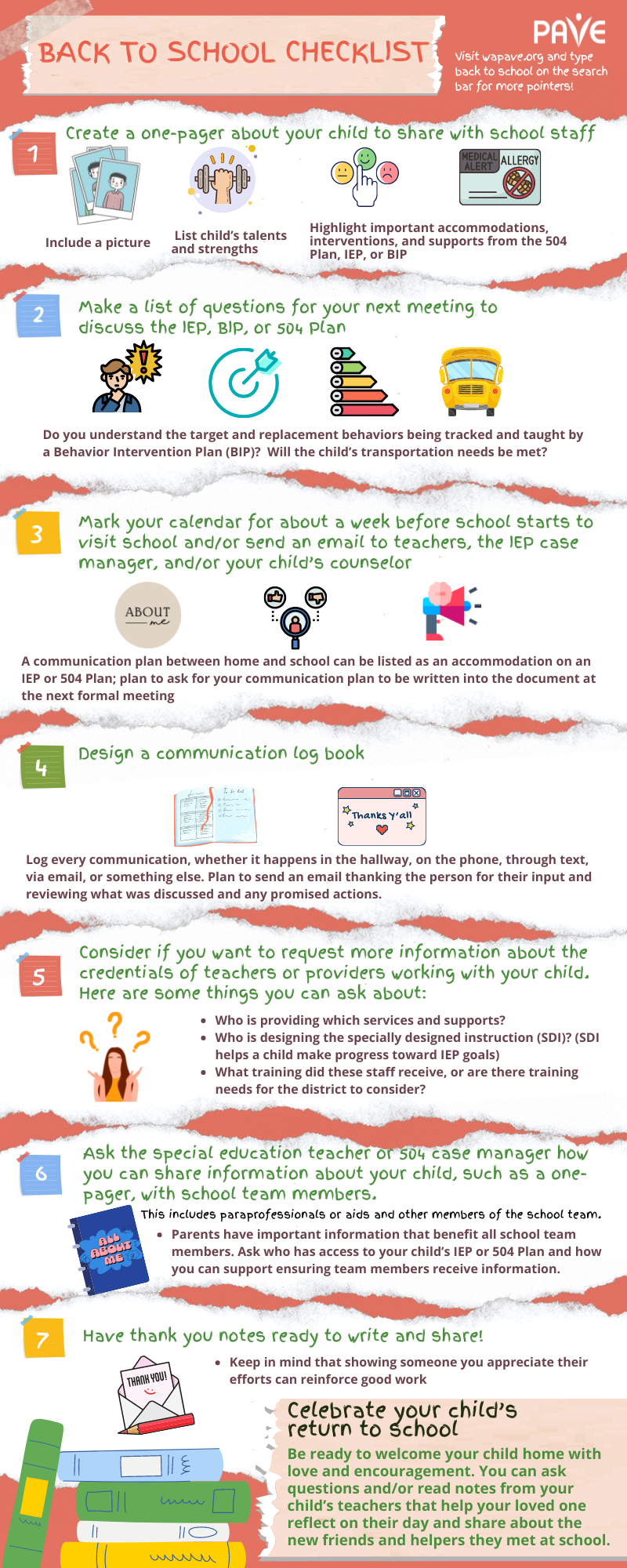
Back To School Checklist!

Late summer is the time to gather school supplies, find out what time the school bus will pick up and drop off, and prepare to find new classrooms and meet new teachers. Parents of students with disabilities have some additional things to check off the list to be ready for the year ahead. As August is National Immunization Month, we are adding updated immunizations and flu and covid boosters to the reminders. These are fully covered medical expenses whether you have insurance or not and can go a long way to keeping your child and your family healthy as we move into the fall and winter months. There are multiple events across our state where families can go to for immunizations.  

Super important: As school begins, make sure you know what’s included in your child’s Individualized Education Program (IEP), Section 504 Plan, and/or Behavior Intervention Plan (BIP). For more, see PAVE’s article: Tips to Help Parents Plan for the Upcoming School Year

If you are new to Washington State, perhaps because of military service, you also may want to review some basic information about how education and special education are structured and delivered here. PAVE provides an article: Help for Military Families: Tips to Navigate Special Education Process in Washington State. 

Here’s a checklist to help you get organized:

  1. Create a one-pager about your child to share with school staff
    • Include a picture
    • List child’s talents and strengths—your bragging points
    • Describe behavioral strategies that motivate your child
    • Mention any needs related to allergy, diet, or sensory
    • Highlight important accommodations, interventions, and supports from the 504 Plan, IEP, or BIP
  2. Make a list of questions for your next meeting to discuss the IEP, BIP, or 504 Plan
    • Do you understand the goals and what skills your child is working on?
    • Do the present levels of performance match your child’s current development?
    • Do accommodations and modifications sound likely to work?
    • Do you understand the target and replacement behaviors being tracked and taught by a Behavior Intervention Plan (BIP)?
    • Will the child’s transportation needs be met?
  3. Mark your calendar for about a week before school starts to visit school and/or send an email to teachers, the IEP case manager, and/or your child’s counselor
    • Share the one-pager you built!
    • Ask school staff how they prefer to communicate—email, phone, a notebook sent back and forth between home and school?
    • Get clear about what you want and need, and collaborate to arrange a communication plan that will work for everyone
    • A communication plan between home and school can be listed as an accommodation on an IEP or 504 Plan; plan to ask for your communication plan to be written into the document at the next formal meeting
  4. Design a communication log book
    • Can be a physical or digital notebook
    • Plan to write notes every time you speak with someone about your child’s needs or services. Include the date, the person’s full name and title, and information about the discussion
    • Log every communication, whether it happens in the hallway, on the phone, through text, via email, or something else
    • After every communication, plan to send an email thanking the person for their input and reviewing what was discussed and any promised actions—now that conversation is “in writing”
    • Print emails to include in your physical log book or copy/paste to include in a digital file
    • Having everything in writing will help you confirm what did/didn’t happen as promised: “If it’s not written down, it didn’t happen.”
  5. Consider if you want to request more information about the credentials of teachers or providers working with your child. Here are some things you can ask about:
    • Who is providing which services and supports?
    • Who is designing the specially designed instruction (SDI)? (SDI helps a child make progress toward IEP goals)
    • What training did these staff receive, or are there training needs for the district to consider?
  6. Ask  the special education teacher or 504 case manager how you can share information about your child, such as a one-pager, with school team members. This includes paraprofessionals or aids and other members of the school team.
    • Parents have important information that benefit all school team members. Ask who has access to your child’s IEP or 504 Plan and how you can support ensuring team members receive information
  7. Have thank you notes ready to write and share!
    • Keep in mind that showing someone you appreciate their efforts can reinforce good work
  8. Celebrate your child’s return to school
    • Do the bus dance on the first morning back to school!
    • Be ready to welcome your child home with love and encouragement. You can ask questions and/or read notes from your child’s teachers that help your loved one reflect on their day and share about the new friends and helpers they met at school

Below is an infographic of the above information.

Tip! you can click on the image and access an accessible PDF to print and keep handy.

Back to School Checklist click to find the accessible PDF

Click to access an accessible PDF of the infographic above

We also have this infographic in 8.5 x 11 easy to print size! Access it now!

School to Adulthood: Transition Planning Toolkit for High School, Life, and Work

Looking to the future can feel exciting, hopeful, confusing, overwhelming—or all emotions at once. For families supporting a young person with a disability, it’s never too soon to begin planning to ensure a smooth process from the teen years toward whatever happens next. This toolkit supports families as they organize this multiyear project.

Presenting our newest resource – the Planning My Path Practical Tips and Tools for Future Planning. This toolkit encompasses a collection of our informative articles, complemented by easy to understand timeline charts to provide you with a solid foundation as you navigate through this crucial transition period. Taking some time to look through it may answer some questions that pop up as you get closer to your high school graduation.

Learn the Words

A good place to begin is a Glossary of Key Terms for Life After High School Planning, which provides vocabulary building and an overview of topics relevant to this important phase of life. 

Earning a Diploma

To earn a high-school diploma in Washington State, students must:

OSPI provides a two-page summary of graduation requirements to support families and students. Included is this statement: “Students who receive special education services under an Individualized Education Program (IEP), also have an IEP Transition Plan, which begins by the school year when a student turns 16 or sooner. The HSBP is required to align with their IEP Transition Plan to ensure a robust planning process toward post-high school goals.”

Various state agencies collaborated to provide a guidebook: Guidelines for Aligning High School & Beyond Plans (HSBP) and IEP Transition Plans.

The state’s 2019 legislature changed graduation requirements (HB 1599). Students may earn a Certificate of Academic Achievement (CAA) or a Certificate of Individual Achievement (CIA) to graduate. How a student earns a CIA is determined by their IEP team.

Students with disabilities seeking a diploma through General Educational Development (GED) testing may be eligible for testing accommodations. A website called passged.com lists a variety of disability conditions that might make a person eligible for testing supports.

Commencement Access

Regardless of when a diploma is earned, a student can participate in Commencement at the end of a traditional senior year, with peers, under a Washington provision called Kevin’s Law. Families may want to plan well in advance with school staff to consider how senior year events are accessible to youth with disabilities.

The Big Picture

The right to a Free Appropriate Public Education (FAPE) includes the right to school-based services that prepare a young person with a disability for adult life.

Here are links to a training video, infographic, and article:

Various state agencies collaborated to provide a downloadable guidebook: Guidelines for Aligning High School & Beyond Plans (HSBP) and IEP Transition Plans. Included are career-planning tools and linkages to current information about Graduation Pathways, which changed in 2019 when the Washington State Legislature passed House Bill (HB) 1599.

Student Self-Advocacy

As they move toward adulthood, many students benefit from opportunities to practice skills of self-advocacy and self-determination. One way to foster those skills is to encourage youth to get more involved in their own Individualized Education Programs (IEPs). To support that, PAVE provides this article: Attention Students: Lead your own IEP meetings and take charge of your future. Included is a handout that students might use to contribute to meeting agendas.

The RAISE Center (National Resources for Advocacy, Independence, Self-determination and Employment) provides a blog with transition related news, information, ideas and opinions. Topics in 2020-21 include how to “Be the Best You,” how issues of race and disability intersect with equity, and how “The Disability Agenda Could Bring Unity to A Fragmented Society,” by RAISE Center co-director Josie Badger, who is a person living with disability.

Student Rights after High School

An Individualized Education Program (IEP) ends when a student leaves secondary education. The protections of the Americans with Disabilities Act (ADA) and of Section 504 of the Rehabilitation Act of 1973 are ongoing throughout the lifespan.

These laws provide for appropriate accommodations in public programs and facilities. To support these disability protections, The IEP accommodations page or a Section 504 Plan can travel with a student into higher education, a vocational program, or work. Often a special services office at an institution for higher learning includes a staff member responsible for ensuring that disability rights are upheld. PAVE provides an article with general information about Section 504 rights that apply to all ages: Section 504: A Plan for Equity, Access and Accommodations.

Universal Design supports everyone

Asking for rights to be upheld is not asking for special favors. A person living with disability, Kyann Flint, wrote an article for PAVE to describe how Universal Design supports inclusion. Her article can provide inspiration for young people looking for examples of what is possible, now as ever: COVID-19 and Disability: Access to Work has Changed.

Agencies that can help

Washington State’s Division of Vocational Rehabilitation (DVR) provides services for high-school students engaged in transition planning as well as adults seeking employment. PAVE provides an article that describes Pre-Employment Transition Services (Pre-ETS) and more: Ready for Work: Vocational Rehabilitation Provides Guidance and Tools.

DVR’s website includes a section with information about Tribal Vocational Rehabilitation (TVR), which is available for people with tribal affiliations in some areas of the state. Each TVR program operates independently. Note that some TVR programs list service areas by county but that sovereign lands are not bound by county lines. Contact each agency for complete information about program access, service area, and eligibility.

Services for individuals who are deaf or hard of hearing are provided by Washington’s Center for Deaf and Hard of Hearing Youth (CDHY), which was formerly called the Center for Childhood Deafness and Hearing Loss (CDHL). This statewide resource supports all deaf and hard of hearing students in Washington, regardless of where they live or attend school.

Services for individuals who are blind or living with low vision are provided by Washington’s Department of Services for the Blind (DSB). Youth services, Pre-Employment Transition Services (Pre-ETS), Vocational Rehabilitation, Business Enterprise Program, and mobility and other independent-living skills are served by DSB.

The Developmental Disabilities Administration (DDA) also has a variety of school-to-work and waiver programs that support youth. PAVE provides a video to support families through the DDA eligibility process. An article provides further detail: How to Prepare for a DDA Assessment.

Not all youth with disabilities are able to access employment-related services through DVR, TVR, DSB, or DDA. A limited additional option is Goodwill, which provides access to a virtual learning library. Students can take classes at their own pace for skills development. Employment skills, workplace readiness, interviewing skills and more are part of the training materials. To request further information, call 253-573-6507, or send an email to: library@goodwillwa.org.

Graduation’s over: Why is school calling?

Schools are responsible to track the outcomes of their special education services. Here’s an article to help families get ready to talk about how things are going: The School Might Call to Ask About a Young Adult’s Experience After High School: Here’s Help to Prepare

Benefits Planning

A consideration for many families of youth with disabilities is whether lifelong benefits are needed. Applying for social security just past the young person’s 18th birthday creates a pathway toward a cash benefit and enables the young person to access Medicaid (public health insurance) and various programs that depend on Medicaid eligibility.

The Washington Initiative for Supported Employment (gowise.org) provides benefit planning information and resources through a program called BenefitU.

When a person 18 or older has a disability, family members may want to stay involved in helping them make decisions. Supported Decision Making (SDM) is the formal name for one legal option. Washington law (Chapter 11.130 in the Revised Code of Washington) includes Supported Decision Making as an option under the Uniform Guardianship, Conservatorship, and Other Protective Arrangements Act. The law changed in 2020 when the state passed Senate Bill 6287. The changes took effect Jan. 1, 2022. PAVE’s article about Supported Decision Making has more information about this and other options for families to support an adult with a disability.

The Importance of Fathers and Father Figures

A Brief overview

  • Parents are children’s first and primary teachers.
  • Every parent has a unique way of caring for and interacting with his/her/their child, with mothers and fathers typically interacting with their children in different ways.
  • Male family members and father figures serve key roles in the healthy development of children and youth.
  • Fathers and father figures can experience barriers in supporting their children, including the myth that there are no barriers.
  • Resources are available to support fathers and father figures on their parenting journey.

Full Article

Parents are children’s first and primary teachers. Every parent has their own way of caring for and interacting with his/her/their child, with mothers and fathers typically interacting with their children in different ways.

Who are fathers and father figures?

Fathers and father figures play an important role in supporting a child’s growth and development across the lifespan. The term “father figure” is sometimes used broadly to describe males who are important in the life of a child. Father figures can include adoptive fathers, foster fathers, loving male relatives, godfathers, uncles, legal guardians, even mentors and older friends.

Research has shown in the early years, fathers support school readiness and the overall well-being of the family.

What are some barriers fathers have to full involvement with their children?

In addition to the many challenges families of children with disabilities face when navigating education and healthcare, there are additional obstacles which may include:

  • Complex legal systems that historically demonstrated bias against males.
  • Lack of confidence in parenting.
  • Conflicts in cultural values that may view caregiving as the role of the mother.
  • Systems that may favor or support mothers’ involvement as a priority.
  • Overall lack of adequate resources to support fathering.
  • Challenges in communication when parents are parenting apart.

The lack of support is often connected to the myth that fathers and father figures are not in need of specialized assistance. When fathers and father figures are seen, supported, and engaged with their children, the child and the whole community benefits. There are many resources available to schools, community organizations, and agencies who are serving or interested in supporting strong fathers and families.

Additional Resources:

Infant Early Childhood Mental Health

A Brief Overview

  • Infant and Early Childhood Mental Health (IECMH) is a term that describes how young children develop socially and emotionally. They learn about their emotions form close and secure relationships with their caregivers and family members. They learn and explore the environment – all in the context of family, community, and culture.
  • Families concerned about a child’s development can call the Family Health Hotline at 1-800-322-2588, with support in multiple languages. Parents can complete a developmental screening online for free at Parent Help 123.
  • PAVE provides an article for next steps after age 3: What’s Next when Early Childhood Services End at Age 3? Another PAVE article for families new to special education: Steps to Read, Understand, and Develop an Initial IEP.
  • PAVE’s Parent Training and Information (PTI) staff help families understand and navigate service systems for children 0-26. Click Get Help on the PAVE website or call 800-572-7368.
  • Early Support for Infants and Toddlers (ESIT) helps young children with disabilities or delays to learn and supports their unique development.

Full Article

New parents may struggle to know whether their child’s emotional development is on track. They may have a feeling that a milestone is missed, or they may observe siblings or the emotional well-being of other children and notice their child is developing differently. Sometimes a parent just needs reassurance. Other times, a child may have a developmental delay or a disability. In those cases, early support, including Infant Early Childhood Mental Health (IECMH) can be critical to a child’s lifelong learning and development.

IECMH is a term that describes how very young children develop socially and emotionally. They form relationships with other people. They learn about their emotions and how to control them. This happens in the settings of their family, community, and culture. (Zero to Three, Basics of Early Childhood Mental Health, 2017).

According to Best Starts for Kids, relationships are at the heart of human development and thriving for infants, toddlers, and young children. Relationships with parents and caregivers give very young children the social and emotional foundations they need to learn and thrive.

The Washington Health Care Authority reports around 1 in 6 young children has a diagnosed mental, behavioral, or developmental condition (Cree et al., 2018). These conditions may be treated with infant early childhood mental health (IECMH) services.

Services work to improve the quality of the child’s relationship with parents or caregivers. They can:

  • Help the distress of the mental health concern.
  • Support the return to healthy development and behavior.

When families receive Early Support for Infants and Toddlers (ESIT) services for a child, the child is tested as part of an Individualized Family Service Plan (IFSP).

The evaluation looks at the child’s ability to:

  • Identify and understand their own feelings;
  • Accurately notice and understand other people’s emotional states.
  • Manage strong emotions in a positive way.
  • Control their behavior.
  • Develop empathy (understand how people feel based on the child’s own experience)
  • Make and support relationships.

The evaluation may show the child is not developing well in some of these areas.  IECMH services may help.

Some examples of Infant and Early Childhood Mental Health services include:

  • Early Childhood Mental Health Consultation
  • Parent training
  • Childcare provider training
  • Group training
  • Parent Behavioral Therapy
  • Cognitive Behavioral Therapy
  • Infant/Child – Parent Psychotherapy
  • Play therapy

If you are concerned about a child’s development:

  • To learn about typical development, read the birth-to-6 pre-screening chart in English or Spanish
  • Please Ask is a three-minute video that shows the importance of referring infants and toddlers for early intervention. ESIT is a part if the Department of Children, Youth and Families
  • Families can call the ESIT local lead agency: Local Lead Agencies by County
  • Family Health Hotline: 1-800-322-2588. This statewide, toll-free number offers help in English, Spanish, and other languages.
  • Early Learning Transition: When Birth-3 Services End

More Resources:

Prior Written Notice (PWN): An Important Document to Read and Understand  

A Brief Overview

  • Prior Written Notice (PWN) is a document that explains school district decisions about a student’s Individualized Education Program (IEP).  
  • Family members can request changes to the PWN if their concerns or positions are inaccurately described or left out of the PWN.
  • If a family caregiver files a special education complaint, the PWN may be among documents reviewed in an investigation.
  • PWN must be provided in the family’s native language.

Full Article

When family members and school staff meet to discuss a student’s services, certain things have to happen. One requirement is for the school to take notes and share those notes with the family within a reasonable amount of time (usually a few days) after the meeting. Those notes are formatted as a Prior Written Notice (PWN). This document is shared after a decision is made and prior to changes in a student’s program.

For example, if the IEP team meets and decides to change a student’s placement (where educational services are delivered), that decision is written down on the PWN. The PWN includes information about how the team made its decision and when the student will start receiving services in the new placement.

Parents can ask for their positions and reasons to be included in the PWN

During a meeting, family members can specifically ask for their position to be noted in the PWN. For example, if a school district staff member recommends changing a service and the parent does not agree to that change, the parent can say, “Please include in the Prior Written Notice that I do not agree to this change in service.” Family members can make sure their reasoning is included along with their position.

Family members also can request changes to the PWN after a meeting if they disagree with the wording or if their concerns or positions are left out. They might also provide something in writing and ask for it to be attached to the PWN for the record.

If the school takes an action that the family continues to disagree with, the family member might use a PWN among documents filed with a formal complaint. The PWN shows how disagreements were managed and documented through the IEP meeting process and whether family participation in decision-making was honored.

Washington State’s educational agency is the Office of Superintendent of Public Instruction (OSPI). On its website, OSPI guides families in what to expect in the PWN. According to OSPI, “The Prior Written Notice should document any disagreements with you and should clearly describe the reasons for this disagreement.”

PWN is an aspect of federal special education law, the Individuals with Disabilities Education Act (IDEA Sec.300.503(b)).

In accordance with IDEA, a PWN must include:

  • A description of the action proposed or refused by the school
  • An explanation of why the school proposes or refuses to take the action
  • A description of each evaluation procedure, assessment, record, or report the school used as a basis for their decision
  • A statement that the parents of a child with a disability have protection under the procedural safeguards and how the parents can obtain a copy of them
  • Sources for parents to contact to obtain assistance in understanding these provisions
  • A description of other options that the IEP Team considered and the reasons why those options were rejected
  • A description of other factors relevant to the school’s proposal or refusal

The school is required to provide PWN to the family when:

  • The school plans to evaluate your child
  • You’ve asked for your child to be evaluated and the school denies your request
  • The school wants to begin or change your child’s identification as a “child with a disability”
  • The school proposes or refuses a particular educational placement for your child
  • The school wants to change your child’s educational placement
  • The school wants to change aspects of the special education or related services that your child is receiving
  • The school refuses a request from you, as parents, with respect to the educational services your child is receiving

Like all formal educational documents, PWN must be provided in the family’s native language.

For more information about PWN and other special education requirements, refer to the Procedural Safeguards, available for download in multiple languages from OSPI’s website.

Advocacy Tips for Parents

When a child has a disability, parents often learn that getting their child’s needs met requires persistence, organization, and advocacy. Advocacy is an action. A person is an advocate when they organize the work and press onward until a goal is achieved. Laws that protect the rights of students with disabilities also protect parents as legal advocates for their children.

This article includes tips for parent advocates working with the school. For more about parent rights, read PAVE’s article, Parent Participation in Special Education Process is a Priority Under Federal Law.

Before a meeting…

  • Invite someone to attend with you. A friend or family member can help you take notes, ask questions, and keep track of your agenda.
  • Make sure you understand the purpose of the meeting. Is it to talk about an evaluation, review the Individualized Education Program (IEP), write a Section 504 Plan, consider a behavior support plan, discuss placement, or something else? If you want a certain outcome, make sure it’s within the scope of the meeting. If not, you may need more than one meeting.
  • Make sure you know who will be at your meeting. An IEP team has required attendees. PAVE provides more detail about IEP team requirements in an article that includes a Sample Letter to Request an IEP Meeting.
  • Consider anyone else you want to attend. Parents have the right to invite vocational specialists, related service providers, behavioral health providers, peer support specialists—anyone with knowledge of the student and their needs.
  • Get copies of important documents (evaluation, IEP, 504 Plan, behavior plan, etc.). Read them carefully so you can use these documents to organize your concerns and questions. Keep in mind that a services program/plan is a draft until after you meet.
  • If the school doesn’t provide documents with enough time for you to prepare, consider rescheduling.
  • Mark up a Draft IEP with your suggestions and questions:
    • Read the educational impact statement carefully. Consider if it accurately summarizes your student’s strengths and needs. If not, makes notes about what you want to add or change.
    • Note any changes you want under Medical/Physical or Parent Concerns.
    • If a goal is too hard or too easy, make a note to ask about adjusting it.
    • If a goal is written with jargon and impossible to understand, ask for an explanation and maybe a rewrite
    • Prepare to ask how teachers are using Specially Designed Instruction (SDI) to help your student reach IEP goals.
    • Read the services table, sometimes referred to as a “services grid” or “services matrix” to understand how often and where your student is being served.
    • Consider any questions you have about placement or access to general education settings. If you believe your student could be successful in general education for more of their day, consider what supports would make that possible.
    • Write down any questions about how the classroom or curriculum are adapted to be accessible. You might ask if the teachers are using Universal Design for Learning (UDL) strategies to support multiple types of learners.
    • Write down your questions about progress and how it’s being tracked.
  • For an IEP or 504 Plan, read the accommodations carefully and make notes to ensure they are individualized and implemented to truly support your student.
  • Highlight anything in the behavior plan that sounds like bias or prejudice and consider how it might be rewritten. PAVE provides examples in a video training about development of a Behavior Intervention Plan.
  • To help you organize your questions and concerns, PAVE provides: Get Ready for Your Meeting with a Handout for the Team.
  • Learn about student and family rights and practice the vocabulary that empowers your advocacy. PAVE provides a three-part video training to help: Student Rights, IEP, Section 504 and More.

At your meeting…

  • Do your best to arrive on time to make sure there is time to address concerns. If you notice there may not be enough time to do this, request to schedule another meeting.
  • Make sure the meeting begins with introductions and that you know everyone’s job and what role they serve on the IEP team. If it’s important to you, when you introduce yourself you can ask team members to use your name instead of mom, dad, gramma, or something else other than your name when they refer to you.
  • Ask school staff to explain acronyms or jargon while they are talking because you want to understand what everyone says.
  • If an IEP team member is absent (WAC 392-172A-03095), parents must sign consent for the absence. If someone is missing and you don’t think it’s appropriate to continue, ask to reschedule. If key members need to leave before the meeting is over, consider ending the meeting and schedule an alternative day/time.
  • Keep focus on your student’s needs. Here are a few positive sentence starters: I expect, I understand, My child needs….
  • If you notice the conversation steering into past grievances, the district’s lack of funds, or what “all the other children” are doing, bring focus back to your child and their current needs. Try stating, “I want to focus on [name].”
  • Use facts and information to back up your positions and avoid letting emotion take over. Ask for a break if you need time for some regulated breathing or to review documents or notes.
  • Notice other team members’ contributions that support your child’s needs. Here are a few phrases to consider:
    • “I think what you said is a good idea. I also think it could help to…”
    • “I think you are right, and I would like to add…”
    • “I hear what you are saying, and…”
  • If you don’t understand something, ask questions until the answer is clear.
  • If you disagree about something and your comments aren’t changing anyone’s mind, explain that you want your position included in the Prior Written Notice (PWN), which is the document the school is required to send immediately after an IEP meeting.
  • If you hear something confusing, ask the school to put their position and rationale in writing so you can follow up.
  • Request to end the meeting if it stops being productive. Tell the other team members that you would like to continue working with them and ask to schedule another meeting. This might include adding people to the team to help resolve issues.

After a meeting…

  • Review your notes and highlight or circle places where there is an action or something that needs follow through. Transfer relevant information into your calendar.
  • When the Prior Written Notice (PWN) arrives (usually within a few days), compare it to your notes. Make sure all key agreements, actions, and IEP/504 amendments match what you understood to be the plan when you left the meeting.
  • If you want something changed in the PWN, ask for those changes in writing.
  • If you disagree with the outcome of the meeting, review your Procedural Safeguards (downloadable in multiple languages) and consider your dispute resolution options.
  • If you consider filing a Community Complaint, PAVE provides a video training to walk you through that option.
  • Consider contacting school district special education staff if they didn’t participate in the meeting and you think your team needs more support.
  • Consider asking for another meeting, Mediation, or a Facilitated IEP meeting, if issues are unresolved.

PAVE’s Parent Training and Information (PTI) program can help family caregivers organize their concerns and options. Click Get Help for individualized assistance.

Special Education is a Service, Not a Place

A Brief Overview

  • A student with a disability has the right to a Free Appropriate Public Education (FAPE) in the Least Restrictive Environment (LRE). General education spaces and curriculum are LRE.
  • Services are generally portable, and special education is delivered to the student to enable access to FAPE within the LRE to the maximum extent appropriate.
  • Federal law protects a student’s right to FAPE within the LRE in light of a child’s circumstances, not for convenience of resource allocation.
  • The TIES Center at the University of Minnesota partnered with the Haring Center for Inclusive Education at the University of Washington to build a resource for families and schools writing IEPs to support students within general education: Comprehensive Inclusive Education: General Education and the Inclusive IEP.

Full Article

An ill-informed conversation about special education might go something like this:

  • Is your child in special education?
  • Yes.
  • Oh, so your student goes to school in that special classroom, by the office…in the portable…at the end of the hall…in a segregated room?

This conversation includes errors in understanding about what special education is, how it is delivered, and a student’s right to be included with general education peers whenever and wherever possible.

This article intends to clear up confusion. An important concept to understand is in the headline:

Special Education is a service, not a place!

Services are portable, so special education is delivered to the student in the placement that works for the student to receive a Free Appropriate Public Education (FAPE), in light of the child’s circumstances. A student with a disability has the right to FAPE in the Least Restrictive Environment (LRE).

General education is the Least Restrictive Environment. An alternative placement is discussed by the student’s Individualized Education Program (IEP) team if access to FAPE is not working for the student in a general education setting with supplementary aids and supports.

Keep in mind that genuine inclusion doesn’t just meet a seat in the classroom. Adult support, adaptations to the learning materials, individualized instruction, and more are provided to support access to education within the LRE.

Here is some vocabulary to further understanding:

  • FAPE: Free Appropriate Public Education. The entitlement of a student who is eligible for special education services.
  • IDEA: Individuals with Disabilities Education Act. The entitlement to FAPE is protected by this law that allocates federal funds to support eligible students.
  • LRE: Least Restrictive Environment. A student eligible for special education services has a right to FAPE in the LRE to the maximum extent appropriate. General education is the least restrictive, and an alternative placement is discussed when data indicate that supplementary aids and supports are not working to enable access to FAPE in general education.
  • IEP: Individualized Education Program. School staff and family caregivers make up an IEP team. The team is responsible to develop a program reasonably calculated to enable a student to make progress appropriate toward IEP goals and on grade-level curriculum, in light of the child’s circumstances. Based on a student’s strengths and needs (discovered through evaluation, observation, and review of data), the team collaborates to decide what services enable FAPE and how to deliver those services. Where services are delivered is the last part of the IEP process, and decisions are made by all team members, unless family caregivers choose to excuse some participants or waive the right to a full team process.
  • Equity: When access is achieved with supports so the person with a disability has a more level or fair opportunity to benefit from the building, service, or program. For example, a student in a wheelchair can access a school with stairs if there is also a ramp. A person with a behavioral health condition might need a unique type of “ramp” to access equitable learning opportunities within general education.
  • Inclusion: When people of all abilities experience an opportunity together, and individuals with disabilities have supports they need to be contributing participants and to receive equal benefit. Although IDEA does not explicitly demand inclusion, the requirement for FAPE in the Least Restrictive Environment is how inclusion is built into special education process.
  • Placement: Where a student learns. Because the IDEA requires LRE, an IEP team considers equity and inclusion in discussions about where a student receives education. General education placement is the Least Restrictive Environment. An IEP team considers ways to offer supplementary aids and supports to enable access to LRE. If interventions fail to meet the student’s needs, the IEP team considers a continuum of placement alternatives—special education classrooms, alternative schools, home-bound instruction, day treatment, residential placement, or an alternative that is uniquely designed. 
  • Supplementary Aids and Supports: The help and productivity enhancers a student needs. Under the IDEA, a student’s unique program and services are intended to enable access to FAPE within LRE. Note that an aid or a support is not a place and therefore cannot be considered as an aspect of a restrictive placement. To the contrary, having additional adult support might enable access to LRE. This topic was included in the resolution of a 2017 Citizen Complaint in Washington State. In its decision, OSPI stated that “paraeducator support is a supplementary aid and service, not a placement option on the continuum of alternative placements.”

Note that the IDEA protects a student’s right to FAPE within LRE in light of a child’s circumstances, not in light of the most convenient way to organize school district resources. Placement is individualized to support a student’s strengths and abilities as well as the needs that are based in disability.

Tip: Families can remind the IEP team to Presume Competence and to boost a student from that position of faith. If the team presumes that a student can be competent in general education, how does it impact the team’s conversation about access to FAPE and placement?

LRE does not mean students with disabilities are on their own

To deliver FAPE, a school district provides lessons uniquely designed to address a student’s strengths and struggles (Specially Designed Instruction/SDI). In addition, the IEP team is responsible to design individualized accommodations and modifications. (Links in this paragraph take you to three PAVE training videos on these topics.)

  • Accommodations: Productivity enhancers. Examples: adjusted time to complete a task, assistive technology, a different mode for tracking an assignment or schedule, accessible reading materials with text-to-speech or videos embedded with sign language…
  • Modifications: Changes to a requirement. Examples: an alternative test, fewer problems on a worksheet, credit for a video presentation or vision board instead of a term paper.

Note that accommodations and modifications are not “special favors.” Utilizing these is an exercise of civil rights that are protected by anti-discrimination laws that include the Rehabilitation Act of 1973 (particularly Section 504 as it relates to school) and the Americans with Disabilities Act (ADA—particularly Title II).

Related Services may support LRE and other aspects of equitable access

An IEP may include related services (occupational therapy, speech, nursing, behavioral or mental health support, parent training, transportation, and more). For some students, related services may be part of the support structure to enable inclusion in the Least Restrictive Environment. If an IEP includes related services, then the IEP team discusses how and where they are delivered.

A tool to support inclusion

The TIES Center at the University of Minnesota partnered with the Haring Center for Inclusive Education at the University of Washington to build a resource to support families and schools in writing IEPs that support students within general education classrooms: Comprehensive Inclusive Education: General Education and the Inclusive IEP.

The resource includes a variety of tools and recommendations for how school and family teams can approach their meetings and conversations to support the creation and provision of a program that recognizes:

  • Each child is a general education student. 
  • The general education curriculum and routines and the Individual Education Program (IEP) comprise a student’s full educational program.
  • The IEP for a student qualifying for special education services is not the student’s curriculum.

Who is required on an IEP team?

Keep in mind that IEP teams are required to include staff from general education and special education (WAC 392-172A-03095). All team members are required for formal meetings unless the family signs consent for those absences. Here’s a key statement from the TIES Center resource:

“The IEP is intended to support a student’s progress in general education curriculum and routines, as well as other essential skills that support a student’s independence or interdependence across school, home, and other community environments.  A comprehensive inclusive education program based upon these principles is important because without that focus, a student’s learning opportunities and school and post-school outcomes are diminished. In order to create an effective comprehensive inclusive education program, collaboration between general educators, special educators, and families is needed.”

LRE decisions follow a 4-part process

OSPI’s website includes information directed toward parents: “Placement decisions are made by your student’s IEP team after the IEP has been developed. The term ‘placement’ in special education does not necessarily mean the precise physical building or location where your student will be educated. Rather, your student’s ‘placement’ refers to the range or continuum of educational settings available in the district to implement her/his IEP and the overall amount of time s/he will spend in the general education setting.”

Selection of an appropriate placement includes 4 considerations:

  1. IEP content (specialized instruction, goals, services, accommodations…)
  2. LRE requirements (least restrictive “to the maximum extent appropriate”)
  3. The likelihood that the placement option provides a reasonably high probability of helping a student attain goals
  4. Consideration of any potentially harmful effects the placement option might have on the student, or the quality of services delivered

What are placements outside of general education?

If a student is unable to access appropriate learning (FAPE) in general education because their needs cannot be met there, then the IEP team considers alternative placement options. It’s important to note that a student is placed in a more restrictive setting because the student needs a different location within the school, not because it’s more convenient for adults or because it saves the school district money.

According to IDEA, Sec. 300.114, “A State must not use a funding mechanism by which the State distributes funds on the basis of the type of setting in which a child is served that will result in the failure to provide a child with a disability FAPE according to the unique needs of the child, as described in the child’s IEP.”

IEP teams may discuss whether there’s a need for a smaller classroom setting or something else. Keep in mind that a home-based placement is a very restrictive placement because it segregates a student entirely from their peers.

The continuum of placement options includes, but is not limited to:

  • general education classes
  • general education classes with support services and/or modifications
  • a combination of general education and special education classes
  • self-contained special education classes
  • day treatment, therapeutic school specializing in behavioral health
  • private placement outside of the school district (non-public agency/NPA)
  • residential care or treatment facilities (also known as NPAs)
  • alternative learning experience (ALE)
  • home-based placement  

School districts are not required to have a continuum available in every school building. A school district, for example, might have a self-contained setting or preschool services in some but not all locations. This gives districts some discretion for choosing a location to serve the placement chosen by an IEP team.

Placement and location are different

Note that the IEP team determines the placement, but the school district has discretion to choose a location to serve the IEP.

For example, an IEP team could determine that a student needs a day treatment/behavioral health-focused school in order to access FAPE—an appropriate education. If the IEP team chooses a Day Treatment placement, then the school district is responsible to find a location to provide that placement. Following this process, a public-school district might pay for transportation and tuition to send a student to a private or out-of-district facility. If a request for a specialized placement is initiated by the family, there are other considerations.

OSPI’s website includes this information:

“… if you are requesting that your student be placed in a private school or residential facility because you believe the district is unable to provide FAPE, then you must make that request through a due process hearing.”

Resources about inclusionary practices

An agency called Teaching Exceptional Children Plus features an article by a parent about the value of inclusion in general education. The January 2009 article by Beth L. Sweden is available for download online: Signs of an Inclusive School: A Parent’s Perspective on the Meaning and Value of Authentic Inclusion.

Understood.org offers an article and a video about the benefits of inclusion.

An agency that promotes best-practice strategies for school staff implementing inclusive educational programming is the IRIS Center, a part of Peabody College at Vanderbilt University in Nashville, Tenn.

As stated earlier, The TIES Center at the University of Minnesota partnered with the Haring Center for Inclusive Education at the University of Washington to build a resource for families and schools writing IEPs to support students within general education: Comprehensive Inclusive Education: General Education and the Inclusive IEP.

The Inclusionary Practices Family Engagement Collaborative is a partnership of four non-profit organizations committed to strengthening family-school partnerships to support culturally-responsive approaches that center the experiences of students with disabilities. Watch recorded trainings offered to help you start the conversation.

Life After High School: Tools for Transition

Helping a student with disabilities prepare for life after high school requires thoughtful organization and planning. This presentation describes three ways to support this important time of life:

  1. High School and Beyond Plan
  2. IEP Transition Plan
  3. Agency Support

Here are resources referenced in the video:

  • OSPI Model Forms: Scroll down to find and open the IEP Form with Secondary Transition
  • OSPI Graduation Requirements, including links to download the High School and Beyond Plan in various languages
  • DDA: Developmental Disabilities Administration
  • DVR: Division of Vocational Rehabilitation
  • TVR: Tribal Vocational Rehabilitation, for Native Americans with disabilities
  • DSB: Department of Services for the Blind, for people with blindness or low vision
  • WAC 392-172A-03090, including description of Age of Majority rights that transfer to the student at age 18
  • PAVE article about Supported Decision Making
  • OSPI: The Office of Superintendent of Public Instruction has a family liaison for special education
  • OEO: The Office of the Educational Ombuds provides online resources and 1:1 support
  • OCR: The Office for Civil Rights can help with questions about equity and access
  • ESD: Nine Education Service Districts; each has a behavioral health navigator, and some are licensed to provide behavioral health services
  • Developmental Disabilities Ombuds
  • PAVE School to Adulthood Toolkit

Discipline and Disability Rights: What to do if Your Child is Being Sent Home

Learning the skills to maintain expected behavior and follow school rules is part of education. All students learn social, emotional and behavioral skills. Students with disabilities may get extra help in these areas of learning. Some have individualized behavior support plans.

When the pre-teaching and interventions fail to stop a behavior from causing a problem, the school might call a parent to say, “Take them home.” What happens next could depend on how well-informed parents are about the rights of students with disabilities.

This video provides key information about what to do if your child is being sent home. The first thing to ask is, “Are they being suspended?” If the answer is yes, the school is required to file specific paperwork. If the answer is no, a parent has choices and may support better long-term outcomes by carefully documenting what happens next.

Below are links to resources referenced in the video:

Related Services in School and Beyond can Support a Child’s Development and Learning

A Brief Overview

  • At school, related services help children with disabilities benefit from their special education by providing extra help and support. Options for related services are described in state law (WAC 392-172A-01155).
  • If a child with public health insurance needs specific therapies to meet medical needs, their insurance company is obligated to support those needs. Medical necessity is described in state law (WAC 182-500-0070).
  • Sometimes a service meets educational and medical needs. In those situations, the school might bill Medicaid directly, with parent permission. Families can learn more about School-Based Health Services (SBHS) and ask if their school is participating in this optional program.
  • Washington’s Office of Superintendent of Public Instruction (OSPI) issued guidance in August 2022 to clarify that all parts of a student’s IEP begin with the start of school unless an IEP team has agreed to shift something to meet a student-centered need. Schools may not delay the start of related services for their own reasons related to scheduling or resources.
  • For federal information about the range of options for related services provided by the school, see parentcenterhub.org.

Full Article

Children with disabilities have a range of needs that may be educational, medical, or both. As they grow, develop, and learn, those needs can shift. How family, school, and medical providers respond can impact how much progress the child makes in their emerging skills. This article includes information to help families understand how therapeutic services may be provided at school or elsewhere.

What are related services?

Schools call services that lie outside the scope of traditional teaching “related services.” Another term is “ancillary services.” Related services help children with disabilities benefit from their special education by providing extra help and support.

Therapies for disabilities that impact physical movement or speech are common. Transportation provided through the special education system also is a common related service. Less common in Washington State are in-school mental health services or counseling for behavioral health conditions. Various possibilities are listed in state law (WAC 392-172A-01155). Here are examples from the Washington Administrative Code (WAC):

  • Occupational, Physical, Speech Therapies
  • Counseling
  • Psychological Services
  • Behavioral Services
  • School Social Worker
  • Special Transportation
  • Parent Training

What does parent training mean?

Notice that the final option on this list is parent training. This service might mean the school helps parents understand the special needs of their child or something about their child’s development. Through the related service of parent training, the school can teach family members to help their child practice emerging skills when they’re at home.

Who provides a related service, and who pays?

A related service may be provided by any professional who is trained to assess and/or serve a specific need for a child with a disability condition that affects their learning or development.

When therapeutic services are paid for through medical insurance, they generally must meet a standard of being “medically necessary.” Keep reading for more information about therapeutic services available through the medical system.

Services are provided at school when they are determined to be “educationally necessary.” In those cases, the school district is responsible for payment.

Sometimes a service is both medically and educationally necessary. Sometimes schools seek parent consent to bill the student’s insurance to fund all or part of a related service. Washington State’s Health Care Authority (HCA) manages a program to reimburse schools for services provided to students who are eligible for Apple Health when those services are delivered as part of their Individualized Education Program (IEP).

Tip: See HCA’s website page about School-Based Health Services (SBHS) and consider asking your school if they are participating in this optional program. The guidebook includes information about allowable services. Note that Applied Behavior Analysis (ABA) therapy is explicitly excluded as a reimbursable service through the state’s SBHS program. Most other therapeutic options are reimbursable, including a range of mental health services.

A related service might be part of evaluation

Sometimes a related service is needed to assess a student because school staff do not have the expertise to properly understand a disability condition in order to make service recommendations. “Medical services for diagnostic or evaluation purposes” are written into federal law (IDEA Section 1432) as something an IEP can provide.

Keep in mind that special education evaluations must be comprehensive, in order to identify all of a child’s special education and related service needs, not just those that relate to the IEP eligibility category.

Families can seek an Independent Educational Evaluation (IEE) if they disagree with the methods or conclusions of a school district special education evaluation. PAVE provides an article and sample letter for requesting an IEE.

Related services support FAPE

The federal law that governs special education services is the Individuals with Disabilities Education Act (IDEA). The IDEA makes clear that its list of related services (see below) includes possibilities and options but does not include every related service a student might need. Other therapeutic services might be included in the IEP if they are educationally necessary.

Access and equity are protected by various educational and civil rights laws; anything that helps a student access school-related opportunities can be included as part of a student’s services. Extracurricular activities and school-sponsored sports count.

An IEP is a written commitment for the school to serve a student’s educational needs. Educational needs might be academic, social-emotional, or something else.  They might have to do with how the student functions or adapts to the environment of school.

Educational needs are determined through a comprehensive evaluation and a collaborative process that includes family, school staff, and anyone else with knowledge of the student and their disability-related needs. If an IEP team decides that a service is necessary for the student to access their right to a Free Appropriate Public Education (FAPE), then the school district is responsible to deliver those services.

IDEA does not expressly require that the IEP team include related services personnel. However, if a particular need or related service is discussed in an IEP meeting, it would be appropriate for the provider to attend. IDEA states that, at the discretion of the parent or the public agency, “other individuals who have knowledge or special expertise regarding the child, including related services personnel as appropriate” may be part of a child’s IEP team.

School-based related services might include, but are not limited to:

  • speech-language pathology and audiology services
  • interpreting services
  • psychological services
  • physical and occupational therapy
  • recreation, including therapeutic recreation
  • early identification and assessment of disabilities in children
  • counseling services, including rehabilitation counseling
  • orientation and mobility services for blindness/low vision
  • medical services for diagnostic or evaluation purposes
  • school health services and school nurse services
  • social work services in schools
  • parent counseling and training

The national Center for Parent Information and Resources (parentcenterhub.org) provides additional information about each of these possible related services and what they might look like for a student receiving them as part of an Individualized Education Program (IEP).

IEP services start on Day 1 unless the student needs something different

Washington’s Office of Superintendent of Public Instruction (OSPI) issued guidance in August 2022 to clarify that all parts of a student’s IEP begin with the start of school unless an IEP team has agreed to shift something to meet a student-centered need.

According to OSPI, “School districts are reminded that they cannot arbitrarily determine when special education and related services will begin or schedule them to begin after the start of the school year for some providers.”

OSPI’s guidance references a parent complaint and the state’s decision that schools cannot delay the start of certain services because of provider availability or district scheduling preferences. If it’s in the IEP, then the school is responsible to provide the service on all scheduled days that the student attends school. If services aren’t provided as scheduled by the IEP, then the IEP team can discuss how and when the student will receive compensatory services to make up the missed time.

Families have the right to file a complaint with the state if the school does not fully serve their student’s IEP. One option is the community complaint: PAVE provides a video describing that process. Another option is Due Process. The Procedural Safeguards describe all dispute resolution options that are free for families and protected rights under federal and state laws. 

Options for therapeutic services through the Medicaid system

If a child needs specific therapies to meet medical needs, their insurance company is obligated to support those needs. For children younger than 21 with Medicaid (Apple Health in Washington), medical necessity is determined through assessments that are a protected benefit called Early Screening and Periodic Screening, Diagnostic and Treatment (EPSDT). This screening process is overseen by the National Academy for State Health Policy (NASHP).

For help navigating complex medical issues, families can request case management from their insurance provider. Calling the number on your insurance card and asking if there a form for requesting case management is a way to begin. Sometimes a case manager is automatically assigned if claims become complex and expensive.

Medical criteria are different than school criteria. While school-based services are built to support a student’s educational access, EPSDT determinations are made to support safety and health in the home and community. Here are examples:

  • Physical Therapy (PT) at school might support adapted physical education (PE) or help the student navigate the school building or curriculum. Outside of school, PT can support navigating the home, community, recreational activities, and more.
  • Speech/language services at school are tailored to help the student achieve goals on their Individualized Education Program (IEP) or access their curriculum. Outside of school, speech/language services can expand to support communication for daily living and might be paired with Occupational Therapy (OT), for example, to work on feeding issues, sensory aversions, breathing challenges, alternative communication systems, and more.

Services to support access to school, home, and community might intertwine, and the school district might choose to bill Medicaid for reimbursement, with the family’s signed consent.

TIP: If the school is going to bill insurance, families may want to find out if the insurance company has a reimbursement limit for the service. If the child is getting a similar service in and out of school, care coordination is important to make sure all the services will be paid. Insurance may be willing to pay for more services if it’s clear which are for school-based needs and which are medical. Those details also may be important to note if services are denied and the family wants to appeal the denial through a medical or special education complaint option.

What meets the standard of medical necessity?

The Washington Administrative Code (WAC 182-500-0070) describes medical necessity. If a service is likely to prevent, diagnose, or treat an identified condition that is causing major life impacts, then it may meet the standard. The WAC says medical necessity is:

“…a term for describing requested service which is reasonably calculated to prevent, diagnose, correct, cure, alleviate or prevent worsening of conditions in the client that endanger life, or cause suffering or pain, or result in an illness or infirmity, or threaten to cause or aggravate a handicap, or cause physical deformity or malfunction.”

The same WAC goes on to say that all federally funded insurance is obligated to pay for a service if it’s the most reasonable option available to serve the need. That standard is met when:

“There is no other equally effective, more conservative or substantially less costly course of treatment available or suitable for the client requesting the service.”

The same WAC also explains that a chosen course of treatment might mean a choice to track a condition through observation or offer no treatment. The WAC says:

“For the purposes of this section, ‘course of treatment’ may include mere observation or, where appropriate, no medical treatment at all.” 

A medical specialist, therapist, or pediatrician might assess the child to determine whether a specific service is medically necessary. In some situations, a case manager from the state’s Developmental Disabilities Administration (DDA) may make the determination.

What about private insurance?

Families with insurance through an employer or the healthcare exchange will need to ask their provider for specific information about what therapeutic services are covered. A company’s human resources department is another place to ask about coverages and whether there is a choice of health plan with more allowable options. School-based services may be the only option for some, as medical parity laws do not protect all possible therapeutic services.

Here are a places to get support in understanding your health plan and navigating access to services:

Insurance denials for employer-based plans can be appealed through:

PAVE’s Family to Family (F2F) Health Information Center provides additional information and resources through it’s website, Family Voices of Washington. Click Get Help at wapave.org to request individualized support.