What Will Happen When We’re Gone? Planning for the Future for Your Child with Disabilities, Part 1: Ages Birth to 12

Overview:

Full Article

Thinking about the future when you will no longer be available to help your child because of death or a condition where you cannot participate in their care can be emotionally difficult. On top of that, this planning process is full of important decisions with significant impacts on your child’s future. To prevent being overwhelmed, it may help to review the entire article, and then tackle the tasks and steps needed to create a plan.

Legal Planning. You will need:

  • A will:If you die and either don’t have a will or don’t specify a guardian in your will, the courts will appoint someone, and it won’t necessarily be a family member. It could be a complete stranger. A will usually includes almost all your instructions for how you want your child to be cared for when you die.
  • A Letter of intent: It expresses your wishes for your child which are not included in the will. It has no legal standing, but acts as a guide for guardians, Power of Attorney agents, and trustees.  It can be provided to your selected guardians and a copy can be saved with the lawyers who helped you set up your will and Powers of Attorney.
  • Powers of Attorney (POAs): Create agents, people who can legally act on behalf of your child for financial, health care and other life areas. They are selected by you, for after your death or when you are temporarily or permanently not capable of caring for your child. These agents do not have to be the same people you select as guardians. These are legal documents best prepared with the help of a lawyer and must be notarized.

Wills:

Who will be your minor child’s guardian? What will they need to know about your child?
How will your child be financially supported while a minor? It’s recommended that parents select someone different than the guardians to manage their child’s finances. Think about close friends as well as your parents or siblings. If your child is older, think about adults with whom your child has a bond. This can help if you want your child to continue in their current school, job, or neighborhood.
List each child individually when naming a guardian, and list all your minor children. Probate courts will not assume you want the same guardian for all your children unless you list them that way and might appoint a separate guardian for unlisted children!

            For ex: “I/We name Harold and Maude Green as guardians for our minor children Georgia Brown, Michael Brown, and Theodore Brown”.

Important: Do not directly leave your child with disabilities any money or assets in your will. Instead, have that child’s share of their inheritance pass to a Special Needs Trust and/or ABLE Account (as described below). Note that in this situation, it’s good to have a lawyer draw up the will to make sure that the inheritance does not impact your child’s current or future benefits, such as Social Security programs or Medicaid.

Financial Planning

Government Benefits: For the present time, and for your child’s future

Supplemental Security Income (SSI) for your child at any age. The SSI program makes cash assistance payments to aged, blind, and disabled persons (including children) who have limited income and resources. Many states pay a supplemental benefit to persons in addition to their Federal benefits.

People who qualify for SSI may, in some states, qualify for Medicaid health insurance, which is either free or low-cost.

Social Security Disability Insurance (SSDI) program for disabled and blind persons. The amount of the benefit is based on your child’s contributions to Social Security OR based on the parents’ earnings. Your child must meet Social Security criteria for disability.

Social Security Administration provides a useful comparison chart on important differences between the two programs on their Red Book page.

Payments from either program are often not enough to pay for everything your child may need or want, and any money or assets in your child’s name may cause their Social Security benefits, Medicaid coverage, and other benefit programs (supported housing, SNAP /food stamps, etc.) to be cut back or eliminated.

Funding your child’s future directly

Special Needs Trusts and ABLE accounts are ways to provide for your child financially that do not reduce their government benefits. They differ in many ways, with their own pros and cons. You might wish to have both an SNT and an ABLE account based on your family’s circumstances.

An ABLE account is a tax-advantaged savings account that can fund disability expenses. Currently, the beneficiary of the account (the person with a disability) must have acquired the disability before age 26, and this age limit will increase to before age 46 on January 1, 2026. The beneficiary of the account owns the funds. Interest (income) earned by the funds will not be taxed. Anyone can contribute to the account (the individual with disabilities, their family members, friends, or a Special Needs Trust).

The funds in the ABLE account are generally NOT COUNTED as income or assets against an individual’s eligibility for SSI, Medicaid, and other programs with income and asset limits, such as federal student aid, HUD housing programs, and SNAP (food stamp) benefits.

Money from an ABLE account may be used for disability-related expenses to supplement benefits through private insurance, Medicaid, SSI, employment, and other resources. The ABLE National Resource Center gives specifics on ABLE accounts on their website.

Special Needs Trust (SNT): A trust is a legal “tool” for managing funds, and Special Needs Trusts are set up so that the beneficiary of the trust, in this case your child with disabilities, can have the funds used on their behalf. Money in the SNT is not counted against income limits for government benefit programs. You can arrange for the Special Needs Trust to be the beneficiary for life insurance policies and retirement plans. You can let friends and relatives know that they can give or leave money/assets to your child through the trust.

Government benefits will cover most of the basic needs while monies from the trust can pay for your child’s wants. Only a qualified attorney should set up the trust. If it is done incorrectly, your child’s benefits could be at risk.

There are several types of SNTs. The one most commonly set up by parents or guardians for a child is called a third-party special needs trust, which means that the funds in the trust are from someone other than the child. Military parents may designate Survivor Benefit Plan payments to an adult dependent child with disabilities, but only through a first party trust.

NOTE: Unlike ABLE accounts, which were set up according to federal law, there is no “official” source of information on Special Needs Trusts. Many elder and disability law practices will have information on their websites about SNTs. Additional information from disability organizations can be found at:

ARC of the United States: Type “Special Needs Trust” in the search bar to find a large number of articles on the topic, not only for individuals with developmental disabilities.

Military OneSource: Type “Special Needs Trust” into the search bar for military-specific information on SNTs.

It’s important to know that a professional should help you create the SNT. Consult with an attorney with expertise in elder and disability law. When naming trustees, it’s important to not only name yourselves, but to name backup (“secondary”) trustees to cover situations when you are not able to act as trustees. Setting up secondary trustees is separate from setting up agents using a Power of Attorney (POA). The authority of an agent under a POA may not be accepted by the financial or legal organization where the trust funds are held. You may choose to use the same individuals you selected for your financial POA, or different people.

Special Needs Alliance “is a national alliance of attorneys for special needs planning.”  They have a directory of attorneys which currently lists two attorneys in Washington State who are members of that organization.

You can search for attorneys with SNT experience through the American Bar Association.

Legal work can be expensive! Here are some resources to seek out free or low-cost help and referrals:

  • WashingtonLawHelp.org: This website has articles on topics about future planning, such as wills, guardianship of children and adults, alternatives to guardianship, Powers of Attorney, and information for non-parents raising children along with many others
  • CLEAR intake hotline: “CLEAR is the statewide intake line for free and low-cost civil legal aid in Washington. Call 1 (888) 201-1014 or use the online intake form on the website. Seniors (people age 60 and over) can access intake by calling CLEAR*Sr at 1 (888) 387-7111. Veterans may dial 1 (855) 657-8387”.
  • ABA Home Front: If you are military, and you do not wish to use your Judge Attorney General (JAG) or they do not have experience with Special Needs Trusts or other future planning when your child has a disability, the American Bar Association has several programs, including free or low-cost options, to locate an attorney or program with a focus on military families. Veterans can get free legal answers on this website, too!

For information on future planning steps in your child’s teen years and through adulthood, see PAVE’s article: What Will Happen When We’re Gone? Planning for the Future for Your Child with Disabilities, Part 2: Age 13 through Adulthood

Home for the Holidays: The Gift of Positive Behavior Support

A Brief Overview 

  • This article provides examples and simple guidance about how to be more strategic in parenting a child who struggles with behavior. 
  • PAVE consulted with University of Washington positive behavior support expert Kelcey Schmitz for this article. 
  • Anticipating trouble and making a best guess about the behavior’s “purpose” is a great place to start. 
  • Listen and look for opportunities to praise expected behavior. It’s easy to forget to pay attention when things are going well, but keeping the peace is easier if praise is consistent while children are behaving as expected. 
  • Read on to gift the family with a plan for improving holiday happiness. 

Full Article 

Holidays can be challenging for families impacted by disability, trauma, grief, economic struggles, and other stressors. The holiday season has its own flavors of confusion. Families with children who struggle with behavior may want to head into the winter with plans in place. Anticipating where trouble could bubble up and developing a strategy for working it out provides all family members with opportunities for social-emotional growth, mindfulness, and rich moments. 

PAVE consulted with a University of Washington (UW) expert in positive behavior supports to provide insight and information for this article. Kelcey Schmitz is the school mental health lead for the Northwest Mental Health Technology Transfer Center, housed at the UW School Mental Health Research and Training (SMART) Center. An area of expertise for Schmitz is Multi-Tiered Systems of Support (MTSS), a framework for schools to support children’s academic, social, emotional, and behavioral strengths and needs at multiple levels. An MTSS framework makes room for Positive Behavioral Interventions and Supports (PBIS). When done well, PBIS teaches and reinforces positive social skills, communication strategies and “restorative justice” (working it out instead of punishing). 

“This holiday season may present additional challenges,” Schmitz says. “Remembering core features of PBIS at home, such as predictability, consistency, safety, and positive interactions are going to be key. In fact, lessons learned during stay-at-home orders during the pandemic can and will carry us through the holidays and beyond.” 

Schmitz has provided articles and content to support PAVE families over the years and offers the following tips for navigating the holidays by using PBIS strategies at home. 

Make a list and check it twice to know what troubling behaviors are about 

Whatever the holidays mean and include, family routines can shift. Food can look and taste different. The house may be decorated in a different way. School takes breaks. Weather changes, and sunrise and sunset are closer together. 

Children may struggle with changes in routines, different food items on the menu, overstimulating environments, long periods of unstructured activities, or sensory issues that make long pants, socks, gloves, coats, and hats feel like shards of glass. 

Keep in mind that all behaviors serve a purpose; they are a way for the child to solve a problem. Without appropriate social skills, children will do what is necessary to have their needs met in the quickest way possible. However, adults who can predict problem behaviors may also be able to prevent them. 

TIP: Anticipate trouble and make a best guess about the motivation 

Set your child (and family) up for holiday success by thinking ahead about the types of routines and situations that might be challenging. Craft a plan to intervene early, before a full-blown escalation. 

Create a best guess statement to better understand the relationship between an unwanted behavior and the child’s environment. Summarize what usually happens by describing: 

  • The behavior (tantrum, hitting, refusal). 
  • Circumstances that set the stage (what’s going on right before the behavior?). 
  • What happens after the behavior (time out, angry adults, something removed or given). 
  • A best guess about the child’s motivation/the “purpose” of the behavior (to get something or get out of something). 

Here is an example: 

At Grandma’s holiday gathering, an adult encourages a child to try a food, demands a “please” or “thank you,” or scolds the child. Note if the child is tired, hungry, or uncomfortable in an unusual or unpredictable situation. These are the circumstances that set the stage. 

The child cries and yells loud enough to be heard in another room (description of the behavior). 

During the child’s outbursts, others leave her alone (what happens after the behavior). 

Best guess about the purpose? The child may want to avoid unpleasant people, food, or situations. 

Making a good guess about what causes and maintains the behavior (crowded or overstimulating environment, being rushed, being told they can’t have or do something they want, different expectations, demands, exhaustion, hunger) can support a plan and potentially avoid worst-case scenarios. 

Determining the purpose or function of a behavior may require a closer look at what typically happens (what others say or do) after the behavior occurs. The behavior may be inappropriate, but the reason for it usually is not.  Most of the time there is a logical explanation. Here are some questions to help think it through: 

  • Does the child get something–or get out of something? 
  • Does the child generally seek or avoid something, such as: 
    • Attention (from adults or peers)? 
    • Activity? 
    • Tangibles (toys/other objects)? 
    • Sensory stimulation? 

Make a list and check it twice: Prevention is key 

Many behaviors can be prevented using simple proactive strategies. Adults can use their best-guess statement to build a customized strategy. Here are some starter ideas that might help prevent or reduce the intensity, frequency, or duration of unwanted behaviors: 

  • Make sure the child is well rested and has eaten before going out. 
  • Bring food that is familiar and appealing. 
  • Anticipate challenges, and plan accordingly. 
  • Pre-teach family expectations (respectful, responsible, safe) and talk about how those expectations work at grandma’s house: “When someone gives you a present, say thank you and smile at the person who gave you the gift.” For information about developing family expectations, see PAVE’s article, Tips to Help Parents Reinforce Positive Behaviors at Home. 
  • Encourage the child to bring a comfort item (toy, book, blanket). 
  • Give more “start” messages than “stop” messages. 
  • Teach a signal the child can use to request a break. 
  • Create a social story about family gatherings; review it regularly. 
  • Rehearse! Practice/pretend having a meal at Grandma’s house, opening gifts, playing with cousins, and other likely scenarios. 
  • Arrive early to get comfortable before the house gets crowded. 
  • Create a visual schedule of events, and let the child keep track of what’s happening or cross off activities as they happen. 

Respond quick as a wink: Reward replacement behavior 

An essential prevention strategy is teaching what to do instead of the unwanted behavior. “What to do instead” is called replacement behavior. To be effective, the replacement behavior needs to get results just as quickly and effectively as the problem behavior. 

For example, if a child learns a signal for taking a break, adults need to respond to the signal just as fast as they would if the child starts to scream and cry. 

Responding quickly will strengthen the replacement behavior and help make sure that the unwanted behavior is no longer useful. 

Here are steps to help teach replacement behaviors: 

  1. Demonstrate/model the wanted behavior 
  1. Provide many opportunities for practice 
  1. Let the child know they got it right (as you would if they learned a skill like riding a bike, writing their name, or saying their colors) 

Praise a silent night 

Inspect what you expect. Listen and look for opportunities to praise expected behavior. It’s easy to forget to pay attention when things are going well, but keeping the peace is easier if praise is consistent while children are behaving as expected. 

  • Evidence indicates that children’s behavior improves best with a 5:1 ratio of positive-to-negative feedback.  
  • Increasing positive remarks during difficult times—such as holidays —might reduce escalations. 
  • Provide frequent, genuine, and specific praise, with details that help encourage the specific behavior being noticed. For example, say, “You did a nice job sharing that toy truck with your cousin!” 

All is calm: Intervene at the first sign of trouble 

Be ready to prompt appropriate behavior, redirect, or offer a calming activity when there are early signs of agitation or frustration. 

  • Provide early, clear instructions about “what to do instead,” using language and modeling consistent with what was pre-taught and practiced (see above). 
  • For example, if a child is getting frustrated, say, “Remember, you can give me the peace signal if you need a break.” 
  • Redirect the child to another activity or topic when appropriate and practical. 
  • Hand the child a comfort item (stuffed animal, blanket). 
  • Show empathy and listen actively: “It seems like you’re having some big feelings right now. Want to talk about it?” After listening, maybe say, “Wow, that’s a lot to feel.” 

Do you hear what I hear? Heed alarm bells when plans need to shift 

Not all challenging behaviors can be prevented, and adults may overestimate a child’s ability to control emotions. A child experiencing significant distress may be unable to process what is going on around them and follow what may seem like simple instructions. 

If an adult’s best efforts are unable to prevent or diffuse a behavior escalation, a graceful exit may be the best strategy. It’s important for adults to remember that a child’s crisis isn’t their crisis. An adult’s ability to remain level-headed is critical, and children may ultimately learn from the behavior they see modeled. 

Wait for a child to calm down before addressing the issue: An overwhelmed brain is not able to problem solve or learn. Later, everyone can review what worked or did not work to adjust the strategy for next time. 

Believe: Be a beacon for hope 

Support a child to learn, practice, and perform behaviors that enable fun, rich family experiences. The work may feel challenging—and the scale of the project may be impacted by a unique set of tough circumstances—but expecting and accepting the challenge enables the whole family to move toward new opportunities. Trust that the work will pay off—and relish the moments of success, however large or small. Believe that consistency and predictability can make a big impact this holiday season and beyond. 

Here are a few points to review: 

  • What might seem fun and relaxing to adults, could be overwhelming and upsetting to children. 
  • Children are more likely to exhibit the behavior that will most quickly get their needs met, regardless of the social appropriateness. 
  • Acting out is typically a symptom of an underlying issue – it’s important to examine the root of the problem for long-term positive results. 
  • Prevention strategies and intervening early can be very effective, but they are often underutilized. Plan ahead to eliminate, modify, or neutralize what might set off behavior. 
  • Support wanted behaviors by teaching them, practicing them, modeling them, and making them consistent sources for praise and encouragement. 

Resources: 

The Comprehensive, Integrated Three-Tiered Model of Prevention (ci3t.org) provides videos and other Related Resources for Families in English and Spanish (scroll down the page to find the Resources for Families). 

The Center on Positive Behavioral Interventions and Supports (PBIS.org) provides a downloadable booklet (English and Spanish) for Supporting Families at Home with PBIS 

Parent Training Modules from Vanderbilt University’s Center on the Social and Emotional Foundations for Early Learning (CSEFEL), available in English and Spanish 

YouTube video interview with Mark Durand, author of Optimistic Parenting: Hope and Help for You and Your Challenging Child 

Educational Program Options for Children Aged 3-5 Years Old

Inclusion Preschool Programs

Inclusion preschools, sometimes called developmental preschools, are special classes in the school district for children aged 3 to 5 with special needs. These students receive custom tailored instruction to meet their individual requirements. The special education team comprises professionals, such as teachers, teaching assistants, speech-language pathologists, occupational therapists, education specialists, physical therapists, school psychologists, and school nurses.

In these preschools, kids learn various skills that prepare them for kindergarten and beyond. These services are free, and eligibility is determined by assessments from a team of specialists who create an Individualized Education Program (IEP) for each child.

Most inclusion preschools have sessions from Monday to Thursday, each lasting 2 1/2 hours. There are morning sessions from 10:00 AM to 12:30 PM and afternoon sessions from 1:30 PM to 4:00 PM on these days. Some programs offer a half-day schedule from Tuesday to Friday, while others have a full-day one from Monday to Friday. Remember that the scheduling can vary depending on your school district.

To see if your child is eligible for an inclusion preschool near you contact your local school districts. Each school district will supply parents with preschool enrollment information. For a complete listing of schools in your area please visit OSPI’s Washington’s state school explore map.

Alternatives to Inclusion Preschool Programs

Although Inclusion preschools are designed for all, some families might seek other preschool options for their child. When exploring alternatives, parents and caregivers should consider factors such as the school’s location, tuition costs, acceptance of working connections, the physical setting (home-like or classroom), adult-to-child ratios, operating hours, cultural competence of staff, and their experience in caring for children with developmental delays and disabilities. Some alternatives to Inclusion preschool include ECEAP programs, centerbased options, family childcare centers, and family, friend, and neighbor (FFN) programs.

The Early Childhood Education and Assistance Program (ECEAP) is Washington’s no-cost prekindergarten program, aimed at preparing 3- and 4-year-old children from families facing more significant challenges for success in school and life. The Department of Children, Youth, and Families (DCYF) oversees the program. Families with children aged 3 or 4 by August 31st may be eligible for this free opportunity. To find out more and locate an ECEAP program in your area.

EECEAP programs (Pierce County)
The Tacoma school district operates eight ECEAP classrooms distributed across seven locations in Pierce County, which include Bonney Lake, Buckley, Eatonville, Orting, South Hill, Sumner, and University Place. Additionally, a dual language program that teaches both Spanish and English is offered at the South Hill location. Families in Pierce County can also access the ECEAP program provided by the Multicultural Child and Family Hope Center, located in Tacoma. For more information on their programs and services please visit the Multicultural Child and Family Hope Center website.


Center-Based Childcare Centers
When families seek alternatives to inclusion preschools, they can decide between center based childcare providers and family childcare homes. Childcare centers offer care to groups of children, typically organizing them into classrooms based on their age. These centers usually have several staff members responsible for looking after the children. Childcare centers are commonly situated in commercial facilities and can be run by various entities, including individual owners, for-profit chains, government agencies, public schools, or nonprofit organizations like faith-based or community organizations.

Family Childcare Centers

Family childcare providers offer personalized care to a small group of children in their own private residence, which can be a house, apartment, or condo unit. If families prefer smaller group sizes and a homely environment with flexible hours, including evenings and weekends, family childcare can be an excellent choice. It’s worth noting that family childcare providers may be a more cost-effective option than certain center-based programs, although rates may differ depending on your local community. For information on how to find a center-based or family childcare center for your child, please contact your local childcare resources and referral agency- Brightspark. You can also find additional information on childcare options by visiting Childcare Aware of Washington, and Childcare.gov.

Family, Friends, and neighbors (FFN)

Family, friend, and neighbor (FFN) providers encompass a diverse group, including friends, neighbors, older siblings, grandparents, aunts and uncles, elders, and other individuals who support families by offering childcare services. FFN care is the most commonly chosen form of childcare for children from birth to age five, as well as for school-age children both before and after school hours. Many parents and caregivers opt for FFN care, especially when their child has special health or developmental needs, as they may already have an established relationship with a family member, friend, or neighbor who shares their language and culture. To learn more about FFN childcare, please visit the DCYF website.

This article forms part of the 3-5 Transition Toolkit

Step-By-Step Guide to Requesting Accommodations on SAT and ACT Exams

The transition from high school to college can be a daunting experience for any teenager. Part of the transition process is preparing for and taking the entrance exams for college. If the student is receiving accommodations in school, they may qualify to receive special accommodations while taking a college entrance exam.

The ACT and College Board Services for Students with Disabilities (SSD) do not approve accommodations for all college entrance exams. Contact your school, college, or testing center for the CLEP and ACCUPLACER tests. Students with documented disabilities may request accommodations on PSAT-related assessments with the help of their school counselor.

Differences Between SAT and ACT Exams

Most universities accept both SAT and ACT and the length of both tests is approximately the same.  ACT has more questions in that same period, so fast workers may prefer it.  However, the best one for a student is the one they feel best about, so trying sections of both before choosing which one to study for is recommended by most test prep professionals. Both ACT and SAT have free practice sections available.

SATACT
Reading (65 min, 52 Questions)Reading (35 min, 35 Questions)
Writing (35 min, 44 Questions)English (45 min, 75 Questions)
Math (80 min, 58 Questions)Math (60 min, 60 Questions)
Optional essay (50 min)Science (35 min, 40 Questions)
Scored 400-1600Optional essay (30 min)
Scored 1-36

A student must have approval from the College Board SSD (for the SAT) or ACT to use accommodations on an exam. If a student uses extended test time or other accommodations without prior approval, their test results will be invalid.

The process of requesting accommodations varies depending on the exam. These are the steps to request accommodations on SAT and ACT college entrance exams:

Step 1: Document the need for accommodations.

The student must have a documented disability. Documentation can be a current psycho-educational evaluation or a report from a doctor. The type of documentation depends on the student’s circumstances. The disability must impact the student’s ability to participate in the college entrance exams. If the student is requesting a specific accommodation, documentation should demonstrate the difficulty the student has performing the related task. The College Board provides a disability documentation guideline and accommodation documentation guideline, as does the ACT. Doctor notes and Individualized Education Program (IEPs) or 504 plans may not be enough to validate a request for accommodations; you must provide supporting information, such as test scores. 

While students typically only receive accommodations if they have a documented disability, some (very few) students who have a temporary disability or special healthcare need can also be eligible. The request is different in these circumstances for those who wish to take the SAT exam and students are often urged to reregister for a date after they have healed. If the student cannot postpone their test, the request form for temporary assistance must be completed by a school official, student (if over 18) or parent, doctor, and teacher. Then, the form must be faxed or mailed to the College Board for processing.

Step 2: Allow plenty of time for processing.

It takes time to apply for accommodations, including a processing period of up to seven weeks after all required documentation has been submitted to the College Board SSD or ACT. If they request additional documentation, or if a request is resubmitted, approval can take an additional seven weeks. Start as early as possible before the exam date to allow enough time for processing, responding to a request for more documentation, and additional processing time. If the student will take the exam in the fall, they should begin the process in the spring to allow sufficient time for processing.

Step 3: Identify appropriate accommodations.

If the student has a formal education plan, review the current plan, and note accommodations listed throughout, especially (but not only) those the student uses during assessments. Read through recent medical evaluations, prescriptions, and records to ensure all accommodations have been included in the formal education plan, if the student has one, or to locate appropriate accommodations recommended by medical professionals. You may recognize some of the Possible Accommodations for SAT and ACT Entrance Exams.

Some accommodations may only be provided during certain sections of the exam, depending on the specific accommodation requested. For example, a student with dyscalculia may receive extended time during the math section of the exam but not for any other subject.

Step 4: Submit the request for accommodations.

The easiest way to request SAT accommodations is to go through your student’s school. If you choose to go through the school, the school’s Services for Students with Disabilities (SSD) Coordinator (Special Education Coordinator, Guidance/School Counselors, etc.) can go online to review the SAT Suite Accommodations and Supports Verification Checklist and submit the application. Having the coordinator submit the application will help streamline the process. Homeschooled students or those who choose not to go through the school may request accommodations on the SAT exam by printing the Student Eligibility Form and submitting all documentation by fax or postal mail.

Requesting accommodations for the ACT exam requires working with a school official who is a part of the IEP team. The accommodations requested should be similar to the accommodations currently being received in school and must be approved by ACT before the test. All requests, including appeals, must be submitted by the late registration deadline for the preferred test date. Homeschooled students may request accommodations on the ACT exam by creating an ACT account online and submitting the required documents electronically.

Step 5: Register for the college exam.

Once the student is approved for SAT accommodations, they will receive a Service for Students with Disability (SSD) number that must be included when registering for the test. The school’s SSD Coordinator should ensure all the correct accommodations are in place when it is time to take the college exam. Approved accommodations will remain in effect for one year after graduation from high school.

Additional Information

Movers, Shakers, and Troublemakers: How Technology Can Improve Mobility and Access for Children with Disabilities

A Brief Overview

  • Mobility (the ability to move around) is important for interacting with the world, developing social relationships, and participating in our community
  • Ableism is when people are treated unfairly because of their body or mind differences. This can make people feel ashamed. It can also make it hard for them to move around because places aren’t accessible. This means they have fewer chances to be mobile.
  • Studies show that when kids with disabilities have self-initiated mobility (can start moving on their own), it helps them grow, make friends, and take part in things. This is true no matter how they move around.
  • Many young children with disabilities lack access to mobility technologies such as wheelchairs or supportive walking devices
  • It is important to spread the word about the benefits of mobility technology, and some of the current barriers that limit access to mobility technologies for children with disabilities
  • We need to tell people about how mobility technology can help kids with disabilities. We need to talk about why it can be hard for families to get this technology and work on making it easier to access these tools.
  • There are many ways for families to try mobility devices for children. They can work with their therapy teams to access the technology they need.
  • This article was developed in partnership with PAVE by Heather A. Feldner, PT, PhD, PCS and Kathleen Q. Voss (ed.),  University of Washington CREATE  (Center for Research and Education on Accessible Technology and Experiences)

Connecting to the World through Mobility

I want to invite you to take 30 seconds and think back to when you were a kid. What did you love to do?​ Why did you love it? How did this contribute to who you were, and how see yourself now? For me, it was playing the 80’s childhood game ‘ghosts in the graveyard’ around my neighborhood in the summer. Ghosts in the graveyard combines tag and hide-and-seek…in the dark. What could go wrong?!  I was with my friends, people I trusted. I was in my own yard, and the yards of my neighborhood. Places I knew well. Sure, there was a bit of risk, or what we thought to be risk in our young minds, but I loved to do it. I felt free and safe at the same time.​

So, what did you think of? Maybe for some of you, it was reading. For others, playing with friends at a playground, or in the sand and water at the beach. Maybe you were a dancer, or an artist. Perhaps you were on a sports team of some sort. Maybe it was none of these things. And regardless of how or where, I imagine we all got into some troublemaking. So, what made it all possible? I would guess that whatever it was, it was possible because of your ability to connect to the world, and objects, and people through mobility. ​

Ableism, Troublemaking, and the Importance of Mobility

Though we may have our own special idea of what mobility means, there’s also likely a lot of common ground, too. Let’s start with how the dictionary defines mobility and locomotion. According to Merriam-Webster, locomotion is defined as ‘the act or power of moving from place to place’. For mobility, we find ‘the ability or capacity to move; the ability to change one’s social or socioeconomic position in a community and especially to improve it.’ What stands out to you when you see these definitions? What is or isn’t included?

Note the definitions don’t talk about how people move or who’s moving. But what they do highlight is that mobility is powerful and social. We know society values some types of movement, like walking, more than others. For those with disabilities, this value judgement can lead to harm. This is ableism at work. It is thinking that being normal means being able-bodied. Ableism leads to unfair treatment of those who function differently. This connects to other ‘isms’ and makes things even harder. Even though there are tools like wheelchairs, walkers, scooters, and gait trainers to help with mobility, ableism affects how we see and value this technology in society. Because of this, people with disabilities wait longer for access, pay more, and have fewer choices. Just exploring these options can cause people to feel shame. Even then, many places are still inaccessible. Our mobility isn’t just about getting from one place to another. It helps us connect with others, make friends, explore new things, and have fun. When the mobility of disabled people is limited, it is an equity issue. For children with disabilities, ableism can take away their chance to be troublemakers.

Parents know that toddlers can be a handful. They touch everything, make messes, and often try to run away. But what if a toddler has a physical disability? How can we help them learn about their bodies and the world around them, especially when they might need help or special equipment to move around? Research shows that when kids start moving on their own, they learn a lot. They get better at understanding space, thinking, talking, and moving. Their relationships with parents and caregivers also improve. They show more emotions and hear more language from adults. These benefits happen for all kids, whether they crawl, use a baby walker, or drive a mobility device.

When kids can’t move on their own, either by using their muscles or with technology, they may have trouble starting to play and interacting with others. They may also have slower development in thinking, seeing shapes, and body awareness. Caregivers may not notice when the child tries to move or talk. Kids with disabilities are often described as quieter and better behaved than other kids. They are often placed near the fun but are not always part of the fun. This is not the child’s fault. It’s because our surroundings, technology, and ways of doing things don’t reflect how important it is for very young children with disabilities to move on their own. Parents and disabilities rights groups have worked hard to make schools more inclusive. But we need to do more to see how technology and design can help kids move and truly take part in things. As a pediatric physical therapist for kids and a technology researcher, my goal is to help kids with disabilities have more chances to be movers, shakers, and troublemakers.

Spreading the Word about the Importance of Self-Initiated Mobility

I work at the University of Washington as a researcher and associate director of an accessibility center called CREATE- The Center for Research and Education on Accessible Technology and Experiences. Our center has researchers from many different fields. We all focus on accessibility in different ways. My focus is on helping kids with disabilities access mobility technology. Our team works with children ages 1-5 who have trouble moving because of conditions like cerebral palsy, Down syndrome, spina bifida, muscular dystrophy, spinal muscle atrophy, and genetic conditions. Some kids will learn to walk. But it’s important for them to have other ways to move around while they practice. Sometimes people think using mobility technology keeps children from developing motor skills like walking. This isn’t true. Research shows that using technology can even help kids learn to walk and do other things better! Our work at CREATE is to learn more about how kids use technology to move and to explore new technology together with the disabled community. We want to share how mobility technology helps kids grow and interact with their world.

Trying Out or Obtaining Mobility Technology

  • We know it’s important for kids with disabilities to be able to move around on their own. Mobility technology can help them do that. If families want to try out or get this technology, how can they start? Here are some important things to think about:
  • Talk with your therapy team to see if they have any devices at the clinic that you can try or borrow
  • If they do not have any devices you can try, ask to be put in touch with a local durable medical equipment supplier. In Washington, you can also contact NuMotion, Bellevue Healthcare, or Olympic Pharmacy and Healthcare.
  • Regional equipment lending libraries may mobility technology for children. It is always worth asking. In Washington, Bridge Disability Ministries has locations in Tukwila and Bellevue, The Washington Technical Assistance Program (WATAP) ships mobility technology accessories (not devices themselves) across the state. There are many other libraries throughout the state that are grouped together on the Northwest Access Fund loan program website.
  • When buying mobility technology, there are many things to consider. Think about the size and weight of the device and your transportation needs. Also think about how your home is set up and how your child will grow. An equipment clinic at a local hospital or therapy center can help. They have staff that can help you find the best equipment for your child as they grow.

  • Some people buy mobility technology themselves, but most get it through public or private funding. To get funding, you need a letter from a doctor saying your child needs the equipment. The letter must explain why the equipment is a good match for your child’s needs, how much it costs, and how it will be used at home and in the community. Staff at equipment clinics usually write the letter and send it to the doctor to sign. Then they send it to the funding agency.
  • It can take 3-12 months to get approved for mobility technology, depending on how you’re paying for it. Sometimes the first request is denied, and you have to appeal. It’s important for you and your equipment clinic team to keep fighting for your child’s needs.
  • You can also make your own mobility technology through the University of Washington Go Baby Go! program. This program changes battery-powered toy cars so kids with disabilities can use them. The cars are changed with a switch and special seats to help kids move around on their own. The program is for young kids from 9 months to 5 years old and is free for families.

Families can learn more about mobility technology by taking part in research. This can help them find out what types of technology are available and get practice using it. For example, at CREATE, we have done studies on how kids with Down syndrome move and explore, how young kids learn to use powered mobility devices, and how families use adapted toy cars. Taking part in research is always up to the family. Parents must give permission for their kids to join. Research studies are usually advertised on university websites and at therapy clinics. You can also join a research registry or ask your therapy team for help finding local researchers. Research centers like CREATE partner with people with disabilities and families to find out what research is most important to them.

In conclusion, being able to move around on your own is a basic human right. It is also really important for kids’ development and social life, no matter how they do it! Mobility technology can help children with disabilities, but it can be hard for families to get. Trying out equipment through therapy providers or lending libraries, buying equipment, or taking part in research can all help your child experience the benefits of mobility technology. These benefits can help your child grow, make friends, and take part in things.

References and Additional Resources:

Sabet, A., Feldner, H., Tucker, J., Logan, S. W., & Galloway, J. C. (2022). ON time mobility: Advocating for mobility equity. Pediatric Physical Therapy, 34(4), 546-550.

Feldner, H. A., Logan, S. W., & Galloway, J. C. (2016). Why the time is right for a radical paradigm shift in early powered mobility: the role of powered mobility technology devices, policy and stakeholders. Disability and Rehabilitation: Assistive Technology, 11(2), 89-102.

UNICEF Assistive Products and Inclusive Supplies

Family Information Guide to Assistive Technology

Oregon Family to Family Health Information Center – Wheelchairs for Children and Youth. Safe and Practical Options that Support Dignity and Community Inclusion

Washington State Department of Social and Health Services – Assistive Technology Services

Center for Research and Education on Accessible Technology and Experiences CREATE

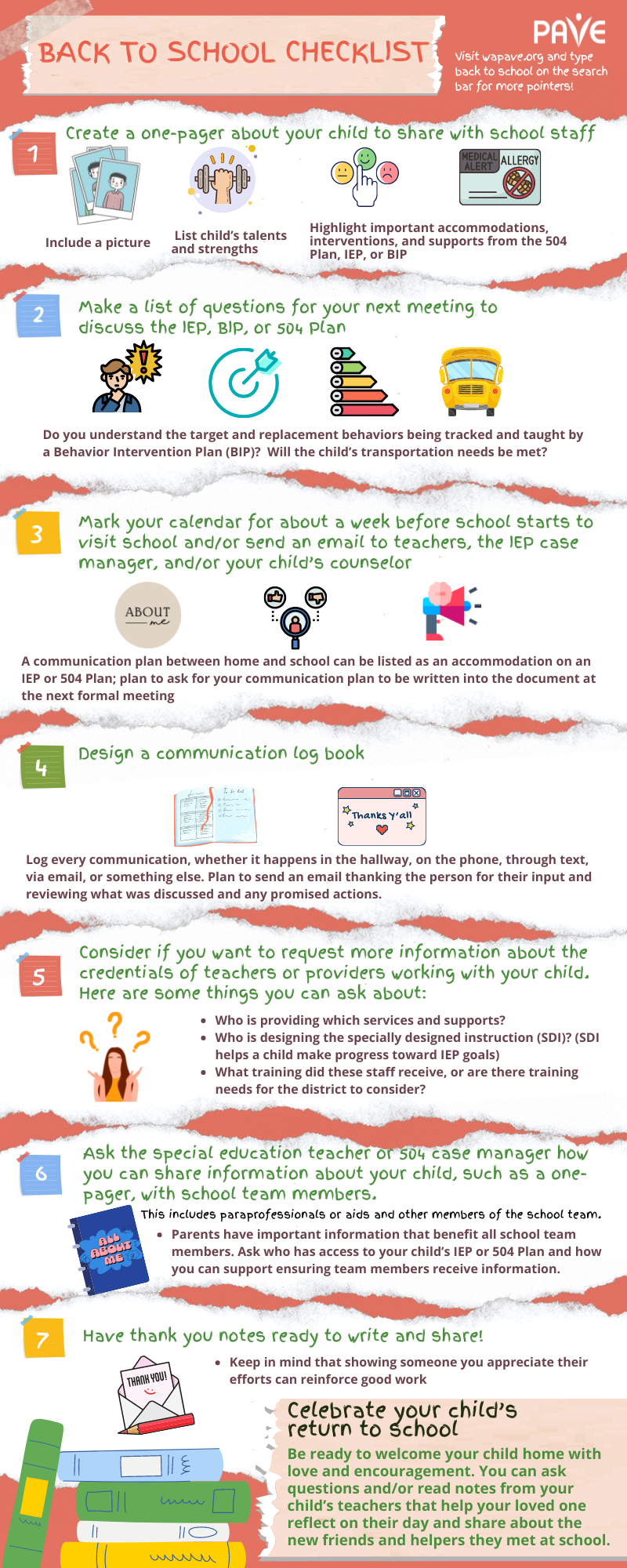
Back To School Checklist!

Late summer is the time to gather school supplies, find out what time the school bus will pick up and drop off, and prepare to find new classrooms and meet new teachers. Parents of students with disabilities have some additional things to check off the list to be ready for the year ahead. As August is National Immunization Month, we are adding updated immunizations and flu and covid boosters to the reminders. These are fully covered medical expenses whether you have insurance or not and can go a long way to keeping your child and your family healthy as we move into the fall and winter months. There are multiple events across our state where families can go to for immunizations.  

Super important: As school begins, make sure you know what’s included in your child’s Individualized Education Program (IEP), Section 504 Plan, and/or Behavior Intervention Plan (BIP). For more, see PAVE’s article: Tips to Help Parents Plan for the Upcoming School Year

If you are new to Washington State, perhaps because of military service, you also may want to review some basic information about how education and special education are structured and delivered here. PAVE provides an article: Help for Military Families: Tips to Navigate Special Education Process in Washington State. 

Here’s a checklist to help you get organized:

  1. Create a one-pager about your child to share with school staff
    • Include a picture
    • List child’s talents and strengths—your bragging points
    • Describe behavioral strategies that motivate your child
    • Mention any needs related to allergy, diet, or sensory
    • Highlight important accommodations, interventions, and supports from the 504 Plan, IEP, or BIP
  2. Make a list of questions for your next meeting to discuss the IEP, BIP, or 504 Plan
    • Do you understand the goals and what skills your child is working on?
    • Do the present levels of performance match your child’s current development?
    • Do accommodations and modifications sound likely to work?
    • Do you understand the target and replacement behaviors being tracked and taught by a Behavior Intervention Plan (BIP)?
    • Will the child’s transportation needs be met?
  3. Mark your calendar for about a week before school starts to visit school and/or send an email to teachers, the IEP case manager, and/or your child’s counselor
    • Share the one-pager you built!
    • Ask school staff how they prefer to communicate—email, phone, a notebook sent back and forth between home and school?
    • Get clear about what you want and need, and collaborate to arrange a communication plan that will work for everyone
    • A communication plan between home and school can be listed as an accommodation on an IEP or 504 Plan; plan to ask for your communication plan to be written into the document at the next formal meeting
  4. Design a communication log book
    • Can be a physical or digital notebook
    • Plan to write notes every time you speak with someone about your child’s needs or services. Include the date, the person’s full name and title, and information about the discussion
    • Log every communication, whether it happens in the hallway, on the phone, through text, via email, or something else
    • After every communication, plan to send an email thanking the person for their input and reviewing what was discussed and any promised actions—now that conversation is “in writing”
    • Print emails to include in your physical log book or copy/paste to include in a digital file
    • Having everything in writing will help you confirm what did/didn’t happen as promised: “If it’s not written down, it didn’t happen.”
  5. Consider if you want to request more information about the credentials of teachers or providers working with your child. Here are some things you can ask about:
    • Who is providing which services and supports?
    • Who is designing the specially designed instruction (SDI)? (SDI helps a child make progress toward IEP goals)
    • What training did these staff receive, or are there training needs for the district to consider?
  6. Ask  the special education teacher or 504 case manager how you can share information about your child, such as a one-pager, with school team members. This includes paraprofessionals or aids and other members of the school team.
    • Parents have important information that benefit all school team members. Ask who has access to your child’s IEP or 504 Plan and how you can support ensuring team members receive information
  7. Have thank you notes ready to write and share!
    • Keep in mind that showing someone you appreciate their efforts can reinforce good work
  8. Celebrate your child’s return to school
    • Do the bus dance on the first morning back to school!
    • Be ready to welcome your child home with love and encouragement. You can ask questions and/or read notes from your child’s teachers that help your loved one reflect on their day and share about the new friends and helpers they met at school

Below is an infographic of the above information.

Tip! you can click on the image and access an accessible PDF to print and keep handy.

Back to School Checklist click to find the accessible PDF

Click to access an accessible PDF of the infographic above

We also have this infographic in 8.5 x 11 easy to print size! Access it now!

Supplemental Security Income (SSI)

A Brief Overview

  • Supplemental Security Income (SSI) is a monthly financial payment made to persons meeting specific eligibility requirements defined by the Social Security Administration (SSA).
  • A person may be eligible for SSI if they are aged, blind or disabled; have limited income and resources; and are a citizen or resident of the United States.
  • SSI is different from Social Security Disability Insurance (SSDI), which is an insurance that workers earn by paying into taxes on their earnings.
  • There is a special rule that allows dependent children of military families serving on overseas assignments to begin or continue receiving SSI benefits while outside of the United States.

Full Article

What Is SSI?

Supplemental Security Income (SSI) is a monthly financial benefit from the Social Security Administration (SSA) to people with limited income and resources who are age 65 or older, blind or disabled.  Blind or disabled children, as well as adults, can get SSI.

Eligibility Requirements

To be eligible for SSI, a person must meet specific eligibility criteria, including:

  • SSA definitions of aged, blind, or disabled
  • Having limited income and resources
  • Citizenship or residency status

Aged Determination

A person who is 65 years of age or older may qualify for SSI as “aged” if they also meet the financial determination.

Blind or Disabled Determination

SSA defines “blind” as seeing at a level of 20/200 or less in the better eye with glasses or contacts, or having a limited field of vision that can only see things at within a 20-degree angle or less in the better eye.  A person with a visual impairment that does not meet the criteria for blindness may still qualify for SSI based on the disability.

An adult or child may qualify for SSI as “disabled” if they have a physical or mental impairment that can be medically diagnosed through clinical and laboratory diagnostic techniques for anatomical, physiological, and psychological irregularities. The condition must cause marked and severe functional limitations, including emotional or learning challenges, that have lasted or are supposed to last for at least 12 months without interruption.

A person aged 18 or older must qualify as an adult, which includes proving they are unable to do substantial gainful activity.  Two (2) months before a child receiving SSI benefits turns 18, SSA will conduct a disability redetermination to determine whether the child meets the adult criteria to continue receiving SSI payments.

Eligibility for disability is determined by a team that includes a disability examiner and a medical or psychological consultant at a state agency known as the Disability Determination Service (DDS).  The team will review medical and financial documents, and determine eligibility based on the documents provided or request more documents be provided.

It is necessary to complete both disability and financial determinations when assessing eligibility. This is because SSI eligibility determination may be used in other programs within your state. 

Limited Income and Resources

SSI is a needs-based program. In order to receive SSI, the applicant must have limited income and resources.

If the applicant has too much income, their application will be denied, and they will be ineligible for SSI payments. A child does not earn income so part of their parent’s income will be attributed to the child. Different sources of income are treated differently and some have greater exclusions than others. When an adult applies on behalf of a child, the parent or guardian’s income is considered “deemed” income to the child. SSA will prorate the adult’s income among the family members to determine the amount applicable to the child.

If you received SSI in another state, be aware that some states have a higher income limit that allows an individual to receive SSI benefits despite being over the federally established income limits. Washington is not a state with a higher income limit and applications submitted in Washington state must meet the federal income limits.

Resources include both money (e.g., cash, bank accounts, Certificates of Deposit, stocks and bonds, investment accounts, life insurance) and property (e.g. vehicles, houses, real estate) that could be sold or converted to cash to pay for food or shelter. There are limits for how much an applicant may have in resources and maintain eligibility for SSI:

  • An individual may have up to $2,000
  • A couple may have up to $3,000
  • When applying on behalf of a child, an adult may have an additional $2,000 in resources and a portion of the adult’s resources may be applied to the child

Some resources are excluded from the eligibility determination, including:

  • Your house and the property you live on
  • The first vehicle (per household)
  • Most personal and household belongings
  • Property that can’t be used or sold for income
  • Up to $100,000 saved in an ABLE account
  • Properly distributed funds from a special needs trust (SNT) on behalf of the individual with a disability

Citizenship or Residency Status

SSI is only available to U.S. citizens and nations residing in the United States or the Northern Mariana Islands, and qualifying non-citizens with certain alien classifications granted by the Department of Homeland Security (DHS).  SSI benefits will stop if a person leaves the U.S. for a full calendar month or at least thirty (30) consecutive days, with the exception of dependent children of active duty servicemembers serving overseas.

Is SSI The Same As SSDI?

Supplemental Security Income (SSI) is not the same thing as Social Security Disability Insurance (SSDI).  SSI is a needs-based public assistance program for children and adults. The eligibility criteria include limited income and resources. SSI payments come from the general funds of the U.S. Treasury from tax revenues.

SSDI is an insurance that workers earn by paying into the Social Security through taxes on their work earnings. It is not affected by income or resources. In order to receive SSDI, the person must have worked and paid from their earnings into the Social Security trust funds in the U.S. Treasury.

How Do I Apply For SSI?

Family to Family Health Information Center (F2FHIC), a program of PAVE, provides technical assistance, information, and training to families of children, youth, and adults with special healthcare needs. The F2F website contains invaluable information and resources to help family members, self-advocates, and professionals navigate complex health systems and public benefits, including SSI. After reviewing F2F’s article about how to apply for SSI, if you have questions and would like to speak with an F2F team member, please submit a Help Request.

Special Consideration For Military Families Overseas

A special rule allows dependent children of military families serving on overseas assignments to begin or continue receiving SSI benefits while outside of the United States. The child must be:

  • is a U.S. citizen
  • living with a parent who is a member of the U.S. Armed Forces assigned to permanent duty ashore outside the United States
  • listed in the Command sponsorship orders.

If the child is receiving SSI benefits before moving overseas with the active duty service member, the benefits will continue based on the rate of the state in which they applied. If the child is born overseas or becomes eligible for SSI while overseas, you can apply for SSI by contacting the Federal Benefits Unit at the nearest U.S. Embassy or Consular Office, or by applying online. For additional support with your application, call SSA at 1-800-772-1213 (TTY 1-800-325-0778).

Once the child turns 18, they will no longer be eligible for SSI until they have been living within the United States for thirty (30) consecutive days and will be subject to the disability redetermination process.

When relocating on military orders overseas, you must report:

  • the servicemember’s expected report date to the duty station overseas
  • the child’s expected date of arrival at the overseas location
  • the mailing address at your new duty station
  • changes in military allowances at your new duty station

Additional Resources

Surrogate Parents Support Unaccompanied Students in Special Education

A Brief Overview

  • Parent participation in IEP process is a protected right for students with disabilities. If a student doesn’t have a family caregiver or legal guardian to advocate in their behalf, a surrogate parent is assigned to fill that role.
  • A surrogate parent is not paid and cannot be employed by the school system, or any other agency involved in the care or education of the child.
  • The provision for a surrogate parent is part of federal special education law, the Individuals with Disabilities Education Act (IDEA Section 300.519).

Full Article

If a student eligible for special education services does not have a family caregiver, adoptive parent, or other legal guardian fulfilling the role of parent, then a surrogate parent is assigned to ensure the student’s rights are protected. The surrogate parent fulfills the family caregiver role on a student’s Individualized Education Program (IEP) team and advocates to ensure the student’s needs are met.

A surrogate parent is an individual appointed by the public agency (usually a school district) responsible for the student’s special education services. Schools are responsible to assign a surrogate parent within 30 days after recognizing the need. Note that a child who is a ward of the state may be assigned a surrogate parent by the judge overseeing their case.

If a private individual, such as a neighbor or friend, has explicit written permission from the student’s parent or guardian to care for the student, a surrogate parent is not required.

A student 18-21 is responsible for their own educational decision-making unless they have a guardian to exercise their legal rights. A school district is responsible to assign a surrogate parent for a student declared legally incompetent or if an adult student with a disability asks for a surrogate parent.

A surrogate parent is required for a minor student when the parent cannot be identified or located or if parental rights have been terminated. A student’s parents are considered to be unknown if their identity cannot be determined from a thorough review of the student’s educational and other agency records.

A student’s parents are considered unavailable if they cannot be located through reasonable effort that includes documented telephone calls, letters, certified letters with return receipts, visits to the parents’ last known address, or if a court order has terminated parental rights. A parent is also considered unavailable if unable to participate in the student’s education due to distance or incarceration.

If a parent is too ill to participate at a meeting, either in person or by phone, that parent has the option of giving another individual written permission to act for them.

An uncooperative or uninvolved parent is not the same as an unavailable one.  A surrogate parent is not assigned because parents choose not to participate in their child’s education.

A child identified as an unaccompanied homeless youth by the McKinney-Vento Homeless Assistance Act is an example of a student who would be assigned a surrogate parent to support them within the special education system. Children with surrogate parents might live in foster homes, nursing homes, public or private group homes, state hospitals, or correctional facilities.

In some cases, a state agency has guardianship of a student with a disability: That student requires the assignment of a surrogate parent. 

Foster parents need to be formally appointed by the school as surrogate parents if they do not have legal guardianship. Relatives without formal kinship rights also can be designated as surrogate parents within the special education process.

A surrogate parent is not paid and cannot be employed by the school system, or any other agency involved in the care or education of the child. However, an unaccompanied homeless youth may be supported by appropriate staff from an emergency shelter, street outreach team, or other agency temporarily until a surrogate parent with no conflict of interest is appointed.

A surrogate parent must have knowledge and skills that ensure adequate representation of the student. A community volunteer, guardian ad litem, or other invested adult might serve as a surrogate parent. The surrogate parent must commit to understanding the student’s strengths and needs and how the educational system is structured to support the student’s services. Ideally, the surrogate parent lives near the student and is a match for providing culturally appropriate help in the student’s language.

The surrogate parent represents the student in all matters relating to special education identification, evaluation, and placement and works to ensure that the student receives a Free Appropriate Public Education (FAPE) from their school-based services.

The provision for a surrogate parent is part of federal special education law, the Individuals with Disabilities Education Act (IDEA Section 300.519).

Washington’s Office of Superintendent of Public Instruction (OSPI) includes some downloadable resources about the surrogate parent in its Special Education Resource Library.

PAVE is here to help all caregivers, including surrogate parents. For direct assistance, click Get Help to complete an online Help Request Form.

Life After High School: Tools for Transition

Helping a student with disabilities prepare for life after high school requires thoughtful organization and planning. This presentation describes three ways to support this important time of life:

  1. High School and Beyond Plan
  2. IEP Transition Plan
  3. Agency Support

Here are resources referenced in the video:

  • OSPI Model Forms: Scroll down to find and open the IEP Form with Secondary Transition
  • OSPI Graduation Requirements, including links to download the High School and Beyond Plan in various languages
  • DDA: Developmental Disabilities Administration
  • DVR: Division of Vocational Rehabilitation
  • TVR: Tribal Vocational Rehabilitation, for Native Americans with disabilities
  • DSB: Department of Services for the Blind, for people with blindness or low vision
  • WAC 392-172A-03090, including description of Age of Majority rights that transfer to the student at age 18
  • PAVE article about Supported Decision Making
  • OSPI: The Office of Superintendent of Public Instruction has a family liaison for special education
  • OEO: The Office of the Educational Ombuds provides online resources and 1:1 support
  • OCR: The Office for Civil Rights can help with questions about equity and access
  • ESD: Nine Education Service Districts; each has a behavioral health navigator, and some are licensed to provide behavioral health services
  • Developmental Disabilities Ombuds
  • PAVE School to Adulthood Toolkit

Disability Rights for Littles: Key Information for Families of Babies, Preschoolers, and Primary-School Children

This two-part video series provides information about the rights of babies, toddlers, and young children with developmental delays or disabilities.

Part 1 provides information about early support services for babies through age 3. An interactive exercise is included to help families better understand how to participate in development of functional outcomes as part of the Individualized Family Service Plan (IFSP). The video includes information about how early support services are provided and delivered in Washington State and where to begin. Keep in mind that early services are provided in the natural environment—places where babies and toddlers would spend their days if there was no disability.

Part 2 includes information about the transition from early services into preschool and primary school. Families will learn how decisions are made about eligibility for an Individualized Education Program (IEP) and how to participate in educational decision-making for their child. Inclusion in general education is covered, with information about federal requirements for services in the Least Restrictive Environment, to the maximum extent appropriate. The video explains the components of an IEP and provides advocacy tips to support parents and children throughout their educational years.

Families can reach out for individualized assistance from our Parent Training and Information (PTI) staff at PAVE. Click Get Help or call 800-572-7368.

After you view the video, please take a quick moment to complete our survey. Your feedback is valuable!

Find Civilian Services for Your Child With a Disability When You Leave the Military

A guide to finding civilian supports and services when your service member separates or retires from the military if you have a child (including an adult dependent child) with disabilities. If you are PCSing to a “forever” home location, it includes resource finders available across the United States and Territories.

As you read down the columns, you will see references to Parent Centers. Parent Centers are funded by Office of Special Education (OSEP), US Department of Education to support parents of children age birth to 26 with disabilities. If you are reading this article through the website for PAVE (*******) or through their Pipeline newsletter, you are in the right place because PAVE is the Parent Training and Information Center (Parent Center) for Washington State.

 You can also use resources at the Center for Parent Information and Resources (CPIR), a national center serving Parent Centers and families with online information. According to the CPIR:

“There are nearly 100 Parent Training and Information Centers PTIs) and Community Parent Resource Centers (CPRCs) in the US and Territories. These Centers perform a variety of direct services for children and youth with disabilities, families, professionals, and other organizations that support them. Some of the activities include:

  • Working with families of infants, toddlers, children, and youth with disabilities, birth to 26
  • Helping parents participate effectively in their children’s education and development
  • Partnering with professionals and policy makers to improve outcomes for all children with disabilities” – https://www.parentcenterhub.org/the-parent-center-network/

Quick-find links:

Children’s Benefits or Services
Active Duty
or Active Reserve

Keep Benefit or Service?
(retiring after 20 yrs service)

Equivalent Civilian Resources

TRICARE Medical Coverage (may include case management, mental health, hospice care)

Yes, but there may be extra financial costs

Private insurance (useful article at the Military Wallet website)
Medicaid  NOTE:  your child can be enrolled in both Medicaid and TRICARE

TRICARE for children after age 21, up to age 26 (including college students)

Yes-up to age 23 if in college (or up to graduation); after which and up to age 26, child may be eligible for TRICARE Young Adult, which charges premiums, has co-pays and deductibles.

Private insurance

Medicaid NOTE:  your child can be enrolled in both Medicaid and TRICARE

TRICARE benefits after age 26 through secondary dependency

Yes

Medicaid NOTE:  your child can be enrolled in both Medicaid and TRICARE

Supplemental Security Income (SSI) (in some states, receiving SSI helps determine Medicaid eligibility)

Private insurance

Yes, but only if the service member retires, as opposed to leaving the military prior to fulfilling the terms of service for retirement. If the service member leaves without retiring, try the resources in the right-hand column.

Medicaid NOTE:  your child can be enrolled in both Medicaid and TRICARE

Medicaid Home and Community Based Services (HCBS) Waiver * NOTE:  your child can be enrolled in both Medicaid and TRICARE

Autism resources by State (Easter Seals)

State Agencies on Developmental or Intellectual Disabilities

Extended Care Health Option (ECHO) provides supplemental support and services not available through TRICARE’s regular coverage. Some benefits similar to Medicaid HCBS waivers

No

Medicaid HCBS Waiver * NOTE:  your child can be enrolled in both Medicaid and TRICARE

Respite Care through ECHO and other programs

No, but check with the community family center at a local installation to identify any military-family support organizations which may offer funding or locator services.

Medicaid HCBS Waiver * NOTE:  your child can be enrolled in both Medicaid and TRICARE

Lifespan Respite (WA)

EasterSeals Respite locator: https://archrespite.org/respitelocator

Exceptional Family Member Program (EFMP) Family Support (help with navigating military and some civilian service systems)

Yes, at the discretion of installation

PAVE (Parent Center, Washington State)

Parent Centers

No

Private: not subsidized, but can use the directory: ChildCareAware.org. If a family has income restrictions, many States have subsidized care through Department of Health and Human Services (or equivalent)

School Liaison Office for help navigating school systems and services, especially under MIC3 (Interstate Compact)

No, except that the Interstate Compact covers your child for one year after you retire

PAVE (Parent Center, Washington State)

Parent Centers (other states)

Response to Intervention (RTI) – Support for Struggling Students

Brief overview

  • Students struggle in school for different reasons.
  • RTI is an acceptable way of identifying students with learning disabilities.
  • RTI isn’t a specific program or type of teaching.
  • RTI works on a tier system with three levels of intervention.

Full Article

Students struggle in school for different reasons. Response to Intervention (RTI)  can help by combining high quality, culturally responsive instructions with assessments and interventions that are proven to work by evidence from research.

RTI was originally recognized in the 1970s as a system for helping students with potential learning problems early, instead of waiting until they fail. With the reauthorization of the Individuals with Disabilities Education Act (IDEA) in 2004, RTI was noted as an acceptable way to identify students with learning disabilities. RTI can help students who haven’t yet been identified as eligible for special education or those who struggle but don’t qualify for special education services.

At any time during the RTI process, parents or teachers can request an evaluation for special education services.  The evaluation can determine whether a student qualifies for an Individualized Education Program (IEP) or accommodations through a Section 504 Plan. RTI does not replace a school’s responsibility to evaluate students who might qualify for special education services. See PAVE’s article on Child Find, a mandate of the Individuals with Disabilities Education Act (IDEA).

RTI’s goal is for schools to intervene before a student falls too far behind. RTI is not a specific program or type of teaching, but rather a proactive way to check in with a student to see how things are going. Data help school staff decide which types of targeted teaching would work best for the student. If a student’s progress is slow or stagnant, then teachers adjust based on the student’s needs. 

RTI has three levels, or tiers, for intervention:

  • In the general education classroom
  • In a special education classroom, resource room, or small group
  • For an individual student

RTI works best when parents are involved

Parents can monitor their child’s progress and participate in the process. Parents can talk to the school about which instructions or reinforcements are working and boost the benefit by being consistent with the same strategies at home.

As military families move from one location to another, they may notice that each school uses different techniques to implement RTI programs.  Schools will format their programs to best fit the needs of their students by using a variety of tools to improve learning for all students. Keeping up with what’s happening at school might be challenging but can help the student find success.

RTI is part of a Multi-Tiered System of Supports (MTSS) framework.  MTSS provides a method for intervention in academic and non-academic areas, including Social Emotional Learning or behavior support. MTSS is used to support adult students and professionals as well. In this video, a researcher from the American Institutes for Research, Rebecca Zumeta Edmonds, Ph.D., discusses differences between MTSS and RTI.

PAVE has an article that describes MTSS and how it can provide a larger framework for Positive Behavior Interventions and Supports (PBIS), when a child’s behavior becomes a barrier to learning.

For more information on RTI, MTSS, and PBIS:

The Three RTI Tiers

Center on Response to Intervention

Response to Intervention (RTI)

 What is the Difference Between RTI and MTSS?

MTSS: What You Need to Know

Positive Behavioral Interventions & Supports (PBIS) in Schools

I want the kind with the people and the pictures

By John O’Brien

After a Difficult Start…

Institutionalized from age three to twenty-three in a place where “they treated us like animals”– Mike has composed a good life, taking many valued roles: husband, father, worker, home owner, friend, organizer, advocate, mentor, teacher, neighbor.[1] Anticipating the changes that come with aging, Mike requested funding for a person-centered plan from his case manager (a service option in his state). The case manager said that it was unnecessary for him to spend any of his budget on a plan because a new Federal Rule requires that Mike’s annual plan of care meeting be a person-centered plan. Mike, who has participated in many person-centered plans organized through self-advocacy, asked some questions about the required plan and concluded, “I still want the kind with the people and the pictures.”

Regulations that require a person-centered plan as a condition of receiving Medicaid Waiver funds introduce a distinction between Want-to-plans and Have-to-plans. Each can make a positive contribution; both must creatively respond to constraints. A good Want-to-plan supports discovery of possibilities and life direction and mobilizes a person’s allies at important moments in their lives. A good Have-to plan gives a person effective control of the Medicaid waiver funded assistance they rely on. Committed and skilled facilitators with the time necessary to prepare and follow-up make a difference to the impact of both kinds of plan. How well either process works for a person depends on conditions outside the planning process: the extent, diversity and resourcefulness of the person’s social network; the openness of the person’s community; the flexibility and responsiveness of providers of necessary assistance; the sufficiency of public funds for necessary assistance and the means for people to control those funds. Good plans will identify the current reality of these conditions and consider how to engage them.

Mike’s is a want-to-plan. At his initiative, he and his invited allies (the people) collaborate to create a customized process to address his desire to deal proactively with the new responsibilities and increasing impairments that show up with aging. Mike chose Michele, an experienced facilitator, to guide the process. Their agreement makes it clear that Michele is responsible for facilitating a process of change over time, not just a meeting.[1] A graphic record (the pictures), created by Alex, provides an energizing memory of what emerges, a way to track and update action plans, and a way to orient new people to Mike’s intentions.[2] Occasional check-ins and revisions guide continuing action. One-to-one meetings assist Mike in sorting through all the suggestions and offers of help he receives to assure a good fit with who he is. Mike will bring some the information generated by this work to inform the required annual person-centered support plan, but his Want-to-Plan does not substitute for it.

Mike’s experience unfolds under highly favorable conditions for any person-centered plan. He has a strong desire to assure his wife and himself the best possible old age. Reciprocity for decades of generous neighborliness, concern for co-workers and leadership in advocacy give him a diverse network to call on. He is not inhibited in asking for help when he needs it. The help he needs is largely with navigating the unfamiliar territory of selling and buying property and preparing wills and other necessary documents and demands no change in his current paid services. Hard work and careful management has accumulated equity in family home. Many Want-to-plans will need to include provision for strengthening or establishing the social and material conditions for moving toward a desirable future.

Want-to-plans can also originate in a person’s positive response to an invitation to join a process of organizational change. This sort of plan poses a challenge that an organization must stretch its capacities to meet.

Have-to-plans are a necessary step in determining expenditure of Medicaid funds on services to meet the assessed needs of eligible people. They are the final responsibility of system staff assigned to coordinate services. While the process can vary to accommodate a person’s preferences, the process and resulting plan must comply with detailed standards. The New York OPWDD Person Centered Planning Regulation Checklist enumerates 23 requirements, 21 of which track US Federal Regulations.[3]

Have-to-plans serve a worthy purpose. The rules set conditions for the person to direct the meeting, understand the results and assure that the person-centered service plan documents the person’s needs strengths, preferences, goals and appropriate services.

This checklist item, based on a Federal requirement, identifies the intended result of Have-to plans:

2‐5. The plan documents the necessary and appropriate services and supports that are based on the individual’s preferences and needs and which will assist the person to achieve his/her identified goals. [Complies with CFR 441.301©(2)(v)]

This form of words sets Have-to-plans in the context of publicly funded disability services. Offering increased influence on which available provider(s) will serve a person and how those services will be of assistance is a clear benefit of Have-to-plans when there is a real choice among providers with a capacity to individualize supports.

This standard also locates a tension that constrains Have-to-plans as two impulses struggle with each other within the same sentence. One impulse, energized by commitment to self direction and the development of people’s strengths, expresses the life a person wants to live and the supports that they prefer to live that life. The other, tied to the historical anomaly of funding US disability support as if it were a medical service, aims to select necessary and appropriate services that are clearly linked to professionally assessed need. State policy can bias the struggle toward one impulse or the other. In some states[1] the person centered plan is bracketed between an assessment of need that involves an extensive inventory of a person’s deficiencies and writing an Individualized Service Plan (ISP) that must demonstrate a direct connection between assessed need and specified services and avoid public funding of “wants” or “lifestyle choices”. Without the skillful facilitation of an intentional shift in perspective, a Have-to-plan will be primed by a focus on deficiencies and develop within unconscious boundaries set by judgements of what can realistically be funded.

A Want-to-plan can safeguard a Have-to-plan. A person and those who care can choose to create a space outside the world of disability services for conversation about a person’s identity, gifts and capacities and the circumstances that offer the best life chances. Often, as with Mike, some action will result from this conversation that requires no change in publicly funded services. When the sort of changes in services that require a Have-to-plan are necessary, a person and their allies have a foundation for negotiating what they need from publicly funded services.

____________________________________________________

[1] See for example, NJ Division of Developmental Disabilities (March 2016). Supports Program Policies & Procedures Manual (Version 3.0).

[1] Other agreements might suit other circumstances. A different person might agree to fill the necessary follow up role.

[2] Denigrating graphic records has become a cliche criticism of person-centered planning (“people have colorful pictures on their walls but their lives are unchanged”). Lack of commitment or capacity for creative action seem to me more likely causes of inaction than a vivid record of people’s thinking does.

[3] http://www.opwdd.ny.gov/sites/default/files/documents/PCPChecklist.pdfThe 22nd standard, specific to New York, defines a person-centered planning process as a right and requires written notice of that right. The 23d assures that all relevant attachments are filed with the plan. The rule itself, Medicaid Program; State Plan Home and Community-Based Services, 5-Year Period for Waivers, Provider Payment

Reassignment, and Home and Community-Based Setting Requirements for Community First Choice (Section 1915(k) of the Act) and Home and Community-Based Services (HCBS) Waivers (Section 1915(c) of the Act), was published in the Federal Register on January 16, 2014.

[1] You can view Mike’s witness to growing up in an institution and a snapshot of his life today in this 2015 TV investigation into his state’s continuing operation of institutions: http://www.king5.com/news/local/ investigations/wash-decades-behind-in-serving-developmentally-disabled-1/48265785


Early Learning Transition: When Birth-3 Services End

The Individualized Family Service Plan (IFSP) ends when a child turns 3. A transition to a preschool plan with an Individualized Education Program (IEP) requires a new evaluation and is a team-led process:

Planning begins 6-9 months before the third birthday.

  • The Family Resource Coordinator (FRC) schedules a transition conference to design a written Transition Plan.
  • The transition includes an evaluation that is conducted by the local school district and usually begins 2-3 months before the child’s third birthday.
  • If the child is determined eligible, the child will transition from a family-centered program of early learning (IFSP) into a school-based program (IEP).
  • Parent participation is critical: You are an important member of the transition planning team!

To qualify for an IEP, the child must meet evaluation criteria under the Individuals with Disabilities Education Act (IDEA). Criteria for Birth-3 services (Part C of the IDEA) are slightly different than the criteria for Special Education programming available for ages 3-21 (Part B of the IDEA).

To qualify for an IEP: (1) The student is determined to have a qualifying disability.  (2) The disability adversely impacts education. (3) The evaluation indicates a need for specially designed instruction.

Differences in Eligibility

IDEA Part C
(Also called Early Intervention -IFSP)

IDEA Part B
(Also called Special Education – IEP)
25% or 1.5 SD (Standard Deviation) Below the mean in one area of development – OR- 2 SD (Standard Deviation ) below the mean in one or more areas of development – OR –
Diagnosed physical or medical condition that has a high probability of resulting in delay  1.5 SD below the mean in two or more areas of development

Qualifying Disability Categories for IEP:

  • Developmental Delay (ages 3-8)
  • Specific Learning Disability
  • Intellectual Disability
  • Autism
  • Hearing Impairment
  • Emotional Disturbance
  • Deaf-blindness
  • Multiple Disabilities
  • Orthopedic Impairment
  • Other Health Impairment
  • Deafness
  • Speech/Language Impairment
  • Traumatic Brain Injury

A child who doesn’t qualify for an IEP:

  • May qualify for a Section 504 plan, which provides accommodations under the Rehabilitation Act of 1973 when:
    • The disability significantly limits one or more major life activities.
    • The student needs accommodations to access the general education curriculum.
  • May qualify for other services like Head Start, co-operative pre-school, paid pre-school or day care with early achievers, play-to-learn programs, and other early learning opportunities in a community setting.

Use this checklist to help track your family’s transition steps:

6-9 months before the child’s third birthday:

  • The Family Resource Coordinator (FRC) starts talking about transition.
  • The FRC transmits your child’s records to the school system, with your written consent. The most recent IFSP and evaluations/assessments are included.
  • If your child is potentially eligible for Part B services, a transition conference is scheduled.
  • Community resources are located.

Transition Conference:

  • Parent’s rights in special education are explained.
  • Options for early childhood special education and other appropriate services are discussed.
  • A transition time line is developed.
  • A transition plan is written into the IFSP.

Evaluation:

  • If you agree, you sign consent for evaluation.
  • Records from Early Intervention Services are received at the school.
  • Information from the family is considered.
  • Evaluation is completed, and the eligibility meeting is held within 35 school days so that an IEP can be developed before the child’s third birthday.

IEP Meeting:

  • The IEP meeting is scheduled with a formal written invitation with date, time and location.
  • Discussion and decision-making include the family, the FRC (with parent permission), and an early childhood special education staff member.
  • Eligibility for special education is decided.
  • If the child is eligible, the Draft IEP is brought to the team meeting and you will have the opportunity to agree or disagree.
  • You receive a copy of your rights and procedural safeguards.
  • If you agree, you sign consent for services to begin.

The IEP in action:

  • The child makes the transition from Early Intervention to Early Childhood Special Education or another pre-kindergarten arrangement, if chosen.
  • The IEP is in place by our child’s third birthday.
  • The team of professionals and parents continue working together to resolve any issues that arise.
  • All IEP team members communicate during this time of change.