Disability History Month Provides Opportunities for Reflection

The history of disability rights shows how people with disabilities have worked hard to get equitable access, fair treatment, and meaningful inclusion. Key laws and strong community voices have helped shape education and civil rights. Today, it is as crucial as ever to learn, speak up, and work together to build a more inclusive society.

A Brief Overview

  • October is Disability History and Awareness Month in Washington State (RCW 28A.230.158). This month helps people learn about disabilities, raise awareness, promote respect and acceptance, and build pride among individuals with disabilities.
  • Federal and state laws, along with court decisions, have helped students with disabilities go to public school, get the services they need, and be included in general education whenever possible.
  • State law requires public schools to teach students about disability history and help them understand what it means to live with a disability.
  • Parent Centers like PAVE help families and individuals understand disability rights. To find a Parent Center outside of Washington State, visit Find My Center on the Center for Parent Information and Resources (CPIR) website.

Celebrating the History of Disability Rights

Disability History and Awareness Month in October is a time for students, families, teachers, and community leaders to remember and learn about the disability rights movement. Equity and access are protected by law, but there is still work to be done to make sure that laws are followed so that everyone has fair access to opportunities.

Organizations like PAVE help families and individuals understand disability rights. They also explain how history has shaped today’s laws, including the words we use when we talk about disability rights.

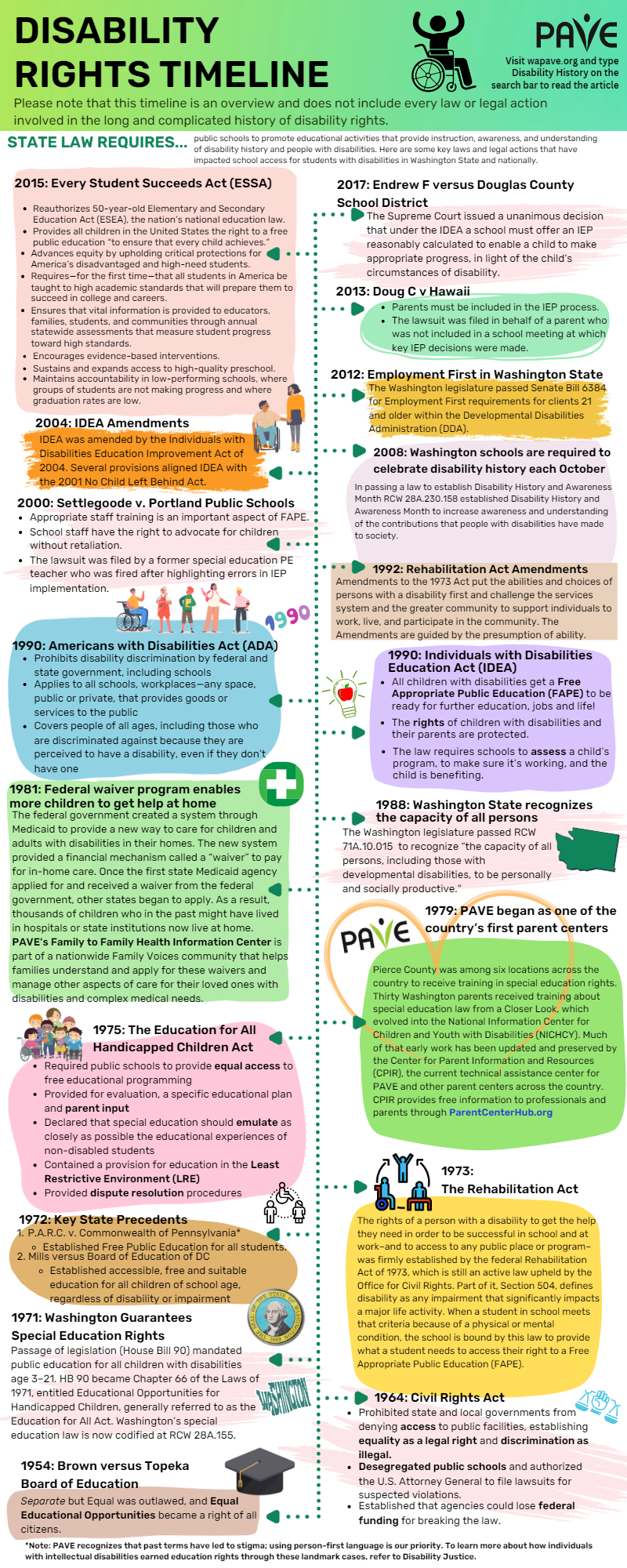
Below is a timeline of key actions at the state and federal level.

Please note that this article is an overview and does not include every law or court case from the long history of disability rights.

1954​: Brown v. Board of Education​ of Topeka

This landmark Supreme Court case was brought by families who challenged racial segregation in public schools. In Brown v. Board of Education of Topeka (1954), the Court ruled that separating students by race was unfair and violated the 14th Amendment’s promise of equal protection under the law.

‘Separate but equal’was outlawed, and equal educational opportunities became a right of all citizens. ​

The decision helped establish the principle that all students deserve equal educational opportunities. It became a foundation for future disability rights cases. Advocates used this ruling to argue that students with disabilities also have the right to attend public schools and receive a fair education.

1964​: Civil Rights Act​

The Civil Rights Act of 1964 was a major law that helped protect people from discrimination. It made it illegal for state and local governments to deny access to public places, like schools, parks, and libraries. This law confirmed that equality is a legal right, and that discrimination is against the law.

It also helped desegregate public schools and gave the U.S. Attorney General the power to take legal action against schools or other public agencies suspected of breaking the law. It also stated that agencies that didn’t follow the law could lose their federal funding.

1971: Washington guarantees special education rights

In 1971, the small but fierce Education for All Committee — Evelyn Chapman, Katie Dolan, Janet Taggart, Cecile Lindquist — worked with two law students to craft and advocate for passage of legislation (House Bill 90) to mandate public education for all children with disabilities age 3–21. HB 90 became Chapter 66 of the Laws of 1971, entitled Educational Opportunities for Handicapped Children, generally referred to as the Education for All Act. Washington’s special education law is now codified at RCW 28A.155

1972: Key precedents are established in other states

In P.A.R.C. v. Commonwealth of Pennsylvania (1971)*, a group of parents went to court to fight for their children’s right to go to public school. At the time, some schools didn’t allow children with disabilities to attend. The court decided that all children, no matter their abilities, have the right to a free public education.

A few months later, Mills v. Board of Education of the District of Columbia (1972) built on the P.A.R.C. decision. In Mills, the court found that education should not only be free and accessible to all students, but also suitable for each child’s needs. These two cases helped establish the principle that all children, regardless of ability, have the right to attend public school and receive an education suited to their individual needs.

To learn more about how individuals with intellectual disabilities gained education rights through these landmark cases, visit Disability Justice.

*Note: PAVE recognizes that past terminology has contributed to stigma. We are committed to using inclusive, disability-affirming language that reflects the preferences of individuals and communities, including identity-first and person-first approaches.

1973: The Rehabilitation Act

The rights of people with disabilities to get the help they need in order to be successful in school, at work, and in any public place or program was firmly established by the federal Rehabilitation Act of 1973. This federal law that is still active today and enforced by the Office for Civil Rights at the U.S. Department of Education. Part of it, Section 504, defines a disability as any condition that seriously affects a major life activity. If a student has a physical or mental condition that meets this definition, the school must follow the law and provide support to help the student access their education and participate in school activities.

1975: The Education for All Handicapped Children Act

In 1975, the U.S. passed the Education for All Handicapped Children Act, the first federal law focused on the education of children with disabilities. It required public schools to give students with disabilities equal access to free educational programming, along with evaluations, a specific learning plan, and input from parents. The law said that special education should emulate the learning experiences of students without disabilities as closely as possible. This means that students with disabilities have the right to a school experience that looks as much like a typical student’s program as possible. It also introduced the idea of the Least Restrictive Environment (LRE), encouraging schools to work harder to include students of many abilities in general education classrooms. To help families resolve disagreements with the school, the law outlined required dispute resolution procedures. Parents are given information about their rights through Procedural Safeguards that are shared at IEP and other official meetings.

1979: PAVE began as one of the country’s first six parent centers

Pierce County was among six locations across the country to receive training in Special Education rights. In 1979, thirty Washington parents received training on Special Education law. The goal was for those parents to share information throughout the state. To help this movement, a clearinghouse named Closer Look provided intense training for these pioneering parents about the laws. Closer Look evolved in the National Information Center for Children and Youth with Disabilities (NICHCY), and much of that work has been updated and preserved by the Center for Parent Information and Resources (CPIR), the current technical assistance center for PAVE and other parent centers across the country. CPIR continues to provide free information to professionals and parents about education rights under federal law.

To connect with a Parent Center outside Washington State, visit Find My Center on the Center for Parent Information and Resources (CPIR) website.

1981: Federal waiver program enables more children to get help at home

The federal government created a system through Medicaid to provide a new way to care for children and adults with disabilities in their homes. This system introduced a funding option called a waiver, which helps pay for in-home support. Once the first state Medicaid agency applied for and received a waiver from the federal government, other states began to apply. As a result, thousands of children who might have lived in hospitals or institutions in the past are now able to live at home. PAVE’s Family to Family Health Information Center is part of a nationwide Family Voices community that helps families understand and apply for these waivers and manage other aspects of care for their loved ones with disabilities and complex medical needs.

1988: Washington State recognizes the capacity of all persons

The Washington legislature passed RCW 71A.10.015 to recognize “the capacity of all persons, including those with developmental disabilities, to be personally and socially productive.

“The legislature further recognizes the state’s obligation to provide aid to persons with developmental disabilities through a uniform, coordinated system of services to enable them to achieve a greater measure of independence and fulfillment and to enjoy all rights and privileges under the Constitution and laws of the United States and the state of Washington.”

1990: Americans with Disabilities Act (ADA)

The Americans with Disabilities Act (ADA) protects people from disability discrimination by the federal and state governments, including public schools. It also applies to all schools, workplaces, and any public or private place that offers goods or services to the public. The law covers people of all ages, including those who are treated unfairly because they are perceived to have a disability, even if they don’t have one.

Many ADA protections are like those found in Section 504 of the Rehabilitation Act of 1973. Both laws focus on equity and access, and they protect people with disabilities throughout their lifespan.

Understood.org offers resources for parents to learn about ADA protections in schools, including printable fact sheets. The U.S. Department of Justice provides an ADA Information Line to answer questions and help people report possible violations of the law. The Office for Civil Rights also provides guidance for students with disabilities as they plan for post-high school education programs.

1990: Individuals with Disabilities Education Act (IDEA)

The Education for All Handicapped Children Act was renamed and enacted as the Individuals with Disabilities Education Act (IDEA) in 1990. Free Appropriate Public Education (FAPE)came into being, which is still key to how schools support students with disabilities. FAPE means that every child with a disability has the right to an education that helps prepare them for further learning, work, and life. The law also protects the rights of students and their parents or guardians. Schools are required to check if a student’s program is working and make sure the student is making progress.

IDEA is an entitlement law, which means students with unique needs must get support based on their individual situation—not just what’s already available. This federal law guides how each state creates its own special education rules. In Washington State, those rules are found in the Washington Administrative Code (WAC), specifically in chapter 392-172A. Title 34, Part 104, is a federal rule that protects people from discrimination and is enforced by the Office for Civil Rights. 

1992: Rehabilitation Act Amendments

Amendments to the 1973 Rehabilitation Act focus on the abilities and choices of persons with disabilities. These changes challenge service systems and communities to support individuals as they work, live, and participate in the community. The Amendments are guided by the idea of a presumption of ability. This means that every person with a disability, regardless of the severity of the disability, can achieve employment and other rehabilitation goals, if they have the right services and support.

The primary responsibilities of the vocational rehabilitation system include:

  • Help individuals with disabilities make informed choices about jobs that lead to integration and inclusion in the community.
  • Develop an individualized rehabilitation program with the full participation of the person with a disability.
  • Match a person’s needs and interests with appropriate services and supports.
  • Work closely with other agencies and programs, including school districts, to build a strong and unified support system.
  • Focus on quality services and ensure service representatives honor the dignity, participation, and growth of each person as they explore employment options.

2000: Settlegoode v. Portland Public Schools

In 2000, the case of Settlegoode v. Portland Public Schools helped bring attention to the rights of teachers who work in special education. A former special education PE teacher filed the lawsuit after being fired for speaking up about problems with how IEPs were being followed. The court ruled that appropriate staff training is an important part of FAPE and that school staff have the right to stand up for students without being punished.

2004: IDEA Amendments

Congress updated IDEA by passing the Individuals with Disabilities Education Improvement Act (IDEIA) in 2004. Some parts of the law were changed to match the goals of the 2001 No Child Left Behind Act. Here are a few examples of updates:

  • IDEIA allowed 15 states to try out 3-year IEPs when parents agreed every year as a pilot program.
  • Based on a report of the President’s Commission on Excellence in Special Education, the law changed the requirements for evaluating children with learning disabilities.
  • New rules were added about how schools handle discipline for students in special education. These updates continue to shape discipline policies in Washington State.
  • The law strengthened the idea of Least Restrictive Environment (LRE), saying students should learn in regular classrooms with extra help and services, “to the maximum extent appropriate.”

2008: Washington schools are required to celebrate disability history each October

Washington State passed a law to create Disability History and Awareness Month (RCW 28A.230.158), which takes place every October. The legislature explained that: “annually recognizing disability history throughout our entire public educational system, from kindergarten through grade twelve and at our colleges and universities, during the month of October will help to increase awareness and understanding of the contributions that people with disabilities in our state, nation, and the world have made to our society. The legislature further finds that recognizing disability history will increase respect and promote acceptance and inclusion of people with disabilities. The legislature further finds that recognizing disability history will inspire students with disabilities to feel a greater sense of pride, reduce harassment and bullying, and help keep students with disabilities in school.”

2012: Employment First in Washington State

The Washington legislature passed Senate Bill 6384 to create Employment First requirements people age 21 and older who receive services through the Developmental Disabilities Administration (DDA). The law states, “The program should emphasize support for the clients so that they are able to participate in activities that integrate them into their community and support independent living and skills.”

The legislation:

  • Supports employment as the first choice for adults of working age.
  • Incorporates the right to transition to a community access program after nine months in an employment service.
  • Clarifies that a client receive only one service option at a time (employment or community access).

DDA Policy Document describes the history behind the law and the rules for how it would be implemented.

2013: Doug C. v Hawaii

In Doug C. v. Hawaii (2013), the court ruled that parents must be included in the IEP. The lawsuit was filed in behalf of a parent who was not included in a school meeting at which important decisions were made about their child’s IEP. The decision confirmed that families have a legal right to be part of planning their child’s education and that schools must make sure parents and guardians are involved.

2015: Every Student Succeeds Act (ESSA)

In 2015, Congress passed the Every Student Succeeds Act (ESSA) to update the Elementary and Secondary Education Act (ESEA), which had been the nation’s main education law for over 50 years. ESSA says that every child in the United States has the right to a free public education “to ensure that every child achieves.”

The law:

  • Protects the rights of disadvantaged and high-need students.
  • Requires for the first time that all students be taught to high academic standards that prepare them for college and careers.
  • Provides important information to families, educators, and communities through yearly statewide tests that show student progress toward high standards.
  • Encourages schools to use evidence-based strategies to support learning.
  • Expands access to high-quality preschool.
  • Keeps schools accountable when student groups are not making progress or graduation rates are low.

2017: Endrew F v. Douglas County School District

In Endrew F., the Court ruled that schools must offer an IEP that is reasonably calculated to enable a child to make progress, based on their individual circumstances of disability. The decision rejected the old “de minimis standard,” which allowed schools to offer only minimal progress. Trivial progress is no longer enough.

The ruling emphasized:

  • Grade-level goals for students who can learn in the general education classroom.
  • Parent participation in the IEP process.
  • Higher expectations for student growth under IDEA.

Writing for the Court, Chief Justice John G. Roberts explained that a child making only small gains would be like “sitting idly… awaiting the time when they were old enough to drop out.” The case continues to influence how schools and agencies support students with disabilities, and many professionals encourage families to hold schools accountable to these higher standards.

PAVE provides more information about parent and guardian rights to participate in their child’s education in this article: Parent Participation in Special Education Process is a Priority Under Federal Law .

Download the Disability Rights Timeline

A visual version of the timeline is available as a downloadable infographic to support learning and reflection.

Infographic of the Disability Rights Timeline. Visit wapave.org and type disability History on the search bar to read the article and receive accessible information included  in this infographic

View this infographic in PDF form

Sample Letter to Request an IEP Meeting

Families can request an IEP (Individualized Education Program) meeting at any time—not just during the annual review. A sample letter is available to help parents and guardians formally make this request. Guidance is also provided on who must attend IEP meetings, common reasons for requesting one, and tips for organizing communication and documentation.

A Brief Overview:

  • Families can request an IEP meeting at any time—not just during the annual review.
  • Washington state law (WAC 392-172A-03095) requires that the IEP team include specific people and roles.
  • Common reasons to request a meeting include academic struggles, behavior concerns, new diagnoses, or transition planning.
  • Students can also request meetings to advocate for themselves or adjust goals and supports.
  • PAVE offers helpful tools to support families in preparing for IEP meetings, including a fillable Who’s Who on the IEP Team contact form and sample letter to formally request a meeting—both available for download in multiple languages within this article.

Introduction

When a student has an Individualized Education Program (IEP), their IEP team is required to meet and review the program at least every year. The annual review date is listed on the cover page of the IEP document. Family caregivers can request additional meetings, and this article includes a sample letter families can use to formally request an IEP meeting.

Keep in mind that parents have the right to participate in meetings where decisions are made about eligibility or changes to a student’s special education services. A court decision in 2013 further affirmed those rights. More information about that case, Doug C. Versus Hawaii, is included in the PAVE article, Parent Participation in Special Education Process is a Priority Under Federal Law.

An IEP meeting request letter can be submitted to school staff and to district staff. Family participants have the right to invite guests to the meeting for support and to provide additional expertise about the student.

Required Members of the IEP Team

The best practice is for the school and parents to communicate about who will attend the meeting. If required school staff are unable to attend a meeting, parents must sign consent for their absence. Under Washington Administrative Code (WAC 392-172A-03095), a school district must ensure that each IEP team includes:

  • Parent/legal guardian
  • At least one general education teacher
  • At least one special education teacher of the student
  • District staff qualified in the provision of specially designed instruction (SDI), knowledgeable about the district’s general education curriculum, and knowledgeable about the district’s available resources
  • Someone (usually a school psychologist) qualified to interpret the instructional implications of evaluation results
  • At the discretion of the parent or the school district, other individuals who have knowledge or special expertise regarding the student, including related services personnel
  • Whenever appropriate, the student (required to be invited once a transition plan is added, by age 16 or earlier)

According to Washington state law (WAC 392-172A-03095), the IEP team includes an individual who is knowledgeable about district resources. Sometimes a school principal or other staff member fulfills that role, but families or school staff can request attendance by someone who works in the district’s special education department. If a school administrator says during a meeting, “We’ll have to check with the district and get back to you,” it may mean that a key decision-maker isn’t present. In that case, families or students can request another meeting with all required team members. This is especially important if the team is discussing services that might cost more or involve a change in the student’s educational placement.

The school’s meeting invitation lists attendees and can clarify when the meeting will start and end and the purpose or agenda for the meeting. PAVE provides an article about how students and families can prepare for a meeting by creating a handout for the team, including a Student Input Form.

Who’s Who on the IEP Team

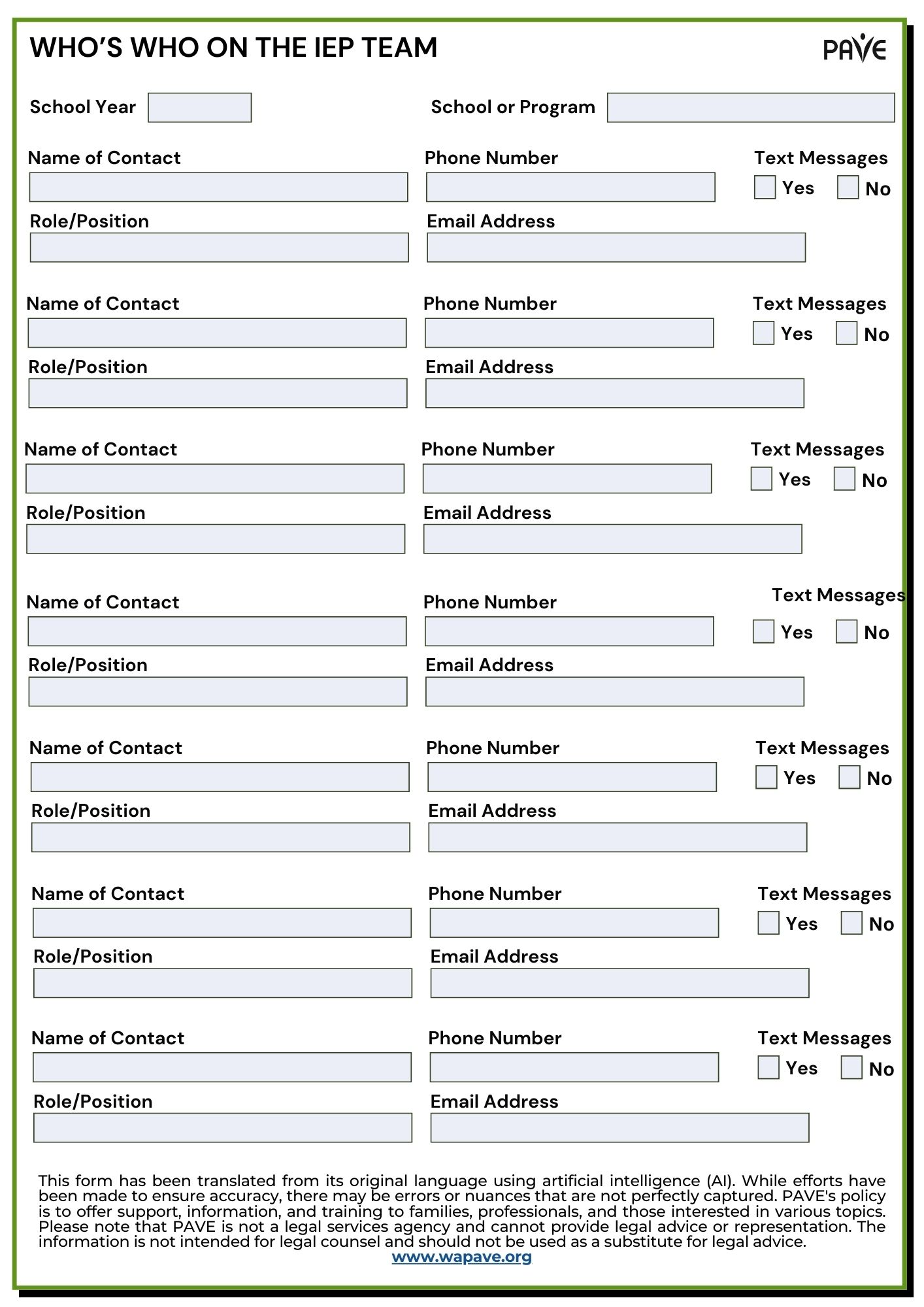
PAVE offers a fillable Who’s Who on the IEP Team contact form to help you organize contact information and roles of the IEP team members.

Who's Who on the IEP Team

Download the Who’s Who on the IEP Team contact form in:
English | Chinese (Simplified) 中文 (Zhōngwén) | Korean 한국어 (Hangugeo) | Russian Русский (Russkiy) | Somali Soomaali | Spanish Español | Tagalog | Ukrainian українська | Vietnamese Tiếng Việt

Common Reasons to Request an IEP Meeting

Parents, guardians, and students have the right to request an IEP team meeting at any time during the school year—not just during the annual review. If there are concerns about a student’s progress, changes in needs, or questions about services and supports, it’s appropriate to ask for the team to come together. IEP meetings can be used to problem-solve, update goals, adjust services, or simply ensure everyone is on the same page. Regular communication helps keep the plan relevant and responsive to the student’s needs.

Here are a few examples of reasons parents or guardians might request an IEP meeting:

  • New diagnosis or information about a student’s disability
  • Frequent disciplinary actions
  • Student is refusing to go to school
  • Academic struggles
  • Lack of meaningful progress toward IEP goals (PAVE provides an article with a handout about SMART goals and progress monitoring
  • Behavior plan isn’t working
  • Placement isn’t working
  • Parent or guardian wants to discuss further evaluation by the school or an independent agency

Here are a few examples of reasons parents or guardians might request an IEP meeting:

  • Feeling unsupported in class
  • Academic struggles
  • Trouble with peers or behavior plan
  • Goals don’t feel meaningful or realistic
  • Preparing for life after high school (transition planning is required by age 16)
  • New diagnosis or change in personal circumstances
  • Practicing self-advocacy or wanting a more active role in the IEP process

PAVE provides a sample letter to request an IEP meeting. You can copy and paste the text of this sample letter into your word processor to build your own letter. If sending through email, the format can be adjusted to exclude street addresses.

Sample Letter to Request an IEP Meeting

PAVE provides a sample letter to request an IEP meeting. You can copy and paste the text of this sample letter into your word processor to build your own letter. If sending through email, the format can be adjusted to exclude street addresses.

Download the Sample Letter to Request an IEP Meeting in:
English | Chinese (Simplified) 中文 (Zhōngwén) | Korean 한국어 (Hangugeo) | Russian Русский (Russkiy) | Somali Soomaali | Spanish Español | Tagalog | Ukrainian українська | Vietnamese Tiếng Việt

You can email this letter or send it by certified mail (keep your receipt), or hand carry it to the district office and get a date/time receipt. Remember to keep a copy of this letter and all school-related correspondence for your records. Get organized with a binder or a filing system that will help you keep track of all letters, meetings, conversations, etc. These documents will be important for you and your child for many years to come, including when your child transitions out of school.

Childcare-What to Know When Your Child has a Disability 

When a parent or family caregiver needs care for their child with a disability, finding safe, appropriate, and affordable care will be a priority. There are resources for children with disabilities and their families in Washington State to find safe and affordable childcare. For providers which take federal funds, civil rights laws protect access and appropriate services for children with disabilities and their families. 

A Brief Overview 

  • Two reliable sites with lists of childcare providers in Washington State are WA State Department of Children, Youth, and Families at findchildcarewa.org, and Childcare Aware of Washington Family Center, which is also by phone at 1-800-446-1114. 
  • Childcare takes place in many different settings, licensed and unlicensed. A state license for childcare can help you decide if a childcare setting is safe. This article tells you how to find out if a provider is licensed. 
  • It’s good to ask certain questions before enrolling a child with a childcare provider. This article offers a sample list. 
  • Three laws protect the rights of children with disabilities in childcare settings that accept federal funding: Americans with Disabilities Act (ADA), Individuals with Disabilities Education Act (IDEA) Part C (Birth to Age 3) and Part B (Age 3 through high school graduation) and Section 504 of the Rehabilitation Act of 1972. 
  • Childcare can be expensive. This article explains about tax credits and state programs that help working families, free early learning programs and preschool, and financial help when family, friends, or neighbors provide childcare for your child. 

How can I find listings for childcare in WA State?

 Use this link for listings on the Washington State Department of Children, Youth, and Families (DCYF): findchildcarewa.org 

Washington State partners with Child Care Aware of Washington Family Center. The phone number for individual assistance with your childcare search is 1-800-446-1114 

How can I find out if a childcare center, program, or family home childcare is safe? 

By law, Washington State licenses certain childcare settings. Licensing sets standards that childcare programs and providers must meet. State inspections help ensure that licensed programs and providers meet the standards, which cover a wide range of topics, from the safety and cleanliness of the physical setting through number of staff per child, staff training, and age-and-ability appropriateness of activities and education. 
Links to Washington’s licensing rules are on DCYF’s page on Becoming a Licensed Child Care and Early Learning Provider. 

Licenses are required for: 

  • Family home early learning programs: 
    An early learning program licensed by the department where a family home licensee provides childcare or education services for 12 or fewer children in the family living quarters where the licensee lives. 
  • Childcare center early learning programs: 
    A facility providing regularly scheduled care for a group of children aged from birth through 12-years-old for periods of less than 24 hours a day. 
  • School-age programs (might provide before and after-school childcare and school vacation care): 
    A facility providing regularly scheduled care for a group of children 5 through 12-years-old for periods less than 24 hours a day, when children are not attending school. 
  • Outdoor Nature-Based program: 
    An early learning program that offers regularly scheduled care for preschool-age children, school-age children, or mixed-age children for periods less than 24 hours a day, when children are not attending school. 

What types of childcare don’t need a license? 

  • A nanny or babysitter in your family’s home 
  • Informal parent cooperatives (example: “babysitting exchange”) 
  • Play groups 
  • Educational preschools that operate less than four hours a day 
  • Parks and Recreation programs run by cities and towns 
  • Family members, friends, and neighbors who provide occasional care (If friends or neighbors are providing childcare for multiple children on a regular basis, they are required to have a state license.) 

Programs operated by cities and towns may have standards set by the local government. Contact your local Parks and Recreation Departments to find out what standards their facilities need to meet, how staff are chosen and background checked, and any other questions you have about whether a program will be safe and appropriate for your child. 

Programs that operate on federal or state funding must meet Washington State licensing requirements, such as Head Start and Early Childhood Education and Assistance Program 
(ECEAP). 

More on Head Start and ECEAP under “How to pay for childcare.” 

Find out if a program or provider is licensed by: 

This search tool lets you search for licensing history (has the home or center ever lost its license?), state monitoring reports (did the inspectors find anything to worry about?) status of staff background checks (are they being done?) and more. The tool finds information in Washington State’s database of all licensed childcare facilities and home childcare providers. 

Here is a downloadable, printable checklist of questions to ask when you visit a childcare setting. It’s from ChildCare Aware of Washington: Child Care Quality Checklist 

Questions to ask a provider:  

Questions to ask a provider when enrolling a child with disabilities into a childcare program. It’s important for parents to ask questions to ensure the provider can meet their child’s unique needs.  

  • What experience do you have caring for children with disabilities? 
  • Do you have staff trained in special education or disability support? 
  • What is your adult-to-child ratio, and how flexible is it for children needing more support? 
  • Are staff trained in administering medications or managing medical devices (e.g., feeding tubes, EpiPens, inhalers)? 
  • How do you support children with behavioral challenges? 
  • What is your approach to discipline, and how is it adapted for children with developmental or emotional disabilities? 
  • Can you create or follow an Individualized Care Plan or IEP? 
  • Are you willing to make reasonable modifications to activities, routines, or environments? 
  • Do you allow assistive technology or support items (e.g., communication devices, wheelchairs, noise-canceling headphones)? 

Are there laws that support my child with disability and protect their rights in a childcare setting? 

There are three laws that may apply to childcare settings: 

  • Americans with Disabilities Act (ADA)  
  • Individuals with Disabilities Education Act (IDEA), Part C (Birth to Age 3) and Part B (Age 3 through high school graduation) 
  • Section 504 of the Rehabilitation Act of 1972, usually referred to as “Section 504” or “504” 

Title III of the Americans with Disabilities Act (ADA) applies to: 

  • Federal, state, and local government-agency programs. Examples of this are Head Start, ECEAP (preschools operated by local school districts), summer programs, and extended day school programs. 
  • Privately run childcare centers such as those licensed by Washington State. “Even small, home-based centers are covered by title III of ADA”  
  • Private childcare centers that operate on the property of a religious organization, leasing or renting space on that property. 

ADA does NOT apply to childcare centers that are RUN by religious organizations, such as a church, temple, mosque, or synagogue. 

ADA requires childcare providers to give both children and parents with disabilities an equal opportunity to participate in the provider’s programs and services. 

  • Centers cannot exclude children with disabilities from their programs unless their presence poses a direct threat to the health or safety of others or requires a fundamental alteration of the program. 
  • Centers must make reasonable modifications to their policies and practices to integrate children, parents, and guardians with disabilities into their programs unless doing so would constitute a fundamental alteration
  • Centers must provide appropriate auxiliary aids and services needed for effective communication with children or adults with disabilities, when doing so would not constitute an undue burden
  • Centers must generally make their facilities accessible to persons with disabilities. Existing facilities are subject to the readily achievable standard for barrier removal, while newly constructed facilities and any altered portions of existing facilities must be fully accessible

This website has many examples of situations to help parents and childcare providers understand what the law requires: Commonly Asked Questions about Child Care Centers and the Americans with Disabilities Act. 

Individuals with Disabilities Education Act (IDEA), Part C (Birth to Age 3): 

Children aged birth to 3 who have a disability or are at risk for certain disabilities may be eligible for services under IDEA. For children who qualify, Part C of IDEA authorizes services to support and promote a child’s development “in their natural environment.” This usually means the family home and often, the child’s childcare setting.  
 
Parents can request their child be evaluated (tested) to see if they are reaching expected developmental stages. If evaluators find that a child needs support, a Family Resource Coordinator (FRC) will help the family create an Individualized Family Services Plan (IFSP). Family members have important roles in that plan, and professional staff provide services and help the family to use natural learning opportunities like playtime, meals, or baths to create opportunities for a child to practice and develop delayed skills. 

Services in an IFSP may include, but are not limited to:  

  • Specialized instruction 
  • Speech therapy 
  • Occupational therapy 
  • Physical therapy 

If childcare is a part of your child’s regular schedule, services may be able to be provided in the childcare setting, such as a scheduled time for a speech therapist to work with your child during childcare hours, and for childcare staff to include your family’s daily “practice time” to help your child meet their development goals. 

 If you are just beginning to look for childcare, your FRC may be a good resource to advise you on things to look for and questions to ask to find a childcare setting that can support your family’s IFSP. 

You can check out these resources for much more information on Birth-to-3 programs: 
 
Disability Rights for Littles: Key Information for Families of Babies, Preschoolers, and Primary-School Children (videos) -all the basics you need to know 

PAVE: From Birth to Three Toolkit Basics and beyond! Read online or download, includes FAQ sheet and “cheat sheets”, summaries of important information at-a-glance.  

WA State Department of Children, Youth and Families (DCYF) Early Intervention Services page: Includes contact information and links to apply for an evaluation for ESIT services to find out if your child qualifies. 

Individuals with Disabilities Education Act (IDEA), Part B (Age 3 through high school graduation): 

IDEA Part B applies to preschool and school-age children, and exists to ensure schools, preschools, and kindergartens provide eligible children with disabilities a Free, Appropriate Public Education (FAPE). When disabilities affect how a child is doing in preschool or school, IDEA Part B states that schools and preschools are required to evaluate the child to see if they qualify for special education and related services and supports. This article from PAVE has important background on this law: IDEA: The Foundation of Special Education. 

If a child is eligible for special education, a team is brought together that includes parents, and an Individualized Education Program (IEP) is created for the child, listing the goals, education, and other supports the school or preschool will provide to meet the child’s learning needs. 

For childcare settings, IDEA Part B will apply for these types of childcare settings: 

This PAVE resource explains the differences in services between Part B and Part C of IDEA. 

Section 504 of the Rehabilitation Act of 1973 

Often called “Section 504” for short, this federal law administered by the Office of Civil Rights prohibits discrimination based on disability. To be protected under Section 504, a child must have a physical or mental impairment that substantially limits one or more major life activities, have a record of such an impairment, or be regarded as having such an impairment. 

Section 504 applies to individuals 3-22 years of age. The law requires childcare centers, camps, and any other recreational programs that receive federal funding to provide preschool children with disabilities equal access to the program, with reasonable accommodations and modifications. 

It also includes programs like Head Start, summer programs, and extended school day programs.  

Requirements for childcare centers: 

  • Non-discrimination: Childcare centers cannot refuse to admit a child with a disability.  
  • Reasonable Accommodations: They must provide reasonable accommodations to enable children with disabilities to participate in the program.  
  • Individualized Assessments: Childcare providers must make an individualized assessment of a child’s needs.  
  • Modifications to Policies and Practices: They must make reasonable modifications to their policies and practices.  
  • Accessible Facilities: Childcare centers must ensure that physical spaces are accessible.  

Help paying for childcare:  

Federal Tax Credit: The child and dependent care credit is a tax credit that may help you pay for the care of eligible children or dependents. This credit is based on your income and the cost of caring for your children or eligible dependents to work, look for work, or attend school.  

Seattle has a Child Care Assistance Program

Washington State offers a program through the Department of Children, Youth, and Families (DCYF): 

Working Connections Child Care (WWCC) helps working families pay for childcare. If a family qualifies and chooses an eligible provider, Washington State will pay part of childcare costs. Parents are responsible for any copayment of childcare fees not covered by the state, and those are payable to the provider every month. 

  • The child or children must live in Washington State 
  • The family with whom the child lives must live in Washington State 
  • The family’s income must be at or below 60% of the State Median Income 
  • The family must have less than $1 million in resources 
  • Parent or parents must be participating in an approved activity, such as self-employment, employment, or being in high school or post-secondary education or taking part in the WorkFirst or BFET program. 
  • Families experiencing homelessness are eligible. 
  • If a parent or parents are seasonal agricultural (farm) workers, and live in certain counties, they may be eligible for the Working Connections program. 

An additional up-to-date online resource is MomsRising.org. This site has brief, helpful information about the Working Families Child Care Program, especially when your child or children have a disability. It goes over issues such as: 

  • How families and family size are defined for this program 
  • Children with physical, intellectual and/or developmental disabilities 
  • Children and families experiencing homelessness 
  • Families where the parent or parents are high school or college students 
  • What types of childcare are available 
  • Getting financial assistance when a family member, friend, or neighbor can take care of your child or children 
  • You can check details of your eligibility, including income requirements, on DCYF’s Working Connections Child Care website page.  
  • Apply by calling the Child Care Subsidy Contact Center 1-844-26-8687 or online at Washington Connection.  
  • Get help applying for this program and help finding childcare that meets your family’s needs through ChildCare Aware of WA

Free state-licensed early learning childcare or preschool: 

Head Start programs are federally funded and Early Childhood Education and Assistance Program (ECEAP) is a Washington State-funded program for children aged three and four, and in some locations, infants and toddlers younger than age three. Head Start offers services to pregnant women in some locations.  

Your local school district will have an ECEAP program available. 

Children are eligible for these programs based on their age and family incomes, with some children able to attend these free programs if they have multiple support needs. Visit the ECEAP & Head Start programs page on the DCYF website for more detail and contact information in English and Spanish. 

Financial help for childcare by family, friends, or neighbors

In Washington, this category is called Family, Friend and Neighbor Care. These settings are not required to have a license and are very common arrangements.  
Informal care for children in your home or the family’s home may involve some expenses, and Washington State recognizes this with financial assistance (subsidies). Visit the Family, Friend and Neighbor Care page on DCYF’s website for contact information to apply for subsidies. 

Online – Special Education Workshops

November 20, 2025 @ 6:00 pm 7:00 pm PST

Present Levels & SMART Goals: Connecting the Dots in the IEP
Discover how to align present levels with meaningful, measurable SMART IEP goals that drive progress.
Presenter: Sherry Mashburn

November 20 @ 6-7 PM
Special Education Eligibility: How Schools Decide / Elegibilidad para Educación Especial: Cómo Deciden las Escuelas
Get a clear look at how school districts determine eligibility, the evaluation process, and what it means for your child’s access to special education services. / Obtenga una visión clara de cómo los distritos escolares determinan la elegibilidad, el proceso de evaluación y lo que esto significa para el acceso de tu hijo(a) a los servicios de educación especial.


January 15 @ 6-7 PM
Accommodations, Modifications, and SDI: What’s the Difference?
Discover how to align present levels with meaningful, measurable SMART IEP goals that drive progress.
Presenter: Marie Kerr

February 19 @ 6-7 PM
Discipline in Schools: What Parents Need to Know
Explore how discipline works for students with IEPs, including suspension rules, manifestation determinations, and how schools must balance safety with your child’s rights.
Presenter: Sherry Mashburn

April 23 @ 6-7 PM
High School Transition Planning: Preparing for What’s Next / Planificación de la Transición en la Escuela Secundaria: Preparándose para lo que Sigue
Learn how transition plans prepare your child for life after high school, college, work, and independent living, and how to make sure the plan reflects your child’s voice. / Aprende cómo los planes de transición preparan a tu hijo(a) para la vida después de la escuela secundaria, la universidad, el trabajo y la vida independiente, y cómo segurarte de que el plan refleje la voz de tu hijo(a).

May 21 @ 6-7 PM
Inclusion & Belonging: What Parents Should Know
Learn how inclusionary practices help students with disabilities access the general education classroom, build friendships, and thrive, while benefiting all students.
Presenter: Marie Kerr

No registration is required!
Click to join via zoom! – Meeting ID: 737 702 3071

Free

Get Ready for School with IEP Essentials

Every student deserves a strong start to the school year. For families of children with disabilities, preparing for school includes reviewing the Individualized Education Program (IEP). The IEP is a legal document and a living plan that outlines the supports and services a student needs to access their education. Families play a key role in shaping the IEP and making sure it works for their child.

A Brief Overview

  • The start of a new school year is a great time for families to revisit or begin the IEP process to support their student’s learning.
  • If a student doesn’t yet have an IEP, requesting an evaluation is the first step to determine eligibility for special education services.
  • Review the IEP before school starts to prepare questions and suggestions for the team.
  • Talk with your student about what to expect to reduce anxiety and build confidence.
  • Learn about the Individuals with Disabilities Education Act (IDEA) to understand your rights and responsibilities in the IEP process.
  • Communicate regularly with the IEP team to monitor progress and adjust plans as needed.
  • Gather documents, write questions, and invite support to prepare for IEP meetings.
  • Follow up after meetings to confirm next steps and maintain communication.
  • Take small, manageable steps to stay involved and support your student’s success.

Introduction

The beginning of a new school year is the perfect time to revisit your student’s Individualized Education Program (IEP). Whether your child already has an IEP or you’re just starting to explore the special education process, this season offers a fresh opportunity to reflect, plan, and engage.

As you and your student get ready for school, the most important thing is the “I” in IEP. The “I” is for “Individualized”. A thoughtful IEP highlights abilities and helps your student access the supports needed to learn. It helps ensure they receive the support necessary to learn, grow, and make meaningful progress—not just in school, but in life beyond graduation.

IEPs are built by teams, and families are essential members. When parents and students understand the process and actively participate, they help shape a plan that truly works.

What to do before the first day

If your student doesn’t have an IEP and you wonder whether a disability might be affecting their learning, now is a great time to explore the special education process. Understanding how evaluations work is the first step. If you’re unsure whether your child needs one, check out our article on How to Request an Evaluation, which explains how to get started.

Before the school year begins, review the IEP to prepare questions and suggestions for the team. PAVE recommends using their Steps to Read, Understand, and Develop an Initial IEP worksheet to guide this process.

After reviewing your student’s IEP or beginning the process to request one, the next step is ensuring your child is properly enrolled in school. Enrollment procedures vary by district, but they typically include submitting documentation, verifying residency, and understanding school assignment policies. For a clear overview of how and when to enroll your student, read this PAVE article: Starting School: When and How to Enroll a Student in School.

To help ease anxiety and build excitement, talk with your child about what to expect. Discuss new activities, classmates, and what will feel familiar. If your school offers an open house, plan to attend together. During your visit, take pictures and ask your child what they notice or wonder about. You can review the photos later to help them feel more prepared. PAVE’s article, Tips to Help Parents Plan for the Upcoming School Year, provides actionable strategies for easing anxiety, fostering independence, and creating a positive school experience.

What parents need to know about FAPE

At the heart of special education is the right to a Free Appropriate Public Education (FAPE), guaranteed by the Individuals with Disabilities Education Act (IDEA). FAPE means that students with disabilities are entitled to an education tailored to their individual needs—not a one-size-fits-all program. This is what makes IDEA unique: it ensures that every eligible student receives services designed specifically for them through an Individualized Education Program (IEP).

To qualify for an IEP, a student must go through an evaluation process to determine if a disability is impacting their education. If the student meets criteria under IDEA, they become eligible for special education services. These services are not about placing a student in a specific classroom—they’re about providing the right support, wherever the student learns. As you review your child’s IEP or prepare for meetings, ask: Is this plan appropriate and suitable for my child’s unique abilities and needs?

IDEA includes six important principles

The IDEA, updated several times since 1990, outlines legal rights for students with disabilities and their families. This PAVE article, Special Education Blueprint: The Six Principles of IDEA, explores the core principles, including: Free Appropriate Public Education (FAPE), Appropriate Evaluation, Individualized Education Program (IEP), Least Restrictive Environment (LRE), Parent and Student Participation, and Procedural Safeguards.

Effective communication is key to student success

Understanding legal rights is just the beginning—clear, consistent communication with the IEP team is one of the most effective ways to ensure your student’s plan leads to meaningful progress. Consider creating a communication plan with your child’s teachers or case manager. This might include weekly emails, a journal sent home in the backpack, scheduled phone calls, or progress reports. Be sure to have this plan written into the IEP or included in the Prior Written Notice (PWN) so everyone stays on the same page.

Writing down how you’d like to stay in touch helps the team understand what works best for your family. Get creative—what matters most is that the plan supports clear, consistent communication for the whole team. ​Here are a few ideas for ongoing communication with the school: ​

  • A journal that your student carries home in a backpack​
  • A regular email report from the Special Education teacher​
  • A scheduled phone call with the school​
  • A progress report with a specific sharing plan decided by the team​
  • Get creative to make a plan that works for the whole team! ​

Keep a log of communication with the school district and educational service providers. PAVE provides a downloadable Communication Log to help you track emails, phone calls, and texts.

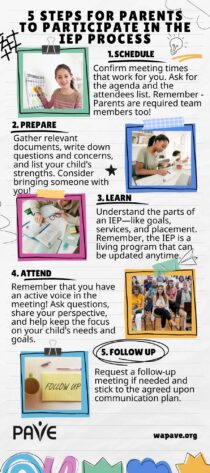
Ready, set, go! 5 steps for parents to participate in the IEP process

Understanding the laws and principles of special education can help parents get ready to dive into the details of how to participate on IEP teams. Getting organized with schoolwork, contacts, calendar details, and concerns and questions will help.

This 5-step process is downloadable as an infographic.

5 Steps for Parents to Participate in the IEP Process (English)

Download the IEP Essentials in 5 Steps in:
English | Chinese (Simplified) 中文 (Zhōngwén) | Korean 한국어 (Hangugeo) | Russian Русский (Russkiy) | Somali Soomaali | Spanish Español | Tagalog | Ukrainian українська | Vietnamese Tiếng Việt

1. Schedule

Parents or guardians should receive a written invitation to the meeting. The school and family agree on a date and time, and the school documents efforts to include families at all IEP team meetings. If the proposed time doesn’t work, remember that parents are required members of the team—you can request a different time that works better for you. 

Ask beforehand for the agenda and a list of who will attend. This helps ensure there’s enough time to fully address the topics being discussed. If a key team member can’t attend the meeting, you have the option to either provide written consent to excuse their absence or request to reschedule if their participation is important to you. ​For a list of suggested attendees and a downloadable form to save contact information, PAVE provides a Who’s Who on the IEP Team.​

If your student already has an IEP, a re-evaluation occurs at least once every three years unless the team decides differently. A parent can ask for a re-evaluation for sooner if needed, though typically a re-evaluation will not occur more than once a year.

2. Prepare

You can ask for a copy of the evaluation results or a draft IEP before the meeting to help you prepare. It’s a good idea to gather letters or documents from medical providers or specialists that support your concerns. Writing down a few questions ahead of time can help you remember what you want to ask. You might also make a list of your student’s strengths and talents—this helps the team build on what’s already working. If you have specific concerns, you can write a letter and ask for it to be included in the IEP. Some families invite a support person to attend the meeting, someone who can take notes, help you stay focused, and offer encouragement.

3. Learn

Knowing the technical parts of an IEP will help you understand what’s happening at the meeting. The IEP is a living program—not just a document—and it can be updated anytime to better meet your child’s needs. The IEP is a work-in-progress, and the document can be changed as many times as needed to get it right and help everyone stay on track.

Familiarize yourself with the components of an IEP: 

4. Attend

At the meeting, each person should be introduced and listed on the sign-in sheet. Schools generally assign a staff member as the IEP case manager, and that person usually organizes the team meeting. Any documents that you see for the first time are draft documents for everyone to work on.

Be present and free of distractions so you can fully participate. Ask questions, share your perspective, and help keep the focus on your child’s needs and goals. If your child isn’t attending, placing a photo of them on the table may remind the team to keep conversations student-centered.

Everyone at the table has an equal voice, including you!

5. Follow up

After the meeting, follow through with the agreed communication plan. Make sure that everyone’s contact information is current and that you know how and when updates will be shared. If you still have concerns after the meeting, request a follow-up meeting or submit additional notes.

Stay organized with calendars, contact lists, and copies of important documents. Talk with your child about the upcoming year to ease anxiety and build excitement!

Tips for a smooth school year

As the school year begins, it’s important to think proactively about how to support your child’s learning and development. Establishing routines, setting goals, and building relationships with school staff can make a big difference.

If all of this sounds a little overwhelming, break the work into steps. Determine the best way to help your family stay organized with paperwork and information. Choose a calendar system that helps you track appointments and school events, such as back-to-school night or parent-teacher conferences.

Help your child’s team understand what works best for your student and share their strengths with a one-pager or a letter of introduction. PAVE provides a one-pager template, What You Need To Know About My Child, and a sample letter of introduction, Sample Letter to the IEP Team – Today Our Partnership Begins.

Let’s wrap things up!

Getting ready for school can feel like a lot, especially when your child has an IEP. But you don’t have to do everything at once. Take it one step at a time, and remember: you are not alone. This journey includes your child, and you’re walking it together. You are a vital part of your child’s team, and your voice truly matters. When families and schools work as partners, amazing things can happen. So trust yourself, speak up, and share what you know—because no one knows your child better than you. You bring love, insight, and hope to the table.

From all of us at PAVE, we wish you a happy and successful school year!

Learn More

Developmental Screening (Birth to Three and Medically needed developmental screening)

What is Developmental Screening?

Developmental screening is the practice of systematically looking for and monitoring signs that a young child may be delayed in one or more areas of development. Screening is not meant to establish a diagnosis for the child, but rather to help professionals and families determine whether more in-depth assessment is the next step. By using a high-quality screening tool, professionals can screen children for delays accurately and cost-effectively.

Think about your child’s first months. The medical professionals set up regular “Well-child” appointments just to monitor how your child is doing.  These “Well-child” visits allow doctors and nurses to have regular contact with children to keep track of the child’s health and development through periodic developmental screening. Developmental screening is a simple process that can have both informal and formal assessments. When using a tool that is more formal in nature, the short test can tell if a child is learning basic skills when he or she should, or if there are delays. Developmental screening can be done by other professionals in health care, community, or school settings.

We have heard many times over the years that a child’s greatest window for development is in the first five years of life. Eighty-five percent of the brain’s development occurs before age three, making the first years of life critical to a child’s future success. The research shows that early intervention greatly improves a child’s developmental and social skills. Early intervention services help children from birth through 3 years of ages. Services usually include the support of an early educator who works with the family, as well as therapy (if identified as a need) to help the child talk, walk, and interact with others.

It’s not uncommon for parents to become concerned when their little one doesn’t seem to be developing within the normal schedule of “baby” milestones. You may worry that he hasn’t rolled over yet, or that he isn’t doing what the neighbor’s child, who is about the same age is doing. There may be concerns about your baby sitting up or beginning to verbalize words and sounds.

While it’s true that children develop differently, at their own pace, and that the range of what’s “normal” development is quite broad, it’s hard not to worry and wonder. If you think that your child is not developing at the same pace or in the same way as most children his or her age, it is often a good idea to talk to your child’s pediatrician. Explain your concerns. Tell the doctor what you have observed with your child. The doctor or other professionals might ask you some questions they may also talk and play with your child to see how he or she plays, learns, speaks, behaves, and moves. A delay in any of these areas could be a sign of a problem.

You can also get in touch with your community’s lead agency for birth-to-three services, and ask for an evaluation to see if there are possible delays. Based on referrals from the Doctor and the evaluation provided by the early intervention team, your child may be eligible for early intervention services, which will be developed with you and will address your child’s special needs.

Screening is a simple process that can identify infants and young children who may be at risk for health, developmental, or social/emotional problems. It identifies children who may need a health assessment, diagnostic assessment, or educational evaluation. “Screening” means using a standardized instrument. This could include a parent questionnaire, observational process, or other form of measurement that has been validated by research to learn more about the child’s development. Using a standardized instrument is much more effective for identifying real concerns or delays than just using professional judgment or informal questions about the child’s development.

The screening process provides an opportunity for young children and their families to access a wide variety of services and early childhood programs. It also supports the parents’ understanding of their child’s health, development, and learning.

The developmental screening and evaluations can lead to the involvement of a Family Resource Coordinator who will walk with the family through those first three years. They do a family needs assessment, if the family wishes to have one done. This helps identify areas the needs and priorities of the child’s family. Family-directed services are meant to help family members understand the special needs of their child and how to enhance the child’s development.

The need to provide early intervention is significant. Many children with developmental delays are not being identified as early as possible. This can result in these children waiting to get the help they need to do well in social and educational settings until they are in a school or pre-school setting. Research has shown that in nearly one in six Washington kids has a developmental delay, but only 30% of these children are identified before starting kindergarten, when early support services are most effective. Additionally, research has also identified that in the United States, about 13% of children 3 to 17 years of age have developmental or behavioral disabilities. These can include autism, intellectual disabilities, and attention-deficit/hyperactivity disorder. Additionally, there are children who have delays in language, social skills, or other areas that affect school readiness. This same research found that many children with developmental disabilities weren’t identified before age 10. These types of delays have significant implications since by that age there are significant delays that might have been addressed earlier and provided opportunities for services and support that was missed.

Because of the rapid growth in a child’s first three years of life, early support and monitoring of child development is essential for these children to reach their full academic potential as well as social and personal success. In all cases, kids will experience greater success academically, socially, and personally if delays are caught early and kids and families get the support they need. Free developmental screening using the Ages and Stages Questionnaire-3 screening tool is one of the best ways to get more awareness of what can help your child. In addition to the Ages and Stages survey a terrific tool and support network has been established called “Within Reach”. The “WithinReach” website is committed to supporting optimal child development of all Washington families. Through the “WithinReach” Family Health Hotline and Plan a Save Care (POSC), families can access free developmental screening, connections to early learning and family support and referrals to early intervention for developmental delays.

If you would like a free developmental screening for your child or have concerns about your child’s development, it is as easy as calling their Family Health Hotline (800) 322-2588 or visiting their website at www.ParentHelp123.org.

Remember that as important as Developmental screening is as a part of early intervention, can go also be important in assuring that the needs of children of older ages also find success and resources. Developmental screening for older youth can include areas of the individual’s development in mental health, social and emotional needs, and communication needs, just to name a few. Developmental screening will help assure that the needs of the individual whether an infant or an older child, can be met, and how those needs can be met. As parents and family members we have a responsibility to help our children thrive and developmental screening can help us know which path to follow to make that happen.

Resources for this article:

Overview of Early Education from Center for Parent Information & Resources

Within Reach – Want to learn more about your child’s development?

Ages and Stages Questionnaires – Helping parents understand the Benefits for Developmental Screening

CDC- Developmental Monitoring and Screening

CDC – Autism Spectrum Disorder (ASD)

CDC – Facts about intellectual Disability

Ages and Stages


Defining your Social Media Game Plan: #Goals

Thinking about how you use social media and screens can help you make better choices for your mind, body, and relationships. When you take time to notice how you feel, what you see, and how much time you spend online, you can stay in control instead of letting screens take over. Talking with trusted adults and setting goals for your screen time can help you stay safe, feel better, and enjoy the good parts of being online. 

Think about Yourself

Your social media accounts are all about you! Think about why you are using social media or other screens. Is your goal to talk to friends, find cool videos, or learn something new? Thinking about your goals and what you like helps you control how you use social media, instead of letting it control you. To better understand your goals, ask yourself:

  • What is your goal when you open an app or go online?
  • Did you reach your goal, so you can set it down now?
  • Are you in control of how you use it, or does it feel like it controls you?

Think about What You See

Consider what you see and read online. What purpose does this have for you? Is it something helpful and interesting, or is it making you feel bad? Sometimes you might see things that are mean or make you feel sad, anxious, or even angry. If you notice that what you’re seeing online is often upsetting or distracting you from important things, maybe it’s time to look for content that helps you feel better. You can control some of what you see online by only following pages that make you feel good, and by unfollowing or muting accounts that post things that upset you or make you feel bad about yourself.

Think about what you see online and ask yourself:

  • What kinds of things do you usually look at online?
  • What purpose does this content have for you?
  • If some content makes you feel bad, are there other things you could look at online that might help you feel better or learn something new?

Think about How You Feel

Think about how you feel and how you use screens when you’re feeling strong emotions. Sometimes we use phones or games to escape negative feelings, but there are other ways to calm down, like talking to people you trust, taking a walk, or making art.

When thinking about how social media makes you feel, ask yourself:

  • How does using social media make you feel?
  • Does what you see online make you feel good?
  • When you’re feeling sad, bored, or stressed, do you often use screens or social media to feel better?
  • Are there other ways you can help yourself feel calm that don’t involve a screen?

Think about What Screens Get In The Way Of

Screens shouldn’t stop you from doing homework, seeing friends in person, getting enough sleep, or doing other things. Think about how long you are going to use an app or website and set a clear time limit for yourself. That way, you can reach that time and be able to put your phone down because you planned to stop. To help you set a time limit that works for you, ask yourself:

  • How long are you planning to use social media or a screen right now?
  • Did you set a clear time to stop using it?
  • Does using screens stop you from doing other important things, like homework, spending time with family or friends in person, or getting enough sleep?

Think about Relationships

You can talk with a friend or trusted adult about your online life and how you are feeling about it. By sharing about how you feel about friends online and in real life, you can better understand what purpose connecting online has for you. Talking helps you learn how to use screens safely.

When you think about your friends and family, ask yourself:

  • Do you feel comfortable talking to a parent or trusted adult about your online life?
  • If something online made you feel uncomfortable or upset, would you feel okay talking to someone about it?
  • How do you feel about your friendships online compared to your friendships in real life?
  • What purpose does connecting online have for you in your friendships?

Remember, social media should be something that adds to your life—not something that takes away from it.


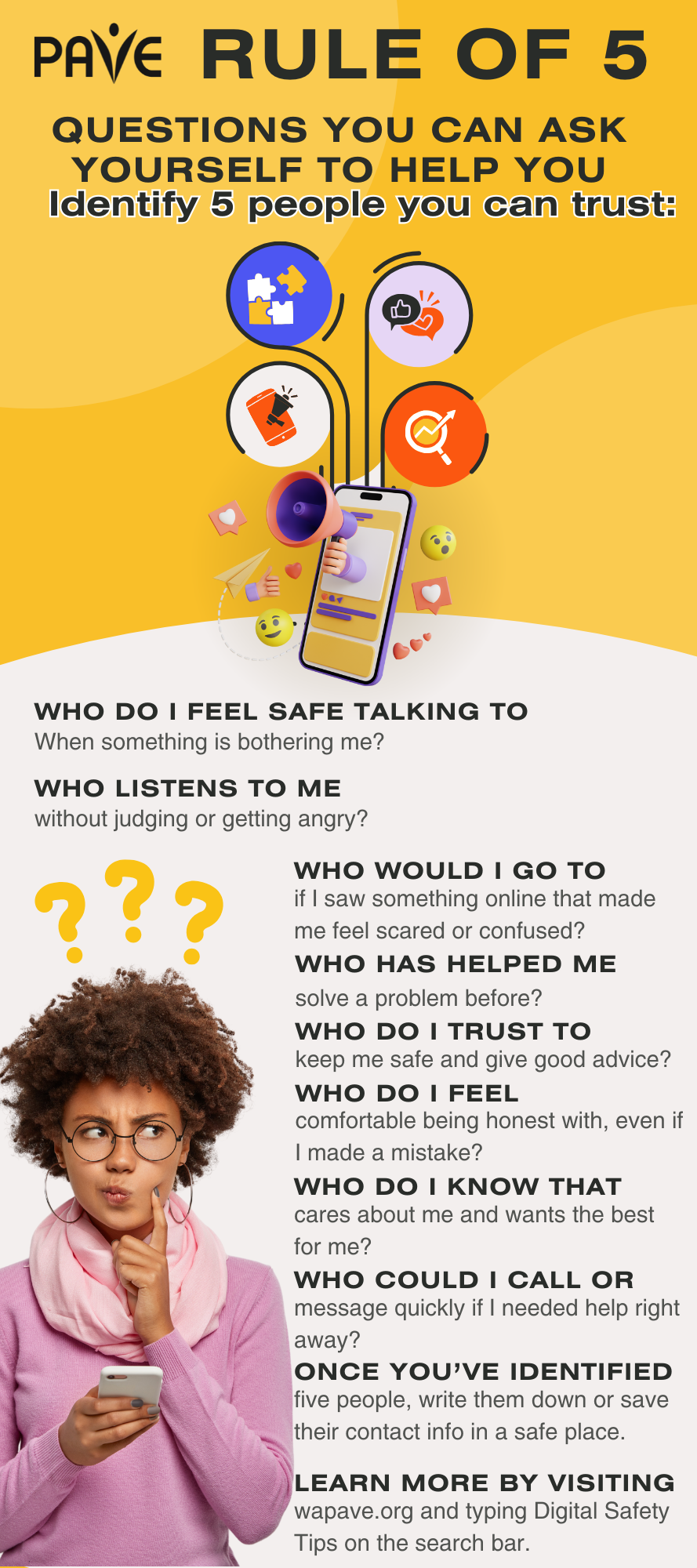
Identify Your Five

One way to stay safe online is by using the “Rule of 5,” which means having five trusted people you can talk to when something online feels wrong or confusing. These questions can help you identify five people you can trust:

  • Who do I feel safe talking to when something is bothering me?
  • Who listens to me without judging or getting angry?
  • Who has helped me solve a problem before?
  • Who would I go to if I saw something online that made me feel scared or confused?
  • Who do I trust to keep me safe and give good advice?
  • Who do I feel comfortable being honest with, even if I made a mistake?
  • Who do I know that cares about me and wants the best for me?
  • Who could I call or message quickly if I needed help right away?

Once you’ve identified five people, write them down or save their contact info in a safe place.

Final Thoughts

Taking control of your social media use starts with understanding your goals, feelings, and habits. By reflecting on how, why, and when you use screens, you can make choices that support your well-being and help you stay safe online. Whether you’re setting time limits, curating your feed, or reaching out to trusted people, every small step counts. Keep checking in with yourself, stay curious, and remember—you have the power to shape your digital world in a way that works for you.

Learn More

This self-reflection guide was developed as a practical tool to help implement the strategies outlined in Level Up Your Social Media Game: Digital Safety Tips for Youth and Young Adults with Disabilities.  It is designed to encourage thoughtful engagement with the digital safety concepts presented in that article, supporting users in applying them to their own online experiences.

Family caregivers and professionals can learn how to support kids’ health and emotional well-being by helping them use social media safely. A great place to start is the American Academy of Pediatrics’ “5 Cs of Media Use” guides.

Level Up Your Social Media Game: Digital Safety Tips for Youth and Young Adults with Disabilities

Social media has both benefits and disadvantages. To use social media safely and effectively, it’s important to practice digital safety and self-awareness. This guide teaches tips and tools to help you make smart choices and stay in control online.

Brief Overview

  • Social media helps people with disabilities connect, express themselves, and find support—but it also comes with risks that users need to understand.
  • A trusted adult is someone you know in real life who cares about your safety and can help you make good choices.
  • Not everyone online is who they say they are.
  • People may act mean online or post things just to get attention.
  • Be careful what you share and talk to someone you trust if something feels wrong.
  • Anything you post online can be copied and shared. Think before you post, especially if someone is pressuring you to share something quickly.
  • Not everything online is true. Learn how to check facts and find trusted websites so you can tell what’s real and what’s not.
  • Asking for help is smart and keeps you safe.

Introduction

Social media is everywhere and isn’t going away. For people with disabilities, it opens up new ways to connect, communicate, and participate in conversations that might otherwise be difficult.  It can help you feel included and connected. It can be a powerful tool for inclusion and accessibility.

However, while social media offers many good things, it also comes with risks that everyone, especially youth and young adults, need to know about.

Knowing Who to Trust

One of the most important ways to stay safe is by knowing who you can trust, especially when talking to people online. Not everyone you meet online is the same as the people you know in real life. A trusted adult is someone you know in real life who truly cares about your safety and wants to help you make good choices. This could be a parent, teacher, school counselor, coach, or another grown-up you feel safe talking to. They listen to you, respect your feelings, and are there to help you when something is wrong. They are someone you can count on in real life. This is very different from a social media “friend” or “follower” who might be someone you’ve never met in person. Just because someone is nice to you online doesn’t mean they are safe or honest. People online might pretend to be someone they are not, like acting like they are your age to try and gain your trust. This can be part of a trick to try and get your personal information or pictures. Remember, a trusted adult is someone you can rely on for help and safety in the real world, not just someone who sends you messages online.

The Evolving Purpose of Social Media

Social media began as a way for people to connect, talk, and share things with each other. It can be a fun place where kids connect with friends, explore their interests, and learn new things. It can also help kids feel supported and included, especially those with disabilities.

Social media apps and websites are free to use, which makes them easy for lots of people to join. Even though you don’t pay money to use them, social media companies still make money—by showing you ads. The longer you stay on the app, the more ads you see, and that helps the company earn more. In other words, the social media companies are making money from your time and attention. That’s why it’s important to remember that you’re in control of how much time you spend online. When you use social media in a smart way, it can be fun and helpful—just make sure it’s working for you, not the other way around.

Social Media Risks and How to Stay Safe Online

But social media isn’t always safe. Some people feel like they can say mean things online because they think no one will find out who they are. Since they can’t see your face or how you feel, they might not realize how much they’re hurting you—and that makes them less likely to stop. Also, when kids see others being mean online, they might think it’s okay to join in. And sometimes, trying to get likes, shares, or views can lead kids to post things that hurt someone else, even if they didn’t mean to. That’s why it’s important to learn about these risks and talk with friends and family about how to stay safe and kind online.

Cyberbullying

Cyberbullying is when people are mean to you online by sending hurtful messages or making unkind posts. Sharing or forwarding mean content that someone else wrote can is also a form of cyberbullying. Studies show that youth with disabilities are more likely than other kids their age to be cyberbullied.

If someone is being mean to you online, you don’t have to handle it by yourself. Talk to an adult you trust, like a parent, teacher, or school counselor. They can help you figure out what to do next. STOP.THINK.CONNECT, a website that specializes in online safety and cybersecurity awareness, says it’s usually best not to talk back to the bully. Instead, save a screenshot or copy of what they said and show it to your trusted adult. That way, they can better understand how to help you. You should also learn how to block or report the person on the app or website you’re using. Most sites have tools to help you stay safe.

Social Engineering and Trickery

Sometimes, people use social media to trick others into giving away personal information—this is called social engineering. It can happen when someone pretends to be your friend, asks you to click a link, or says something that makes you feel scared or rushed. They might try to get your passwords, address, or other private details. This can be especially confusing if you have trouble telling when someone is being dishonest. That’s why it’s important to be careful about what you share online and to talk to a trusted adult if something doesn’t feel right or makes you uncomfortable.

You have the right to say “No” if someone—even someone you know—makes you feel uncomfortable online. It’s okay to stop talking to them or to question what they’re saying. If something doesn’t feel right, trust your instincts and talk to a friend or trusted adult. Some people online may pretend to be kids or teens when they are actually adults with harmful intentions. That’s why it’s important to be careful about who you talk to and what you share in conversations. You don’t have to handle anything alone—there are people who care about you and want to help.

Anything you share online or through your phone—pictures, posts, texts, comments, everything!—can be copied and shared. Once you post or send something, it might be used in ways you didn’t expect or want. Before you share anything, ask yourself if it includes private information or something you wouldn’t want everyone to see. If someone is pressuring you to send something quickly, that’s a red flag. Take a moment to think, and don’t let anyone rush you. Talk to a trusted adult if you’re unsure. Being smart about what you post helps protect your privacy and keeps you safe.

Harmful Content

Social media can sometimes show things that make people feel bad, unsafe, or want to do things that aren’t healthy. This is called harmful content. You might see pictures or videos that make you feel bad about your body or tell you to do unhealthy things, like not eating enough. This kind of content can hurt your self-esteem and mental health. Many of the photos and videos online are edited or only show the best parts of someone’s life, not the full picture. These unrealistic expectations can make people feel like they have to be perfect all the time, which isn’t fair or healthy. Everyone has good days and bad days, but social media often hides the hard parts.

To protect yourself, remember that it’s okay to be yourself and that nobody is perfect. Try to follow people who are honest and positive, and take breaks from social media when you need to. If something online makes you feel bad, talk to a friend or trusted adult.

Privacy

When you share personal information online—like your full name, address, phone number, or passwords—it can be used in ways you don’t expect. That’s why it’s important to protect your privacy by being careful about what you share and who can see it. Some companies collect your data to show you ads or sell your information, and strangers online might try to trick you into giving away private details. To protect yourself, don’t share private details online, especially with people you don’t know.

When playing games or talking with people you don’t know online, you can use game names and avatars to protect your privacy. Often, online game websites and apps will help you to create a random name that doesn’t require any personal information.

Use strong passwords and keep them secret. You can also check your privacy settings on apps to control who sees your posts.  The National Cybersecurity Alliance (StaySafeOnline.org) provides a list of links to the official privacy settings pages for popular websites and mobile apps, including major social media sites, and a guide to creating and using strong passwords.

Misinformation and Digital Literacy

Not everything you see online is true. Sometimes, people post things that are made up or not based on real facts. This is called misinformation. It can spread quickly on social media because the internet often cares more about what gets attention than what is true. It’s important to check if something is true before you believe it or share it. You can do this by looking it up on trusted websites or asking an adult to help you. 

Learning how to tell the difference between real and fake information online is called digital literacy, and it helps you stay smart and safe online. A big part of being digitally literate is knowing where to find information you can trust. Websites from certain places are often trusted sources. These kinds of websites are generally considered places that share reliable facts and safety tips backed by research:

  • Websites that end with .gov usually belong to the U.S. government, like places that share safety tips or resources.
  • Websites ending with .ed or .edu are often connected to educational organizations or government education departments.
  • Websites ending with .mil are for the U.S. military.

Looking for these endings can be a helpful way to find information you can trust. It’s a good idea to stay current and check trusted websites for the latest information.

Scams

 Scams are tricks people use to try to steal your money or personal information. Scammers might pretend to be someone you know, like a friend or family member, or even act like they’re from your bank or a company you trust. They might send you messages asking for your password, bank info, or to send them money.

If something feels weird or too good to be true, it probably is. One way to stay safe is to check with a trusted adult that you know in person—before you respond.

Rule of Five

One way to stay safe online is by using the “Rule of 5,” which means having five trusted people you can talk to when something online feels wrong or confusing. These people could be parents, teachers, counselors, or other adults who care about you and want to help. If you get a message or see something that makes you feel uncomfortable, it’s always okay to stop and check with one of your five trusted people before you respond. Even if you feel embarrassed or worried, asking for help is the smart thing to do. Your safety matters more than keeping a secret or being afraid of losing your phone. Trusted adults are there to support you, not to get you in trouble.

Here are some questions you can ask yourself to help you identify five people you can trust:

  • Who do I feel safe talking to when something is bothering me?
  • Who listens to me without judging or getting angry?
  • Who has helped me solve a problem before?
  • Who would I go to if I saw something online that made me feel scared or confused?
  • Who do I trust to keep me safe and give good advice?
  • Who do I feel comfortable being honest with, even if I made a mistake?
  • Who do I know that cares about me and wants the best for me?
  • Who could I call or message quickly if I needed help right away?

Once you’ve identified five people, write them down or save their contact info in a safe place.

Helpful infographic on how to find out the 5 people you trust

Final Thoughts

Social media is a tool, and like all tools there are right ways and wrong ways of using it. Social media should help you—not control you. When you know how to stay safe, set limits, and ask for help when something feels wrong, you can enjoy the fun parts of being online. Always try to be kind and respectful, just like you would be in person. With the right tools and support, you can find ways to make social media work for you, not the other way around.

Learn More

Check out the related article, Defining your Social Media Game Plan: #Goals, for self-reflection questions to help children, youth, and young adults identify their goals for social media.

Dating on the Spectrum

This article is written for older youth and young adults who are neurodivergent, with an emphasis on autistic neurodivergence. It is based on research and the life experiences of autistic individuals, who chose the term “autistic person” rather than “person with autism” as their person-first term.

Definitions:

  • Neurodivergent: when a person’s mental or neurological function is different from what is thought of as typical or normal. It is often used to describe autistic people or people with other brain-based conditions like attention deficit hyperactivity disorder (ADHD).
  • Ableism: when a person, or most people in a society, believes that being normal means not having a disability. This belief results in discrimination against people with disability because they are viewed as “not normal” or “less than normal.”
  • Infodumping: sharing a large amount of detailed information about a topic all at once, without the back-and-forth of most conversations. It’s a term and communication style that is common among neurodivergent people.
  • Stim, stimming: short version of “self-stimulatory behavior.” Repeated movements, sounds, or other actions by people to regulate their emotions, cope with sensory overload, or express themselves. For example, an autistic person might jiggle their leg while eating dinner with a large group of people or in a noisy room.

Brief Overview:

  • Dating while neurodivergent often looks very different than traditional dating, and there are many aspects to be aware of as you seek out a prospective relationship.
  • Ableism can influence attitudes about dating, relationships, partners, and yourself, so it’s important to think about it and try to change those beliefs both in yourself and in your relationship.
  • Individuals with disabilities are at much higher risk for abuse, sexual victimization, and other issues, so it is important to teach boundaries and use precautions.

Introduction

Neurodivergent individuals are rarely shown as romantic partners in the media. They’re often shown as emotionless robots, or as people who can’t connect well with others. Society often views neurodivergent people dating negatively, which can make it tough to think about relationships.

Still, neurodivergent people do find love, long term partners, and start families. However, they may face more challenges in relationships and are at higher risk of being hurt or abused.

If you accept your neurodivergence and disability as a part of who you are, believe in your ability to act, and learn to express your needs and boundaries (your limits), you will have a better chance of having healthy romantic relationships.

How ableism appears in relationships and stereotypes

Ableism is everywhere, and it can have a tremendous impact on your relationship. Even when you are both disabled, you may have accepted beliefs, stereotypes, and expectations that can affect your wellbeing together.

All these beliefs are false. You can be aware of them, and work to avoid them:

  • People with disabilities can’t get better, it’s pointless to try.
    • Like anyone else, people with disabilities need to work on their own self-improvement, especially in the context of a relationship.
  • It’s ok to stereotype people with disabilities.
    • There’s a lot of media with stereotypes about neurodivergent women in particular. You are more than your diagnosis, and people trying to date you based on your diagnosis should try to understand you as a person rather than a negative stereotype. If they can’t see past those stereotypes, you may want to move on.
  • People with disabilities deserve whatever they can get, it’s ok to mistreat them.
    • It is never ok to mistreat another person. People with disabilities can be successful dating and can choose a partner that’s right for them.
  • People with disabilities can’t be in real relationships.
    • People with disabilities can date, form relationships, get married, move in, become sexually active, and start families. It is absolutely possible to form a healthy, happy relationship. Don’t let anyone tell you otherwise.

Why date?

Forming relationships in the 21st century can be difficult. Between navigating dating apps, social media, and shifts in how people look at dating and relationships, it can be hard to know how to approach things. Recent studies show that increasing numbers of young people aren’t pursuing relationships , and with social media sex scams  on the rise, there’s less enthusiasm to partner up. Yet, people still want relationships and it’s important to reflect on your own wants and needs when looking for partner.

Common reasons to pursue dating and relationships include romantic companionship, fun, sexual intimacy, exploring your romantic self, financial stability, and starting a family.

The case for dating neurodivergent partners

Do you want to date someone with a similar disability? Many neurodivergent individuals prefer to date others who are neurodivergent, saying that they tend to understand disability better, they are easier to communicate with, and they often have shared interests and challenges.

However, you may find yourself interested in someone without a disability. In this case you may have a stronger need to know how to advocate for your own needs as someone who has a disability and educate your partner on challenges you face. Self-advocacy, setting boundaries, and having meaningful conversations about expectations, accommodations, and your needs are all skills you can use to help your romantic relationships thrive.

With a neurodivergent partner, relationships are not automatically easy

There’s an old saying: If you’ve met one autistic person, you’ve met one autistic person. It’s true! All autistic people are different. When you are in a relationship with someone, your neurodivergence and their neurodivergence are going to interact, and sometimes, they mesh very well. For example, you both may love the same tv shows and enjoy infodumping about your shared interests.

However, sometimes they may create friction. For example, your partner may prefer to use an electric toothbrush, and you may find the noise horrible. Figuring out how to create fair solutions that meet everyone’s needs is a challenge, but a critical skill for being in a relationship. As you get closer to a person, you discover all the “sharp and rough edges” of their personality and behaviors. At these points it’s good to remember to love your partner as a whole, because challenging traits and behaviors are as much a part of them as the fun parts.

Know what you want, be open and respectful

As you think about dating, it’s important to know what you want from dating, and look for potential partners whose goals match yours. If you want to start a family, but your romantic partner is seeking a summer fling, neither of you may be satisfied with the relationship. Think clearly about what you are looking for and be willing to communicate your dating or relationship goal with the person you are dating.

Realize that things may change, that a “summer fling” might get serious and turn into a “want to start a family.” It’s important to be open about what you want and be true to yourself about your desires for the relationship, while respecting your partner as an individual with the ability and right to make their own decisions and communicate their own needs.

Self-advocacy

Self-advocacy is the ability to speak up respectfully for your own needs. It might be stating that you need your partner to not spring things on you at the last minute, not slurp soup loudly, or to tell you directly when they are upset with you. In turn, you can make sure that when they self-advocate, you are there to listen to their needs and not become defensive.

It’s helpful to be patient, be an active listener who focuses on the other person and responds thoughtfully and kindly especially when someone advocating for their own needs may seem like criticism.

Some things that can help include:

  • “I” statements: “I feel left out when you don’t tell me that you’re unhappy.”
  • Writing things down to share with the other person
  • Scheduling conversations for times when you can both listen but take breaks as needed.

Here is an article from PAVE with more tips about self-advocacy: Self-Advocacy: Becoming an Active Member in Your Community.

Building neurodivergent joy and identity

A big part of being able to advocate for yourself socially is the ability to think of your neurodivergence in a healthy way. This means thinking of it as part of your identity, finding joy in your neurodivergence, and the ability to explain that your neurodiverse behaviors are a part of you. In a society that is not designed for neurodivergent people, they are often stigmatized or seen as wrong or broken. Creating a culture of acceptance in your relationship can help you and your partner see yourselves in a more positive light.

Here are some ways you can do this:

  • Explain your neurodivergent traits and what they mean in your own words. You might say, “I like to stim like this because it helps clear the fog out of my head and helps me get centered so I can relax with you on the couch.”
  • Finding the joy may be difficult in a world not designed for neurodivergent happiness, but being able to infodump, explore pleasant sensory experiences, or stimming together can help build a sense of shared joy.
  • Finally, making neurodivergence part of your identity can be very powerful. By making it your own, and taking pride in it, you take away much of the power of people who would call you broken. By building a healthy sense of identity and ownership of your disability in your relationship, you set yourself up for a healthier view of yourself and your relationship, not as people who are defined by being broken, but defined by being different.

Safety

Safety in a relationship is critical, because if you don’t feel safe in a relationship, it is not a healthy relationship. If you cannot advocate for your own safety needs, it is time to look out for yourself and leave the relationship.

Unfortunately, the rates of abuse in autistic relationships are high.  Some say abusers target disabled individuals because abusers think the disabled person is less likely to leave, others feel that the higher levels of stress in autistic relationships can trigger unhealthy relationship dynamics. It becomes very important to educate yourself on the various types of abuse and keep or build a community of supportive people who can help you if you need to leave an abusive relationship.

Self-advocating for safety: sometimes relationships can start to feel uncomfortable or not safe. You can tell your partner that you don’t feel comfortable and need things to “stop right now.” An example: your partner has started drinking a lot, and you do not feel safe with them when they’re drunk. You want to tell them you don’t feel safe when they’ve been drinking more, and they need to reduce how much they drink if they want the relationship to continue.

One healthy way to set boundaries is to use the ‘If you do X, I will do Y.” method, which focuses on their behavior, and your response. For example, “If you yell at me again like that, I will go to my parents for the weekend.” That way, you set an expectation, and your response is your own. These conversations are difficult, and can be intimidating, but it’s better to address things and come to a resolution, than be stuck in an unsafe situation which may get worse.

Working on yourself as a romantic partner

While your disability can play a large part in your relationship, that doesn’t remove the need to see yourself as a romantic partner first, with your own strengths and challenges. Some of these may be related to your disability, some of these might simply be personal traits.

When you know which strengths and challenges are due to disability, and which are due to personal traits can help you and your partner work through conflicts more easily. As an example, becoming dysregulated and upset when your partner cooks with garlic, a serious sensory challenge for you, may be tied to your disability.

However, becoming upset because your partner wants you to help more with cooking when you’d rather play videogames may be something to work on as a partner.
When you discuss these issues or situations with your partner, a need based on your disability is not something you can change, while choosing to play video games over helping to cook is under your control.


Being a good partner is being able to grow and inspire growth with your partner. When you understand the nature of the challenge, know how to communicate it, and can help figure out a solution that works for everyone, that’s a sign of a healthy relationship and being a good partner.

A final note on this: it can be helpful to find other neurodivergent couples and seek their advice on what works, or a relationship counselor who specializes in neurodivergent relationships. There’s no shame in getting help if you need it.

Challenges

Unfortunately, dating while disabled comes with several challenges from living in a society where neurodivergence and disability are not always supported.

  • Marriage penalty: Due to the limit on assets to receive disability benefits, you may lose your SSI benefits if you get married.  Because of this, many disabled couples do not get married as they would lose their lifesaving benefits.
  • Scams: There has been a marked increase in internet scams targeting people with disabilities. Educating yourself on the various scams and online threats out there is very important. 
  • Lack of trained therapists and appropriate sexual or relationship education: Finding neurodiversity-affirming couples therapy and sex-ed can be difficult. Couples’ therapists may not be trained to understand the experiences of neurodivergent couples. In addition, many neurodivergent and disabled people may not receive sexual or healthy relationship education. Those who do receive this education may find it’s not effective for them (i.e., abstinence-based education) or based around neurotypical relationship norms.

It’s up to the individual or couple to look for community resources on healthy neurodivergent relationships if you need more support or information.

Living your best disabled life together

There’s a scene in the film Tekkon Kinkreet’ where an autistic boy says of his mentally ill brother, “I’m missing pieces, and he’s missing pieces. But he’s got all the pieces I need, and I’ve got all the parts he needs!” This can be a big reality for a lot of disabled couples; you are stronger together and can use your unique abilities to help your partner out. Find ways to use the strengths and skills that come with your disability to support each other.

For example, if someone with ADHD is dating someone with autism and they move in together, the person with ADHD can handle all the unique chores that only need to be done once or twice a year, while the autistic person handles the weekly apartment cleaning. That way the person with ADHD can handle novel tasks that the autistic person may struggle with, while the autistic person does chores as part of a regular routine that they’re comfortable with.

As a couple, you can define your relationship on your own terms. Maybe the yard is messy, or your apartment isn’t as organized as you’d like, but being able to be together and help each other flourish is what’s important.

Finally, it’s important to realize that your relationship is in some ways an act of defiance against a world that would deem it, and you, wrong, strange, or broken. Things will often be more difficult. You may be more likely to be fired from a job or fail in school. You might have communication issues with others, or your partner. You may run into various barriers within your own abilities, or things that are imposed by the larger society. That is why it is important to be patient and understanding, but able to find those special things that bring joy in a way that is unique to your relationship. Joy in the face of stigma is the ultimate act of resistance.

Conclusion

In conclusion, dating while neurodivergent comes with challenges, but that doesn’t mean it’s impossible. In fact, many neurodivergent people go on to have healthy dating lives, and end up forming families together, or figure out ways to create happy relationships with neurotypical partners. At the end of the day, being in a healthy relationship is your path, and you can make it work for you AND your partner, equally.

Giving the Gift of Sensory-Regulation: Supporting a Happy Holiday Season for All  

It’s the most wonderful time of the year, that is, until…  

Sensory overload can happen to anyone. It is not specific to any single age or disability. In fact, it can also happen to people who do not have a disability.  Whether your sensory systems are functioning as usual for you or disordered, your body needs both sensory input and a break from sensory input.  

The holidays can be a joyous but chaotic time for the whole family. Planning ahead to ensure your personal sensory needs are met, as well as those of your loved one with a disability, can make the difference between experiencing a beloved tradition and struggling to fulfill holiday obligations. In this article, we will share time-honored tips and innovative ideas for managing sensory needs throughout the holiday season from family members, professionals, and self-advocates.  

 Try out these holiday planning and self-regulatory tools.  

Download “The Sensory Systems and How to Meet Their Needs”  

Get to know the eight sensory systems, what they do for the body, and some quick ideas for getting sensory input for each system.  

Download Holiday Mindfulness Profiles  

Use these worksheets to identify your own needs, as well as the needs of your loved one with a disability. Identify what you find enjoyable, what you dread, and rethink your schedule with time to meet your personal needs. Then, use the second page to discuss and plan for your loved ones’ needs. 

 Download the “Ground Yourself in the Moment Worksheet” 

Apply this strategy of counting down with sensory input to calm yourself or your loved one when you feel anxious. Use this worksheet to help yourself or your loved one through each step in the countdown process.  

This video on mindful breathing can be helpful for calming and grounding:

Parents can share this practice out loud with younger children; the techniques in the video help reduce anxiety and help people of any age fall asleep:

Additional Resources:

This is part of a series on the topic of creating joyful holidays for everyone:

Procedural Safeguards: Student and Parent Rights in Special Education

A Brief Overview:

  • Procedural safeguards are a legal requirement for schools and must be provided to parents once a year and during specific situations (e.g., initial referral, filing a complaint, change in placement due to disciplinary action).
  • The Office of Superintendent of Public Instruction (OSPI) issued a statewide procedural safeguards notice, available for download in multiple languages, that outlines parental rights in special education.
  • The Individuals with Disabilities Education Act (IDEA) requires that each state education agency provide ways to solve disagreements between parents and schools regarding a student’s special education.  Procedural safeguards provide information on the formal and informal dispute resolution options available in Washington state.
  • Specific protections are in place when disciplining students with disabilities, including requirements for conducting manifestation determinations and continuing education services during extended removals.
  • Section 504 includes its own procedural safeguards to protect the rights of students with disabilities who are not eligible for special education under IDEA. The Section 504 Notice of Parent Rights is available for download in multiple languages from OSPI.

Full Article

The Procedural Safeguards are a written set of legal protections under the Individuals with Disabilities Education Act (IDEA) designed to ensure that students with special needs receive appropriate education. IDEA, implemented under Washington State law, requires schools to provide the parents/guardians of a student who is eligible for or referred for special education with a notice containing a full explanation of the rights available to them (WAC 392-172A-05015). Understanding these safeguards allows for effective advocacy in a child’s education and ensures their rights are protected throughout the special education process. They do not constitute legal representation or legal advice.

A copy of the procedural safeguards notice is downloadable in multiple languages from the Office of Superintendent of Public Instruction (OSPI). School districts must provide this notice once a year and during key times such as:

In addition to detailing when the procedural safeguards notice must be provided, the procedural safeguards contain information about several key areas, including:

Prior Written Notice

Schools must give prior written notice (PWN) before making any significant decisions about a student’s education, such as changes in identification, evaluation, or placement. This notice must include a detailed explanation of the decision and the reasons behind it. This document is shared after a decision is made and prior to changes in a student’s educational program.

Parental Consent

Schools must get written parental consent (permission) before conducting an initial evaluation or providing special education services for the first time. Parents can withdraw their consent at any time, but this doesn’t undo actions already taken. Once consent is given, the school has 35 school days to complete the evaluation. This consent is only for the evaluation, not for starting services. If the child is a ward of the state, consent might not be needed under certain conditions. When starting special education services under the initial IEP, the school must get consent again, and if refused, they can’t force it through mediation or legal action. Consent is also needed for reevaluations involving new tests, and schools must document their attempts to get it. However, consent isn’t needed to review existing data or give standard tests that all students take.

Independent Educational Evaluation

If a parent disagrees with the school’s evaluation of their child, they can ask for an independent educational evaluation (IEE) that the school district will pay for. The district must give the parent information on where to get an IEE and the rules it must follow. If the district does not agree to the IEE, they have 15 calendar days to either start a file a due process hearing request or agree to pay for the IEE. PAVE provides a downloadable sample Letter to Request an Independent Educational Evaluation.

Confidentiality of Information

Student educational records are confidential. IDEA provides parents and guardians the right to inspect and review their student’s educational records and request amendments if they believe they are inaccurate or misleading. When the child turns 18 years of age, these rights pass from the parent or guardian to the student. The Department of Education provides a website page called Protecting Student Privacy to share resources and technical assistance on topics related to the Family Educational Rights and Privacy Act (FERPA). The procedural safeguards explain terms about educational records from IDEA and FERPA to help parents understand their rights and protections.

Dispute Resolution

IDEA requires that each state education agency provide ways to solve disagreements between parents and schools regarding a student’s Individualized Education Program (IEP). In Washington State, there are both informal and formal options. When parents and school districts are unable to work through disagreements, the procedural safeguards outline the dispute resolution processes available. These options ensure that parents and schools can work towards a mutually agreeable solution while protecting the child’s right to a Free Appropriate Public Education (FAPE).  The formal dispute resolution options available through OSPI are mediation, due process hearings, and state complaints.

Disciplinary Protections

When disciplining students eligible for special education, schools must follow specific rules to ensure fair treatment. If a student is removed for more than 10 consecutive school days or shows a pattern of removals totaling over 10 days in a school year, it’s considered a change of placement, and parents must be notified. After 10 days, the school must provide services to help the student continue their education. A manifestation determination must be conducted within 10 days to see if the behavior was related to the student’s disability. If it was, the IEP team must address the behavior and return the student to their original placement unless agreed otherwise. If not, the student can be disciplined like other students but must still receive educational services.

Also, schools must keep providing educational services to students with disabilities even if they are removed from their current school setting for disciplinary reasons. This helps the student keep making progress in their education. Parents and guardians have the right to join meetings about their child’s disciplinary actions and can ask for a due process hearing if they disagree with decisions. These safeguards ensure students with disabilities receive necessary support and fair treatment during disciplinary actions.

In special cases, such as carrying a weapon or using drugs at school, the student can be placed in an alternative setting for up to 45 days regardless of whether the behavior was related to the student’s disability.

Protections for Students Not Yet Eligible for Special Education

The procedural safeguards outline protections for students who have not yet been found eligible for special education but for whom the school should have known needed services. A school is considered to have this knowledge if a parent previously expressed concerns in writing, requested an evaluation, or if staff raised concerns about the student’s behavior to supervisory personnel. However, if the parent refused an evaluation or the child was evaluated and found ineligible, the school is not considered to have knowledge. In these cases, the student may be disciplined like other students, but if an evaluation is requested during this period, it must be expedited. If the student is found eligible, special education services must be provided.

Requirements for Placement in Private Schools

If parents believe the public school cannot provide FAPE and choose to place their child in a private school, there are steps to request reimbursement from the district. If the child previously received special education services, a court or administrative law judge (ALJ) may require the district to reimburse the cost of private school enrollment if it is determined that the district did not timely provide FAPE and that the private placement is appropriate, even if it does not meet state educational standards.

Reimbursement may be reduced or denied if the parent did not inform the IEP team of their rejection of the proposed placement during the most recent IEP meeting, failed to provide written notice to the district at least 10 business days before the removal, or did not make the child available for a district evaluation after prior written notice. However, reimbursement cannot be denied if the district prevented the notice or if the parent was unaware of their responsibility to provide it. The court or ALJ may also choose not to reduce reimbursement if the parents are not able to read or write in English, or if reducing or denying the reimbursement would cause serious emotional harm to the child.

This PAVE article, Navigating Special Education in Private School, explains the rights of students to receive equitable services in private schools, regardless of whether they are placed there by their parents or through an Individualized Education Program (IEP) decision.

Procedural Safeguards under Section 504

The procedural safeguards under Section 504 ensure that parents are informed of their rights before any evaluation or development of a 504 plan begins. These safeguards include the right to request a referral for evaluation, the formation of a 504 team to assess the student’s needs, and the requirement for parental consent before any evaluation or implementation of the plan. Parents must be provided with a copy of their rights at key points in the process. Additionally, the school must review and evaluate the 504 plan annually and re-evaluate the student’s eligibility at least every three years. Parents also have the right to file formal complaints if they believe the school is not following the 504 plan or if their child is experiencing discrimination or harassment. The Section 504 Notice of Parent Rights is available for download in multiple languages from OSPI.

Conclusion

Procedural safeguards are a requirement under the Individuals with Disabilities Education Act (IDEA) that ensure the rights of students with disabilities and their parents are protected throughout the special education process. By outlining the legal protections available, these safeguards empower parents to actively participate in their child’s educational planning and decision-making. Understanding these rights—from prior written notice and parental consent to confidentiality and dispute resolution—allows families to advocate effectively and collaborate with schools. Through adherence to these safeguards, schools and parents can work together to provide a Free Appropriate Public Education (FAPE) tailored to the unique needs of each child.

Additional Resources:

  • OSPI’s Special Education webpage includes information about data collection, dispute resolution, funding information, guidance for families, legal procedures, program improvement initiatives, resource libraries, and support for secondary transition services.
  • Special Education Parent & Community Liaison provides non-legal support by phone (360-725-6075) or through an online message portal, Ask OSPI web page.
  • PAVE provides direct support to parents and guardians, youth with disabilities, adult self-advocates, and professionals. Complete the Get Help request form to be connected with individualized information, resources, and training.

When Parents and Schools Disagree: Navigating Special Education Disputes

A Brief Overview:

Full Article

The Individuals with Disabilities Education Act (IDEA) requires that each state education agency provide ways to solve disagreements between parents and schools regarding a student’s Individualized Education Program (IEP). These options ensure that parents and schools can work towards a mutually agreeable solution while protecting the child’s right to a Free Appropriate Public Education (FAPE). The Office of Superintendent of Public Instruction (OSPI) offers both informal and formal dispute resolution processes.

These dispute resolution options provide structured processes for addressing and resolving disagreements, ensuring that the rights of students with special needs are upheld and that they receive the education and services to which they are entitled.

Informal Dispute Resolution

IEP facilitation is a voluntary and informal process where parents and school districts can address their special education concerns with the assistance of a trained, neutral facilitator. This process allows both parties to resolve issues collaboratively without the formality of mediation, and it is provided at no cost. OSPI contracts with Sound Options Group to offer free facilitation services from facilitators skilled in conflict resolution to help clarify disputes, set agendas, and work towards mutually agreeable solutions. Participation in facilitation is entirely optional for both families and districts.

The IEP facilitation process starts when either a family or a school district contacts the Sound Options Group to request help. A parent can request facilitation by contacting Sound Options Group directly by phone at 800-692-2540 or 206-842-2298 (Seattle) to request a mediation session. For Washington State relay service, dial 800-833-6388 (TDD) or 800-833-6384 (voice). Sound Options Group gathers initial information about the student and the needs of both parties, confirming that both the family and district agree to proceed with a facilitated IEP meeting. Once the IEP team sets a date for the 3–4-hour meeting, the facilitator is assigned. The facilitator helps everyone prepare by sharing documents, setting a mutually agreeable agenda, confirming the meeting details, and preparing both parties for the meeting. After the facilitated IEP meeting, a case worker from Sound Options Group and the facilitator review the session and decide if another meeting is needed. A successful facilitated IEP meeting will result in the development of an IEP that is tailored to meet the unique needs of the student.

Another option for informal dispute resolution is Washington State Governor’s Office of the Education Ombuds (OEO), which helps parents and schools resolve disagreements about special education services. Acting as a neutral and independent guide, the OEO helps parents and educators understand special education regulations, facilitates problem-solving, and advises on communication strategies to support a team approach to a student’s education. The OEO does not provide legal advice, act as an attorney, conduct investigations, or advocate for any party. OEO can be contacted through their online intake form or by phone (1-866-297-2597) with language interpretation available.

Formal Dispute Resolution

When informal methods are unsuccessful, families and schools can turn to formal dispute resolution processes outlined in the procedural safeguards  and available through the special education system. A copy of the procedural safeguards notice for Washington is downloadable in multiple languages from the Office of Superintendent of Public Instruction (OSPI).

In Washington state, the formal dispute resolution options are:

1. Mediation

Mediation is a voluntary process provided at no cost to parents and schools. It is designed to resolve disputes related to the identification, evaluation, educational placement, and provision of FAPE. Both parties must agree to participate in mediation. Mediators are trained, impartial individuals knowledgeable about special education laws. OSPI contracts with Sound Options Group to provide trained, neutral mediators to facilitate effective communication and problem-solving between parents and school districts. This brochure, Mediation in Special Education, outlines the services provided by Sound Options Group. Discussions during mediation are confidential and cannot be used in due process hearings or civil proceedings. If an agreement is reached, it must be documented in writing and is legally binding. Parents can contact Sound Options Group directly to request mediation.

2. Special Education Complaint

Any individual or organization can file a special education complaint if they believe a school district or public agency has violated Part B of the Individuals with Disabilities Education Act (IDEA). Complaints must be filed within one year of the alleged violation. OSPI investigates the complaint, gathering information from both the parent or guardian and the school district. OSPI then issues a written decision addressing the complaint and any corrective actions required within 60 days of receiving the complaint. PAVE has developed this training video, Procedural Safeguards: How to File a Special Education Complaint, that walks through OSPI’s community complaint form with a pretend scenario.

3. Due Process Hearing

A due process hearing is a formal meeting to resolve disputes about a child’s identification, evaluation, placement, or FAPE. Either parents or the school district can request this hearing, but they must do so within two years of the issue, unless there was misrepresentation or withheld information. The request for a due process hearing must be in writing, signed, and include:

  • the name, address, and contact information of the student (even if homeless)
  • the name of the student’s school
  • the school district responsible for the IEP
  • a description of the issue, the facts, and related events
  • your proposed resolution

The original request must be provided to the other party – the parent or guardian must send it to the superintendent of the student’s school district, and the school district must provide the original to the parent or the guardian of the student. In addition, a copy of the request must be sent to the Office of Administrative Hearings by mail (PO Box 42489, Olympia, WA 98504-2489), fax (206-587-5135), or email (oah.ospi@oah.wa.gov). The party asking for a due process hearing must have proof that they gave their request to the other party.

Before the hearing, the school district must meet with the parents and relevant IEP team members within 15 days to try to resolve the issue at a resolution session. OSPI provides a direct to download form, Information and Forms on Resolution Sessions. During the hearing, both sides present evidence and witnesses. Parents have the right to bring a lawyer, present evidence, and question witnesses. An administrative law judge (ALJ) makes a decision, which can be appealed in state or federal court. The decision is final unless it is appealed and the decision is overturned. If an agreement is reached before the hearing, it must be written down in a settlement agreement.

For disputes about disciplinary actions that change a student’s placement, expedited due process hearings are available. These hearings happen faster than regular ones to resolve urgent issues quickly.

Dispute Resolution Outside of Special Education

If parents disagree with the decision made in a due process hearing, they have the right to file a civil lawsuit in state or federal court. This must be done within a specific time period, often 90 days, after the due process hearing decision. The court will review the administrative record, hear additional evidence if necessary, and make a ruling (decision) in the case. The civil lawsuit is not a part of the special education dispute resolution process and there are additional costs associated. Please note that PAVE is not a legal services agency and cannot provide legal advice or representation. Washington State Office of Administrative Hearings has compiled this Legal Assistance List for Special Education Due Process Disputes.

If parents win a due process hearing or lawsuit, the school district might have to pay their attorneys’ fees. But if the court decides the complaint was frivolous or filed for the wrong reasons, parents might have to pay the school district’s attorneys’ fees.

Additional Considerations

If a child hasn’t been identified as needing special education but parents think they should be, there are protections if the child faces disciplinary actions. If the school knew the child might need special education services before the behavior happened, they must follow special education disciplinary procedures.

Every school district has a process for filing a formal complaint related to harassment, intimidation and bullying (HIB). PAVE has compiled information and resources to address bullying in this article, Bullying at School: Resources and the Rights of Students with Special Needs.

Complaint Processes Related to Discrimination

OSPI’s Complaints and Concerns About Discrimination page states, “Each student must have equal access to public education without discrimination.” This page contains Discrimination Dispute Resolution Information Sheets that contain definitions of key terms, information about the role of district Civil Rights Compliance Coordinators, and instructions and requirements for filing different types of complaints, available for download in different languages. Anyone can file a complaint about discrimination involving students with disabilities in a Washington public school, which is prohibited by Washington law (RCW 28A.642.010). Formal discrimination complaints must be written, and the complaint must contain:

  • a description of the incident
  • why it is allegedly discriminatory
  • proposed corrective action the district or charter school can take

The formal discrimination complaint must be hand carried, mailed, faxed, or emailed to district superintendent, administrator of the charter school, or Civil Rights Coordinator. When a school district or charter school receives a complaint, it must investigate and respond within 30 days, unless an extension is agreed upon. The civil rights coordinator provides the complaint procedure and ensures a thorough investigation. If exceptional circumstances require more time, the school must notify the complainant in writing. The school can also resolve the complaint immediately if both parties agree. After the investigation, the school must respond in writing, summarizing the results, stating whether they complied with civil rights law, explaining appeal options, and detailing any corrective measures, which must be implemented within 30 days unless otherwise agreed.

Students with disabilities in public schools are also protected against discrimination by federal laws, including Section 504 of the Rehabilitation Act of 1973 and IDEA. The U.S. Department of Education’s Office for Civil Rights (OCR) accept complaints with overlapping civil rights concerns, such as racism and disability discrimination. An OCR complaint must be filed within 180 calendar days of the alleged discrimination. If the school district’s dispute resolution process is already handling the case through a means like what OCR would provide, OCR will not take on the case. Once the school district’s process is completed, individuals have 60 days to file their complaint with OCR, which will then decide whether to accept the result from the other process. OCR provides step-by-step instructions for filing a discrimination complaint.

Some families are anxious about questioning actions taken by the school. Parents have protections under the law. The Office for Civil Rights maintains specific guidelines that prohibit retaliation against people who assert their rights through a complaint process. 

Additional Resources:


What is a Medical Home?

Brief Overview 

  • A “medical home” is a coordinated care team with a coordinated care plan for an individual’s medical needs.   
  • Medical homes can be very useful any time an individual has more than one provider and more than one provider prescribing medications or treatments. They are not only for highly complex medical conditions. 
  • Medical homes have many advantages, but it’s important to select providers with the interest and qualities to make it work 
  • This article offers tips and questions to ask yourself and your family’s providers to help decide if your child or other family member needs a medical home. 

Medical Home: What is it? Does my child need one?  

A medical home creates a coordinated team and a coordinated care plan around all your child’s medical needs. When a family or youth works with a physician or clinic to build (create) a medical home they all work together to “wrap around” the different medical providers and services needed for that person’s best health and wellbeing.   

Medical homes don’t happen right away and don’t always look the same. Often a medical home is started and/or managed through a primary care or pediatric clinic, but if a person has complex medical needs, a specialist provider, practice, or clinic may be a useful “site” for the medical home. 

Medical complexity, or a diagnosis that affects multiple systems in the body or has the potential to be life-threatening, adds its own set of challenges to a medical home. A medical home for an individual who is considered medically complex often has multiple specialists as well as therapists, medication management, and other systems such as school or early intervention. A good medical home can be a communication hub that helps this large multi-disciplinary team stay on the same page and not work at cross purposes.  

No matter who provides coordination, a medical home supports your child and helps you as the parent or guardian with care coordination. Some families have medical homes “built” through a specialist’s office, some a primary care pediatrician, and others who are on Medicaid can have that coordination through a managed care patient care specialist.  

There doesn’t need to be medical complexity to start discussing a medical home with a child’s team; there just needs to be more than one provider working with the child/youth or young adult, and with different medications prescribed by different providers. A medical home helps everyone be on the same page and you as a family to be part of the overall care plan.  

When working with a provider to develop a medical home, remember that respect is a two-way street. Working with complex needs can be frustrating and scary and just because someone is a physician doesn’t mean they have all the answers.  

Ask questions and let your providers know when you don’t understand a decision or if you disagree with their decision. This can be done respectfully and can help build a strong line of communication.   

A medical home set up under this mutual respect with the family and patient at the center and as co-creators of care is at the heart of the medical home idea and an essential foundation for a medical home that works.   

When choosing a provider to help you create a medical home, here are questions to ask yourself:  

  1. Who is being valued and honored as the expert on the child or youth? Is it the family and the individual?  
  1. Is this team family and patient-centered?  
  1. Is there trust and respect that goes both ways?  
  1. Are Culture, race, language, and religion being honored?  
  1. Is an effort being made to understand not only the diagnosis but also its long-term impact on the patient and the family?   
  1. Are all an individual’s healthcare needs included in the care plan, including well-child and required immunizations?  
  1. Can you get help to find specialty care and community services when needed?  
  1. Do you feel supported in managing the care plan as a caregiver, family, or individual?  
  1. Is information provided to help understand choices and options in care, and is time set aside for discussion, with the family and/or patient being the person who decides?  

What other qualities are important when choosing a provider or practice to create a medical home? 

  • It’s helpful if your provider has at least some experience with the diagnosed condition. The relationship of the provider with a patient and their family can be just as important.  
  • Is the provider a good listener? Open communications are important so decisions are developed together, and the provider recognizes that the family and their youth/young adult are the experts in developing the young person’s care. 
  • If your child is a transitioning youth an important consideration may be a provider or clinic’s connection to adult care and their willingness to work with the youth rather than the adult caregiver in developing care plans. 
  • Does a provider work well with the other members of a child’s care team?  Are they willing to communicate and think proactively about sharing information? When a family with their child, youth, or young adult works with a provider in a medical home to make decisions together as a team, and information is shared with all members of the team, it provides a robust model for long-term working care plan development no matter who moves in and out of that family and individual’s medical home.  
  • A willingness to work with supports inside and outside the medical profession is also something to think about. A physician that is willing to work with a school and advocate for the child’s needs in a school environment goes a long way in setting up a strong IEP or 504 education plan.  

Additional advantages to consider taking time to work with a provider to develop a medical home:  

  • It can help in the early identification of additional healthcare needs or potential complications, creating a proactive approach  
  • Provides consistent, ongoing primary care   
  • Continuing coordination with a broad range of other specialty services  
  • Medical home team’s support can help in finding more medical services when needed  
  • More cost-effective care overall  
  • A child or youth’s doctors will get to know their needs and individual circumstances better  
  • The integrated partnership approach creates better healthcare outcomes  
  • Information is easier to share across the different providers, with therapists, schools, and the patient and families themselves  
  • Strong relationship building is emphasized in care  
  • Fewer visits to the emergency room and hospital when problems are found more quickly  

Family can be a constant in many children’s lives. They know the history of the child and they will be there in the future.  

Bringing a trusted medical provider into that circle to help with medical coordination and care can increase a family’s ability to look beyond the need to juggle the many issues of caring for a child with special healthcare needs.  

A medical home can spread the burden of coordination and decision-making between many hands and can keep everyone on the same page. This alone can be worth the extra work that you may face in the beginning.  

Resources  

Here are some useful online resources for creating and using a medical home: 

American Academy of Pediatrics  

Washington State Medical Home  

Related  

Tips to Organize Your Child’s Medical and School Documents 


Ages 3-5 Transition Toolkit

Cute preschoolers playing game on table.ai generative

Ages 3-5 Transition Toolkit

A Guide to Washington Services for 3-5 Year Olds with Disabilities


New parents have a lot to manage. Concern about whether a child’s growth and development are on track can be confusing. This toolkit provides places to begin if caregivers suspect that a baby or young child may need services due to a developmental delay or disability.

Presenting our newest resource – the 3-5 Transition Toolkit – A guide to Washington services for 3-5 year olds with disabilities. This toolkit encompasses a collection of our informative articles, complemented by sample letters to provide you with a solid foundation as you navigate through this crucial transition period.

Toolkit now available in Russian, Vietnamese and Spanish!

A user – friendly toolkit for families, Each section is detailed below:

Early Learning Articles:


Where to Begin When A Student Needs Help

Diverse friends taking big group selfie shot smiling at camera -Laughing young people standing outdoor and having fun - Cheerful students portrait outside school

Where to Begin When A Student Needs Help

A toolkit to guide you through the special education process in Washington State


When a student has unmet needs and may need new or different school-based services, figuring out what to do next can feel confusing or overwhelming. PAVE provides this toolkit to support families in taking initial, critical steps. These guidelines apply regardless of where school happens.

Presenting our newest resource – the Where To Begin When a Student Needs Help.  This user-friendly toolkit has been created to give you and your family the guidance you need when you are navigating the special education process in Washington State.

A user – friendly toolkit for families, Each section is detailed below:

Where to Start Articles: